CPT code 92652 – Auditory brainstem response for threshold determination
Code Definition
92652 is the CPT code for auditory evoked potentials for threshold estimation at multiple frequencies, with interpretation and report. It covers electrophysiologic estimation of hearing thresholds, used when behavioral audiometry is not possible or reliable.
Denials for this code usually trace back to three problems. They are the wrong ICD-10 pairing, missing threshold data in the report, and documentation that fails Local Coverage Determination criteria.
Related Information
Section
90281-99607 Medicine
Subsection
92502-92700 Special Otorhinolaryngologic Services and Procedures
Code range
92550-92700 Audiologic Function Tests
Billable
No
Code also known as
ABR audiometry, brainstem audiometry, electrophysiological threshold testing, BAEP threshold testing
Save time. Improve accuracy. Get paid faster.
Automate coding with Pabau
Let Pabau's smart automation suggest the right codes, reduce claim denials, and keep your practice compliant—effortlessly.
Auditory brainstem response for threshold determination
Codes
Suggested by Pabau AI
92652Auditory brainstem response for threshold determination
CPT Code Suggestion
AI
Suggested code
92652Auditory brainstem response for threshold determinationHigh match
Confidence score
98%
Why this code?
Matches patient diagnosis
Supported by clinical notes
Commonly used for this condition
Why practices choose Pabau
Save hours every week
Automate repetitive tasks and focus on what matters most—your patients.
Improve accuracy
Reduce coding errors and ensure compliance with the latest regulations.
Get paid faster
Clean claims, fewer denials, and faster reimbursements.
Grow with confidence
Powerful insights and reporting to help your practice thrive.
HIPAA compliant•SOC 2 certified•GDPR-compliant•Trusted by 4,000+ clinics worldwide
Key takeaways
CPT code 92652 covers auditory evoked potentials for threshold estimation at multiple frequencies, with interpretation and report.
It differs from 92650 (screening), 92651 (hearing status) and 92653 (neurodiagnostic), and 92651, 92652 and 92653 are not reported together for the same service.
Medicare Part B covers diagnostic ABR when it is medically necessary but not routine hearing screening, so pair the claim with a covered ICD-10 code.
Missing frequency-specific thresholds and wave V latency data are documentation failures that commonly trigger denials.
Pabau, a practice management platform, tracks each prior authorization’s code, dates and sessions on the patient’s case and warns you when one is missing.
CPT code 92652: Definition and clinical description
CPT code 92652 describes auditory evoked potentials for threshold estimation at multiple frequencies, with interpretation and report.
ASHA’s 2026 Medicare fee schedule explains it as extensive electrophysiologic estimation of behavioral hearing thresholds, using broadband or frequency-specific stimuli at multiple levels and frequencies. The audiologist applies scalp electrodes, presents calibrated click and tone-burst stimuli and records the brainstem response. Wave V is then traced to find the lowest intensity that produces a replicable response at each frequency tested.
The descriptor, set by the American Medical Association, specifies no laterality. The report should give threshold values for each ear tested. An audiologist (Au.D. or CCC-A) performs the test in an audiology practice, hospital outpatient department or neonatal unit. Infants and young children may need sedation to stay still for the recording.
What CPT 92652 covers: Procedure overview
The ABR procedure involves placing surface electrodes on the scalp and earlobes, then delivering auditory stimuli through insert earphones or bone oscillator. The audiologist varies stimulus intensity to find the lowest level at which wave V stays reproducible. That level becomes the electrophysiological threshold for that frequency and ear.
A complete 92652 study covers all of the following steps:
Patient preparation: Electrode placement on vertex (Cz), mastoid or earlobe (A1/A2), and forehead ground. Impedance check below 5 kΩ.
Stimulus delivery: Click stimuli (broadband) and tone bursts at 500 Hz, 1000 Hz, 2000 Hz, and 4000 Hz to map frequency-specific thresholds.
Threshold search: Intensity reduced in 10 dB steps until wave V disappears, then raised in 5 dB steps to bracket the threshold. Performed for each ear independently.
Waveform analysis: Identification and measurement of wave V absolute latency, amplitude, and interaural latency difference.
Report generation: Written interpretation including stimulus parameters, threshold values per frequency per ear, waveform data, and clinical impression.
When a child needs sedation, the sedation is billed separately under its own CPT code. Record the sleep state in the report. “Natural sleep ABR” and “sedated ABR” change the interpretation context, but the code stays 92652.
CPT 92652 vs. 92650, 92651, and 92653: Key differences
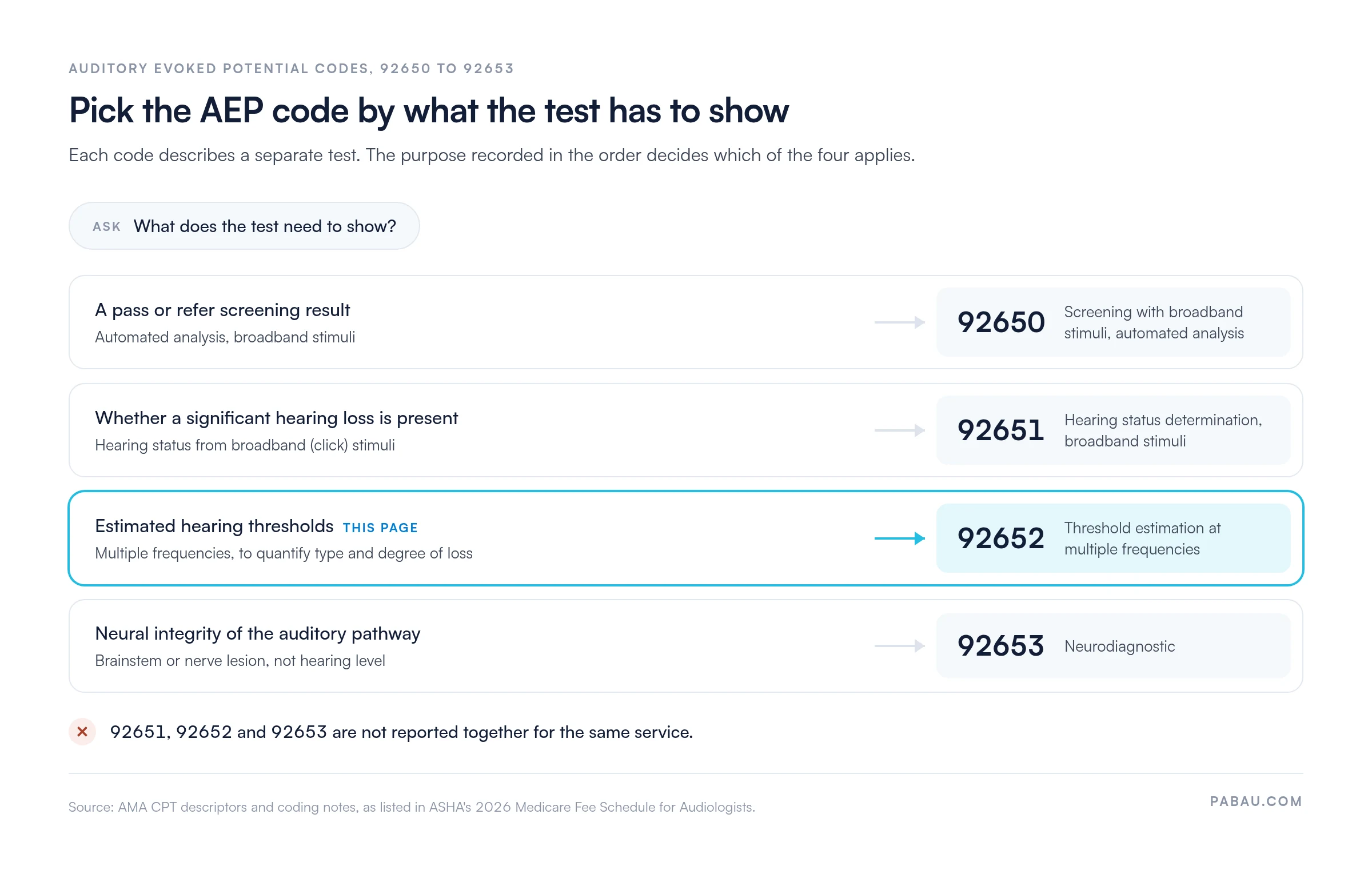
The four codes in the 92650-92653 family cover distinct clinical purposes. Coders often confuse 92651 and 92652 because both use ABR, yet only 92652 estimates thresholds at multiple frequencies. The other audiologic function tests are listed in our library of CPT codes.
Code
Official descriptor (abbreviated)
Clinical purpose
Laterality
Typical population
92650
Auditory evoked potential; screening with broadband stimuli, automated analysis
Pass/refer hearing screening, no threshold estimation
Unilateral or bilateral
Neonates, universal screening programs
92651
Hearing status determination, broadband stimuli, with interpretation and report
Assess hearing status; click-evoked only; no frequency-specific thresholds
Not specified in descriptor
Infants, pediatric, difficult-to-test adults
92652
Threshold estimation at multiple frequencies, with interpretation and report
Frequency-specific threshold mapping for hearing aid fitting or diagnosis
Not specified in descriptor
Infants, pediatric, uncooperative adults, hearing aid candidates
92653
Neurodiagnostic, with interpretation and report
Evaluate brainstem neural pathway integrity; not for hearing threshold
Not specified in descriptor
Adults with neurological symptoms, acoustic neuroma workup
Critical distinction: CPT instructs that 92652 and 92651 are not reported together, and 92652 is also not reported with 92653. Bill the one code that matches the service performed. National Correct Coding Initiative (NCCI) edits may also flag the pair, so check the current quarterly NCCI table at cms.gov before submitting.
The diagram below starts from what the test has to show, because that purpose is what decides the code.
Only a test that estimates thresholds at several frequencies is billed as 92652. Descriptors and coding notes are from the AMA CPT code set, as listed by ASHA for 2026.
ICD-10 diagnosis codes to pair with CPT 92652
Pairing CPT 92652 with a non-covered ICD-10 code is a common reason for medical necessity denials. The diagnosis has to show why threshold estimation was needed, which routine screening does not. In pediatric workups the usual pairing is bilateral sensorineural hearing loss, H90.3.
ICD-10 code
Description
Clinical scenario
H90.0
Conductive hearing loss, bilateral
Bilateral conductive loss requiring threshold mapping
H90.3
Sensorineural hearing loss, bilateral
Most common indication; infant or pediatric SNHL workup
H90.6
Mixed conductive and sensorineural hearing loss, bilateral
Mixed loss requiring frequency-specific threshold data
H91.90
Unspecified hearing loss, unspecified ear
Use only when laterality not yet established; more specific codes preferred
Z01.110
Encounter for hearing examination following failed hearing screening
Neonatal diagnostic ABR following failed newborn screen; not for Medicare
Z13.5
Encounter for screening for eye and ear disorders
Screening encounter; payer acceptance varies, verify LCD before using
Many Medicaid programs accept Z01.110 and Z13.5 for pediatric diagnostic ABR. Medicare Part B routinely rejects them, because it covers only medically necessary diagnostic services. Consult your MAC’s Local Coverage Determination before using encounter codes like these on Medicare claims.
Medicare and insurance coverage for CPT 92652
Medicare Part B covers diagnostic audiology services, including ABR, when the service is medically necessary for a diagnosed or suspected condition. Routine hearing screening is explicitly excluded from Medicare Part B coverage, so a 92652 claim tied only to a screening encounter code will be denied. The clinical indication must be in the medical record before the test is ordered.
Coverage specifics to know before billing:
LCD jurisdiction matters: Local Coverage Determinations for audiology vary by Medicare Administrative Contractor (MAC). Noridian, Novitas, CGS, and other MACs publish their own covered diagnoses lists and documentation standards. Check your specific MAC’s LCD before the encounter, not after. Reviewing medical billing compliance protocols with your MAC’s policy page can prevent avoidable denials.
Physician order usually required: Medicare and most commercial payers expect a written or electronic order from a referring or ordering physician. Since 2023, CMS has let audiologists provide some nonacute hearing assessments without an order, under limited circumstances. When there is an order, the claim must carry the referring provider’s NPI.
Medicaid EPSDT: Under the Early and Periodic Screening, Diagnostic, and Treatment (EPSDT) mandate, state Medicaid programs must cover medically necessary ABR for pediatric patients. State-level implementation varies, so verify your state’s Medicaid provider bulletin for specific documentation and prior authorization requirements.
Commercial payers: Prior authorization requirements are payer- and plan-specific. Some commercial plans require pre-authorization for all diagnostic audiology; others only require it for inpatient settings. Confirm prior auth requirements at the time of insurance eligibility verification for each patient encounter. Insurance eligibility verification run before the appointment prevents post-service authorization denials.
Reimbursement rates and RVUs for CPT 92652
Medicare reimbursement for 92652 is set each year through the CMS Physician Fee Schedule. The table shows the 2026 national figures from the final rule, as published by ASHA. Check the MPFS lookup tool for your locality before quoting patients or modeling revenue.
Metric (2026)
Value
Notes
Work RVU
1.46
The clinician work portion of the value
Practice expense RVU
1.70
Non-facility setting
Malpractice RVU
0.07
Professional liability portion
Total RVU
3.23
Non-facility total, before GPCI locality adjustment
National payment (non-facility)
$107.88
Up from $105.13 in 2025, before GPCI locality adjustment
Facility rate
N/A
Not typically paid under the MPFS in a facility, where the hospital is paid under OPPS
Modifier 26 / TC
Not applicable
Paid as a global service, with no professional or technical component split
Use the FastRVU lookup tool to find current-year RVU values and calculate locality-adjusted payment amounts using your practice’s Geographic Practice Cost Index (GPCI). Payment varies significantly by region. Pabau’s billing software sends US claims through Claim.MD, so practices can submit 92652 claims electronically. ERA remittances then show what each payer paid.
Pro Tip
Run your 92652 claims through real-time eligibility verification before each encounter. Some payers require prior authorization specifically for diagnostic ABR. A denied claim on a $108 reimbursement costs more to rework than to prevent. Build the authorization check into your scheduling workflow, not your billing workflow.
Documentation requirements for CPT 92652
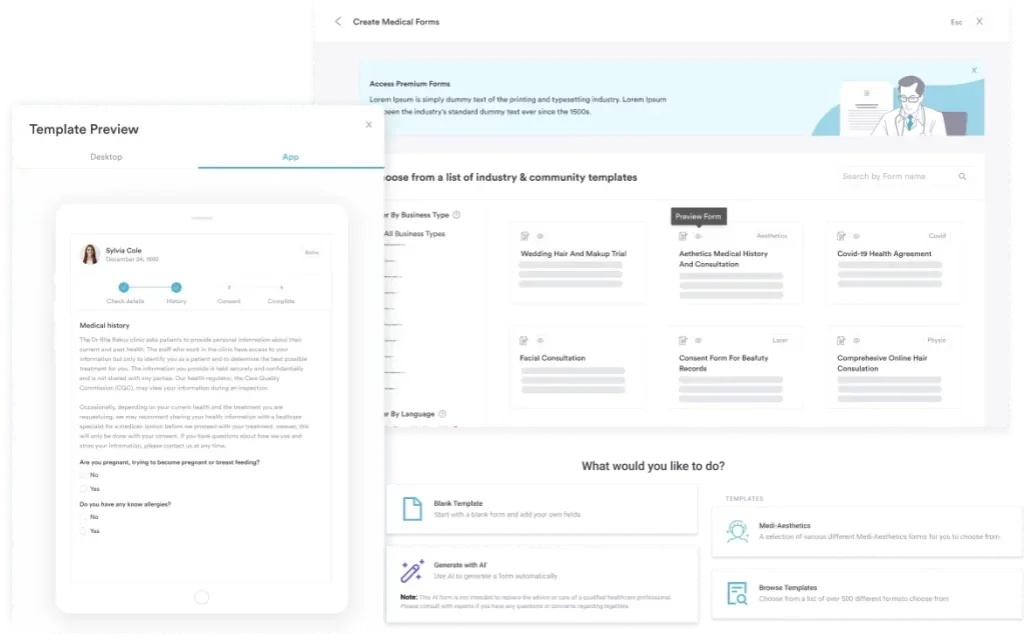
A clean 92652 claim depends on the medical record containing specific elements that satisfy both MAC LCDs and commercial payer policies. Generic audiology reports that say “ABR completed, results reviewed” are not sufficient. In Pabau, audiology practices can build digital forms that capture each required field at the time of service.
Pabau’s digital forms can hold each field a 92652 report needs, so thresholds, wave V data and the ordering NPI are recorded before sign-off.
Every 92652 medical record must include:
Ordering provider information: Name and NPI of the referring or ordering physician who requested the diagnostic ABR.
Clinical indication: The specific reason for the test, stated in medical necessity terms. For example: “Bilateral sensorineural hearing loss identified on behavioral audiometry. ABR requested for threshold mapping to fit hearing aids.”
Stimulus parameters: Type of stimuli used (click, tone burst), stimulus levels tested, presentation rate, polarity, and transducer type (insert earphones or bone oscillator).
Waveform analysis: Wave V absolute latency and amplitude at multiple intensity levels for each ear. The report must demonstrate the threshold-search process, not just the final result.
Frequency-specific threshold data: Electrophysiological threshold values in dBnHL at each frequency tested (500, 1000, 2000, 4000 Hz minimum) for each ear independently.
Audiologist credentials: Signature, degree (Au.D. or M.S.-CCC-A), and date of service. The supervising audiologist must sign if a student or technician ran the test.
Place of service code: Must match where the test was actually performed (11 for office, 22 for hospital outpatient, 23 for emergency department).
Reviewing clean claim submission best practices before each billing cycle catches missing report elements before they turn into denial letters.
Modifiers for CPT 92652
CMS pays 92652 as a global service only. The 2026 fee schedule lists no professional (26) or technical (TC) component for it, so neither modifier applies. Modifier 52 is the one that comes up, when a study ends early.
Modifier
When to use
Documentation required
Common error
52
Study was incomplete (e.g., only one ear tested when bilateral was planned, or test terminated early due to patient arousal)
Report must state reason for incompleteness and what was actually performed
Using 52 routinely to reduce fees rather than when the service was genuinely reduced
Bill 92652 with no modifier when the study is complete. Don’t append 26 or TC to split the test between an interpreting audiologist and a facility, because the code has no component split to report.
Common claim denial reasons for CPT 92652 (and how to avoid them)
Most 92652 denials are preventable. The denial management patterns below appear repeatedly across MAC jurisdictions and commercial payers.
Denial reason
Root cause
Fix action
Non-covered ICD-10 pairing
Encounter code (Z01.110, Z13.5) submitted to Medicare; payer LCD does not list the diagnosis
Use a specific hearing loss code (H90.x, H91.x) supported by the clinical record. Verify against your MAC’s LCD covered diagnoses list before submission.
LCD criteria not met
Payer’s local policy requires the test be ordered by a physician, or the clinical indication is not documented
Ensure referring physician order is in the chart before service. Document the specific clinical reason in the medical record, not just the code.
Missing prior authorization
Commercial or Medicaid plan requires pre-auth; obtained too late or not at all
Verify prior authorization requirements at the scheduling stage, not day-of-service. Track auth numbers in your practice management system.
Unbundling with 92651
92652 and 92651 reported together for the same service, which CPT does not allow and NCCI edits flag
Bill only the code that matches the service. Use 92652 when thresholds were estimated at multiple frequencies, and 92651 when only hearing status was determined. Never report 92652 with 92653 either.
Insufficient documentation
Report lacks frequency-specific threshold data, wave V latency values, or audiologist signature
Use a structured report template that requires all mandatory fields before the report can be finalized and signed.
Place of service mismatch
POS code on claim does not match where the test was performed; facility vs non-facility fee schedule mismatch
Confirm POS code at scheduling. Use POS 11 for outpatient office, POS 22 for hospital outpatient department.
Frequency limitation exceeded
Some payers limit 92652 to once per 12 months without prior auth; second study within the period denied
Track test dates in the patient record. Document clinical justification for repeat testing within the payer’s frequency limit period and obtain prior auth when required.
Pro Tip
Audit your 92652 claims from the last 90 days. Pull the denial codes and sort them by frequency. If one denial code accounts for more than 30% of your denials, look for a systemic documentation or workflow cause. Fix the template or the scheduling checklist as well as the individual claim.
Billing CPT 92652 for neonatal and pediatric patients
Neonatal and pediatric 92652 claims need extra care. The same ABR procedure can serve three clinical purposes, and each one is billed differently.
Universal newborn hearing screening (UNHS): The initial hospital-based OAE or automated ABR screen is not billed as 92652. UNHS is typically billed under 92650 (automated ABR screen) or the OAE code, 92558, or within the hospital’s newborn care billing. CPT 92652 applies when the infant fails the UNHS and returns for a full diagnostic ABR to estimate hearing thresholds.
Diagnostic ABR after failed newborn screen: This is the primary pediatric use of 92652. The ICD-10 code should reflect the suspected or confirmed hearing loss (H90.3, H90.5, or similar). The visit is now diagnostic, so a screening encounter code no longer fits.
Medicaid EPSDT coverage: Under EPSDT, state Medicaid plans must cover medically necessary diagnostic ABR for children under age 21. Prior authorization thresholds and documentation requirements vary significantly by state. Contact your state Medicaid provider relations office for the current bulletin governing diagnostic audiology CPT codes.
Sedation coding: When the pediatric ABR requires moderate or deep sedation, the sedation service is billed separately using the appropriate anesthesia or sedation CPT codes. The sedating provider bills those codes; the audiologist bills 92652 for the ABR itself. Never include sedation time within the 92652 descriptor.
Place of service for pediatric ABR: Neonatal ABR performed in the NICU uses POS 21 (inpatient hospital). Outpatient hospital audiology department uses POS 22. Private audiology practice uses POS 11. The setting decides whether the practice bills the MPFS rate or the hospital is paid for the test.
How claims management software supports CPT 92652 billing
The denial patterns above share a cause. Billing details get assembled from memory or paper checklists instead of being captured in the clinical workflow. Claims management software built for healthcare practices moves those checks to before the claim is submitted.
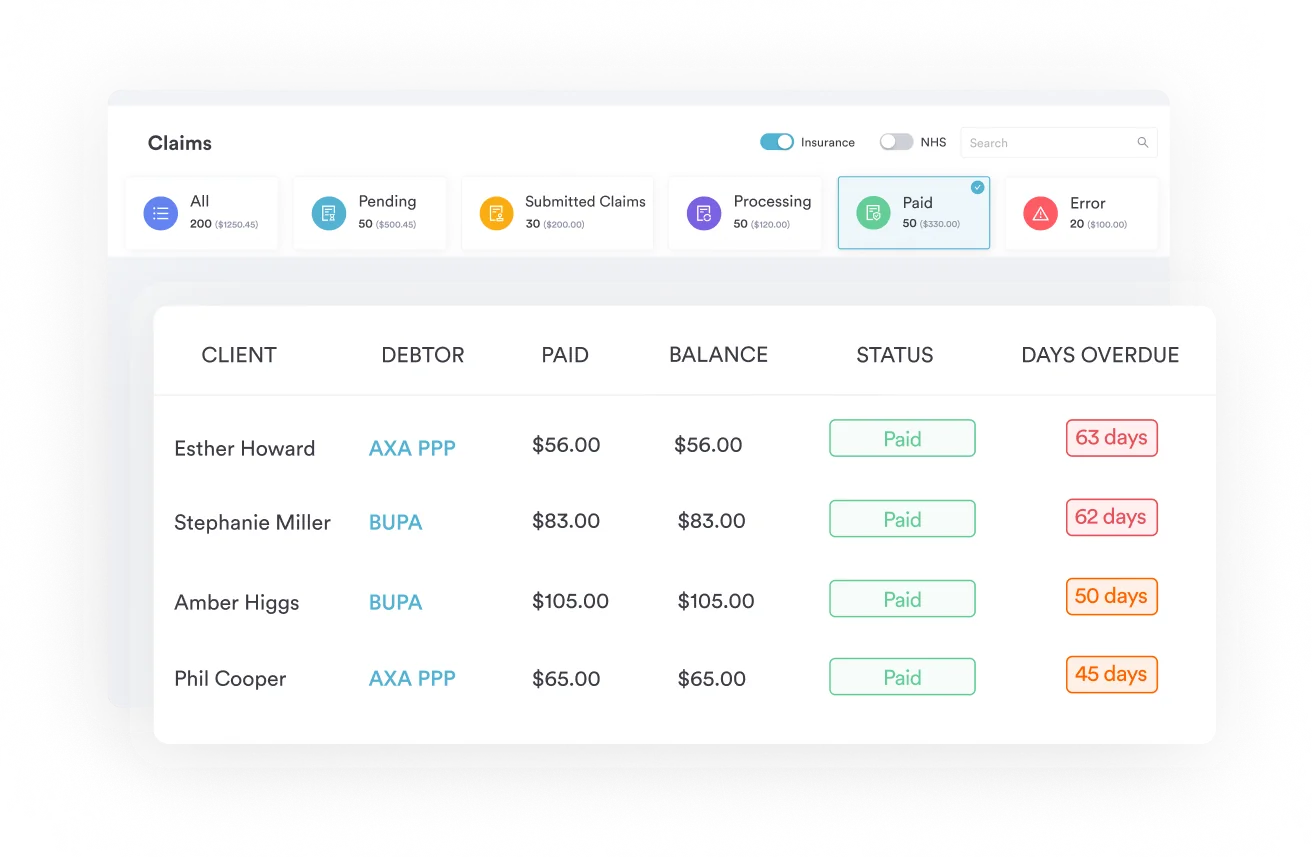
Pabau tracks each 92652 claim from submission to remittance, so a denial surfaces with its code while there is still time to appeal.
Here is how Pabau handles the steps where 92652 claims usually fail:
CPT and ICD-10 codes on the claim: Practices record both codes on the claim, so the 92652 line and its supporting diagnosis travel together.
Prior authorization tracking: The auth code, its dates and the sessions it covers are tracked on the patient’s case. Pabau warns you when an authorization is missing.
Structured documentation: Digital forms can be built around the required elements: wave V latency, frequency-specific thresholds, ordering provider NPI and POS code. The audiologist completes them before signing.
Electronic claims: US claims go out through Claim.MD as CMS-1500/837P claims, with eligibility checks available before the visit.
ERA remittances: When a 92652 claim pays or denies, the electronic remittance advice comes back into Pabau. Your team sees the denial code and can appeal or correct quickly.
Get 92652 claims paid the first time
Pabau’s forms capture the fields a 92652 report needs. Its claims tools track prior authorizations and send US claims through Claim.MD.
CPT 92652 is simple to bill once the order states the purpose and the report gives thresholds for each ear tested. Choose the code from that purpose, pair it with a diagnosis that justifies threshold estimation, and confirm authorization while the appointment is being booked.
The work sits at the front of the process. A few minutes at scheduling and sign-off cost far less than reworking a $108 denial weeks later. Book a demo to see how Pabau keeps authorizations, reports and claims for audiology practices on one record.
Continue your research
Need a faster way to verify claim accuracy before submission?Claim.MD clearinghouse guide explains how real-time claim scrubbing catches errors before they reach the payer.
Struggling with denial codes on your ABR claims?Denial codes in medical billing breaks down the most common CARC codes and how to respond to each one.
Want to understand the full billing lifecycle for a CPT claim?Revenue cycle management guide covers every stage from patient registration through final payment posting.
Frequently asked questions
What does CPT code 92652 cover?
CPT code 92652 covers auditory evoked potentials for threshold estimation at multiple frequencies, with interpretation and report. It includes electrode placement, stimulus delivery, the threshold search, waveform analysis and a written report. It is used when hearing thresholds must be estimated electrophysiologically because behavioral audiometry is not possible or reliable.
What is the difference between CPT 92652 and 92653?
CPT 92652 estimates hearing thresholds at multiple frequencies, for diagnosis or hearing aid fitting. CPT 92653 is neurodiagnostic ABR, used to check the integrity of the brainstem auditory pathway in patients with neurological symptoms. The two codes serve distinct clinical purposes and are not reported together.
Does Medicare cover CPT code 92652?
Yes, Medicare Part B covers CPT 92652 when it is medically necessary for a diagnosed or suspected condition, such as sensorineural hearing loss. Medicare does not cover routine hearing screening, so the claim must include a covered ICD-10 diagnosis code and comply with your MAC’s Local Coverage Determination.
What modifiers can be used with CPT 92652?
Modifier 52 (reduced services) applies when the study is incomplete, for example when testing ends early. CMS pays 92652 as a global service with no professional (26) or technical (TC) component split, so neither of those modifiers applies. A complete study is billed with no modifier.
Does CPT 92652 require prior authorization?
Prior authorization requirements vary by payer and plan. Medicare does not require prior authorization for medically necessary diagnostic audiology, but many commercial payers and some state Medicaid programs do. Verify authorization requirements at the time of scheduling, not at the time of billing, to avoid post-service denials.
Can CPT 92652 be billed for newborn hearing screening?
No. Universal newborn hearing screening is billed under other codes, such as 92650 (automated ABR screen) or the OAE code, 92558. CPT 92652 applies when an infant fails the initial screen and returns for a full diagnostic ABR to estimate hearing thresholds. The ICD-10 code should reflect the suspected or confirmed hearing loss, not a routine screening encounter.
Can CPT 92652 be billed with 92651 on the same date?
No. CPT instructs that 92652 and 92651 are not reported together, and 92652 is also not reported with 92653. Bill only the code that reflects the service performed. If thresholds were estimated at multiple frequencies, bill 92652. If only hearing status was determined, bill 92651.