HCPCS Code V2208: Spherocylinder bifocal lens billing guide
HCPCS Code V2208: Definition and code attributes HCPCS Code V2208 is a Level II ...

Last Updated: Oct 7, 2026
92588 is the CPT code for a comprehensive diagnostic distortion product otoacoustic emissions (DPOAE) evaluation, with interpretation and report. It covers quantitative analysis of outer hair cell function by cochlear mapping, at a minimum of 12 frequencies.
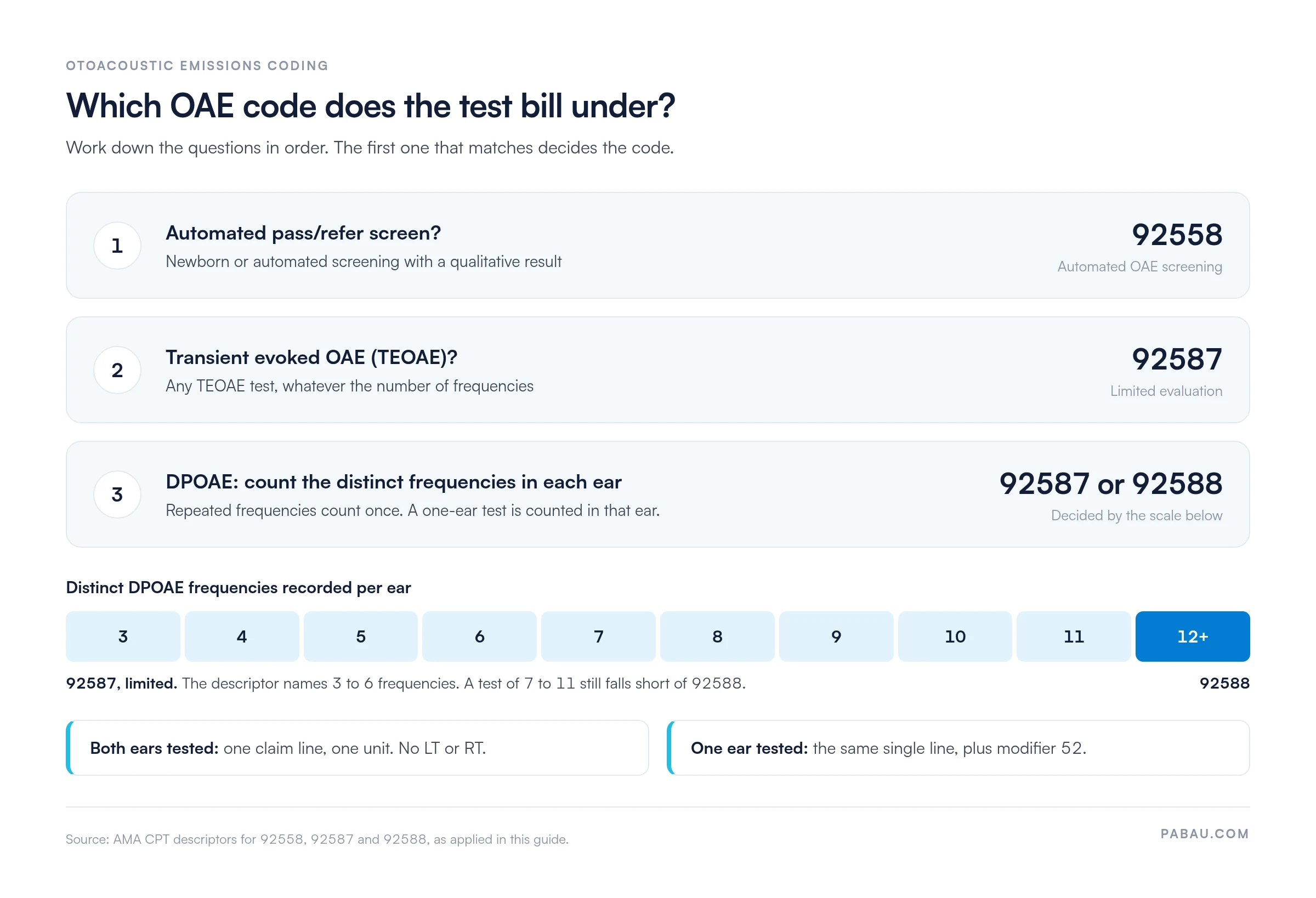
Code assignment turns on the frequency count. The 12 frequencies must be distinct and recorded in each ear, so a DPOAE test with fewer bills as 92587. One unit covers both ears, and modifier 52 marks a test of one ear only. Newborn and automated screening never bills as 92588.
Let Pabau's smart automation suggest the right codes, reduce claim denials, and keep your practice compliant—effortlessly.
Automate repetitive tasks and focus on what matters most—your patients.
Reduce coding errors and ensure compliance with the latest regulations.
Clean claims, fewer denials, and faster reimbursements.
Powerful insights and reporting to help your practice thrive.
HIPAA compliant SOC 2 certified GDPR-compliant Trusted by 4,000+ clinics worldwide

CPT code 92588 is a comprehensive diagnostic DPOAE evaluation that requires at least 12 distinct frequencies in each ear.
A DPOAE test with fewer than 12 distinct frequencies per ear, or any TEOAE test, bills as 92587 instead.
Both codes cover both ears, so bill one line and one unit, and add modifier 52 only when one ear is tested.
Newborn and automated OAE screening bills as 92558 or 92587, never as 92588.
Pabau’s claims management software supports clean-claim submission and electronic remittance tracking for audiology billing workflows.
CPT code 92588 is the American Medical Association code for a comprehensive diagnostic evaluation of distortion product otoacoustic emissions (DPOAE), with interpretation and report. The official descriptor calls for quantitative analysis of outer hair cell function by cochlear mapping, at a minimum of 12 frequencies.
It sits in the Audiologic Function Tests subsection of the CPT Medicine section, next to the limited code 92587.
Both ears are part of the service. Therefore, a test of both ears goes on one claim line with one unit. When only one ear is tested, the same single line carries modifier 52.
Distortion product otoacoustic emissions testing measures the acoustic response the cochlea generates when two simultaneous pure-tone stimuli are delivered to the ear canal. First, a probe in the ear canal emits two tones at specific frequencies. Healthy outer hair cells respond with a third tone at a predictable mathematical relationship, and the equipment plots that response against frequency.
As a result, DPOAE testing is a sensitive, objective, and non-invasive tool for assessing outer hair cell function. Moreover, it does not require a behavioral response from the patient, which is why it works across all age groups.
The comprehensive test produces a cochlear map with results at each tested frequency in each ear. A map of at least 12 distinct frequencies per ear, with interpretation and report, is what qualifies the encounter for CPT code 92588.
The two codes differ in purpose and in frequency count. CPT 92587 is a limited evaluation that confirms whether a hearing disorder is present. It uses DPOAE at 3-6 frequencies or a transient evoked OAE (TEOAE) test. CPT 92588 is a comprehensive diagnostic DPOAE evaluation that maps outer hair cell function across at least 12 frequencies.
A DPOAE test with 7-11 frequencies does not meet the 92588 threshold, so it bills as 92587. The frequencies must also be distinct. Running the same six frequencies twice still counts as six, and the test stays a 92587 service.
However, coders sometimes default to 92588 on the assumption that a fuller test pays more. If the report shows fewer than 12 distinct frequencies in each ear, 92587 is the correct code, whatever the audiologist planned to test.
The decision path below puts test type, frequency count and ear count in the order a coder checks them.
No. CPT 92588 already includes both ears, so a bilateral test is one claim line with one unit. Billing two units, or two lines with LT and RT, reports the service twice and invites a duplicate or unit-limit denial.
When the audiologist tests only one ear, append modifier 52 to the single 92588 line. The note should say why the second ear was not tested, such as an occluded canal or an anatomical atresia. A one-ear test still needs at least 12 distinct frequencies in that ear to bill as 92588.
OAE testing rarely happens in isolation. Audiology encounters typically combine several diagnostic procedures. Check National Correct Coding Initiative (NCCI) edits before submitting a claim with multiple codes.
Also, the NCCI edits for the 925xx audiology code family are updated quarterly. Always verify the current column 1/column 2 edit pairs before submitting CPT code 92588 with 92557 or another audiology code on the same date. A defined denial management workflow catches bundling conflicts before claims leave the practice.
Pull the current NCCI table directly from CMS before submitting any same-day audiology claim that includes 92588. NCCI edits update every quarter, and a pair that was separately billable last year may now require modifier 59 or be mutually exclusive. Build a quarterly calendar reminder to download the updated table.
Two modifiers come up in routine 92588 billing. Laterality modifiers LT and RT do not apply, because the code already covers both ears.
Document the reason for a one-ear test in the encounter note whenever modifier 52 goes on the claim. However, some payers apply their own rules to modifier 52 on audiology codes. Check the payer policy or the applicable Local Coverage Determination before you submit.
Medicare covers CPT code 92588 only as a diagnostic test, ordered by a physician or nonphysician practitioner to evaluate a hearing or balance concern. In contrast, Medicare does not pay for hearing screening. Screening OAE codes and screening Z-codes are a matter for commercial and Medicaid payers only.
Reimbursement rates under the Medicare Physician Fee Schedule (MPFS) are updated each January. The non-facility rate (office, audiology practice) and the facility rate (hospital outpatient, ASC) differ.
Facility-setting rates carry a lower practice expense RVU because the facility, not the practitioner, bears overhead. Always pull the current-year rate from the CMS MPFS Look-Up Tool rather than prior-year figures or third-party summaries.
A Medicare claim for 92588 without a verified eligibility check and a physician or NPP order invites a medical necessity denial. Run eligibility before the appointment, not on the day of claim submission.
Clean claim submission for CPT code 92588 depends on what the chart contains before the claim leaves the practice. Payer auditors reviewing 92588 claims look for five documentation elements. As a result, missing any one of them can trigger a denial or a request for additional information.
Many practices use a standardized audiology report template that pulls frequency results from the equipment output. That reduces transcription error, but the template still needs a field for the provider interpretation and signature. However, most payers treat an equipment printout without a provider attestation as insufficient.
The ICD-10-CM code on the claim must support the medical necessity of comprehensive OAE testing. For example, payers cross-reference the diagnosis code against their LCD or coverage policy. An unsupported diagnosis is grounds for denial even when the DPOAE test was performed correctly. One of the most common pairings on 92588 claims is H90.3.
For ototoxicity monitoring, pair the T-series adverse effect code with H91.0- ototoxic hearing loss when hearing loss is found. Moreover, that pairing builds a stronger medical necessity case than either code alone. Also, always confirm the most specific code available among the ICD-10-CM codes. Then check it against the payer coverage policy with tools like the AAPC Codify CPT lookup.
Traditional Medicare does not require prior authorization for CPT code 92588, but other payers may. Overall, authorization requirements for audiology vary widely by plan type.
When prior authorization is required, reviewers typically look for three items. First, they want a physician or NPP order and documentation of the symptoms or risk factors behind the test. Many also ask for proof that a screening (92558) or limited (92587) OAE test was inconclusive. Therefore, sending full documentation with the PA request reduces back-and-forth and approval delays.
Newborn and automated OAE screening never bills as 92588, however many frequencies the device tests. For example, an automated pass/refer screen bills as 92558. Similarly, a limited evaluation confirming whether a hearing disorder is present bills as 92587.
CPT 92588 belongs to the diagnostic follow-up, when an audiologist maps cochlear function across at least 12 distinct frequencies per ear. Medicare does not cover screening, so screening claims go to Medicaid or commercial payers under their own rules.
These are the 92588 denial patterns audiology billers see most often, with the fix for each.
Build a five-step 92588 check into your billing workflow. First, confirm the report lists at least 12 distinct frequencies in each ear. Second, bill one line and one unit, with modifier 52 for a one-ear test. Third, verify the ICD-10 code matches the applicable LCD. Fourth, check NCCI for same-day code pairs. Fifth, confirm a physician or NPP order is on file for Medicare. The check takes two minutes and prevents the most common denials.
In fact, most 92588 denials start with a manual step, such as a frequency count read off a printout or a laterality line keyed by habit. Pabau, the practice management platform we build for clinical practices, keeps patient records, billing codes, and claims in one place. Billers check the report and the claim side by side before submission.
In addition, Pabau connects to the Claim.MD clearinghouse to run eligibility checks and submit claims electronically. The integration retrieves electronic remittance advice (ERA), so billers see each payer response without chasing paper EOBs. For a wider view of how claims fit into audiology finances, see the guide to revenue cycle management in healthcare.

Pabau’s claims management tools help audiology and ENT practices submit clean claims, track remittances, and see each payer response in one place.

First, assign CPT code 92588 from the report, never from the order. If the printout shows at least 12 distinct frequencies in each ear, bill one line and one unit. If it shows fewer, bill 92587, even when the audiologist set out to run the comprehensive test.
The fix that lasts sits upstream of the claim. Instead, add a frequency count and an ear count to your audiology report template. The coder then reads the answer instead of counting points on a graph. Finally, a few extra report fields cost far less than a rebill and a delayed payment.
Pabau’s claims management software brings eligibility checks, clearinghouse submission, and ERA tracking into one workflow. Book a demo to see how your audiology or ENT practice can submit cleaner OAE claims and get paid faster.

Need to understand how clearinghouse submission works end-to-end? Medical claims clearinghouse guide explains how claims move from practice to payer and where errors are caught.
Want to reduce revenue lost to claim denials? Denial codes in medical billing breaks down the most common CARC codes and how to respond to each.
Looking for a clean-claim reference? Clean claim definition and checklist outlines every field a payer validates before processing payment.
Billing tympanometry on the same date? CPT code 92550 billing guide covers tympanometry with acoustic reflex testing and its bundling rules.
Hearing loss type not yet confirmed? ICD-10 code H90.5 guide explains when unspecified sensorineural hearing loss is the right diagnosis.
CPT code 92588 covers a comprehensive diagnostic evaluation of distortion product otoacoustic emissions (DPOAE), with interpretation and report. It requires quantitative cochlear mapping of outer hair cell function at a minimum of 12 distinct frequencies in each ear.
Yes, Medicare Part B covers CPT code 92588 as a diagnostic test ordered by a physician or nonphysician practitioner. Medicare does not cover hearing screening. Local MAC LCDs may set further conditions, so check your jurisdiction before billing.
Traditional Medicare does not require prior authorization for 92588. Medicare Advantage and commercial plans often do, particularly for adult diagnostic testing or repeat encounters. Medicaid requirements vary by state. Verify the specific plan policy before scheduling the appointment.
Generally yes, because comprehensive audiometry (92557) and DPOAE testing (92588) measure different aspects of auditory function. NCCI edits are updated quarterly, so verify the current edit table before submitting both codes on one claim.