

HCPCS Code L0472: Hyperextension TLSO billing guide
HCPCS code L0472: Official descriptor and device definition HCPCS code L0472 des...

Last Updated: Nov 5, 2026
70488 is the CPT code for computed tomography of the maxillofacial area without contrast material, followed by contrast material(s) and further sections. In practice, it is a two-phase face or sinus CT, with a plain series first and a contrast-enhanced series in the same session.
CPT has no sinus-specific CT code, so a sinus study is billed from this family. If the report shows only one series, the claim belongs on 70486 or 70487.
Let Pabau's smart automation suggest the right codes, reduce claim denials, and keep your practice compliant—effortlessly.
Automate repetitive tasks and focus on what matters most—your patients.
Reduce coding errors and ensure compliance with the latest regulations.
Clean claims, fewer denials, and faster reimbursements.
Powerful insights and reporting to help your practice thrive.
HIPAA compliant SOC 2 certified GDPR-compliant Trusted by 4,000+ clinics worldwide

CPT code 70488 reports a maxillofacial CT acquired without contrast first, followed by contrast material and further sections in the same session.
CPT has no sinus-specific CT code, so a sinus CT is reported with 70486, 70487 or 70488 based on the contrast sequence performed.
Code from the signed radiology report, never from the order, because a study that stops after one series belongs on 70486 or 70487.
Modifier 26 (professional component) and modifier TC (technical component) split the claim between the radiologist and the facility. If both bill global, the payer denies a duplicate claim.
Pabau, the practice management platform we build, connects to Claim.MD so your team can check eligibility, submit and track radiology claims, and post ERAs.
CPT code 70488 is the American Medical Association code for a maxillofacial CT performed without contrast and then with contrast.
The official descriptor reads: Computed tomography, maxillofacial area; without contrast material, followed by contrast material(s) and further sections. On a radiology worklist, that usually means a two-phase sinus or facial CT.
Each clause in that descriptor carries billing weight. “Maxillofacial area” names the region, which takes in the facial bones and the paranasal sinuses around the nasal cavity. CPT has no separate code for a sinus CT, so a sinus study is reported from this family.
The second clause sets the sequence. The non-contrast series is acquired first, then contrast is given and further sections are acquired in the same session. Those post-contrast images are the “further sections” the descriptor refers to.
A complete 70488 encounter has two components, and different entities often bill them. The technical component covers the CT equipment, the facility and the radiologic technologist. The professional component covers the interpreting radiologist’s read, report and signature.
Contrast agent supplies sit outside the technical component and are reported separately where the setting allows. For a global bill, the report has to confirm three things: the non-contrast series, the contrast administration and the post-contrast series that followed it.
The table below lists what an auditor expects to find.
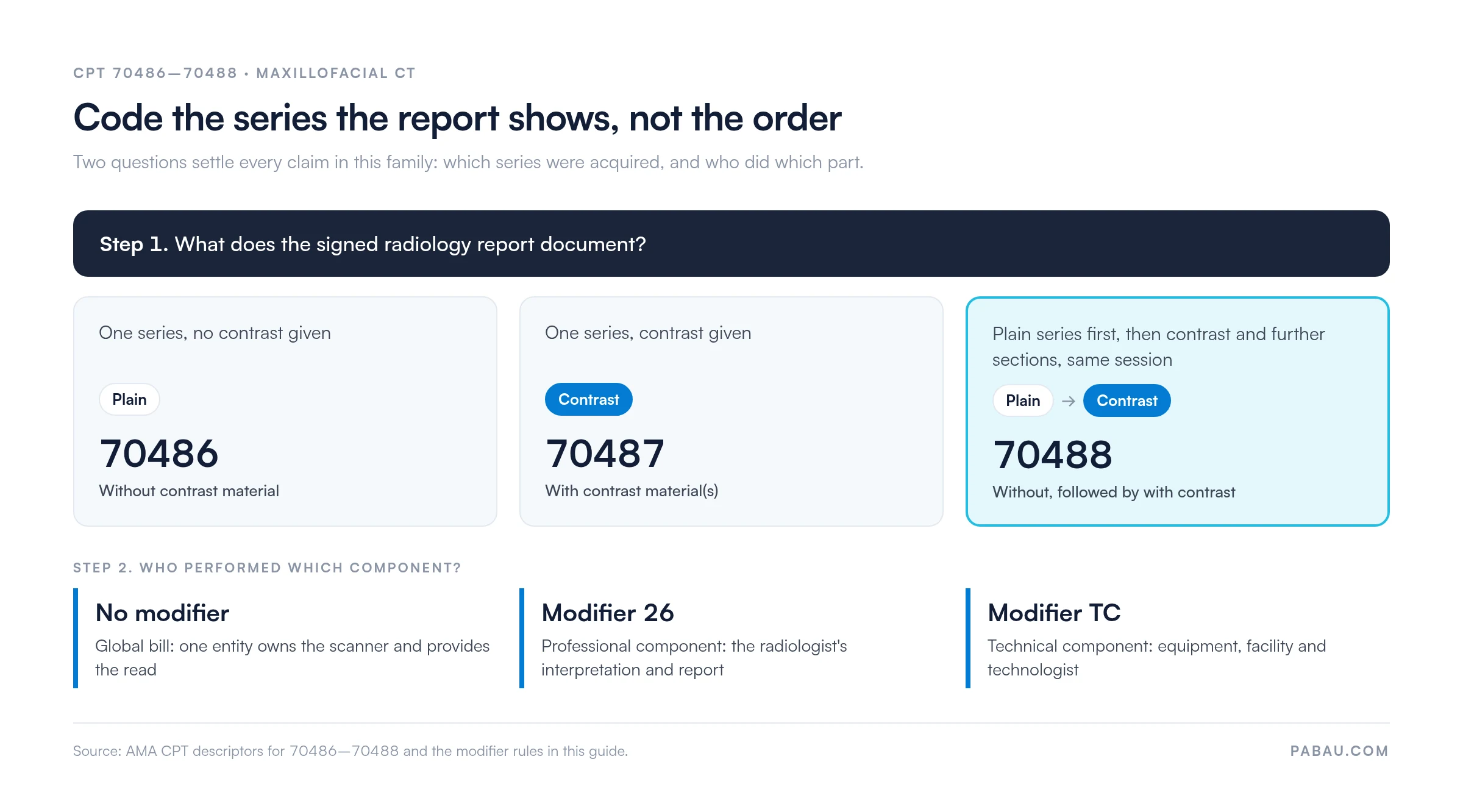
The 70486-70488 family covers the same maxillofacial region under different contrast conditions. An order that reads “CT sinuses” doesn’t say which code applies, so the decision waits for the radiology report.
Sequence is what sets CPT code 70488 apart. The non-contrast series comes first, and the contrast-enhanced series follows in the same session. If the report shows only one of those series, the claim belongs on 70486 or 70487.
Here’s how that plays out at the desk. The order reads “CT sinus without and with contrast.” After the plain series, though, the patient mentions a past contrast reaction, and the radiologist stops there. The report shows one non-contrast series, so the claim goes out on 70486, whatever the order said.
The diagram below puts both decisions on one page: which code the report supports, then which modifier the billing arrangement calls for.
Cone beam computed tomography (CBCT) uses a cone-shaped X-ray beam and captures volumetric data in a single rotation. CPT has no separate code for a sinus CBCT study. It can only go on the maxillofacial CT codes where the payer’s policy and CPT guidance allow it.
Where it is reportable, the code still has to match the contrast sequence performed. Check the payer’s written policy and current guidance in a reference such as AAPC Codify before billing a CBCT study. Then keep that policy in the claim file in case the payer asks.
Most of the trouble with 70488 comes from steps that happen before anyone opens a coding screen. Here is the path a clean claim takes, in the order the work happens.
A delay at step one or two is the expensive kind. An authorization that’s missing when the patient is on the table can’t be fixed by the coder later.
Three billing arrangements govern how CPT code 70488 is submitted. The right modifier, or the absence of one, decides whether the claim pays or comes back as a duplicate.
CPT 70488 carries a global period indicator of XXX, which means the global surgery concept doesn’t apply. That is standard for diagnostic radiology codes.
Even so, NCCI (National Correct Coding Initiative) edits can bar certain codes from being billed with 70488 on the same date. Where a distinct procedural service is documented, a modifier such as 59 is needed.
If only one series was acquired, for example because contrast was contraindicated, don’t bill 70488. Report 70486 or 70487 for the series performed.
Modifier 76 (repeat procedure by the same physician on the same day) and modifier 77 (repeat procedure by a different physician) can also apply. Each needs documentation of why the repeat was necessary.
Before submitting a 70488 claim with modifier 26 or TC, confirm the other entity is not also billing global. Check the claim status in your clearinghouse after submission for a duplicate-claim rejection. Catching it in the first week is far quicker than appealing a duplicate denial later.
Medicare pays CPT code 70488 from the annual CMS Medicare Physician Fee Schedule (MPFS). Rates change each January 1, when CMS updates the conversion factor and relative value units.
Look up current-year values in the CMS Physician Fee Schedule search tool before you use them in revenue projections or contract talks.
Commercial payer rates for 70488 vary by contract. Hospital outpatient rates follow the Hospital Outpatient Prospective Payment System (OPPS) rather than the MPFS. That’s why a facility-based radiology practice sees different figures from a freestanding imaging center.
Every 70488 claim needs a diagnosis code that establishes medical necessity. The ICD-10-CM codes below are common supporting categories for a sinus or facial CT.
Each payer’s coverage policy, or your MAC’s Local Coverage Determination (LCD), defines the covered list, so verify against it before billing. The CDC/NCHS ICD-10-CM web tool confirms current code descriptions and validity.
The code on the claim has to link logically to the clinical indication in the radiology report. Pairing J32.0 (chronic maxillary sinusitis) with a report that mentions only nasal polyps creates a medical necessity mismatch, and auditors flag it during post-payment review.
To look up each code in these ranges, browse our ICD-10-CM code library.
Most commercial health plans and many Medicare Advantage plans require prior authorization for advanced imaging, sinus CT included.
Radiology benefit management (RBM) companies typically run it. Carelon Medical Benefits Management (formerly AIM Specialty Health) and eviCore healthcare manage programs for many commercial insurers, though payer contracts change regularly.
So check whether the patient’s plan uses an RBM before you schedule. Then confirm insurance eligibility verification and authorization status on the day of service.
Clinical criteria for a sinus CT usually include documented failure of conservative treatment, such as antibiotics or nasal corticosteroids. Payers also tend to look for symptoms lasting more than 12 weeks and an assessment by an ENT or primary care provider.
These are general industry patterns, and a working prior authorization process checks the criteria each RBM publishes for the patient’s plan.
Denials on 70488 cluster around a predictable set of errors, and front-end checks prevent most of them. Good denial management workflows catch them at the claims scrubbing stage, before the payer has processed and rejected the claim.
When a denial does arrive, submit a corrected claim or a formal appeal with the radiology report attached. Radiology claims management software that tracks CARC denial reason codes makes patterns across 70488 claims easy to spot. One denial might be a typing error, while five with the same CARC in a month point to a workflow problem.
A clean claim process catches these errors before they reach the payer. Five checks cover the denials in the table above.
Most 70488 denials start with a mismatch between the radiology report and the claim. A coder reads the order, picks a code from the family and adds a modifier from memory. Then nobody checks the authorization again before the claim goes out.
Pabau keeps the order, the report and the claim in one patient record. The claim form pre-fills from that record, and required fields such as the authorization number must be complete before it can be sent.
Our Claim.MD clearinghouse integration then handles eligibility checks, 837P electronic claim submission to thousands of payers, and ERA remittance tracking.
The result is fewer claims going out without an authorization and fewer split-bill duplicates. Your billing team also sees denial patterns early, before they turn into lost revenue.
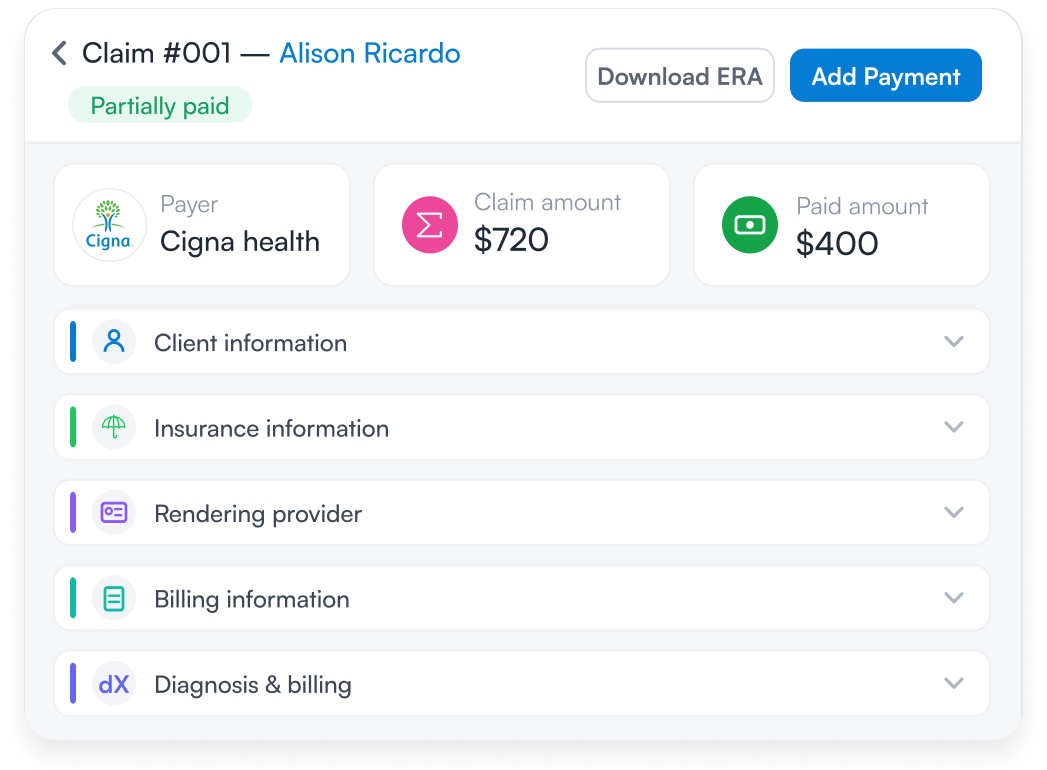

Pabau connects to Claim.MD for eligibility checks, 837P submission and ERA posting, so your team can track every 70488 claim from scan to payment.

CPT code 70488 has one job: a maxillofacial or sinus CT with a plain series first, then contrast and further sections in the same session. Code it from the signed report, not the order, and a study that stopped after one series goes on 70486 or 70487.
Once the code is right, the denials that remain come from the modifier, the diagnosis and the authorization. Settle who bills which component before the scan, and the claim has very little left to fail on.
Book a demo to see how Pabau tracks radiology claims from eligibility check to remittance.

Need to understand how denials move through your practice? Denial management in healthcare explains the workflow from initial rejection through appeal resolution.
Want to know what carries your claim to the payer? 837 electronic claim file guide covers the EDI transaction format that carries your 70488 claims to payers.
Wondering how electronic remittances map back to your claims? Electronic remittance advice (ERA) guide walks through reading 835 remittances and posting payments automatically.
Auditing your imaging claims for risk? Medical billing compliance sets out the rules and audit habits that keep claims defensible.
New to the billing side of the practice? What is medical billing? explains how a claim turns into payment, step by step.
It means the images acquired after contrast is given. The descriptor requires a full non-contrast series first, then contrast, then those post-contrast sections in the same session. Without both halves documented, the study isn’t a 70488.
No. The code pays for the scan and its interpretation, not the drug. In an office or imaging center, low-osmolar contrast is usually reported per ml with HCPCS Q9965-Q9967. Under hospital outpatient payment, contrast is packaged into the scan.
Bill the series that was completed, which is 70486, and document why contrast was not given. Never bill 70488 for an order that ran short. The report wording decides the code.
Yes. Since 2012, Medicare has required suppliers billing the technical component of advanced imaging, CT included, to hold accreditation from a CMS-approved body. This applies to ENT and other physician offices running their own scanner.
No. CMS ended the appropriate use criteria (AUC) program for advanced imaging in its 2024 fee schedule rule. AUC modifiers and G-codes are no longer reported. Commercial plans may still require radiology benefit manager review.



