



CCSD code G5100: Bypass of duodenum billing guide
CCSD code G5100 bills a bypass that leaves the duodenum in place CCSD code G5100...

Last Updated: Oct 16, 2026

CPT code 70486 describes a CT scan of the maxillofacial area (facial bones, sinuses, jaw, orbits) performed without contrast material.
The 2026 Medicare national average is $128.26 for the global service, $88.51 for the technical component and $39.75 for the professional component.
Modifier 26 and TC split those two components, and a missing modifier is the leading denial cause for this code.
Medicare coverage follows CMS billing and coding article A57204, so the diagnosis code has to establish medical necessity.
Practice management software like Pabau keeps the order, the radiology report and the diagnosis code on one patient record.
CPT code 70486 bills a computed tomography scan of the maxillofacial area performed without contrast material. It covers the facial bones, the paranasal sinuses, the mandible and maxilla, the orbital rims, and the temporomandibular joint region. Radiologists, oral surgeons and dental implant practices all bill it.
This reference covers the code description, 2026 Medicare rates, modifiers, ICD-10-CM pairings and NCCI bundling rules. It also walks the billing workflow step by step. The last section covers the CBCT cross-billing route oral surgery practices use to reach medical insurance rather than a dental plan.
CPT code 70486 describes computed tomography of the maxillofacial area without contrast material. It sits within the Diagnostic Radiology section of the AMA CPT code set, under the CT of head and neck subsection (codes 70450-70498).
The maxillofacial region covers the bones of the face and jaw, the paranasal sinuses, the orbital rims and the temporomandibular joint complex. Clinicians order the scan for trauma evaluation, sinus disease, surgical planning before orthognathic or implant surgery, and tumor staging. In each of those the diagnostic question is answered by bone detail, so contrast enhancement adds nothing.
Sinus and facial bone questions belong to 70486, never to a brain study. A contrast-enhanced CT of the brain is billed under 70460 instead.
The three maxillofacial CT codes differ only by contrast administration. Selecting the wrong variant is the most common upcoding or downcoding error in radiology billing for this anatomical area.
The radiology report and the physician order must both document which contrast protocol was performed. Billing 70486 when contrast was administered, even incidentally, triggers a downcoding audit. Billing 70487 for a non-contrast scan is upcoding.
Medicare pays 70486 in one of three ways, depending on who owns the scanner and who reads the study. The national averages below come from the CMS Physician Fee Schedule. Actual payment varies by Medicare Administrative Contractor (MAC) jurisdiction and geographic practice cost index (GPCI). Verify the rate for your locality before you submit.
Practice expense weighting is what drives the difference. A practice that owns the CT scanner absorbs the equipment, room and staff cost, so the technical component carries most of the payment. Where a hospital owns the scanner, it bills the technical component under the outpatient prospective payment system (OPPS) and the radiologist bills only modifier 26. The split below is what each billing form is worth in 2026.
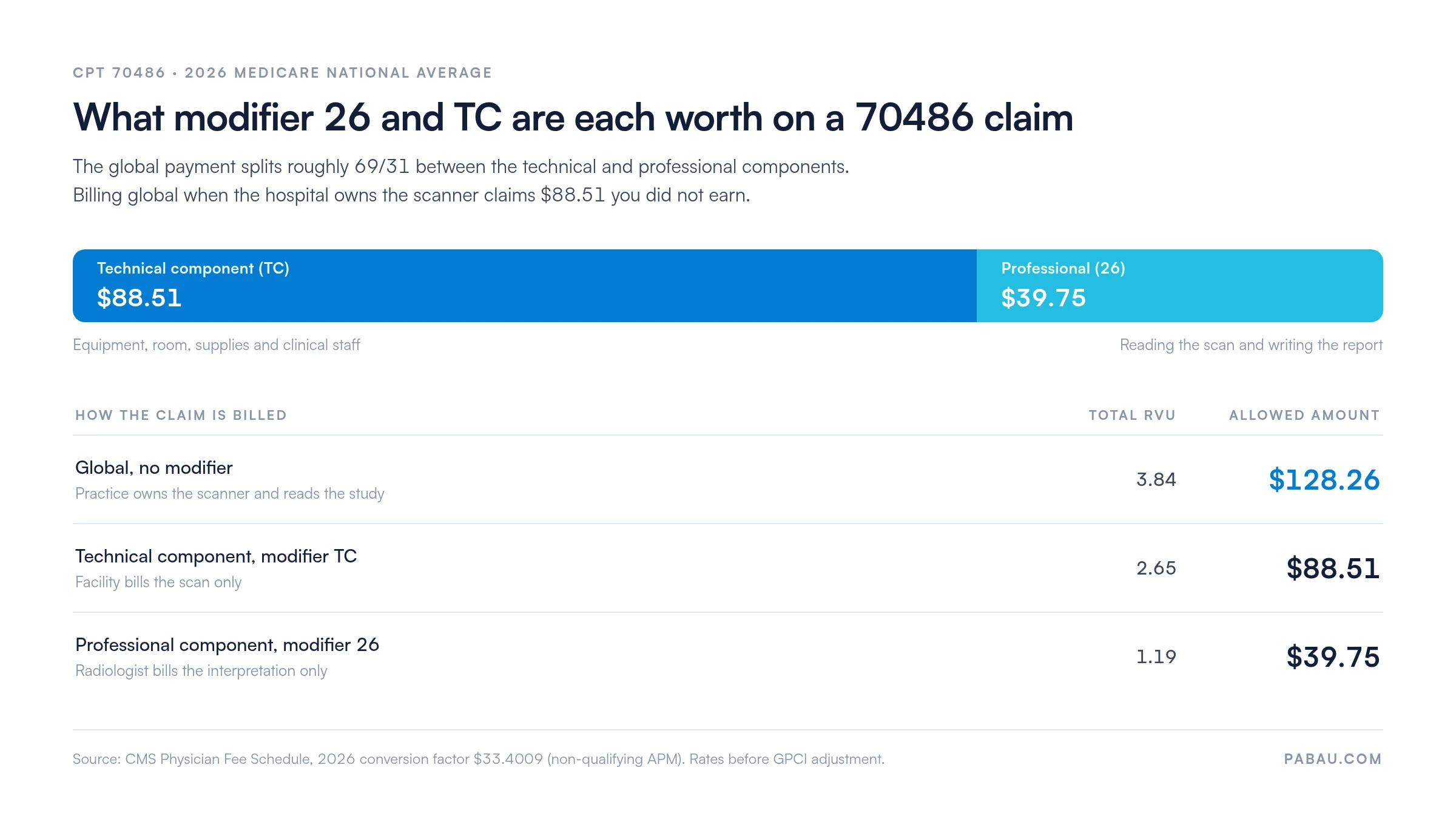
Every allowed amount above is the code’s total RVU multiplied by the 2026 conversion factor. That factor is $33.4009 for clinicians outside a qualifying alternative payment model, and $33.5675 for those inside one. The figures on this page use the $33.4009 rate.
The work RVU is identical on the global bill and on modifier 26, because the physician effort is the interpretation either way. Practice expense is where the two diverge, and it is the reason a technical-only bill outearns a professional-only bill by more than two to one.
RVU values are set in the annual MPFS final rule, and the conversion factor changes each January. The remittance advice from your clearinghouse shows the allowed amount after the locality adjustment is applied, which is what you reconcile against.
Modifier selection for 70486 depends on the billing arrangement between the radiologist and the facility. Getting it wrong is the single biggest cause of avoidable denials for this code.
Modifier policy varies by payer. Commercial insurers do not always follow the same professional and technical split rules as Medicare. Check each payer’s provider manual before applying modifier 26 or TC to a commercial claim.
Run a modifier audit on your last 90 days of 70486 claims. Filter for claims billed global at a facility place of service. Those are almost certainly missing modifier 26, which means you billed the $88.51 technical component you do not own. That single error drives most of the overpayment recoupments in outpatient radiology billing.
Every 70486 claim needs a diagnosis code that establishes medical necessity, and that code must match the clinical indication on the physician’s order. The pairings below are the ones that appear most often across payer coverage policies, including CMS article A57204. If you are checking a code you do not see here, the full ICD-10-CM code reference lists each one with its billable status.
ICD-10-CM codes update annually on October 1. Verify that any diagnosis code is active for the date of service, not the date of billing. A code retired before the service date is rejected at the clearinghouse before a payer ever sees it. The same applies to non-billable parent codes such as M26.60, which needs its fifth character to pass.
Medicare coverage for 70486 is governed by the CMS billing and coding article “MRI and CT Scans of the Head and Neck” (A57204). That article took effect on January 1, 2026, and each MAC administers it. Coverage is not automatic. The claim has to demonstrate medical necessity through the diagnosis code and the supporting documentation.
Core coverage requirements under A57204 include:
Commercial payers often follow a similar medical necessity framework, but many add prior authorization for elective imaging. Check each payer’s portal before scheduling a non-urgent scan. Documentation that never records the clinical indication is a top-three denial driver across the whole 704xx imaging series.
The National Correct Coding Initiative (NCCI) maintains edit pairs that prevent double-billing for overlapping services. For CPT 70486, the most important bundling considerations involve 3D reconstruction and bilateral imaging add-on codes.
CPT 76377 covers 3D rendering with interpretation and reporting, not postprocessed from CT data. It may be billed alongside 70486 when the 3D reconstruction is performed separately from the primary scan interpretation. The reconstruction also has to generate a distinct diagnostic report. Verify the pair against the current CMS NCCI edit tables, which are updated quarterly.
When modifier 59 is needed to override a bundling edit, the documentation must support that the two services were genuinely distinct. Modifier 59 attached to 76377 without supporting documentation is a common audit trigger for radiology practices.
CPT 70486 cannot be billed on the same claim as 70487 or 70488 for the same anatomical area on the same date. The three codes are mutually exclusive. They describe the same procedure with different contrast protocols. Billing more than one is unbundling, and a fraud and abuse risk. Use the AAPC Codify CPT lookup to review edit pairs for other combinations specific to your payer mix.
The workflow below applies in any setting that bills 70486. That includes a hospital outpatient department, an independent radiology group, and an oral surgery office cross-billing a CBCT scan to medical insurance.
Claims for maxillofacial CT without contrast fail for predictable reasons. Most are correctable on appeal, but only when they are caught quickly and the supporting documentation already exists.
Denials have to be worked inside the payer’s timely filing window, which typically runs 90 to 180 days from the denial date. Tracking denial reason codes by CPT category is what surfaces a systemic billing error before it becomes a pattern. That only works when the order, the report and the diagnosis code sit on one record you can pull in seconds.
Oral surgeons and dental implant practices use 70486 to cross-bill cone beam computed tomography (CBCT) scans to medical insurance. CBCT is the predominant 3D imaging modality in implant dentistry and maxillofacial surgery. Where the scan answers a medically diagnosable question, the patient’s medical insurer may cover it rather than their dental plan. Trauma, pathology, jaw infection and tumor staging all qualify.
Payer variability here is significant. Key points for practices pursuing this billing pathway:
Payer-specific CBCT cross-billing rules change frequently. Confirm current policy with each commercial payer before submitting these claims. Check your MAC’s coverage article for Medicare guidance in your own jurisdiction.
CPT 70486 is one of several CT codes covering the head and neck region. Knowing the sibling codes helps coders select the right code and avoid confusion between anatomically adjacent procedures.
Cervical soft tissue below the mandible falls outside 70486 and into the neck CT codes. Those codes split by contrast the same way, so a neck scan run without contrast and then with it is 70492.
A limited or localized follow-up CT of the same region is reported with 76380, not 70486. The documented scope of the study decides which code applies.
The maxillofacial CT answers a bone question. Where disc position drives the clinical decision, MRI of the temporomandibular joint is billed under CPT code 70336 instead.
This is the most common confusion in head imaging billing. CPT 70450 covers the brain and cranial vault, meaning the intracranial contents. CPT 70486 covers the facial skeleton: bones, sinuses, jaw and orbits. The two do not overlap anatomically. A scan ordered for a forehead laceration with concern for an orbital rim fracture is coded 70486, not 70450. Billing 70450 for a facial fracture evaluation is incorrect and unsupportable on audit.
Check your superbills and order forms. Where ‘facial CT’ appears as a single line with no contrast specification, coders cannot pick between 70486, 70487 and 70488. They have to go back to the radiology report every time. Adding a required contrast field to the order form removes that bottleneck before it reaches billing.
On most imaging claims the order lives in one system, the radiology report in another, and the diagnosis code in the billing module. When a payer asks why a 70486 scan was medically necessary, someone spends an afternoon assembling the answer from three places.
Pabau holds all three on the patient record. The order, the report, the diagnosis code and the authorization number sit together, and every edit is timestamped against whoever made it. Practices billing 70486 at volume get cleaner claims management because the evidence and the submission share one file.
Claims go out pre-filled through Claim.MD, our US clearinghouse partner, and come back into the same record with their status attached. Background checks flag a claim missing a membership number or an authorization code before it is submitted. Choosing the code and the modifier stays the coder’s call, and the audit trail is there when a payer questions it.

Pabau stores the order, the radiology report and the diagnosis code on one patient record. Claims go out pre-filled through Claim.MD, and each one’s status comes back to the same file.

Three decisions made before submission settle most 70486 claims. They are the contrast protocol the scan used, the component of the service you own, and whether the diagnosis code matches the order.
The payment split is the part worth remembering. At $128.26 global against $39.75 for the interpretation alone, a modifier decision moves nearly ninety dollars per scan. On a busy CT list that adds up to a recoupment rather than a rounding error.
The workflow only holds if the documentation behind each claim is easy to produce months later. Book a demo to see how Pabau keeps imaging orders, reports and claim status on one record.

Need to understand how clearinghouse submissions work? Medical claims clearinghouse overview explains how electronic claims move from practice to payer and where errors get caught.
Want to reduce claim rejections before they happen? Submitting a clean claim covers the validation steps that prevent the most common pre-submission errors across all CPT codes.
Managing billing for multiple imaging codes across specialties? Best medical billing software options for US practices breaks down the platforms best suited for radiology, oral surgery, and multi-specialty billing environments.
CPT code 70486 is a diagnostic radiology code used to bill for a computed tomography (CT) scan of the maxillofacial area performed without contrast material. Clinicians order it for trauma evaluation, sinus disease assessment, and pre-surgical planning before orthognathic or dental implant surgery. It also covers tumor staging where soft-tissue contrast enhancement is not required.
The most commonly paired diagnoses are facial fracture codes (S02.40XA), chronic sinusitis codes (J32.0, J32.4) and jaw inflammatory conditions (M27.49). TMJ disorders (M26.609) and oncology staging codes for oral and maxillofacial malignancies also appear often. Each must reflect the documented clinical indication and be active for the date of service.
Yes, Medicare covers CPT 70486 when medical necessity is established through an appropriate ICD-10-CM diagnosis code and supporting clinical documentation, per CMS article A57204. Coverage is not automatic for every order. Routine or screening scans without a specific clinical indication are not covered, and prior authorization may apply under some Medicare Advantage plans.
A 70486 claim needs four documents. The physician order must specify maxillofacial CT without contrast. The radiology report must confirm the anatomy covered and the absence of contrast. Clinical notes must establish the medical indication, and the ICD-10-CM code must be active and link that diagnosis to the imaging. Where a commercial payer required prior authorization, the authorization number goes on the claim.



