CCSD code J1900: Gallbladder anastomosis billing guide
CCSD code J1900 joins the gallbladder to another organ CCSD code J1900 is the UK...

Last Updated: Oct 22, 2026
70487 is the CPT code for computed tomography, maxillofacial area; with contrast material(s). It covers a contrast-enhanced CT of the facial bones, sinuses, jaw and temporomandibular joints.
The code turns on one fact: the radiology report must show that contrast was given. Without that note, the claim is often downcoded to 70486. Mixing up 70486, 70487 and 70488 is also a frequent audit finding. Medicare pays about $150 for the scan in 2026, so each miss puts that payment at risk. Below, we follow a 70487 claim from order to payment and flag where it usually stalls.
Let Pabau's smart automation suggest the right codes, reduce claim denials, and keep your practice compliant—effortlessly.
Automate repetitive tasks and focus on what matters most—your patients.
Reduce coding errors and ensure compliance with the latest regulations.
Clean claims, fewer denials, and faster reimbursements.
Powerful insights and reporting to help your practice thrive.
HIPAA compliant SOC 2 certified GDPR-compliant Trusted by 4,000+ clinics worldwide

CPT code 70487 covers maxillofacial CT with contrast, and the radiology report must document the contrast or the claim is downcoded to 70486.
Three sibling codes split the family by contrast protocol: 70486 without, 70487 with, and 70488 without then with. Bill only one per study.
Medicare Advantage and most commercial plans require prior authorization for 70487, and a missing authorization number is a frequent denial cause.
Medicare’s 2026 national non-facility payment for 70487 is about $150, based on 4.54 total RVUs.
Place of service decides the split: POS 11 bills globally, while hospital outpatient settings pair the radiologist’s modifier 26 with the hospital’s OPPS claim.
CPT code 70487 reports a CT scan of the maxillofacial area performed with contrast material. The official AMA descriptor reads Computed tomography, maxillofacial area; with contrast material(s). It sits in the Radiology section of CPT, within the head and neck CT range.
The maxillofacial area covers the facial bones, mandible, maxilla, paranasal sinuses and temporomandibular joints. A head CT, billed with 70450 to 70470, images the brain and skull instead. A dedicated orbit study has its own codes too, 70480 to 70482.
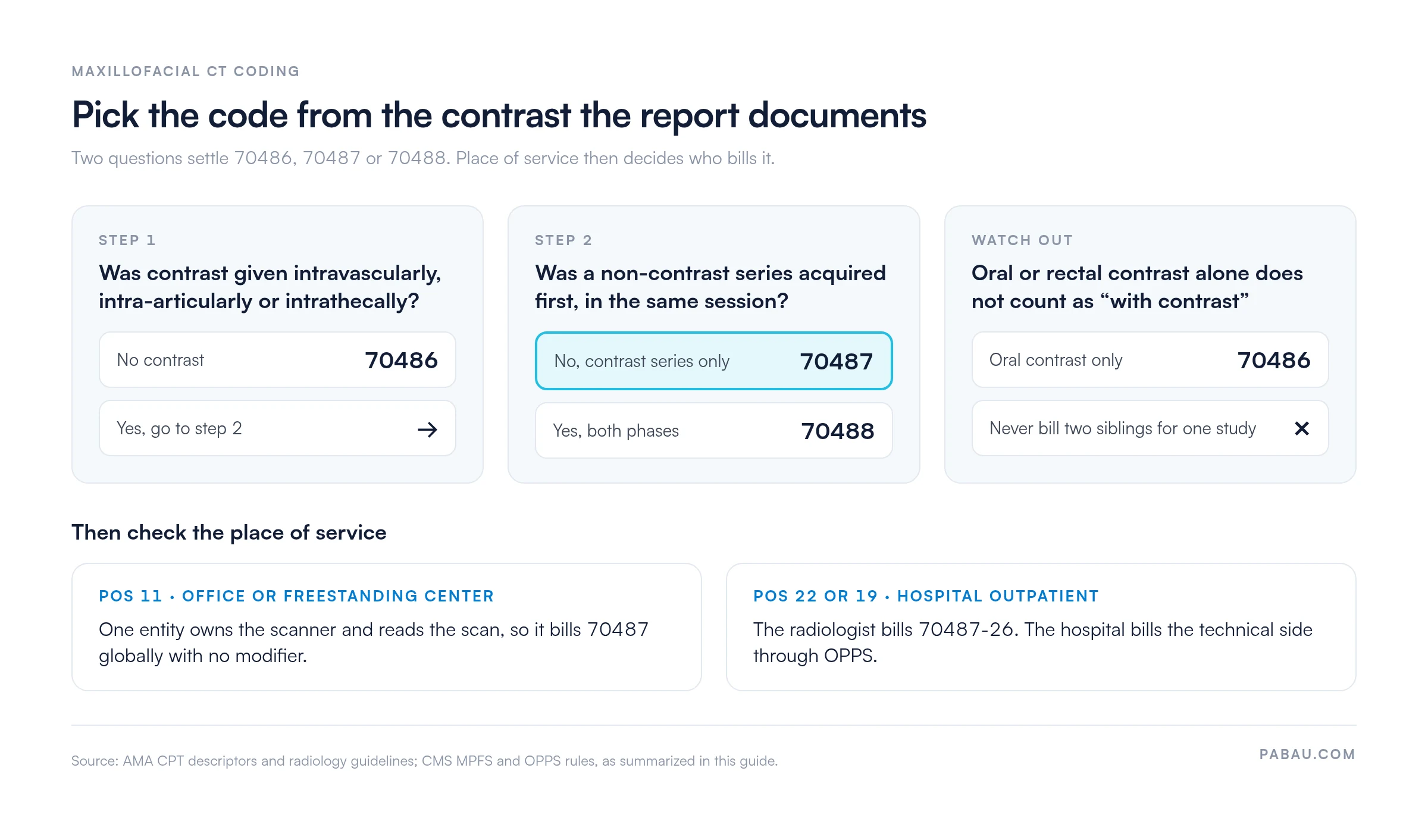
Contrast is what separates 70487 from its siblings. Under CPT radiology guidelines, “with contrast” means contrast given intravascularly, intra-articularly or intrathecally. Oral or rectal contrast on its own doesn’t qualify, so that study is reported as 70486.
The chart below turns that rule into two questions, then adds the place-of-service check that decides who sends the bill.
Contrast earns its place when the clinical question is about soft tissue, infection or a mass. Typical 70487 orders include:
Facial fractures, routine chronic sinusitis and dental implant planning usually need no contrast, so they’re normally ordered as 70486. If the order and the protocol disagree, settle it before the scan. Billing a non-contrast acquisition as 70487 is incorrect coding that can trigger overpayment recovery.
3D work trips coders up as well. Routine multiplanar reformats from the same dataset are part of 70487 and aren’t billed separately. A separately ordered 3D rendering, done under physician supervision, is reported with 76376 or 76377 when documented.
Missing contrast documentation is a frequent reason 70487 gets downcoded to 70486. Auditors read the radiology report first. If it doesn’t say contrast was administered, the claim is treated as a non-contrast study, whatever the order said.
A clean claim for CPT code 70487 needs these pieces to line up:
A structured report template helps here. Give it a required contrast field, and the radiologist can’t sign the report without the contrast details.
Payers judge medical necessity for CPT code 70487 at the diagnosis level. They ask whether the ICD-10-CM code supports a contrast-enhanced scan of the face. A weak or mismatched diagnosis can sink a correctly coded procedure.
Coverage rules vary by Medicare Administrative Contractor (MAC). A diagnosis listed under one LCD may be missing from another. Check your MAC’s active policy before you bill an implant planning scan.
Medicare pays CPT code 70487 under the Medicare Physician Fee Schedule (MPFS). The rate is total RVUs times the conversion factor, adjusted by the geographic practice cost index (GPCI) for your locality.
For 2026, 70487 carries 4.54 total non-facility RVUs. At the $33.4009 conversion factor, that gives a national payment of $151.64. In 2025, at a $32.3465 conversion factor, the same scan paid about $147.
Use the CMS lookup to pull the 26 and TC split for your locality. Commercial plans often price radiology as a percentage of Medicare, but contracted rates vary by plan.
Each modifier on CPT code 70487 tells the payer which part of the service you performed, and so who gets paid. The AAPC lists these as the ones that apply to this code family.
Whether you bill CPT code 70487 globally or split it depends on who owns the scanner and where the scan happens. Check the place of service code before you pick a modifier.
Global billing fits when one entity owns the CT scanner, employs or contracts the radiologist, and performs both the scan and the read. A freestanding imaging center set up this way bills 70487 with no modifier. POS 11 (office) tells the payer the non-facility MPFS rate applies.
Split billing applies when two entities provide the two parts. In a hospital outpatient department, the radiologist bills 70487-26. The hospital bills the technical side through OPPS (Outpatient Prospective Payment System), not with modifier TC.
Use POS 22 for an on-campus department and POS 19 for an off-campus one. A radiologist who bills globally in either setting faces denial or recoupment on audit.
Traditional Medicare has no precertification for CPT code 70487. CMS paused the Appropriate Use Criteria (AUC) program and rescinded its rules in the CY2024 fee schedule final rule, effective January 1, 2024. So no AUC consultation number goes on the claim.
Medicare Advantage and commercial plans are a different matter. ForwardHealth (Wisconsin Medicaid) lists 70487 on its advanced imaging precertification list. Blue Cross Blue Shield of Massachusetts includes it in the Carelon (formerly AIM) head and neck imaging code list.
Payers that commonly require precertification for this code include:
Rules change each plan year and differ between HMO, PPO and Medicare Advantage products, so check the current policy before each scan. A missing or invalid authorization number is a frequent denial cause for this code family. A clear prior authorization process captures that number before the patient arrives.
The National Correct Coding Initiative (NCCI) decides which codes can share a claim. For CPT code 70487, the rules that matter most involve the other maxillofacial CT codes.
NCCI tables update quarterly, and an edit’s status can change between updates. Check each pair against the current CMS tables rather than last year’s cheat sheet.
Set a claim scrubbing rule in your billing system that flags 70487 billed with 70486 or 70488 for the same patient, date and site. It catches a common unbundling error before the payer does.
Each 70487 denial pattern has its own fix. Track them by Claim Adjustment Reason Code (CARC), and use our guide to denial codes to read each one. That shows which denials need an appeal and which need a workflow change.
Say a patient is referred with a suspected dental abscess spreading into the cheek. The referral records the abscess, and the order reads “CT maxillofacial with contrast”. The radiologist documents the IV contrast agent, dose and time, then signs the report.
The freestanding center bills 70487 globally at POS 11, with the abscess diagnosis attached. The plan’s authorization number goes on the claim, and it pays on first pass.
Many 70487 denials start with re-keyed data. A code gets typed wrong, an authorization number is left off, or a diagnosis never makes it across. Each one costs a resubmission and weeks of waiting.
Pabau, the practice management platform we build, takes out the re-keying. Its claims management software pre-fills the claim from the patient record, with the CPT and ICD-10 codes already attached. Built-in CPT and ICD-10 lookup libraries help staff find the right code.
The claim won’t send until required fields, such as the authorization number, are complete. US claims go to payers through the Claim.MD clearinghouse, with real-time eligibility checks, ERA posting and claim tracking. That leaves your team free to work the appeals that deserve the effort.
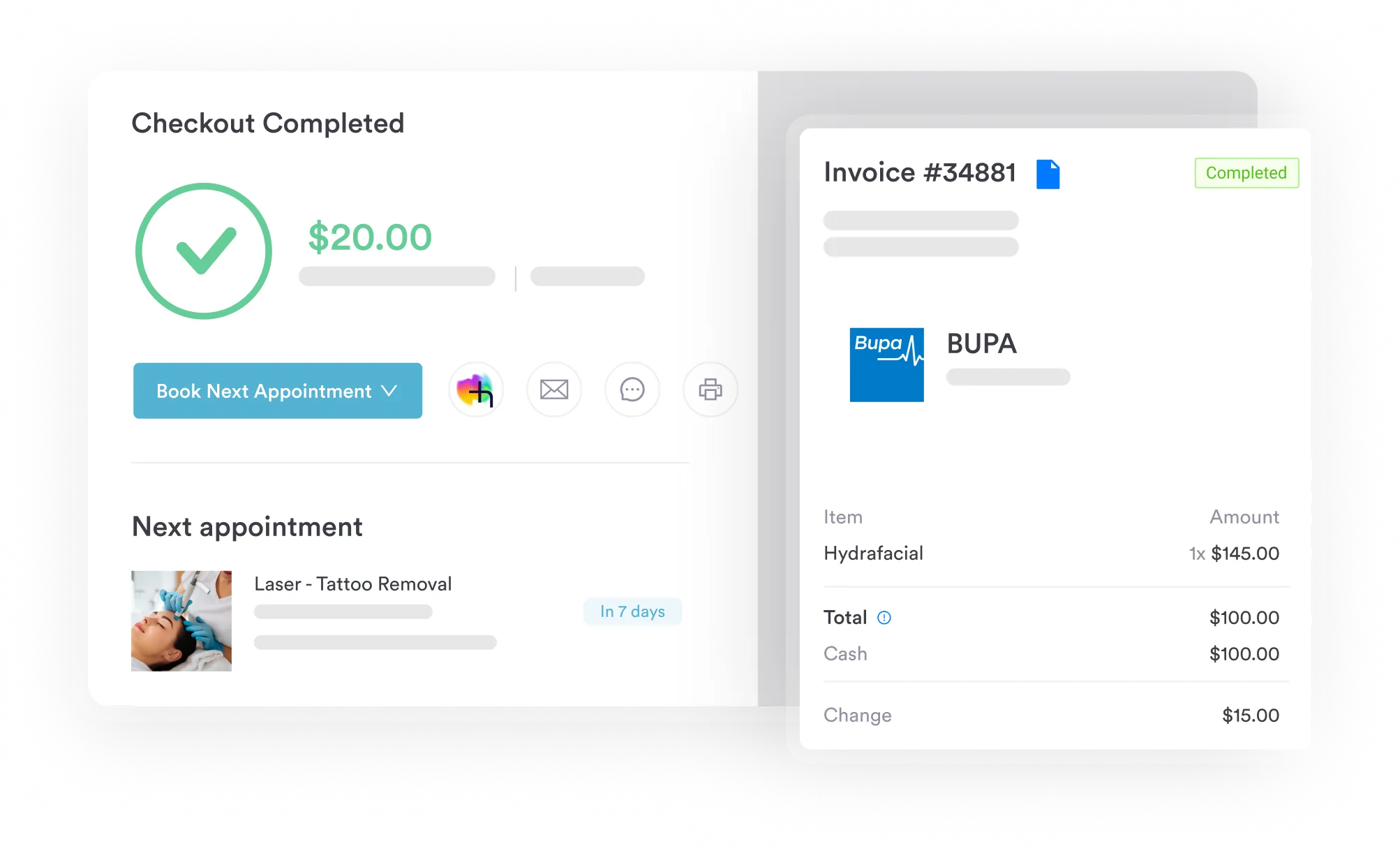

Pabau pre-fills 70487 claims from the patient record, checks required fields before sending, and submits through Claim.MD with real-time eligibility checks. Your billing team spends less time re-keying data.

CPT code 70487 rewards practices that settle the contrast question before the scan, not after the denial. Agree the protocol with the ordering physician, make the report prove what was given, and match the modifier to where the scan happened.
The trade-off is a few extra checks at intake in exchange for fewer appeals later. An authorization confirmed at booking is one less denial to chase in six weeks.
Book a demo to see how Pabau pre-fills and validates imaging claims, so your 70487 submissions go out complete.

Want a full breakdown of how to manage imaging claim denials? Denial management in healthcare walks through CARC-based denial categorization and appeal prioritization.
Preparing a clean 837P file for your radiology claims? 837 file billing guide explains the EDI format, required fields, and the submission errors that cause rejections.
Need to understand how the clearinghouse processes your 70487 claims? Claim.MD clearinghouse explained covers how electronic claims are routed, validated, and acknowledged before reaching the payer.
Need a standard way to request imaging approval? Medical prior authorization form gives your team a template for the clinical details payers ask for.
Want your imaging claims to hold up in an audit? Medical billing compliance covers the rules and safeguards that keep coded claims defensible.
No. The paranasal sinuses sit inside the maxillofacial area, so a contrast sinus CT is billed with 70487. A non-contrast sinus CT is 70486, and a two-phase study is 70488.
No. CPT radiology guidelines define “with contrast” as intravascular, intra-articular or intrathecal contrast. A scan with oral or rectal contrast alone is reported as 70486.
Yes, when it’s separately ordered, done under physician supervision and documented. Report it with 76376 or 76377, depending on whether an independent workstation was used. Routine reformats are part of 70487.
CPT 70487 carries 4.54 total non-facility RVUs for 2026. At the $33.4009 conversion factor, that’s a national Medicare payment of $151.64 before locality adjustment.
No. CMS rescinded the Appropriate Use Criteria program in the CY2024 fee schedule final rule, effective January 1, 2024. Medicare Advantage and commercial plans may still require prior authorization.
The radiologist bills 70487 with modifier 26 for the interpretation. The hospital bills the technical side through OPPS. Billing globally in that setting leads to denials or recoupment.