HCPCS Code V2629: Ocular prosthesis billing guide
HCPCS Code V2629: Definition, descriptor, and code attributes HCPCS Code V2629 i...

Last Updated: Nov 6, 2026
67901 is the CPT code for repair of blepharoptosis; frontalis muscle technique with suture or other material (eg, banked fascia). The surgeon suspends the upper eyelid from the frontalis muscle, so the patient lifts the lid by raising the brow. It is used when levator function is poor.
Payers treat it as functional surgery when the record shows an MRD1 of 2 mm or less. A Humphrey visual field test must also show superior field loss that improves with the lid taped. An autologous fascial sling with fascia harvest is coded 67902 instead.
Let Pabau's smart automation suggest the right codes, reduce claim denials, and keep your practice compliant—effortlessly.
Automate repetitive tasks and focus on what matters most—your patients.
Reduce coding errors and ensure compliance with the latest regulations.
Clean claims, fewer denials, and faster reimbursements.
Powerful insights and reporting to help your practice thrive.
HIPAA compliant SOC 2 certified GDPR-compliant Trusted by 4,000+ clinics worldwide

CPT code 67901 covers upper eyelid ptosis repair through the frontalis muscle, using suture or other material such as banked fascia. Levator repairs, superior rectus repairs and autologous fascial slings each have their own code.
Medical necessity documentation needs an MRD1 of 2 mm or less and Humphrey visual field testing that shows superior field loss. Pre-operative photographs must show the brow relaxed.
E1 (upper left) and E3 (upper right) are the laterality modifiers for 67901. Medicare pays bilateral repair on one line with modifier -50 at 150%, while some commercial payers want two lines.
Traditional Medicare requires prior authorization for 67901 in hospital outpatient departments, and in ambulatory surgery centers in ten demonstration states since early 2026.
Claims software such as Pabau tracks prior authorization cases, flags claims that need action before submission, and sends 67901 claims to the clearinghouse through Claim.MD.
CPT code 67901 is the surgical code for upper eyelid ptosis repair using the frontalis muscle technique with suture or other material. The AMA descriptor reads Repair of blepharoptosis; frontalis muscle technique with suture or other material (eg, banked fascia). The surgeon attaches the eyelid to the frontalis muscle instead of shortening the levator, so the patient lifts the lid by raising the brow.
Surgeons choose the frontalis sling when levator function is severely reduced, typically under 4 mm of excursion. The blepharoptosis series has a separate code for each major repair method. Picking the wrong one is a frequent denial trigger in medical billing for eyelid surgery.
CPT 67901 covers two technique variants. Both route eyelid elevation through the frontalis muscle rather than the levator complex:
Both variants need the material and the technique documented. An operative note that only says “ptosis repair” without naming the frontalis approach won’t support 67901. It may also cause a recode to 67903 or 67908.
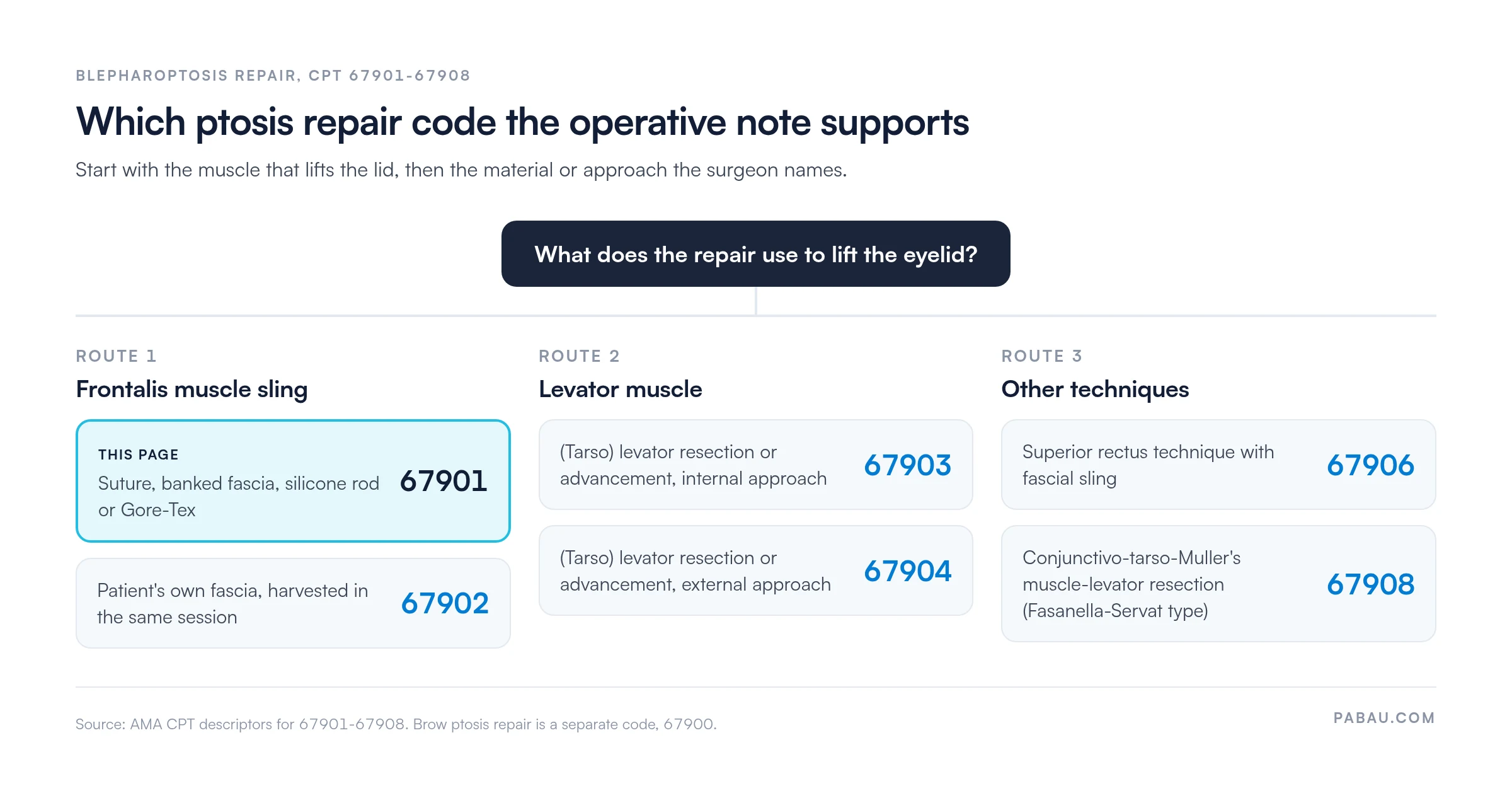
The blepharoptosis series from 67901 to 67908 covers six distinct ptosis repair techniques, and 67900 handles the brow. Billing the wrong code is a compliance risk as well as a billing error. The table shows where each code sits and what sets it apart. Every sibling also has an entry in our full CPT code library.
The 67901 vs 67902 choice causes the most trouble, because both codes describe a frontalis sling. CPT 67901 uses suture or other material, such as banked fascia or a silicone rod. CPT 67902 applies when the surgeon harvests the patient’s own fascia in the same session, and the harvest is included in that code.
Levator-based repairs belong to a separate family, such as 67904, the external levator resection or advancement. The diagram below maps each technique an operative note might describe to its code. Confirm the sling material and the approach in the note before you pick one.
Every 67901 claim needs a paired ICD-10-CM diagnosis code that establishes functional impairment. Billing cosmetic ptosis as functional can amount to fraud. Use only diagnosis codes that reflect a clinically documented, vision-affecting condition.
Payers vary in which ICD-10 codes they accept for 67901. Confirm accepted codes against the applicable local coverage determination (LCD) before submitting. H02.409 (unspecified laterality) is a frequent denial trigger and should be avoided when the operative side is known.
Functional blepharoptosis documentation is the make-or-break element for CPT 67901 claims. The clinical record must show that the eyelid position impairs vision, beyond any cosmetic concern the patient raises. Missing even one required element gives the payer grounds to deny the claim outright.
The core documentation set required across most payers and Medicare local coverage determinations includes:
Humphrey visual field testing thresholds for ptosis medical necessity vary by Medicare Administrative Contractor (MAC) and by private payer. The most widely cited criteria across MACs and major commercial payers are:
These thresholds vary, so verify them against the policy for the jurisdiction where the procedure is performed. The First Coast billing article A57025 (LCD L34028) is one example of a MAC policy. No LCD applies nationally, so check your own MAC’s policy.
Test results that fall just outside the local threshold are a common audit finding. Keeping clean claim submission standards means verifying local criteria before booking the case, rather than after the denial arrives.
CPT 67901 needs an eyelid laterality modifier on almost every claim. Missing or misapplied modifiers are a frequent denial reason, alongside thin documentation.
Under Medicare, bill bilateral repair on one line with modifier -50 and 1 unit, which pays 150% of the fee schedule. Some commercial payers instead want two lines with E1 and E3. Bilateral billing format is payer-dependent, so confirm the payer’s preference before submitting.
Run a bilateral billing check before every 67901 submission. Medicare wants one line with modifier -50 and 1 unit, while some commercial payers want two lines with E1 and E3. Getting the format wrong can leave the practice paid for one eye when both were repaired.
Medicare covers CPT 67901 when the ptosis is functional, meaning the eyelid position measurably impairs the superior visual field. Coverage does not extend to cosmetic ptosis repair, regardless of patient preference or surgeon opinion. This distinction must be supported by objective clinical data in the record.
Traditional Medicare requires prior authorization for 67901 when it is performed in a hospital outpatient department, a rule in place since July 1, 2020. Office-based procedures and some other settings fall outside that program, so check the setting before you schedule.
Since early 2026, a CMS prior authorization demonstration for ambulatory surgery centers (ASCs) has also covered 67901. It runs in Arizona, California, Florida, Georgia, Maryland, New York, Ohio, Pennsylvania, Tennessee, and Texas. An ASC in those states that skips the request faces prepayment medical review instead.
Each MAC publishes its own LCD for blepharoplasty and blepharoptosis repair, with its own threshold criteria. The major private payer stances track closely with Medicare’s framework but add payer-specific wrinkles:
Maintaining medical billing compliance for eyelid repair procedures means tracking each payer’s LCD or clinical policy bulletin. Update internal documentation checklists whenever those policies change, which typically happens annually and after CMS rule-making cycles.
Medicare reimbursement for CPT 67901 is calculated using the Resource-Based Relative Value Scale (RBRVS). The formula is (Work RVU + Practice expense RVU + Malpractice RVU) x Geographic adjustment x Conversion factor. The 2026 conversion factor is $33.4009 for non-qualifying APM participants ($33.5675 for qualifying participants). Always verify current rates in the CMS Physician Fee Schedule lookup tool.
The 2026 RVU values for 67901 come from the CMS fee schedule file, as listed by FastRVU. Values are updated annually, so recheck them each January:
These payment figures are unadjusted national amounts, so your local rate will differ once the geographic adjustment is applied. A bilateral claim billed with modifier -50 pays 150% of the single-side amount.
Private payer rates for 67901 typically exceed Medicare rates, often ranging from 110% to 150% of the Medicare fee schedule depending on the contract. The AMA CPT code set and the AAPC’s coding resources define the procedure, but each payer sets its own payment amounts. Benchmark contracted rates against the Medicare fee schedule annually, using the AAPC Codify CPT lookup as a cross-reference.
Payers treat CPT 67901 as a procedure that needs active proof of medical necessity rather than presuming coverage. As a result, the most frequent denial reasons follow a consistent pattern.
Effective denial management workflows for ptosis repair claims start with a pre-submission checklist that verifies each element before the claim goes out.
CPT 67901 can be billed on the same day as other eyelid or facial procedures in some circumstances. National Correct Coding Initiative (NCCI) edits govern which combinations are payable.
The most common same-session scenario is ptosis repair alongside upper blepharoplasty (CPT 15822-15823). Payment for both depends on a documented, distinct functional indication for each procedure.
Since October 1, 2017, Medicare has paid medically necessary upper eyelid ptosis repair even when a cosmetic blepharoplasty is done on the same eye. In that case, the cosmetic blepharoplasty is billed separately with modifier GY, and the ptosis repair is not bundled away. A superbill documentation approach that separates the two procedures by operative objective supports each line.
Key bundling rules for 67901:
CMS updates the NCCI edit tables quarterly, so verify the current edit status of any code combination before billing. The NCCI Policy Manual for Medicare Services explains the rationale for each edit and is free from CMS.
Many 67901 denials start before the claim is sent. A taped field test is missing, an authorization has lapsed, or the bilateral claim uses the wrong format. Catching these by hand means a coder rereading every chart against each payer’s checklist.
Pabau, the practice management platform we build, tracks each prior authorization case by patient and procedure. Its error-flagging claims management software validates each claim before submission and marks incomplete ones as Needs action. Your team fixes them before the clearinghouse sees them.
Claims then go out through Pabau’s Claim.MD integration, which supports thousands of US payers and real-time eligibility checks. Electronic remittance advice comes back matched to the claims you submitted. The result is fewer 67901 claims returned for rework, and payments you can reconcile against expected fee schedule amounts.
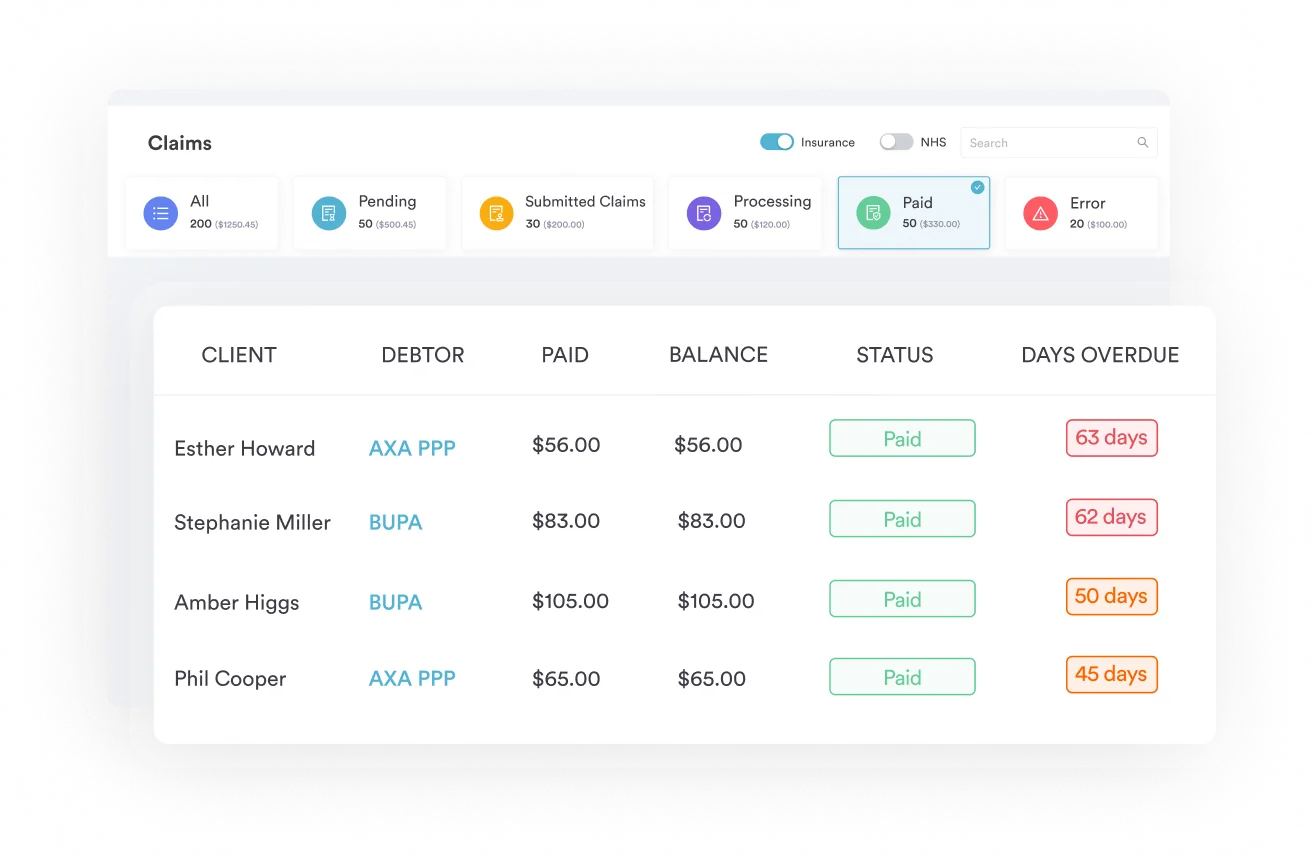

Pabau tracks prior authorization for ptosis repair, flags claims that need action before submission, and sends them through Claim.MD. Fewer 67901 claims come back as denials.

Treat the operative note as the coding decision for 67901. If it names a frontalis sling with suture, banked fascia or synthetic material, 67901 fits. If the surgeon harvested the patient’s own fascia, the claim belongs under 67902.
Settle authorization and the bilateral format before the case is booked. A Medicare case in a hospital outpatient department needs prior authorization, and Medicare pays bilateral repair on a single -50 line. Getting both right before surgery takes minutes, while appealing a denial takes months.
Book a demo to see how Pabau tracks ptosis authorizations and flags incomplete 67901 claims before they reach the payer.

Need to understand how clearinghouse submission works for surgical claims? Medical claims clearinghouse guide explains how electronic claim routing reduces denial rates and speeds reimbursement cycles.
Want to tighten your electronic remittance reconciliation? Electronic remittance advice (ERA) guide covers how 835 files map payer payment decisions back to individual claim lines.
Looking for guidance on insurance credentialing for new oculoplastic providers? Insurance credentialing guide walks through the enrollment steps that affect reimbursement eligibility for surgical procedures.
Billing a levator repair instead? CPT code 67904 billing guide covers external levator resection or advancement and how it differs from a frontalis sling.
CPT code 67901 covers upper eyelid ptosis repair using a frontalis muscle technique with suture or other material, such as banked fascia. It applies when the levator muscle has too little function, so the surgeon routes eyelid elevation through the frontalis muscle instead. Levator resection, posterior approaches and autologous fascial slings with fascia harvest (67902) use different codes in the 67900 series.
Both codes describe a frontalis sling, but they differ in the sling material. CPT 67901 uses suture or other material, such as banked fascia, a silicone rod or Gore-Tex. CPT 67902 uses an autologous fascial sling, and it includes harvesting the patient’s own fascia in the same session. The operative note must name the material, because billing 67901 for a harvested-fascia sling is a documentation mismatch on audit.
Yes, Medicare covers CPT 67901 when the ptosis is functional. That means the eyelid causes measurable superior visual field loss that meets your MAC’s local coverage determination (LCD) threshold. Medicare does not cover cosmetic ptosis repair. Traditional Medicare requires prior authorization for 67901 in a hospital outpatient department, and in ambulatory surgery centers in the ten states of its 2026 demonstration. Medicare Advantage plans set their own prior authorization rules, so verify with the specific plan.
E1 (upper left eyelid) and E3 (upper right eyelid) are the laterality modifiers for 67901, since E2 and E4 describe the lower lids. Under Medicare, bill bilateral repair on one line with modifier -50 and 1 unit, which pays 150% of the fee schedule. Some commercial payers want two lines with E1 and E3 instead, so the format is payer-dependent. Modifier -22 can be added when the operative note documents exceptional complexity. Some commercial payers accept -RT and -LT in place of E modifiers.
Prior authorization requirements for CPT 67901 vary by payer and setting. Traditional Medicare requires it in hospital outpatient departments, and in ambulatory surgery centers in the ten states of the 2026 CMS demonstration. Office-based procedures fall outside both programs. Most major commercial payers, including UnitedHealthcare, Aetna and most BCBS regional plans, require it for frontalis sling repair, as do many Medicare Advantage plans. Submit the clinical packet (MRD1 measurement, visual field results, pre-operative photographs) with the request. Turnaround typically runs five to fifteen business days, depending on the payer.
The most common reason is missing Humphrey visual field results, especially the taped versus untaped comparison. Another is an MRD1 that is undocumented or above the payer’s threshold. Claims also fail for a missing prior authorization, a wrong or missing eyelid modifier, or an ICD-10 code that doesn’t establish functional impairment. Choosing the wrong code also causes denials on audit, such as billing 67901 for levator resection (67903 or 67904) or a harvested-fascia sling (67902).