EHR ROI: How to calculate and maximize your return
EHR ROI is the financial return a practice earns on its electronic health record...

Last Updated: Oct 15, 2026

Insurance credentialing is the payer’s verification of your license, training, and work history before it lets you join its network.
You can do this yourself, because the work is paperwork and follow-up rather than a test of clinical merit.
The spine of the process is the same at every payer: your NPI numbers, a current CAQH profile, then one application each.
Published timelines run from 45 days at Cigna to 120 days at UnitedHealthcare, and Medicaid publishes almost nothing.
Practice management software like Pabau issues superbills while you wait, then submits in-network claims from the day your contract starts.
A one-page checklist of every document, number, and login payers ask for, grouped by where you get it. It covers personal credentials, business identifiers, digital accounts, and a per-payer tracker for submission dates, reference numbers, and effective dates.
Download templateYou get credentialed with insurance companies by preparing your credentials, completing a CAQH profile, and applying to each payer’s network separately. Then you follow up on a schedule until the contract is signed and your effective date lands. Once credentialing is underway, some practices use the wait to research med spa software for services that don’t need a payer contract at all.
The reason it feels harder than it is comes down to pace. Nothing about it is difficult, and all of it is slow. Every payer wants the same 12 documents in a slightly different order. Miss one, and your application sits in a queue for three weeks before anyone tells you.
Below are the documents to gather first, the eight steps in order, and what each major payer publishes about timelines and costs. The last section covers what to do during the 60 to 120 days you spend waiting.
Insurance credentialing is the process a payer uses to verify your license, education, training, and work history before admitting you to its network. It checks each item against the original source, which is why it takes weeks rather than days.
Three separate things get called credentialing, and confusing them is why people think they are done when they aren’t. Credentialing verifies you. Contracting sets your terms. Enrollment gets you into the systems that pay claims.
| Stage | What happens | What you end up with |
|---|---|---|
| Credentialing | The payer verifies your license, training, and history at source. | An approval from the payer’s credentialing committee. |
| Contracting | You and the payer agree the terms of participation. | A signed agreement and a fee schedule. |
| Enrollment | Your details load into the payer’s claims and payment systems. | An effective date, plus electronic remittance and payment set up. |
You are not in-network until all three are finished. A credentialing approval with no signed contract bills exactly like being out-of-network. So does a signed contract that hasn’t reached the payer’s claims system yet.
Collect everything before you open the first application. Payers reject and pause applications for missing documents far more often than for anything about your qualifications.
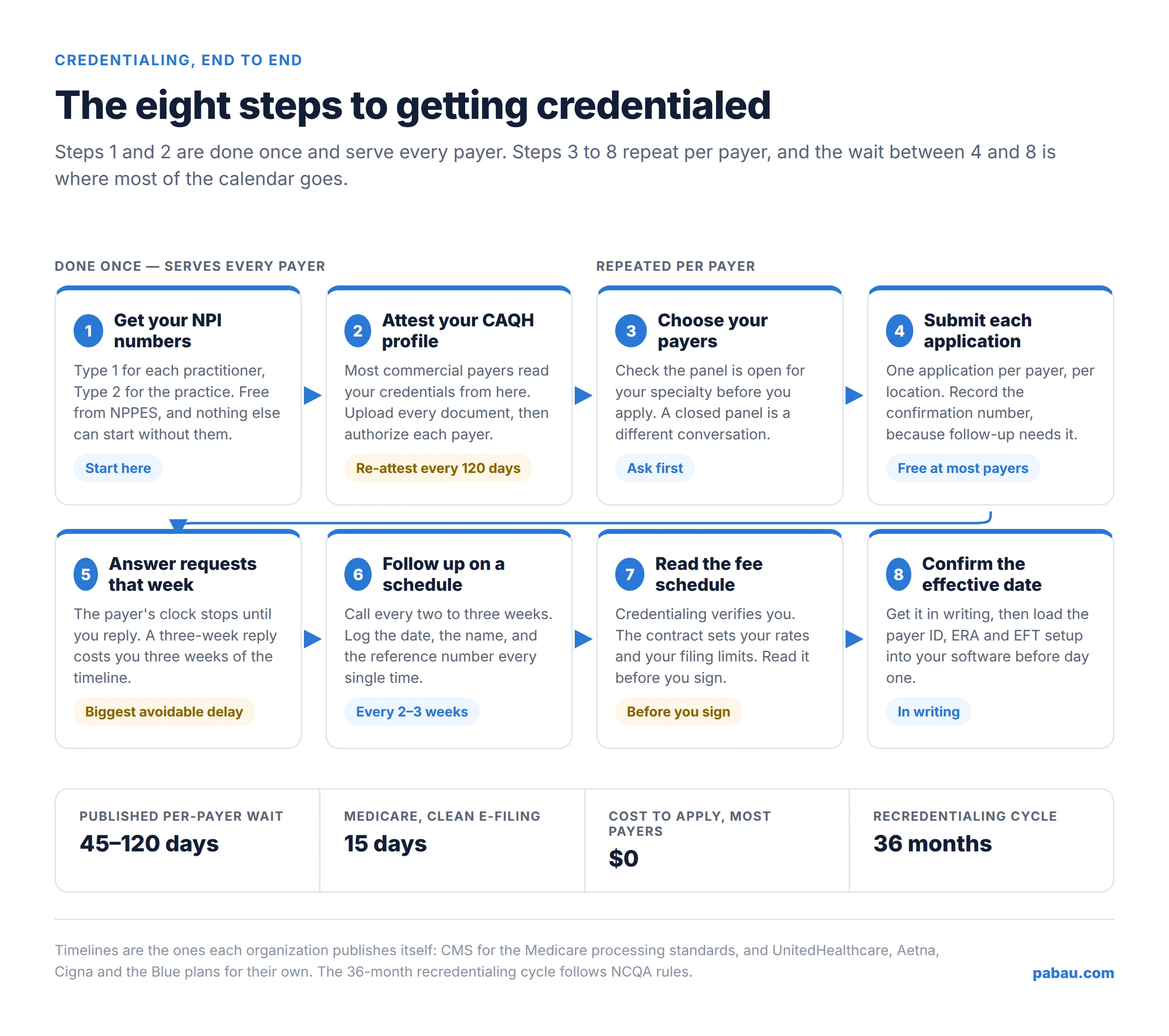
Apply through the NPPES registry for a Type 1 number as an individual, and a Type 2 for the practice entity. There is no fee, and approval is usually same-day or next-day online. Every later step references these numbers, so do this first.
CAQH is the shared database commercial payers read your credentials from, and it is free to providers because health plans pay for access. One note on names: CAQH rebranded as DataSpring in 2026, and ProView is now the Provider Data Portal. The login at proview.caqh.org is unchanged.
Fill the profile in completely, upload your documents, and authorize each payer you plan to apply to. Then attest. You must re-attest every 120 days, and a lapsed profile quietly stalls every application in flight, so put the date in your calendar.
Applying to everything is the most common mistake, and it costs months. Look at what your existing patients already carry, and at the largest employers within a few miles of you. Three or four payers usually cover most of a local market. Look at your service mix too, since a lab-heavy practice billing 87661 leans on a different set of plans.
Each contract you sign also sets what you get paid for the work you already do. A panel you barely bill is admin you maintain forever, including recredentialing every three years. That bites when one code carries the panel, such as an orthosis fitting billed under L0641.
Most commercial payers start with a request to join the network on their provider site. Medicare goes through PECOS, and Medicaid through your state’s own portal. Save a PDF of every submission, along with the date and any confirmation number.
Expect the payer to ask whether its panel is open for your specialty in your area. That answer arrives before any verification work starts.
Payers verify your credentials against the original source, which means writing to licensing boards, schools, and previous employers. When they come back to you for a missing date or a signature, the clock stops until you reply.
This is where most of the lost time hides. A request answered in two days costs nothing, while the same request answered in three weeks adds three weeks.
Call every two to three weeks. Ask for the file’s current status, the name of the person you spoke to, and a reference number for the call. Log all three.
Applications do get lost. A polite call every two weeks surfaces that in two weeks instead of two months.
Approval brings a participation agreement and a fee schedule. Pull out the 10 CPT codes you bill most and check what each one pays. A turbinate resection billed as 30140 can pay very differently from one plan to the next. If the schedule isn’t attached, ask for it, because signing without it commits you to rates you haven’t seen.
Check the timely filing window and the termination clause too. Rates are sometimes negotiable for a specialty a payer is short of in your area, and asking costs nothing.
Get the effective date in writing, and do not bill in-network before it. Claims dated a day early come back denied, and refiling them eats the timely filing window you just agreed to. Encounter characters move with those dates, so S42.494G belongs on a later visit rather than the first.
Then check you can reach the payer electronically. Confirm the payer ID your software uses, and that your electronic remittance and payment enrollment is live, before the first claim goes out.
Published timelines run from 45 days to 120 days per payer, and applying costs nothing at most of them. The table below carries only figures the payers and CMS publish themselves. Where nobody publishes a number, it says so.
| Payer | Published timeline | Cost to apply | Recredentialing cycle |
|---|---|---|---|
| Medicare (Part B) | CMS allows its contractors 15 days for a clean PECOS filing, and 50 when fingerprinting or a site visit applies. | Free for physicians and non-physician practitioners. Institutional providers pay $750 in 2026. | Revalidate every 5 years. |
| Medicaid (state agency) | Unpublished. Most state agencies set no target, and your screening risk level drives the wait. | No fee for individual practitioners. The same $750 institutional fee applies in 2026. | Revalidate at least every 5 years. |
| UnitedHealthcare | Up to 120 days from the decision date to verify and approve your credentials. | No published application fee. | At least every 36 months. |
| Aetna | 45 days for an eligibility answer, or 60 for facilities. No end-to-end figure published. | No published application fee. | Every 36 months, under NCQA rules. |
| Cigna | 45 to 60 days once the packet arrives, then up to 10 business days to load their systems. | No published application fee. | Every 36 months, under NCQA rules. |
| Blue Cross Blue Shield | Set per plan. Highmark of Western New York publishes 45 days, Excellus 60 days. | No published application fee. | Every 36 months, under NCQA rules. |
Every figure above comes from the organization that sets it. The Medicare standards are the ones CMS allows its administrative contractors for processing. Clean PECOS filings get 15 days, and paper filings 30.
Fingerprinting, a site visit, or a request for more information stretches that to 50 days through PECOS, and 65 on paper. The $750 application fee for 2026 applies to institutional providers enrolling in Medicare, Medicaid, or CHIP, not to individual practitioners.
On the commercial side, UnitedHealthcare’s credentialing plan gives itself 120 days and recredentials at least every 36 months. Cigna publishes 45 to 60 days, plus 10 business days to load your details into its directories and claim systems. Aetna commits to 45 days for an eligibility decision, but publishes no figure for credentialing itself.
Blue Cross Blue Shield is not one company. Each plan is independent and sets its own standard, so check the plan for your state rather than a national number. The 36-month recredentialing cycle across commercial payers comes from NCQA’s accreditation standards, which most of them are audited against.
Medicaid is the honest blank on this table. States publish revalidation rules but rarely a processing target, and the wait depends on the risk category your provider type falls into. Colorado, for one, allows 30 calendar days for the fingerprint check alone. Federal rules require states to revalidate every provider at least every five years.
Not to the payer, in almost every case. Commercial payers publish no application fee, and Medicare charges individual physicians and non-physician practitioners nothing. CAQH is free to providers as well.
What it costs you is staff time and, if you outsource, the credentialing service. Published pricing guides across the industry put outsourced credentialing at roughly $100 to $300 per provider, per payer. Complex specialties are quoted higher.
For four payers, that is a few hundred to a couple of thousand dollars, against perhaps 20 hours of your own time.
Treat the wait as setup time, because everything you postpone until approval lands on the same day as your first in-network patient. Equipment you plan to supply needs its own enrollment, which is true of a wound pump billed under E2402. The five jobs below build the front end of your revenue cycle.
Keep seeing patients out-of-network and issue superbills. A superbill is an itemized receipt with your NPI and the CPT and ICD-10 codes, which the patient submits to their own insurer for reimbursement. It keeps revenue moving, and working from a superbill template forces your coding to be right before a payer grades it.
Build your fee schedule and code list. Decide the CPT codes you will bill and the diagnoses that support them. Pair them deliberately, so a shoulder fracture coded S42.265D lines up with the follow-up visit you bill against it. Practices moving into insurable services from cash-pay work almost always underestimate this. It is far easier to do calmly in month two than urgently on day one.
Set up eligibility checking. Verifying benefits before an appointment stops the first month of in-network claims turning into a first month of denials. It also flags the treatments that need prior authorization before you book them. Getting the habit in place while the stakes are low is worth more than the tool itself.
Finish your electronic remittance and payment enrollment. These are separate from credentialing, they have their own forms, and they routinely add weeks after approval. Starting them early is the difference between billing on your effective date and billing a month later.
Decide who submits your claims. Pick your medical billing software or biller now, and confirm the payer IDs work. Check how it treats low-value lines as well, because 99000 is not paid by many plans. Then approval day starts with billing rather than setup.
A closed panel means the payer already has enough providers of your type in your area. It is not a judgment on you, and it is not always final.
Write a short letter of interest setting out what you offer that the network lacks. That might be a language, evening hours, a subspecialty, or a rural location. Ask to be reconsidered in writing, and ask again in six months.
For an individual patient who needs you specifically, ask the payer about a single case agreement. It covers one member rather than joining the network.
Medicare has one rule worth knowing. Once you are enrolled, 42 CFR 424.521 lets physicians and non-physician practitioners bill retrospectively for services up to 30 days before their effective date. Long orthopedic follow-ups are where that window earns its keep, since S82.032Q can describe care given weeks earlier. Commercial payers rarely offer anything similar, so never assume backdating.
Practice management software like Pabau covers both halves of this timeline. That matters most in insurance-heavy fields like physical therapy and behavioral health, where almost every client claims. While credentialing runs, you print or export superbills for out-of-network clients straight from their record. Patients claim reimbursement themselves, so your revenue doesn’t pause for four months. Correct coding is one half of getting paid; claims management software handles submission through remittance.
The same system then handles the in-network side. You browse the Claim.MD payer directory, link each payer to the insurer on your client records, and track how far each enrollment has got. Built-in CPT and ICD-10 catalogs mean the codes you chose during the wait are already in place.
On your effective date, you check a client’s benefits in real time from their client card. Then you submit the claim as a CMS-1500 or 837P file from the invoice you already raised. Pabau reaches thousands of US payers this way. Nothing gets re-keyed into a separate portal, and going in-network becomes a switch you flip rather than a second implementation project.

Pabau issues superbills while credentialing runs, then links your new payers through Claim.MD, checks eligibility from the client card, and submits claims from the invoice. Your first in-network week is billing, not setup.

Credentialing is a queue, not an exam. Nobody is judging whether you deserve to be in the network. The practices that get through in three months rather than eight simply sent complete files and called every two weeks.
So pick three payers your patients carry, gather the documents on the checklist above, and start. Then spend the wait building the billing side, because approval only pays you if you can submit a clean claim the week it arrives.
The trade-off worth remembering is that every panel you join is a contract you maintain forever, at rates you agreed once. Choose fewer, read the fee schedule, and put the recredentialing date in your calendar. Book a demo to see how Pabau handles superbills during credentialing and in-network claims after it.

Wondering how claims reach payers once you are in-network? What is a medical claims clearinghouse? follows one claim from your invoice to the payer and back.
Billing out-of-network while you wait? What is a superbill? covers the document patients send to their own insurer for reimbursement.
Need the form behind your first claim? CMS-1500 form walks the boxes every professional claim has to fill in correctly.
Billing for a depression diagnosis? Depression ICD-10 coding guide walks through the F32 and F33 codes and the severity specifiers each one needs.
Got denials in that first month anyway? Denial management in healthcare covers the five-step process for working them and getting paid.
It is slow rather than hard. The work is gathering documents, filling in one application per payer, and following up until a contract arrives. The common failure is an incomplete file or a lapsed CAQH attestation, not a rejection on merit.
Yes. Solo and small practices do it themselves routinely, and payers accept applications directly from providers. Budget around 20 hours across a few months, mostly spent on documents up front and follow-up calls afterward. Outsourcing buys back that time, not a better outcome.
Not to the payer, in most cases. Commercial payers publish no application fee, CAQH is free to providers, and Medicare charges individual physicians and non-physician practitioners nothing. Institutional providers pay a $750 application fee in 2026. Outsourced credentialing typically runs $100 to $300 per payer.
Plan for 60 to 120 days per payer. Cigna publishes 45 to 60 days, UnitedHealthcare allows itself up to 120, and Blue Cross Blue Shield plans publish their own figures between those. Medicare can be quicker through PECOS, while Medicaid varies by state.
Initial credentialing and recredentialing. Initial credentialing verifies your qualifications before you join a network. Recredentialing repeats that check on a cycle. NCQA sets it at least every 36 months for accredited health plans, while Medicare and Medicaid revalidate at five years.