HCPCS Code A4627: Spacer and valved holding chamber
HCPCS Code A4627: official descriptor and code definition HCPCS Code A4627 is th...

Last Updated: Oct 21, 2026
62270 is the CPT code for spinal puncture, lumbar, diagnostic. It covers a lumbar puncture that collects cerebrospinal fluid (CSF) for lab analysis, done without fluoroscopic or CT guidance.
Code selection turns on intent and imaging. A tap that drains CSF to relieve pressure is reported with 62272, and an image-guided diagnostic tap with 62328.
Let Pabau's smart automation suggest the right codes, reduce claim denials, and keep your practice compliant—effortlessly.
Automate repetitive tasks and focus on what matters most—your patients.
Reduce coding errors and ensure compliance with the latest regulations.
Clean claims, fewer denials, and faster reimbursements.
Powerful insights and reporting to help your practice thrive.
HIPAA compliant SOC 2 certified GDPR-compliant Trusted by 4,000+ clinics worldwide

62270 covers a diagnostic lumbar puncture only, and therapeutic drainage of CSF is coded 62272.
When fluoroscopy or CT guides the needle, report 62328 instead, because that code already includes the imaging.
Documentation must state the needle level, CSF characteristics, volume obtained, and the clinical indication.
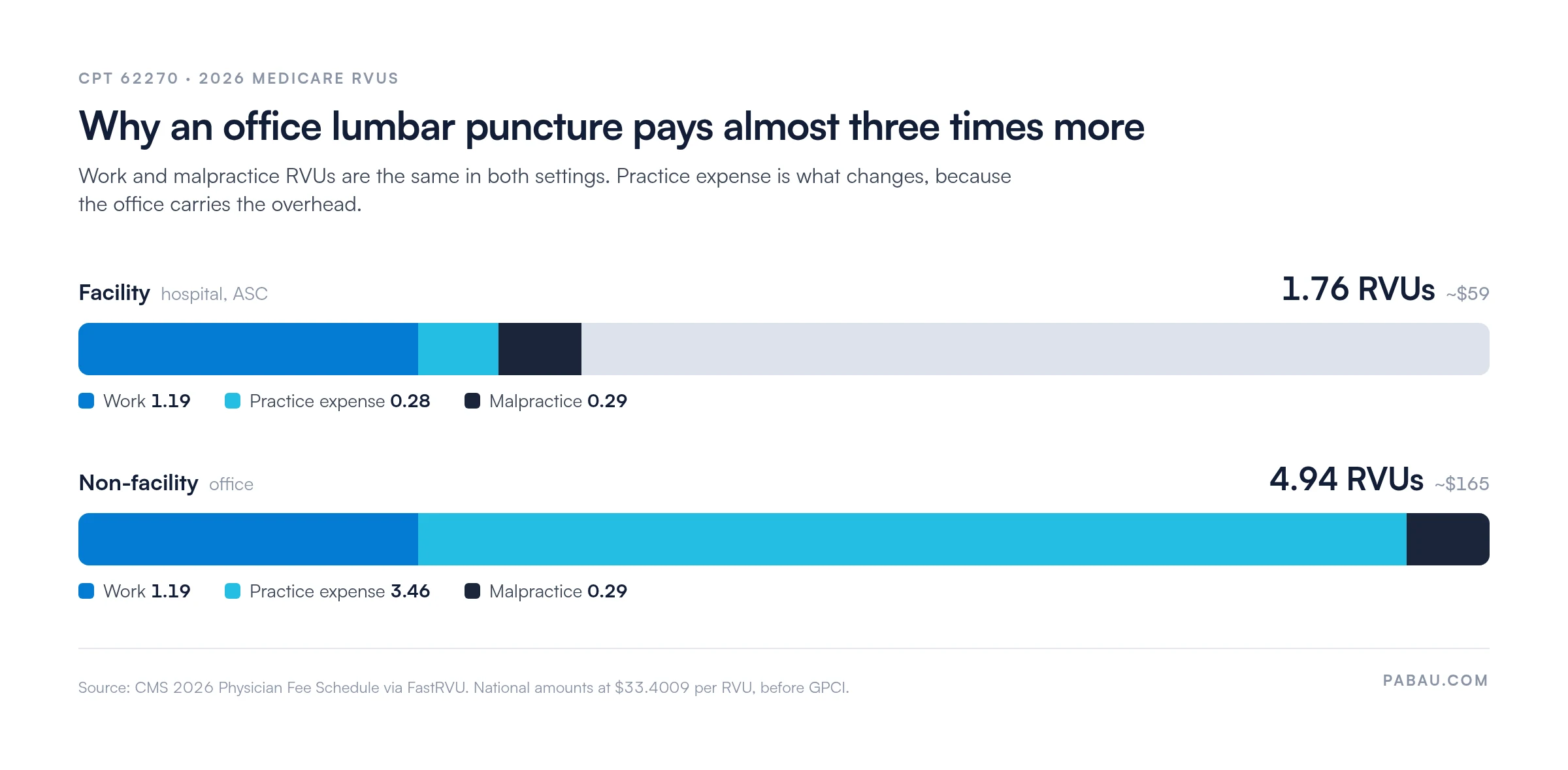
The 2026 national Medicare amount is about $59 in a facility and $165 in an office, before geographic adjustment.
Pabau, the practice management platform we build, raises each 62270 claim from the invoice and validates it before it reaches the payer.
CPT code 62270 reports a diagnostic lumbar puncture, where cerebrospinal fluid (CSF) is collected for lab analysis without fluoroscopic or CT guidance. The American Medical Association (AMA) publishes it in the Surgery section, Nervous System subsection. It sits in the Injection, Drainage, or Aspiration Procedures on the Spine and Spinal Cord range (62263-62329). The official descriptor is “Spinal puncture, lumbar, diagnostic.”
A lumbar puncture involves inserting a needle between lumbar vertebrae (typically L3-L4 or L4-L5) into the subarachnoid space. The clinician then withdraws cerebrospinal fluid for laboratory analysis. For coding, the deciding factor is intent. 62270 applies when the CSF sample is collected to investigate a clinical question, not to reduce CSF volume or intracranial pressure.
Coders don’t need the full clinical technique, but these procedural points affect code selection and documentation review:
62270 and 62272 describe the same needle-insertion technique but differ on why the CSF is removed. 62272 is used when the intent is therapeutic. The clinician drains CSF to lower intracranial pressure, as in normal pressure hydrocephalus or idiopathic intracranial hypertension.
When both diagnostic and therapeutic intent are documented in a single session, coding guidance generally supports 62272 as the primary code. Therapeutic drainage is the higher-complexity service, so document both purposes clearly.
Several codes sit next to CPT code 62270 and are often confused during claim preparation. The most important is 62328, which replaces 62270 whenever fluoroscopy or CT guides the needle.
Don’t add 77003 to an image-guided diagnostic tap, because 62328 already includes the fluoroscopic or CT guidance. Check current NCCI edits and payer policy before billing any imaging code alongside a lumbar puncture.
An attempted lumbar puncture where no CSF is obtained still represents significant physician work and can be billed. Modifier selection is what decides whether it gets paid, and incorrect modifier use on an incomplete LP is a common audit trigger.
The procedure note for an incomplete LP must state the date, needle gauge, level attempted and number of passes. It must also give the reason no CSF was obtained and the plan for the patient. A bare notation of “unsuccessful LP” without these elements won’t support the claim.
Strong documentation for a 62270 claim goes beyond naming the procedure. Payers audit lumbar puncture claims for specificity, and missing any element below is grounds for denial or post-payment recoupment.
Run a documentation checklist before submitting any 62270 claim. If the procedure note lacks the needle level, CSF appearance, and opening pressure, request an addendum before billing. Addenda added after a payer inquiry carry lower evidentiary weight than notes completed at the time of service.
The diagnosis code paired with CPT code 62270 must establish medical necessity for the procedure. Payers match the ICD-10-CM code against published coverage criteria, so an unspecified or poorly matched code invites a denial. Use the most specific code available. A superbill for neurology visits should pre-load the most common pairings below.
Since October 1, 2025, multiple sclerosis is reported with a G35 subcode rather than G35 alone. A tap done to confirm a suspected MS diagnosis pairs with G35.D until the subtype is documented.
The 2026 Medicare Physician Fee Schedule sets payment for CPT code 62270 from relative value units (RVUs) and geographic practice cost indices. Rates differ by place of service. Facility rates (hospital, ASC) are lower than non-facility rates (office) because the institution is paid separately for its overhead.
Check your local rate with the CMS Physician Fee Schedule Look-Up Tool or the FastRVU 2026 RVU lookup. Figures are locality-adjusted and updated every year.
These are national amounts at the 2026 conversion factor of $33.4009, before geographic adjustment. Your locality’s geographic practice cost index (GPCI) moves the final payment up or down. Practices billing 62270 can reconcile each payment against the expected amount in their claims management software.
Work and malpractice RVUs are identical in both settings. The chart below shows that practice expense accounts for almost the whole difference between the two rates.
Medicare does not currently require prior authorization (PA) for CPT code 62270 in most clinical scenarios. Commercial payers and Medicaid managed care plans are less consistent. Completing insurance eligibility verification before scheduling the procedure is the fastest way to surface a PA requirement before it becomes a denial.
When PA is required, send the clinical indication and the prior imaging or lab results that prompted the LP. Add the ordering provider’s credentials and the planned place of service. A PA granted for an outpatient LP does not automatically transfer to an inpatient setting if admission becomes necessary.
Modifier selection for CPT code 62270 depends on the circumstances of the encounter. Using the wrong modifier, or omitting a required one, is one of the most common reasons lumbar puncture claims are flagged for review.
Modifier -25 applies to the evaluation and management code billed on the same date, not to 62270 itself. When an E/M and a lumbar puncture fall on the same day, append -25 to the E/M code. That shows it was a significant, separately identifiable service. Without -25, NCCI edits bundle the E/M into the procedure payment.
CPT code 62270 denials cluster around five issues. Fixing them before submission costs far less than working denials afterward. A structured denial management workflow should flag each of these before claims leave the practice, so you submit a clean claim the first time.
When a 62270 claim is denied for medical necessity, attach the procedure note and the ordering note with its documented indication to the appeal. Include any supporting imaging or lab results. Review medical billing denial codes to identify the specific CARC reason code on the ERA before drafting the appeal.
Check your practice’s 62270 denial rate quarterly by pulling an aging report filtered to this code. When more than 15% of lumbar puncture claims come back denied, the procedure note is usually the cause rather than the code. Tighten the procedure note template before you change the claim submission workflow.
Without connected software, a 62270 claim passes through several manual steps. Staff re-key invoice data into a separate billing tool, check eligibility by phone, and match remittances line by line.
In Pabau, each claim is raised from the patient’s invoice, so the code, diagnosis and place of service carry over without re-keying. Claim validation checks every claim for missing or invalid details before it goes to Claim.MD, our US clearinghouse partner. A rejected claim is flagged as Needs action with the reason attached.
Prior authorization codes are stored as cases and follow the appointment through to the claim. Eligibility checks run through Claim.MD before the visit, and payments settle straight from ERA files. Your team spends its time on the procedure note, which is where lumbar puncture claims are won or lost.

Pabau raises each 62270 claim from the invoice, validates it before submission, and tracks it to paid. See how it fits your neurology billing workflow.

Billing 62270 correctly comes down to two facts the procedure note has to record. Was the CSF collected to diagnose or to relieve pressure? And did fluoroscopy or CT guide the needle? Get both on the page and the choice between 62270, 62272, 62328 and 62329 makes itself.
Start with the note template rather than the claim. A template that prompts for intent, imaging, needle level and CSF findings prevents more denials than any amount of rework after a rejection. The trade-off is a slightly longer note at the bedside, which costs far less than an appeal.
If your team still re-keys lumbar puncture claims by hand, book a demo to see Pabau raise and validate them straight from the invoice.

Need to understand the clearinghouse behind your 62270 submissions? How the Claim.MD clearinghouse works covers how electronic claims reach payers and what happens when they don’t.
Dealing with 837 file rejections on spinal procedure claims? Understanding the 837 file explains the electronic transaction format that carries your 62270 claims to payers.
Want to reduce rework from denied claims before they reach the payer? Reading electronic remittance advice (ERA) shows how to extract denial reason codes and reconcile payments against expected fee schedule amounts.
CPT code 62270 is used to bill a diagnostic lumbar puncture (spinal tap). A clinician inserts a needle into the lumbar spine and collects cerebrospinal fluid for analysis, without fluoroscopic or CT guidance. An image-guided diagnostic tap is reported with 62328 instead.
62270 is for diagnostic lumbar puncture, where CSF is collected as a specimen. 62272 is for therapeutic lumbar puncture, where CSF is drained to relieve elevated intracranial pressure. The intent documented in the procedure note decides the code, and using the wrong one is a common audit trigger.
Traditional Medicare does not require prior authorization for 62270, but many Medicare Advantage and commercial plans do for elective lumbar punctures. Verify benefit and PA requirements at the time of scheduling. Document the PA number on the claim when one is obtained.
No. A diagnostic lumbar puncture performed under fluoroscopic or CT guidance is reported with 62328, which includes the imaging. Reserve 62270 for taps done without that guidance, and don’t add 77003 to an image-guided tap.
The spinal tap CPT code is 62270 for a diagnostic procedure, or 62272 when the intent is therapeutic drainage. With fluoroscopic or CT guidance, those become 62328 and 62329. “Spinal tap” and “lumbar puncture” are clinical synonyms, so the documented purpose decides the code.
The epidural blood patch CPT code is 62273. It is used when autologous blood is injected into the epidural space to treat a post-dural puncture (post-LP) headache. It is not an alternative to 62270 and is never substituted for the lumbar puncture code itself.