CCSD code XR320: Nasolacrimal duct stenting billing guide
CCSD code XR320 is the UK private insurance code for dilatation or stenting of t...

Last Updated: Nov 24, 2026
61107 is the CPT code for a twist drill hole made to implant a ventricular catheter, pressure recording device or other intracerebral monitoring device.
It applies when a device stays in place, such as an external ventricular drain or an intracranial pressure sensor. A twist drill puncture with nothing left behind is 61105, and draining a subdural hematoma is 61108.
Let Pabau's smart automation suggest the right codes, reduce claim denials, and keep your practice compliant—effortlessly.
Automate repetitive tasks and focus on what matters most—your patients.
Reduce coding errors and ensure compliance with the latest regulations.
Clean claims, fewer denials, and faster reimbursements.
Powerful insights and reporting to help your practice thrive.
HIPAA compliant SOC 2 certified GDPR-compliant Trusted by 4,000+ clinics worldwide

CPT code 61107 covers a twist drill hole for implanting a ventricular catheter, ICP pressure recording device or other intracerebral monitoring device.
What goes through the hole decides the code: puncture alone is 61105, hematoma drainage is 61108, and a burr hole device placement is 61210.
The operative note must name the twist drill technique, the device implanted, the clinical indication and the surgeon’s rationale for invasive monitoring.
Pabau’s claims management software supports electronic claim submission via Claim.MD and denial tracking.
CPT code 61107 is the code for a twist drill hole through the skull when the surgeon leaves a catheter or monitoring device in place. AAPC’s 61107 code summary describes the hand-operated drill and the subdural, intracerebral or ventricular access it gives for a drain or pressure monitor.
The American Medical Association owns the code set and publishes this official descriptor.
Twist drill hole(s) for subdural, intracerebral, or ventricular puncture; for implanting ventricular catheter, pressure recording device, or other intracerebral monitoring device.
Read it as two conditions. The access method is a twist drill hole, not a burr hole or craniotomy. The purpose is implanting something, not removing something. Both have to be true for 61107 to apply.
A twist drill hole is a small-diameter cranial opening made with a hand-operated or powered drill. It reaches the subdural, ventricular or intracerebral space without the larger footprint of a burr hole or craniotomy.
For coders, the size matters less than the reason. The surgeon uses a twist drill when the goal is to pass a catheter or small monitor through the skull and dura. Twist drill holes are often made at the bedside, while burr holes usually happen in the operating room.
All three fall under CPT code 61107, because they share the access method and the implantation purpose. Only the device changes.
CPT code 61107 fits when a neurosurgeon makes a twist drill hole to leave a monitoring or drainage device in place. The table pairs common scenarios with the device and the code. One row is there as a warning, because nothing stays in place.
Medical necessity documentation has to link the scenario to the device. Picture a TBI claim for ICP monitoring with no device type, no GCS score and no stated reason for invasive monitoring. Most commercial payers will stop it at medical necessity review.
All three twist drill codes describe the same kind of opening. What separates them is what the surgeon does through the hole, and a burr hole moves the claim to a different code again.
The grid below sets the two questions side by side.
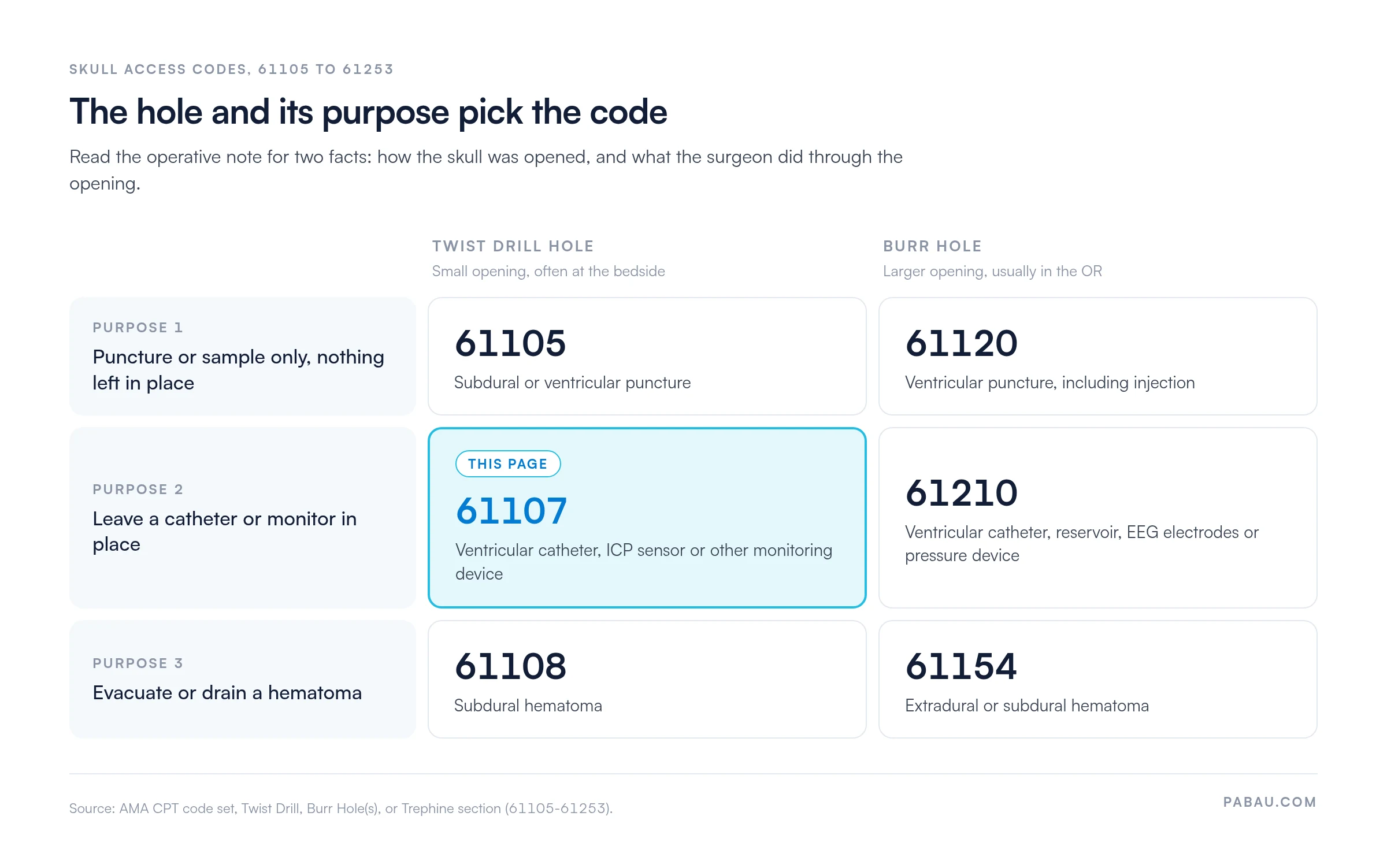
The 61107 versus 61108 mix-up carries the most risk in this family. Both can mean a catheter in the subdural space. The question is whether the catheter is there to monitor or drain CSF (61107) or to evacuate a hematoma (61108).
The operative note must say which. “Subdural drain placed” with no purpose leaves the coder guessing, and the payer will downcode or deny.
Before choosing 61107 or 61108, find the stated purpose of the catheter in the operative note. ‘ICP monitoring,’ ‘ventricular catheter for CSF diversion’ or ‘pressure recording device’ point to 61107. ‘Evacuation of subdural hematoma’ or ‘hematoma drainage’ point to 61108. If the purpose is missing, query the surgeon before coding.
A few add-on codes and modifiers show up in the same episode of care as CPT code 61107. Knowing which ones are separately reportable prevents both underpayment and NCCI edit denials.
Check the current National Correct Coding Initiative (NCCI) edits from CMS before you report companion codes with 61107. The edits change every year and decide which code pairs are mutually exclusive.
Payers judge 61107 claims against the operative note. A note missing the elements below invites a medical necessity denial, downcoding or a recovery request. The clean claim standard applies here, so every element is present before the claim goes out.
Some Medicare Administrative Contractors (MACs) and commercial payers publish Local Coverage Determinations (LCDs) for neurosurgical monitoring. Check your MAC’s LCD for any extra documentation it asks for in your jurisdiction.
Medicare pays CPT code 61107 from the annual Medicare Physician Fee Schedule (MPFS). The CMS Physician Fee Schedule lookup tool publishes the values each year, so confirm them before you quote a figure.
The FastRVU 2026 entry for 61107 lists the values below. At the $33.4009 conversion factor, 8.61 RVUs comes to about $287.58 before geographic adjustment.
Commercial payers set their own rates, often as a percentage of Medicare. Pull the contracted rate from the payer’s fee schedule rather than assuming the MPFS figure.
Most CPT code 61107 denials trace back to one of six causes. A steady denial management workflow catches them before submission.
Mapping medical billing denial codes back to these causes tells your team which fix each 61107 remittance needs.
Run a quarterly audit of your 61107 claims against the operative notes. Check three points: does the note say ‘twist drill hole’ or ‘burr hole’, is the device type named, and is the catheter’s purpose stated? These checks resolve most preventable 61107 denials before they reach the payer.
Prior authorization for CPT code 61107 varies by payer and by MAC jurisdiction. No single rule covers every commercial or Medicare plan.
Original Medicare doesn’t usually require prior authorization for inpatient neurosurgical procedures like 61107. Medical necessity is judged in claims review instead. Medicare Advantage plans often do require it, so check the plan before scheduling.
Practices billing 61107 for traumatic brain injury or hydrocephalus should review medical billing fundamentals with the billing team. Payer documentation expectations are where most of these claims succeed or stall.
Run through these points with the operative note open. Each one maps to a denial reason above.
Many neurosurgery billing teams still key 61107 claims by hand and chase remittances in a separate portal. A coding error then shows up weeks later as a denial nobody links back to the note.
Pabau, the practice management and billing platform we build, sends claims electronically through its Claim.MD integration. It supports 837P submission, eligibility checks and ERA/835 remittances for Medicare and commercial payers.
Pabau’s denial-tracking claims management tracks claim status and denial reasons from submission through payment. Your team sees which 61107 claims stalled and why, while the operative note is still easy to pull.

Pabau links your documentation to electronic claim submission, eligibility checks and payment posting. Track claim status and denial reasons for codes like 61107 in one place.

CPT code 61107 rewards a coder who reads the operative note for two facts: the opening and what stayed behind. Get those right and the code almost picks itself.
The trade-off is speed against certainty. Querying the surgeon about a vague “subdural drain” costs a day, while a denied claim costs weeks. Build that query into your workflow and 61105, 61108 and 61210 stop being traps.
Book a demo to see how Pabau tracks claim status and denial reasons from submission through payment.

Need a clearinghouse integration for neurosurgery claims? Claim.MD clearinghouse overview explains how Pabau’s integration handles 837P submission, ERA processing and payer enrollment for specialty practices.
Confused about which denial code is appearing on your remittance? Electronic remittance advice explained covers how to read ERA files and map CARC codes back to specific claim fixes.
Looking for a credentialing resource before billing Medicare for neurosurgery? Insurance credentialing guide walks through the enrollment steps for Medicare and commercial payers.
They describe one setup from two angles. A ventriculostomy is the opening and the catheter placed into a ventricle. An external ventricular drain is that catheter connected to an outside collection and monitoring system.
No. 61107 is a standalone primary procedure code. When the catheter is placed with neuroendoscopic guidance, the add-on code +62160 is reported alongside it.
No. 61107 only covers access through the skull. Draining CSF through a needle or catheter in the lower spine is reported with the spinal puncture code 62272.
Common pairings include hydrocephalus codes in G91 and traumatic intracranial injury codes in S06, such as S06.4- epidural and S06.5- subdural hemorrhage. G93.6 cerebral edema is another. Check your MAC and payer policies for the accepted list.
In 2026, 61107 carries 8.61 total RVUs. At the $33.4009 conversion factor that is about $287.58 nationally, before geographic adjustment.