

CCSD code G5100: Bypass of duodenum billing guide
CCSD code G5100 bills a bypass that leaves the duodenum in place CCSD code G5100...

Last Updated: Oct 16, 2026
62272 is the CPT code for spinal puncture, therapeutic, for drainage of cerebrospinal fluid (by needle or catheter). It covers removing CSF to lower pressure or volume, usually at a lumbar level, and the code has no imaging component.
A diagnostic lumbar puncture is reported with 62270 instead. When fluoroscopy or CT guides a therapeutic drainage, report 62329, which includes the imaging. That leaves 62272 for drainage done without image guidance, such as in idiopathic intracranial hypertension or normal pressure hydrocephalus.
Let Pabau's smart automation suggest the right codes, reduce claim denials, and keep your practice compliant—effortlessly.
Automate repetitive tasks and focus on what matters most—your patients.
Reduce coding errors and ensure compliance with the latest regulations.
Clean claims, fewer denials, and faster reimbursements.
Powerful insights and reporting to help your practice thrive.
HIPAA compliant SOC 2 certified GDPR-compliant Trusted by 4,000+ clinics worldwide

CPT code 62272 reports a therapeutic spinal puncture that drains cerebrospinal fluid by needle or catheter, and the code carries no imaging component.
A diagnostic lumbar puncture is 62270, so the purpose recorded in the procedure note decides between the two codes.
When fluoroscopy or CT guides the drainage, report 62329 instead, because that code already includes the imaging.
In 2026, Medicare’s national rate for 62272 is $217.85 non-facility and $85.26 facility at the qualifying APM conversion factor.
Pabau’s practice software submits claims through Claim.MD and tracks eligibility and ERA remittance, so your team can follow each 62272 claim to payment.
CPT code 62272 describes a spinal puncture, therapeutic, for drainage of cerebrospinal fluid (by needle or catheter). The provider removes CSF from the subarachnoid space, usually at a lumbar level, to lower pressure or volume. The code describes the drainage alone. It has no imaging component, and its purpose is treatment rather than sampling.
The same needle technique can be diagnostic or therapeutic, and CPT gives each purpose its own code. Guidance with fluoroscopy or CT moves the service to a different code again.
62272 sits in the Surgery section of the CPT code set, under Nervous System. Within it, the code falls in the injection, drainage, or aspiration range for the spine and spinal cord (62263-62329). It is a standalone code with a 0-day global period. The American Medical Association’s CPT code set overview explains how the AMA maintains these descriptors.
The patient lies in lateral decubitus or sits with the spine flexed. The provider identifies the interspace, usually L3-L4 or L4-L5, and enters the subarachnoid space with a spinal needle. Opening pressure is often measured before fluid is removed.
The provider then drains a planned volume of CSF and records the closing pressure where it was measured. Because the descriptor reads “by needle or catheter,” drainage through a catheter is reported with the same code. Some fluid may still go to the lab, but the documented reason for the puncture stays therapeutic.
Two questions pick the code: was the puncture diagnostic or therapeutic, and did fluoroscopy or CT guide it? CPT 62270 is a diagnostic lumbar puncture without that guidance. CPT 62272 is a therapeutic drainage without it. Image-guided punctures move to 62328 and 62329, and those two codes include the imaging.
Work RVUs come from the CMS 2026 PFS relative value file, October release.
The practical rule is to read the indication first and the imaging second. A tap to relieve raised pressure in idiopathic intracranial hypertension is 62272 when no fluoroscopy or CT was used. The same drainage under fluoroscopy is 62329. A tap to look for meningitis is diagnostic, so it belongs to 62270 or 62328. The grid below puts both questions side by side.
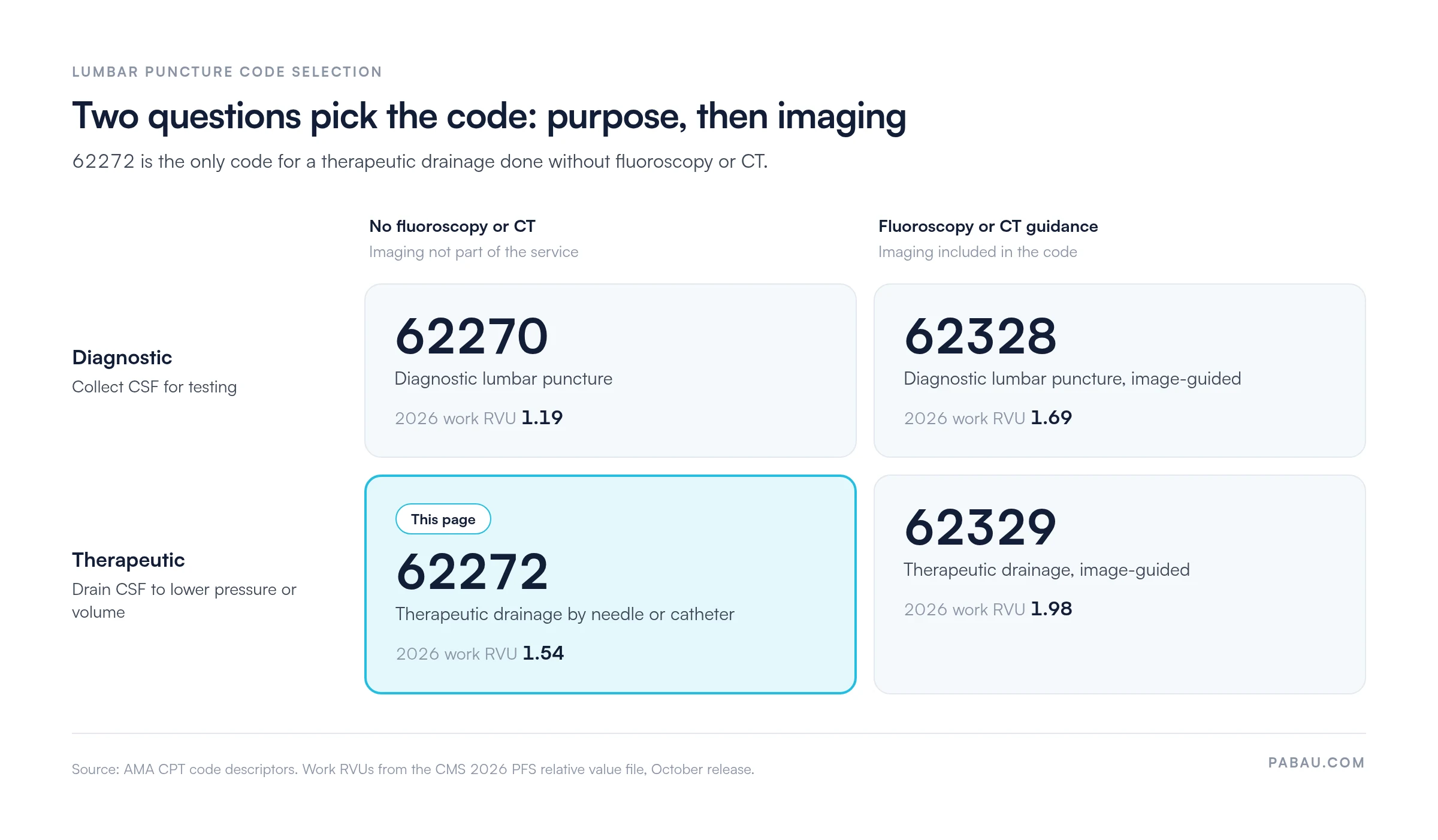
62272 pays for the drainage itself. Knowing what sits inside the code, and what moves to another code, prevents both unbundling and the wrong-code denials that follow.
Sedation or general anesthesia from a separate anesthesia provider is not part of 62272 either. That provider reports the service with 00635.
When fluoroscopy or CT guides a therapeutic drainage, the correct code is 62329, not 62272 plus a guidance code. 62329 includes the imaging, so 77003 or 77012 is not added for that guidance. Check the current quarter’s NCCI edits before you combine 62272 with any other code on the same date.
Medical necessity for 62272 rests on a diagnosis that explains why CSF had to be removed. The strongest pairings are conditions where raised pressure or excess fluid is the problem being treated.
Codes and titles match the FY2026 ICD-10-CM code set from CMS. Obstructive hydrocephalus (G91.1) is left off the list on purpose. Lumbar drainage is generally avoided when CSF flow is blocked, so payers will question that pairing.
A vague code such as R51.9 (headache, unspecified) does not explain why fluid was drained. Link the specific condition that the drainage treats.
A clean 62272 claim starts with a procedure note that shows the drainage was therapeutic. If the note reads like a diagnostic tap, a payer can recode the claim to 62270 or deny it. Following clean claim requirements from the start removes most post-submission rework.
The procedure note should record these elements:
Medicare pays 62272 at different rates in facility and non-facility settings, because the practice expense RVU changes with the setting. The figures below come from the CMS 2026 PFS relative value file, October release. For 2026, CMS set two conversion factors: $33.5675 for qualifying APM participants and $33.4009 for everyone else.
Each payment is the total RVU multiplied by the conversion factor, before the locality adjustment. Confirm your local rate in the CMS Physician Fee Schedule Look-Up Tool. Commercial rates are negotiated separately.
When the ERA remittance arrives, compare the paid amount against your locality rate to catch underpayments early.
Prior authorization rules for 62272 depend on the payer, so check the patient’s plan before an elective drainage. Write that check into your billing compliance protocols so it happens at scheduling for every elective case.
Urgent drainage, such as rapidly worsening vision in intracranial hypertension, often goes ahead before authorization. Record the urgency in the note and follow the plan’s retro-authorization process.
Denials on 62272 follow a predictable set of patterns. Each one has a front-end fix, and good denial management workflows apply it before the claim goes out.
Before you submit a 62272 claim, check the note for three things. Look for a therapeutic purpose, no fluoroscopic or CT guidance, and a diagnosis that explains the drainage. If guidance was used, the claim belongs on 62329.
Neurology and interventional practices billing 62272 often track eligibility, claim status and remittances across several payer portals. Pabau connects to Claim.MD, a US medical claims clearinghouse, to submit CMS-1500 and 837P claims.
Through that connection, your team can check a patient’s eligibility before the drainage is scheduled. After submission, Pabau tracks claim status and processes ERA (835) remittances, including the CARC reason codes on any denial. Your billers see why a 62272 claim came back without calling the payer.
Pabau’s medical claims management submits and tracks the claim data your team enters. Code selection and the procedure note stay with your providers and coders, so the documentation checks above still belong in your own pre-bill review.

Pabau submits CPT 62272 claims through Claim.MD, checks eligibility before the procedure, and tracks ERA remittance so your team can follow each claim to payment.

CPT code 62272 is the right code only when the note shows a therapeutic drainage done without fluoroscopy or CT. Get the purpose wrong and the claim belongs on 62270. Add image guidance and it belongs on 62329.
Build that two-question check into your pre-bill review, and pair the claim with a diagnosis that explains why fluid was drained. The trade-off is a few extra lines in each procedure note against a recoded or denied claim. Book a demo to see how Pabau submits and tracks your spinal procedure claims through Claim.MD.

Need to understand denial codes on returned claims? Denial codes in medical billing covers CARC and RARC code meanings and how to act on each.
Want to reduce your overall claim rejection rate? Medical claims clearinghouse guide explains how electronic clearinghouse submission reduces edit errors before claims reach payers.
Verifying patient coverage before scheduling? Insurance eligibility verification walks through real-time eligibility checks and what to confirm before a spinal procedure date.
CPT code 62272 covers a therapeutic spinal puncture to drain cerebrospinal fluid by needle or catheter. It is used to lower CSF pressure or volume, and the code includes no imaging guidance.
CPT 62270 is a diagnostic lumbar puncture, done to collect CSF for testing. CPT 62272 is a therapeutic puncture, done to drain CSF. The documented purpose of the procedure decides which code applies.
Use 62328 for a diagnostic lumbar puncture and 62329 for therapeutic CSF drainage with fluoroscopic or CT guidance. Both codes include the imaging, so 62272 is not reported for an image-guided drainage.
For 2026, 62272 carries 6.49 total RVUs in a non-facility setting and 2.54 in a facility setting. At the $33.5675 qualifying APM conversion factor, that is $217.85 and $85.26 nationally. At the $33.4009 non-qualifying factor, it is $216.77 and $84.84 before locality adjustment.
Traditional Medicare does not generally require prior authorization for 62272. Medicare Advantage, Medicaid and commercial plans set their own rules, so check the patient’s plan before an elective drainage.
Common pairings include G93.2 (benign intracranial hypertension), G91.2 ((idiopathic) normal pressure hydrocephalus), G91.0 (communicating hydrocephalus) and B45.1 (cerebral cryptococcosis). Add H47.11 when papilledema from raised intracranial pressure is documented.
Only when the tap is done to drain fluid. A spinal tap done to collect CSF for testing is 62270, and image-guided taps are 62328 or 62329.



