HCPCS Code Q4185: Cellesta flowable amnion billing guide
HCPCS Code Q4185: definition and official descriptor HCPCS Code Q4185 is the Lev...

Last Updated: Nov 20, 2026
Billable Code Specific Code
62273 is the CPT code for injection of blood or clot patch, epidural. Clinicians bill it for an epidural blood patch, where the patient's own blood is injected into the epidural space to seal a dural leak.
It is most often billed for post-dural puncture headache after a spinal, epidural or lumbar puncture. The claim needs a supporting diagnosis such as G97.1 and a procedure note that records the interspace and the volume injected.
Let Pabau's smart automation suggest the right codes, reduce claim denials, and keep your practice compliant—effortlessly.
Automate repetitive tasks and focus on what matters most—your patients.
Reduce coding errors and ensure compliance with the latest regulations.
Clean claims, fewer denials, and faster reimbursements.
Powerful insights and reporting to help your practice thrive.
HIPAA compliant SOC 2 certified GDPR-compliant Trusted by 4,000+ clinics worldwide

CPT code 62273 reports an epidural blood patch, which seals a dural leak with the patient’s own blood injected into the epidural space.
Post-dural puncture headache is the main indication, and G97.1 (other reaction to spinal and lumbar puncture) is the usual supporting diagnosis code.
62273 is often confused with 62272, 62270 and 64483, but each one describes a different space, substance or purpose.
Medicare lists 62273 with a 0-day global period, and traditional Part B does not routinely require prior authorization for it.
Pabau’s claims management software sends 62273 claims through Claim.MD, checks eligibility first and posts ERA remittances back to the patient record.
CPT code 62273 describes “injection of blood or clot patch, epidural,” the code billed for an epidural blood patch. It belongs to the CPT code set, which the AMA’s CPT Editorial Panel maintains and updates. In the procedure, the clinician draws a small volume of the patient’s own blood and injects it into the epidural space.
The blood clots and seals the dural defect that is leaking cerebrospinal fluid (CSF). An anesthesiologist, pain management physician or interventional pain specialist usually performs it, typically in an outpatient procedure suite.
Check the descriptor above against the CPT edition for your billing year. A claim narrative that drifts from the official wording can trigger a medical-necessity denial.
Post-dural puncture headache (PDPH) is the main clinical reason to bill CPT code 62273. PDPH develops when a needle punctures the dura mater during a lumbar puncture, spinal anesthesia or epidural catheter placement. CSF then leaks through the defect, and intracranial pressure drops. The result is a positional headache that worsens on sitting or standing and eases when the patient lies flat.
Medical necessity is established when conservative management has failed, or when the headache is severe enough to need immediate treatment. Conservative care usually means hydration, caffeine, analgesics and bed rest. Record the failed conservative trial in the encounter note, because payers regularly deny 62273 when it is missing.
Supported ICD-10 diagnosis codes for 62273 claims:
Local Coverage Determinations (LCDs) from Medicare Administrative Contractors (MACs) set which diagnosis codes are covered for spinal injections. Confirm the applicable LCD with your MAC before submitting, because covered lists vary by jurisdiction. Each code above has a full entry in our ICD-10-CM codes library.
The epidural blood patch follows a consistent sequence, and the procedure note must capture each step to support the claim. Missing elements are a common trigger for post-payment audit findings on CPT code 62273.
Before the claim goes out, confirm the note records each of these:
Payers deny claims with no completed note at high rates under medical-necessity review. A template note that lacks procedure-specific detail fares little better.
Audit your 62273 note template before billing. It should record the interspace level, the volume of blood drawn, the volume injected, the patient’s response and the physician attestation. One missing element is enough for a payer to deny on medical necessity grounds.
62273 and 62272 sit next to each other in the spinal procedure code family and are often confused. They describe opposite actions. One injects blood, and the other drains CSF. Selecting the wrong code produces a claim the payer cannot match to the documented procedure.
Both codes involve a spinal needle and both relate to CSF, which is where the confusion starts. The record settles it. If blood was drawn and injected, the code is 62273. If CSF was drained, the code is 62272. Never report both for the same encounter unless a distinct second procedure was documented.
Several neighboring spinal procedure codes are billed alongside or instead of CPT code 62273. The ones billers mix up most are the diagnostic lumbar puncture code 62270 and the epidural steroid injection code 64483. Getting the distinction right avoids downcoding, upcoding audits and NCCI bundling denials.
Two facts in the procedure note separate all four codes: the space the needle reached, and what moved through it.
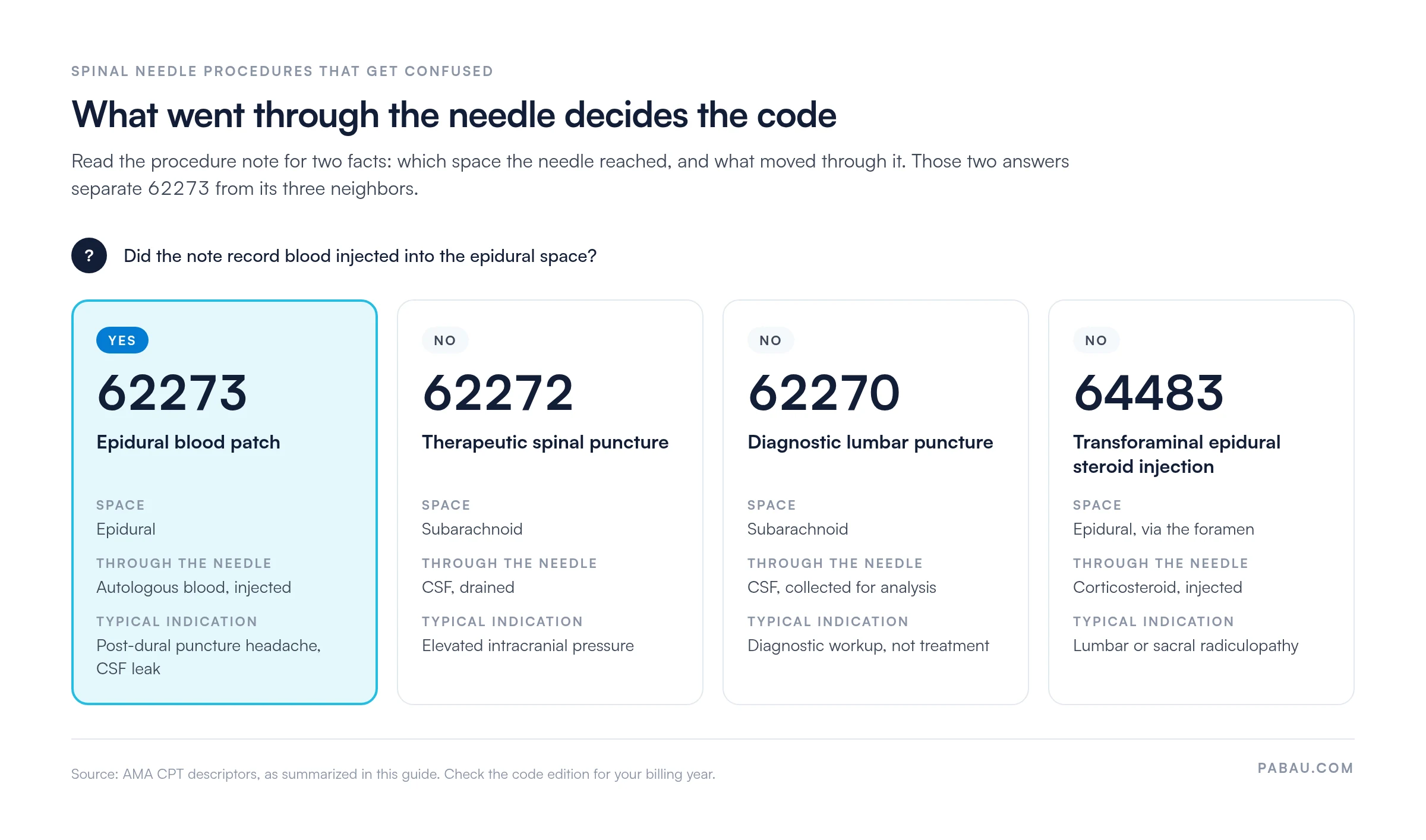
64483 is the code most often misbilled against 62273. Both use an epidural needle, but the approach, the injectate and the indication all differ. 64483 is a transforaminal steroid injection for radiculopathy, while 62273 delivers autologous blood to seal a dural leak.
NCCI edits do not pair 64483 with 62273 as a routine bundle. Billing one when the operative note describes the other is still a false-claims risk. The AAPC Codify CPT lookup and the CMS Physician Fee Schedule search are the two fastest references for confirming code families and payment rates.
Fluoroscopy guidance (CPT 77003) is not routinely billed with CPT code 62273. The epidural blood patch is usually performed without imaging. The needle follows the approach used for the original dural puncture, and the blood spreads broadly through the epidural space. Most MAC LCDs and payer policies do not separately reimburse 77003 reported with 62273.
That said, payer policy on this pairing is not uniform. Before billing 77003 alongside 62273, confirm three things:
Appending 77003 to 62273 without meeting all three criteria invites a denial. In a post-payment audit, it can also be treated as improper billing. When in doubt, describe the imaging in the narrative but do not bill it separately unless the LCD and NCCI table both support it.
Medicare Part B covers CPT code 62273 when medical necessity is documented and an appropriate ICD-10 diagnosis code supports the claim. Coverage still depends on the applicable MAC LCD. A practice billing in the Noridian jurisdiction may face different LCD criteria than one billing under Palmetto GBA or CGS. Check the LCD for your area before assuming coverage.
For the current payment amount, enter 62273 and your locality in the CMS Physician Fee Schedule lookup tool. Rates change with each annual Medicare Physician Fee Schedule update. The FastRVU lookup tool shows the work, practice expense and malpractice RVUs alongside the calculated rate for a locality.
Our guide to how RVUs work explains how those three components combine into a payment. Never rely on a hardcoded dollar figure, and use the live fee schedule for the billing year instead.
Traditional Medicare Part B does not routinely require prior authorization for CPT code 62273. Medicare Advantage plans are different, because each plan sponsor sets its own authorization policy. A patient on an MA plan may need prior auth where traditional Medicare would not.
Commercial payers vary. Some treat the epidural blood patch as a low-risk emergency procedure and waive prior auth. That is most common for an inpatient case after an obstetric or surgical dural puncture. Others apply standard interventional pain management criteria and ask for documentation of:
Verify prior auth requirements with the payer before scheduling when time allows. For an urgent case that cannot wait, document the clinical urgency in the record. Then submit retro-authorization within the payer’s window, typically 24-72 hours after the service.
CPT code 62273 denials cluster around a small set of repeating causes. Fixing each one before the claim goes out removes most of the rework.
Most of these denials start before submission, so the fix is a check at the front of the billing workflow. Remittances help with the rest. Electronic remittance advice returns each denial reason code in a structured format, which makes appeals faster to work.
Five modifier and provider scenarios come up most often when pain management and anesthesiology practices bill 62273.
Storing the CARC denial reason code with the original claim makes denial management faster. Appeal letters can then cite the exact rejection, grouped by code and modifier.
If you bill 62273 with modifier 59 to bypass an NCCI edit, document why the two procedures were distinct before submitting. The modifier alone does not justify it. The supporting documentation is what an auditor reviews if the claim is flagged.
Pain management practices billing CPT code 62273 run into the same three problems. Procedure notes are incomplete at billing time, diagnosis codes don’t support the claim, and bundling errors surface only after submission. Each one costs a resubmission and days of payment delay.
Pabau, the practice management platform we build, keeps the procedure note and the claim in the same patient record. Its claims management software sends CMS-1500/837P claims through the Claim.MD clearinghouse. It also runs eligibility checks before the visit and handles secondary claims.
When the payer responds, ERA remittances post back against the same record. A denied 62273 claim then shows its reason code beside the note that has to support it. Prior authorization codes, dates and sessions are tracked on the patient’s case, with a warning when one is missing.

Pabau’s claims management software sends claims through Claim.MD, checks eligibility and posts ERA remittances to the patient record. Pain management and anesthesiology practices see each denial beside the note behind it.

CPT code 62273 is one of the simpler codes to choose and one of the easier ones to lose on paper. The code itself rarely goes wrong. What goes wrong is a note without the interspace or the volume, or a headache code where G97.1 belonged.
So put the effort into the note template, not into memorizing modifier rules. Build the documentation elements and the failed conservative trial into the template, and check your MAC’s LCD once rather than on every claim. Slow down on fluoroscopy and modifier 59, because both draw audits when the record doesn’t back them.
Book a demo to see how Pabau keeps the procedure note, the claim and the remittance in one record for your pain management team.

Need a clearinghouse for spinal injection claims? Pabau’s Claim.MD clearinghouse guide explains how claims, eligibility checks and remittances move through the clearinghouse.
Looking to understand how denial codes map to corrective actions? Denial codes in medical billing covers CARC and RARC code interpretation for appeal workflows.
Want to see how 837P electronic claims submission reduces rework? 837 file guide explains the HIPAA transaction standard used for professional claim submission.
Managing billing across several providers? Revenue cycle management explained follows a claim from the procedure through to payment posting.
CPT code 62273 covers injection of a blood or clot patch into the epidural space. It is most often used to treat post-dural puncture headache by sealing a dural leak with autologous blood. It does not cover spinal steroid injections, diagnostic lumbar punctures or CSF drainage, which each have their own code.
62273 injects autologous blood into the epidural space to seal a dural leak. 62272 drains cerebrospinal fluid from the subarachnoid space for therapeutic purposes. One injects and the other removes fluid, in different anatomical spaces. Never report both codes for the same encounter.
Medicare pays 62273 from the code’s RVUs, multiplied by the annual conversion factor and adjusted by the Geographic Practice Cost Index for your locality. Rates change each January with the MPFS update. Use the CMS Physician Fee Schedule search tool at cms.gov to find the current rate for your practice location.
Not under traditional Medicare Part B as a routine rule. Medicare Advantage plans and commercial insurers set their own policies, so verify the plan’s requirements before scheduling an elective case. For an urgent procedure, document the clinical urgency and submit retroactive authorization within the payer’s window.
Usually not as a separately paid service, because the procedure is typically performed without imaging. Before billing 77003 with 62273, check for an NCCI bundling edit on the date of service. Your MAC’s LCD must also permit separate imaging billing for this code. The operative note must document why fluoroscopy was medically necessary for that patient.
Yes. The official AMA descriptor for 62273 is “injection of blood or clot patch, epidural,” which describes the procedure performed for post-dural puncture headache. No other CPT code describes an epidural blood patch using autologous whole blood more precisely.
The procedure note must record the interspace level, such as L3-L4, and the volume of autologous blood drawn and injected. It should also document sterile technique, the patient’s response, any early stop and the physician attestation. Link the procedure to a supporting ICD-10 code, preferably G97.1 or G97.0. Claims missing these elements are often denied on medical necessity review.
The diagnostic lumbar puncture code, CPT 62270, describes needle entry into the subarachnoid space to collect CSF for analysis. CPT 62273 describes injecting autologous blood into the epidural space to seal a dural leak. The two procedures have opposite purposes, reach different spaces and are billed in different clinical circumstances.