

CCSD code XR940: Radiology billing guide for UK private practice
CCSD code XR940 is a UK private healthcare radiology procedure code used to bill...

Last Updated: Nov 26, 2026
72240 is the CPT code for myelography, cervical, radiologic supervision and interpretation. It covers the physician's supervision of the contrast study and the reading of the cervical images, while the injection is coded separately.
Referring physicians order it when MRI cannot adequately assess nerve root compression, spinal stenosis or myelopathy. This is common in patients whose implanted hardware creates MRI artifact.
Let Pabau's smart automation suggest the right codes, reduce claim denials, and keep your practice compliant—effortlessly.
Automate repetitive tasks and focus on what matters most—your patients.
Reduce coding errors and ensure compliance with the latest regulations.
Clean claims, fewer denials, and faster reimbursements.
Powerful insights and reporting to help your practice thrive.
HIPAA compliant SOC 2 certified GDPR-compliant Trusted by 4,000+ clinics worldwide

CPT code 72240 covers the radiologic supervision and interpretation of cervical myelography, and the injection is coded separately.
It sits apart from the thoracic (72255), lumbosacral (72265) and two-or-more-region (72270) myelography codes, so the region imaged decides the code.
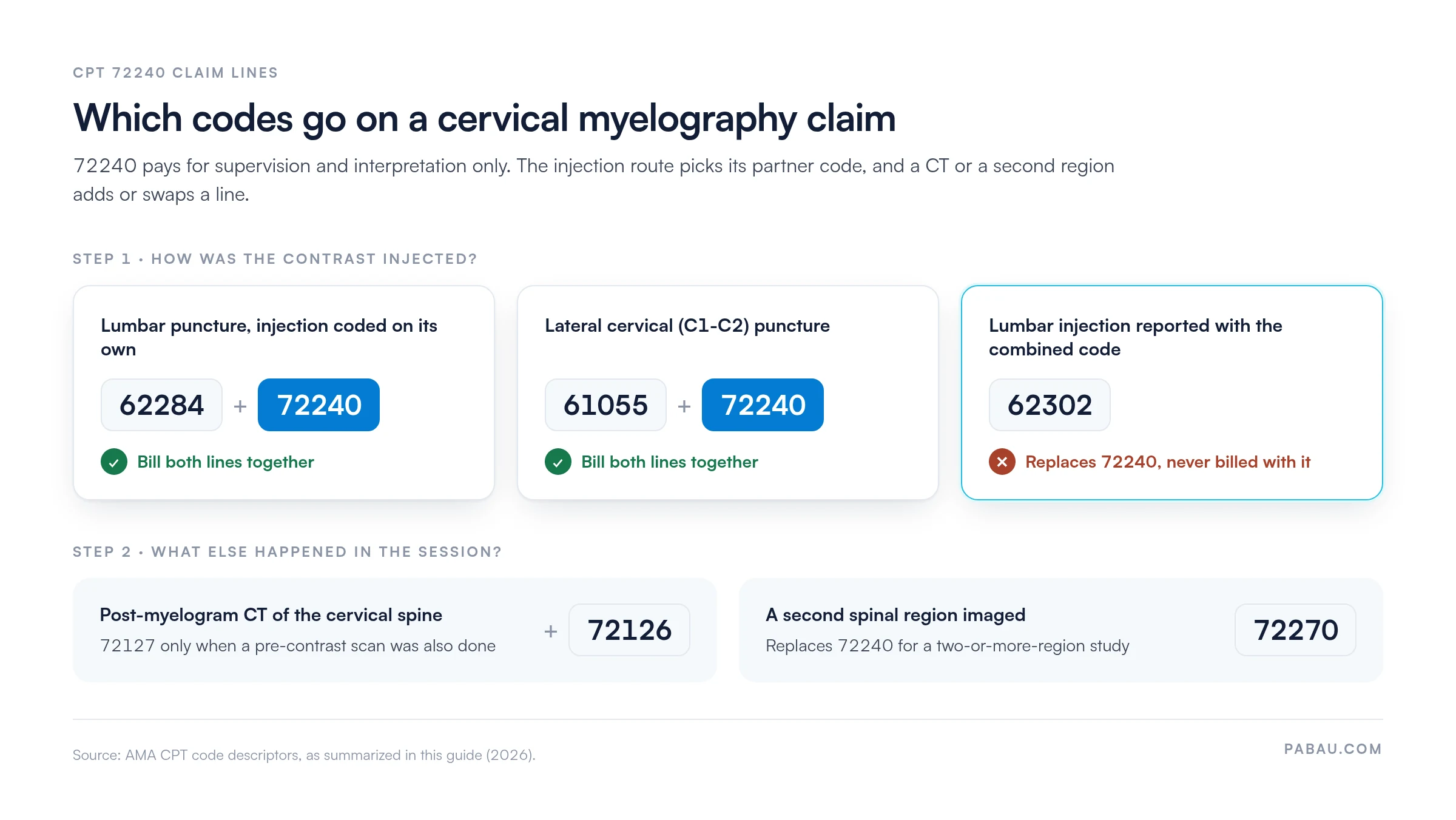
For a lumbar injection, bill 62284 with 72240. Code 62302 already includes the supervision and interpretation, so it is billed instead of 72240, never with it.
A post-myelogram CT of the cervical spine is billed separately on the same date, normally as 72126 because the intrathecal contrast is already in place.
Pabau, a practice management platform with insurance billing, sends 837P claims through Claim.MD, runs eligibility checks and posts ERA remittances. Prior-auth codes sit on the patient’s case, with a warning when one is missing.
CPT code 72240 covers the radiologic supervision and interpretation of a cervical myelogram, which is the imaging half of the procedure. AAPC’s CPT 72240 reference confirms the code represents only imaging supervision and interpretation, so the contrast injection goes on its own line.
The American Medical Association, which publishes the CPT code set, gives the descriptor as “Myelography, cervical, radiologic supervision and interpretation.” The physician supervises the contrast injection into the subarachnoid space and interprets the cervical images. A lumbar injection is reported with 62284, and a C1-C2 puncture with 61055.
A referring physician orders cervical myelography when MRI is contraindicated, as with non-MRI-compatible implants or severe claustrophobia. It is also ordered when MRI fails to show a suspected nerve root or cord compression clearly.
The procedure steps matter to coders for two reasons. The documentation must reflect every step performed, and the injection technique decides which companion code applies.
The procedure note should record each of these steps, especially the contrast type, the injection approach, the number of views and the radiologist’s findings. Auditors look specifically for evidence that the radiologist personally supervised the procedure rather than simply reading static images after the fact.
Bundling errors are a common denial reason for myelography claims. Knowing what 72240 covers prevents two opposite errors. Undercoding misses services that are billed separately, and unbundling bills services the code already includes.
Put together, the injection route decides which line sits next to 72240, and a CT or a second region adds or swaps a line.
The myelography family has four region-specific codes. Picking the code for the wrong region is an easy error to make on spinal imaging claims. The key differentiator is the spinal region examined, not the injection site.
When both the cervical and lumbosacral regions are examined in a single myelography session, 72270 is the correct code. Billing 72240 and 72265 together for a combined study is an unbundling error that triggers both claim denial and potential compliance review.
Post-myelogram CT of the cervical spine is reported separately from CPT 72240, because the two codes describe different studies with different descriptors.
CPT 72240 covers conventional radiographic myelography only. A CT of the cervical spine performed right after the contrast injection, to obtain axial images, is coded on its own line.
That CT is normally reported as 72126, because the intrathecal contrast from the myelogram is already in place. Use 72127 only when a pre-contrast scan is also done, and 72125 only for a separate non-contrast scan.
The common billing error is assuming 72240 encompasses the CT component because it was ordered as part of the same myelography workup. It does not. Bill 72240 for the conventional myelogram and the CT code, usually 72126, on the same date of service. Both should appear on the same claim with the same procedure date.
Always confirm whether your facility performs a post-myelogram CT as a standard protocol. If CT follows every cervical myelogram in your practice, build a charge capture workflow that automatically prompts coders to add 72126 alongside 72240. Missing the CT code on even a few claims leaves revenue unbilled, and the loss compounds in a high-volume radiology practice.
Pairing CPT code 72240 with an ICD-10 code that meets the payer’s local coverage determination is a step the practice controls directly. The diagnosis must reflect the clinical indication for the myelogram, as documented in the referring physician’s note and order.
MAC Local Coverage Determinations vary by jurisdiction. The list above reflects commonly accepted diagnoses across major MACs. Your own MAC (Noridian, Novitas, CGS or another) may have a narrower or broader list.
Always cross-reference your MAC’s active LCD for cervical myelography before submitting claims with less common diagnosis codes. When the order cites cervical radiculopathy, the M54.12 reference explains what that diagnosis covers.
Medicare reimbursement for CPT 72240 is calculated from the Relative Value Unit (RVU) values in the CMS Physician Fee Schedule. The table below shows 2026 national figures at the conversion factor of $33.4009. For 72240 the facility and non-facility totals are the same, and payment still varies by locality.
Payment rates change annually with the Medicare Physician Fee Schedule update. Use the FastRVU lookup tool for current year RVU values by locality. Commercial payer rates are negotiated through payer contracts.
In Pabau, practices send 72240 claims electronically through Claim.MD, which routes them to the payers on Claim.MD’s list. ERA remittances come back into the same system, so payment is tracked from submission to posting.
Prior authorization for CPT code 72240 is not required under traditional Medicare fee-for-service. Many Medicare Advantage plans and commercial payers do require it for myelography, given its complexity and cost.
Assuming the Medicare FFS exemption extends to Medicare Advantage is a frequent billing mistake that leads to denials. Following medical billing compliance protocols for prior auth protects the practice from post-service denials that are hard to reverse.
Documentation typically required for a prior authorization submission includes:
Submit authorization requests at least five to seven business days before the scheduled myelogram date. Urgent cases involving acute myelopathy or progressive neurological deficits typically qualify for expedited review. Document every authorization reference number in the patient’s record and on the claim submission.
Complete documentation is the backbone of a defensible 72240 claim. Auditors specifically look for evidence that the radiologist actively supervised the procedure rather than interpreted pre-existing images. Submitting a clean claim for myelography requires all of the following elements in the patient record.
Denials for CPT code 72240 cluster around predictable patterns. The table below maps each denial reason to the CARC (Claim Adjustment Reason Code) typically returned on the ERA and the corrective action to take. Tracking these patterns in radiology claims software that sorts denials by code cuts the lag between denial and resubmission.

Effective denial management workflows for radiology codes track both the initial denial reason and the outcome of each appeal. Practices that log denial patterns by CARC code spot systemic errors faster than anecdotal review does, such as a coder selecting 72265 for cervical studies.
For a full reference of CARC codes and their fixes, see the guide to medical billing denial codes.
Run a quarterly audit of your 72240 claims. Filter for encounters where a post-myelogram CT was performed, then check that a CT cervical code, usually 72126, was billed on the same date. If the CT code is missing on any of those encounters, your charge capture workflow is not prompting for it.
The denial patterns above share one root cause. The ordering physician, the radiology team and the billing desk each hold part of the record. A 72240 claim then leaves the practice before anyone checks the authorization, the ICD-10 pairing and the documentation together.
Pabau keeps those pieces on one patient case. The prior-auth code, its dates and the authorized sessions are tracked on the case, and Pabau warns the team when the code is missing. That makes it harder for a myelogram to go ahead without authorization.
Claims go out as 837P files through Claim.MD, and the team can run eligibility checks before the visit. ERA remittances come back into the same system, so each denial code lands next to the order and notes it relates to.
Understanding the full revenue cycle management workflow shows where 72240 denials enter the system and which step to fix first.

Pabau sends 837P claims through Claim.MD, runs eligibility checks and posts ERA remittances. Prior-auth codes sit on the patient’s case, with a warning when one is missing.

CPT code 72240 pays for one thing, the supervision and interpretation of the cervical myelogram. Every other part of the encounter needs its own line, so build the claim from the procedure note rather than from the order.
Before submission, check three things. A lumbar injection takes 62284 next to 72240, unless 62302 replaces both. A post-myelogram CT adds 72126. And the diagnosis has to sit on your MAC’s covered list for myelography.
Pabau keeps the prior-auth code on the case and brings remittances back with their denial codes. A wrong pairing then shows up as a pattern you can fix. Book a demo to see how Pabau handles myelography claims for spine and radiology practices.

Need a full reference on claim rejection codes? Denial codes in medical billing maps every CARC code to its corrective action across payer types.
Want to understand how clearinghouse claim routing works? Medical claims clearinghouse guide explains how 837P files are validated and routed to payers.
Looking to tighten your billing compliance program? Medical billing compliance covers the documentation and workflow standards that reduce audit risk on complex imaging codes.
CPT code 72240 covers the radiologic supervision and interpretation of a cervical myelogram, a conventional X-ray study of the cervical spine after intrathecal contrast injection. It does not include the injection itself, which is usually coded as 62284, or any post-myelogram CT, which is billed separately.
CPT 72240 is for cervical myelography (C1-C7 region) and CPT 72255 is for thoracic myelography (T1-T12 region). The code selection is determined by the spinal region being imaged, not the injection site. If both cervical and another region are examined in the same session, bill 72270 instead of both individual codes.
Commonly supported ICD-10 codes include M50.00 (cervical disc disorder with myelopathy) and M48.02 (spinal stenosis, cervical region). M54.12 (radiculopathy, cervical region) and M47.22 (other spondylosis with radiculopathy, cervical region) are also common. The specific list varies by MAC and payer LCD, so verify your MAC’s active Local Coverage Determination before submitting.
Yes, traditional Medicare covers CPT 72240 when medical necessity criteria are met. The claim also needs an ICD-10 code on the MAC’s covered diagnosis list. Medicare Advantage plans may impose additional prior authorization requirements that do not apply under traditional Medicare FFS.
It depends on the payer. Some payers allow separate reporting of fluoroscopy guidance (CPT 77003) alongside 72240. Others bundle it into the myelography code. Check the CCI (Correct Coding Initiative) edits for the specific payer before billing fluoroscopy separately. An unbundling denial returns CARC 97 and cannot be appealed if the payer contract confirms the bundling.
The national Medicare payment for CPT 72240 is approximately $112 (national, 2026 PFS), and the facility and non-facility rates are the same. Rates change each year with the Physician Fee Schedule update and vary by locality. Use the CMS PFS Look-Up Tool or FastRVU for your locality’s current rate.
Yes. A post-myelogram CT of the cervical spine on the same date is billed separately, normally as 72126 because the intrathecal contrast is already in place. Use 72127 only when a pre-contrast scan is also done. Both codes belong on the same claim with the same procedure date.



