ICD-10 code S61.201A: Open wound of left index finger without nail damage
ICD-10 code S61.201A covers a left index finger wound of unstated type ICD-10 co...

Last Updated: Oct 16, 2026
Billable Code Specific Code
G35.D is the billable ICD-10-CM code for multiple sclerosis, unspecified.
Let Pabau's smart automation suggest the right codes, reduce claim denials, and keep your practice compliant—effortlessly.
Automate repetitive tasks and focus on what matters most—your patients.
Reduce coding errors and ensure compliance with the latest regulations.
Clean claims, fewer denials, and faster reimbursements.
Powerful insights and reporting to help your practice thrive.
HIPAA compliant SOC 2 certified GDPR-compliant Trusted by 4,000+ clinics worldwide

ICD-10 code G35.D (multiple sclerosis, unspecified) is a billable FY2026 code effective October 1, 2025, replacing the former catch-all code G35.
Eight billable subcodes now sit under G35: G35.A, G35.B0 through G35.B2, G35.C0 through G35.C2, and G35.D.
Use G35.D only when the record confirms MS but does not document a disease course.
Report companion manifestation codes alongside G35.D when documented: spasticity (R25.2), bladder dysfunction (N31.-), or vision disorders (H53-H54).
Inpatient G35.D claims group to MS-DRG 058, 059, or 060, depending on documented complications and comorbidities.
ICD-10 code G35.D describes multiple sclerosis, unspecified. It is a billable, specific ICD-10-CM code, so it can go to a payer on its own without a more granular subcode. The CDC’s ICD-10-CM tool confirms G35.D became effective October 1, 2025, as part of the FY2026 code cycle. MS NOS (not otherwise specified) is an acceptable approximate synonym in the tabular list.
G35.D sits in the G35-G37 demyelinating disease block, under the G00-G99 nervous system chapter. Its parent category is G35, the former general multiple sclerosis code it now replaces for unspecified presentations.
For years, G35 was a single catch-all code covering every presentation of multiple sclerosis. A neurologist documenting relapsing-remitting MS used G35. So did one documenting primary progressive MS. Payers got no clinical detail about disease course or MS type.
The CMS FY2026 ICD-10-CM update retired G35 as a standalone billable code and expanded it into a family of subcategory codes. Each subcode matches a recognized MS disease course. G35.D holds the residual unspecified category, for records where no specific type is documented. The same push toward specificity runs through the wider set of ICD-10-CM codes that CMS revises each October.
The FY2026 update is the largest expansion of MS-specific ICD-10-CM codes to date. Eight billable subcodes now sit under the G35 parent. Each one targets a distinct disease course, and the two progressive courses add an activity status.
Treat G35.D as the default only when the medical record genuinely cannot support a more specific subcode. The AAPC ICD-10-CM code reference notes that G35.D is new for FY2026 and replaces the former G35 code for unspecified presentations. The naming logic is easier to read as a decision: the letter follows the documented course, and the digit follows activity status.
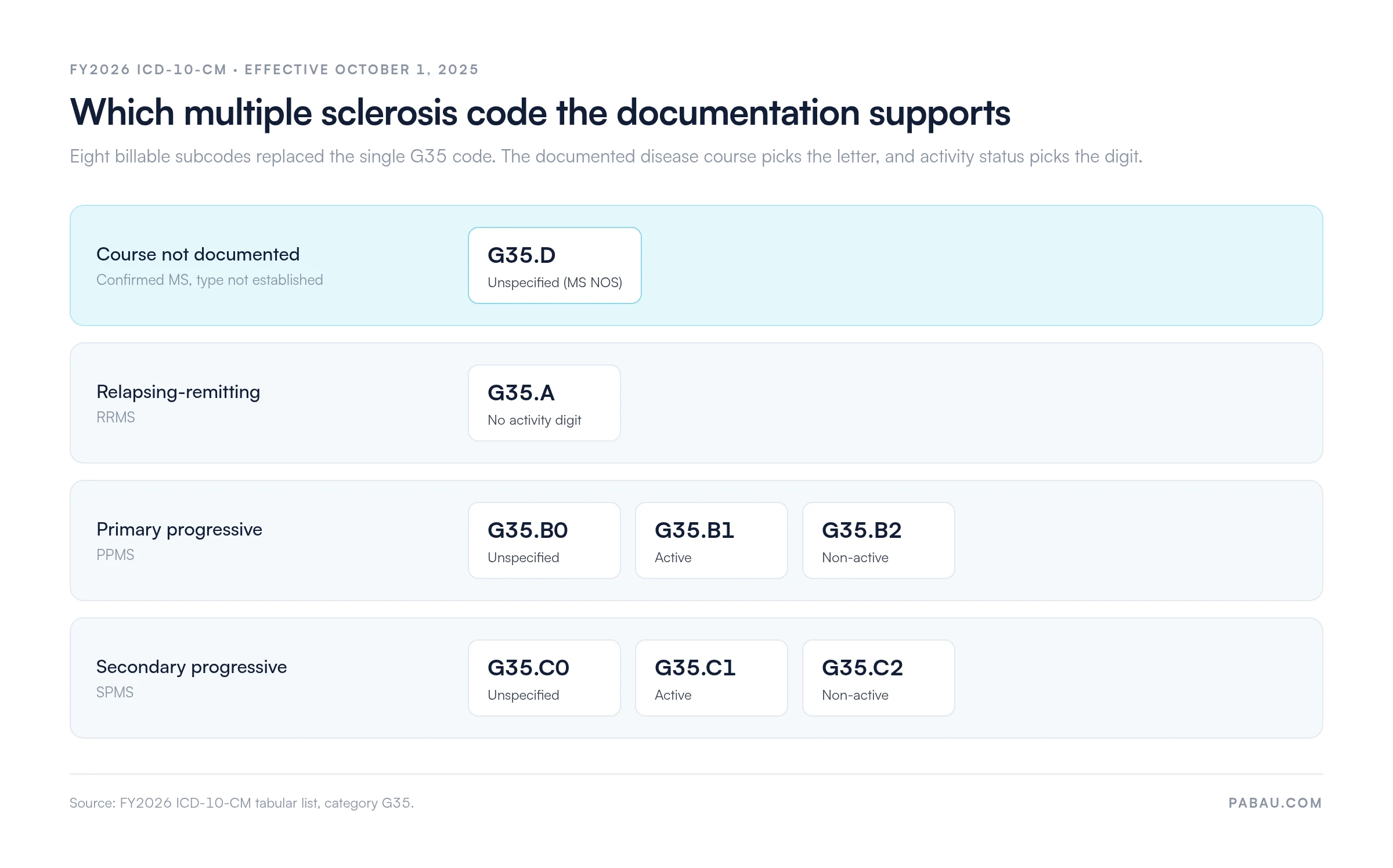
G35.D applies when a confirmed MS diagnosis is on the record but the clinician has not documented a disease course. That happens most often at initial diagnosis, while the neurologist is still watching the clinical pattern. It also happens when a patient transfers care and the prior records are incomplete.
Using G35.D when a specific course is documented and supportable is a coding error. Payers reviewing prior authorization for disease-modifying therapies increasingly want the MS subtype in the diagnosis code. Natalizumab and ocrelizumab requests are the common examples. G35.D on a request for a PPMS-specific therapy often triggers a medical necessity review.
Submitting G35.D without adequate medical record support is an audit risk. ICD-10-CM Official Guidelines require code selection to reflect what the clinician documented, not what the coder inferred. For G35.D, the record must establish three things.
Adding a structured field for MS disease course to the EHR note template keeps this situation rare. When neurologists record the course at every encounter, coders rarely fall back to G35.D after the first few visits.
The CDC ICD-10-CM tabular list instructs coders to report additional codes when certain MS manifestations are clinically present. These companion codes show payers the patient’s full disease burden and support medical necessity for associated treatments. Leaving them off a claim when they are documented understates the case.
Comorbid conditions that often accompany MS, such as depression or anxiety, also belong on the claim when documented. The G35.D tabular entry does not list them under a use additional code instruction. Coding them anyway is correct ICD-10-CM practice and gives payers and care coordinators a fuller clinical picture.
The G35-G37 demyelinating disease block carries no Excludes1 notes that bear on G35.D directly. Coders should still check the FY2026 tabular list for Excludes2 notes that apply in specific scenarios. Neuromyelitis optica (Devic’s disease) and acute disseminated encephalomyelitis sit in adjacent code ranges. Where the documentation describes one of those as a distinct condition rather than an MS manifestation, code it separately.
G35.D works as a principal or a secondary diagnosis, depending on the encounter type. In outpatient settings, code the condition chiefly responsible for the visit. In inpatient settings, follow the Uniform Hospital Discharge Data Set rules for principal diagnosis selection.
On inpatient claims, G35.D groups to the multiple sclerosis and cerebellar ataxia DRGs under the FY2026 grouper, version 43.1. Which of the three applies depends on documented complications or comorbidities. Note that v43.1 is the grouper version, not a DRG number.
| MS-DRG | Title | Severity |
|---|---|---|
| 058 | Multiple sclerosis and cerebellar ataxia | With MCC |
| 059 | Multiple sclerosis and cerebellar ataxia | With CC |
| 060 | Multiple sclerosis and cerebellar ataxia | Without CC/MCC |
Verify the assignment against the CMS MS-DRG v43.1 Definitions Manual before you rely on it. Relative weights and payment rates change every fiscal year, so a dollar figure quoted without a current CMS source is not one to bill against.
Submitting G35.D claims through a clearinghouse that validates ICD-10-CM codes against current payer edits cuts rejection risk. Practice management software like Pabau builds that check into its claims management software. Billing teams see the payer edit and fix a G35.D sequencing error before the claim goes out. Remittance data posts back after adjudication, so the team reconciles G35.D payments without parsing an 835 file by hand.

Payer prior authorization (PA) systems now recognize G35.D in place of the retired G35. Most major commercial insurers want one of the specific G35 subcodes when they process PA for disease-modifying therapies. Submitting G35.D for a drug whose label is tied to one MS type, such as ocrelizumab for PPMS, often triggers an automated medical necessity review.
Billing teams should note three practical workflow adjustments.
Coding teams and neurologists who relied on a G35 favorites-list shortcut need to act before legacy templates generate the wrong code. Most EHR systems do not auto-update diagnosis picklists when CMS publishes new codes. Five steps close the loop.
A platform that links clinical documentation directly to claim generation makes this kind of transition cheaper. The code change propagates once, instead of being re-entered in each disconnected system.
Most neurology billing teams work the FY2026 transition by hand. The coder reads the note for a documented disease course, looks up the matching subcode, then trusts that the EHR picklist was updated. When it was not, G35.D goes out on a claim that could have carried G35.A.
Pabau keeps the clinical note, the diagnosis code, and the claim on one patient record. Claims leave through an integrated clearinghouse that checks each ICD-10-CM code against current payer edits first. Remittance advice posts back automatically, so the team reconciles G35.D payments without opening an 835 file.
The result is fewer avoidable denials on MS claims, and a shorter path from a returned claim back to the note that caused it.

Pabau connects clinical documentation, claim submission, and remittance reconciliation in one platform. See how neurology and specialty practices cut coding errors and get paid faster on MS claims.

The FY2026 change is a documentation problem as much as a coding one. G35.D is the right code for a genuinely unspecified presentation. It becomes a liability when the neurologist had the clinical detail to support G35.A, G35.B1, or G35.C1 and the template never asked for it.
So the work sits with the picklist and the note template, not with the coder. Fix those two and G35.D shows up only where it belongs. Book a demo to see how Pabau keeps MS documentation and claim coding on the same record.

Need the workflow behind an MS therapy request? The prior authorization process explains how to build and track a request before the payer reviews it.
Tracking denials by diagnosis code? Denial management in healthcare covers the workflows for logging, appealing, and reducing payer denials.
Want to know what makes a claim clean? Clean claim lists the fields payers check before they accept a submission.
Reconciling payments after adjudication? Electronic remittance advice explains how 835 data posts back against the original claim.
Need the wider billing picture? What is revenue cycle management connects diagnostic coding to claim generation, adjudication, and payment posting.
ICD-10 code G35.D is the FY2026 ICD-10-CM diagnosis code for Multiple sclerosis, unspecified. It applies when a clinician has confirmed a multiple sclerosis diagnosis but has not documented a specific disease course. That covers relapsing-remitting, primary progressive, and secondary progressive MS. The code is also recognized under the alternate description “MS NOS.”
Yes, G35.D is a billable, specific ICD-10-CM code that can be submitted directly to payers for reimbursement. It does not require a more granular seventh character or additional subcode to be valid for claim submission. It became effective October 1, 2025, as part of the FY2026 ICD-10-CM update.
The CDC ICD-10-CM FY2026 tabular list calls for additional codes when certain manifestations are documented. Report spasticity (R25.2), bladder dysfunction (N31.-), and vision disorders (H53-H54). Comorbid conditions such as depression or anxiety should also be coded separately when documented, following standard ICD-10-CM sequencing guidelines.
Yes. G35.D groups to MS-DRG 058, 059, or 060, all titled Multiple sclerosis and cerebellar ataxia, under the FY2026 grouper version 43.1. Which one applies depends on documented complications or comorbidities (CC or MCC). Verify the assignment against the CMS MS-DRG v43.1 Definitions Manual, since relative weights change each fiscal year.