CPT Code 69610: Tympanic membrane patch repair (myringoplasty)
CPT code 69610: official descriptor and procedure overview CPT code 69610 descri...

Last Updated: Oct 19, 2026
62284 is the CPT code for an injection procedure for myelography and/or computed tomography, lumbar. It covers placing a needle in the lumbar subarachnoid space and injecting contrast for a myelogram, a CT myelogram, or both.
The imaging study that follows is coded separately. When one provider performs the injection and also interprets a conventional myelogram, the combined codes 62302-62305 replace 62284.
Let Pabau's smart automation suggest the right codes, reduce claim denials, and keep your practice compliant—effortlessly.
Automate repetitive tasks and focus on what matters most—your patients.
Reduce coding errors and ensure compliance with the latest regulations.
Clean claims, fewer denials, and faster reimbursements.
Powerful insights and reporting to help your practice thrive.
HIPAA compliant SOC 2 certified GDPR-compliant Trusted by 4,000+ clinics worldwide

CPT Code 62284 covers the intrathecal contrast injection for lumbar myelography or CT myelography only, not the radiologic imaging component.
Report 62284 when a different provider bills the myelography S&I (72265), and report 77003 guidance separately when documented, subject to NCCI edits.
When one provider performs the injection and also interprets the myelogram, report 62302-62305 instead of 62284 plus 72265.
The most common denial triggers are missing ICD-10 medical necessity linkage, incorrect modifier usage, and bundling conflicts with guidance codes.
Pabau’s claims management software runs eligibility checks, submits 62284 claims electronically and tracks each claim’s status through to payment.
The American Medical Association (AMA) defines CPT Code 62284 as Injection procedure for myelography and/or computed tomography, lumbar. The code covers one procedural component, the intrathecal injection of contrast medium at the lumbar level. That contrast may serve a conventional myelogram, a CT myelogram, or both in the same session.
The procedure is performed in radiology, interventional radiology, or neurology settings. A practitioner inserts a spinal needle into the subarachnoid space, confirms positioning with fluoroscopy, and injects iodinated contrast. Imaging follows separately. The AMA CPT code set assigns 62284 to the surgery section, subsection nervous system. That placement reflects the invasive injection, while the diagnostic imaging that follows is coded in radiology.
Key clinical facts for coders:
Bundling errors are a frequent cause of 62284 rejections. Knowing exactly what the code bundles prevents both over-coding and under-billing.
National Correct Coding Initiative (NCCI) edits govern which companion codes can and cannot be billed together. Verify the current NCCI tables before submitting 77003 alongside 62284, because edit versions update quarterly. Submitting a clean claim from the start means checking these edits before the encounter closes. Waiting for the remittance means waiting for the denial.
Payers judge a 62284 claim largely on the procedural note. They need to confirm the procedure was medically necessary, performed as described, and billed to the correct code. The operative or procedural note must reflect each step of the injection process.
A superbill that captures all billed codes at the time of service reduces the risk of omitting companion codes or selecting the wrong modifier. Practices using integrated billing workflows can build 62284 encounter templates that auto-populate required fields and flag missing documentation before submission.
CPT Code 62284 and CPT Code 62323 are the two lumbar spine injection codes coders confuse most often. Both put a needle in at the lumbar level, but they describe different procedures with different indications, substances and imaging companions. 62323 is an interlaminar epidural injection at the lumbar or sacral (caudal) level with imaging guidance. Its counterpart without imaging is 62322.
Using 62323 when the patient had a contrast injection for myelography is a coding error. If it results in higher payment, it can constitute a false claim. The distinction is diagnostic versus therapeutic, and 62284 is always diagnostic imaging preparation.
CPT Code 62284 rarely stands alone on a claim. The injection code pairs with imaging and, where documented, with fluoroscopic guidance. Who interprets the study matters too, because one provider doing both parts reports a combined code instead. The decision guide below maps each scenario to the codes that belong on the claim.
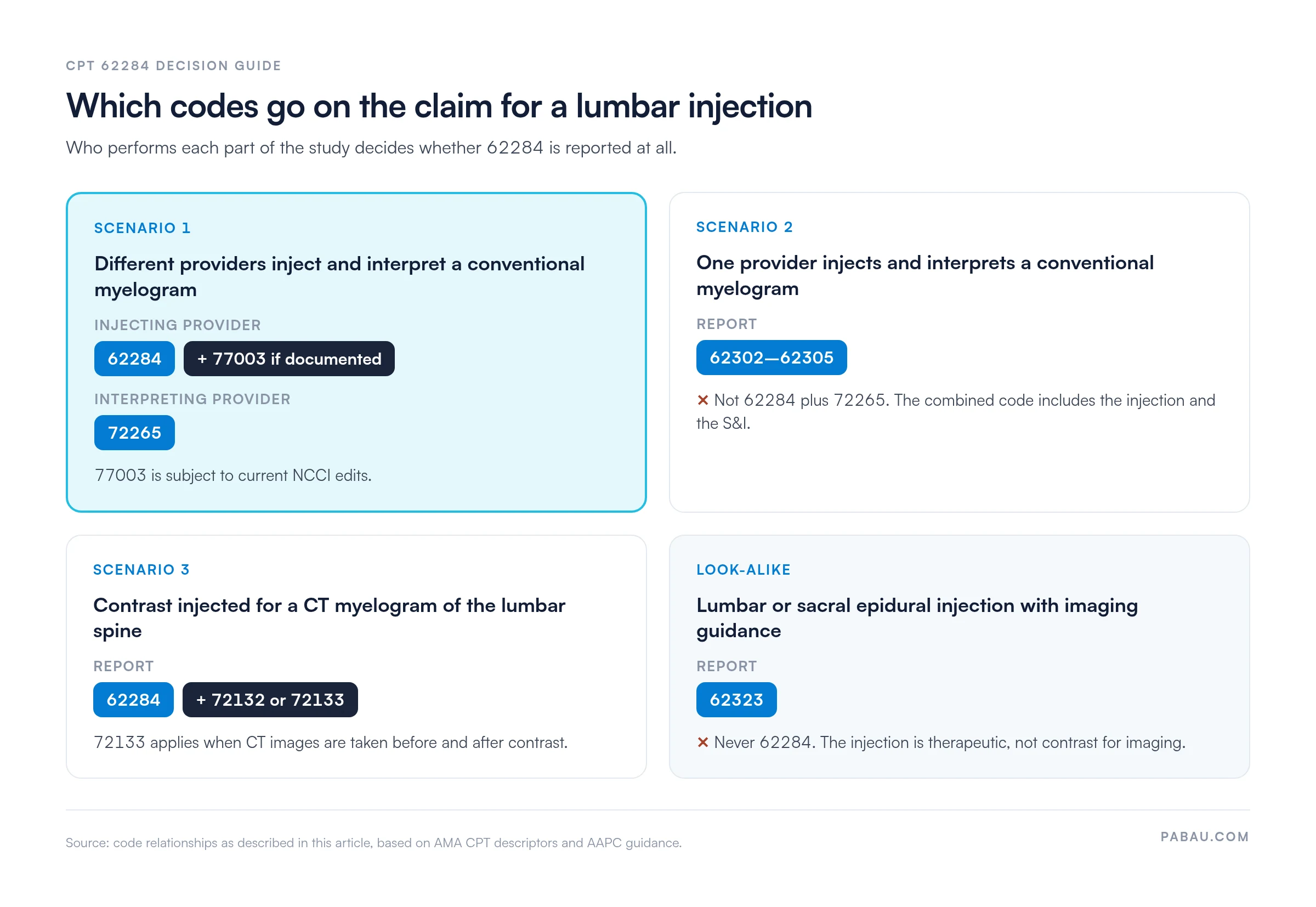
The table lists each companion code and how it relates to 62284.
For facility billing, the facility bills the technical component (TC) of imaging codes. The interpreting radiologist or neurologist bills the professional component with modifier 26. Check the PC/TC indicator for 62284 in the current CMS Physician Fee Schedule before splitting the injection code by component. For neighboring spine codes, browse our CPT codes library.
Check the NCCI Procedure-to-Procedure (PTP) edit table quarterly before billing 62284 with guidance codes. NCCI edits update four times per year. A guidance code that passed without a modifier six months ago may now require modifier 59 or be fully bundled. Build a quarterly edit review into your compliance calendar.
Modifier selection for CPT Code 62284 depends on the billing setting (facility versus physician office) and payer rules. It also depends on whether guidance codes are on the same claim. The table below covers the modifiers most commonly applied to this code.
Medicare modifier rules may differ from commercial payer rules. Before attaching a modifier to CPT Code 62284 on a Medicare claim, confirm the guidance in the applicable Local Coverage Determination (LCD) or payer contract.
Medicare pays for CPT Code 62284 under the Physician Fee Schedule (PFS) using the Resource-Based Relative Value Scale (RBRVS). Reimbursement figures change annually when CMS publishes the updated fee schedule. The table lists the components that make up the payment. Look up 62284’s current RVUs, conversion factor and GPCI in the CMS Physician Fee Schedule lookup tool before billing.
For quick RVU lookups, FastRVU’s 2026 RVU lookup tool pulls current CMS data by code and locality. Medicare reimbursement for CPT Code 62284 varies by location and service setting. Use the CMS lookup directly rather than national averages published in third-party references.
Every CPT 62284 claim requires at least one ICD-10-CM diagnosis code that establishes medical necessity for the lumbar myelography injection. The diagnosis code must reflect the clinical indication documented in the procedural note. No ICD-10 code automatically qualifies a claim. Clinical findings in the note must support it.
Myelography is typically ordered when MRI is contraindicated (pacemaker, retained metallic foreign body) or when MRI findings are inconclusive for surgical planning. The documentation must explain why myelography was chosen over or in addition to MRI. This explanation directly supports medical necessity and reduces the risk of a coverage denial.
Prior authorization requirements for CPT Code 62284 vary by payer and by Medicare Administrative Contractor (MAC) region. Medicare generally does not require prior authorization for myelography procedures, but commercial insurers commonly do.
Practices billing CPT Code 62284 for commercial or Medicare Advantage patients should build insurance eligibility verification and authorization checks into scheduling. Leaving them to the day of the procedure is a leading source of avoidable denials on this code. Pabau, the practice management platform we build, connects to the Claim.MD clearinghouse, which supports eligibility checks, electronic claim submission and claim-status tracking.
Most CPT Code 62284 denials fall into five categories. Each is preventable with correct coding practice and pre-submission review.
Effective denial management for CPT Code 62284 means tracking claim adjustment reason codes (CARCs) to spot patterns across claims. A practice seeing repeated CARC 4 (inconsistent or missing modifier) should audit its modifier selection protocol. Repeated CARC 50 (non-covered service) denials suggest the notes are not documenting medical necessity.
Integrated claims management software lets practices filter denials by reason code and track them through appeal. The AAPC CPT code reference adds guidance on bundling rules and modifier use for spinal injection codes.

Run a quarterly audit of 62284 claims sorted by denial reason code. If CARC 4 (modifier inconsistency) appears more than twice, your modifier selection protocol needs review. If CARC 50 (non-covered service) appears, pull the corresponding MAC LCD and compare the ICD-10 codes being submitted against the covered diagnosis list. Both are fixable with a process change, not an appeal.
Medical billing compliance for CPT Code 62284 means coding the procedure exactly as it was performed and documented. It also means choosing the correct modifiers and billing only services that meet payer coverage criteria. Practices performing lumbar myelography should keep written coding policies on the 62284-vs-62323 distinction, modifier rules and documentation requirements.
The medical billing compliance framework for spine procedures includes regular internal audits, coder education on NCCI updates, and a defined denial appeal process. Practices using electronic health record systems should verify that their charge capture workflows reflect current CPT descriptors. Outdated superbill templates that still reference retired codes or bundling rules create compliance exposure that often goes unnoticed.
Without a connected billing system, the front desk checks eligibility on a payer portal, keys each claim by hand and chases its status by phone. Every handoff is a chance to drop the 77003 line or lose track of an authorization.
In Pabau, eligibility checks, electronic claim submission and claim-status tracking run through Claim.MD from the same system that holds the patient record. Your coder still selects the codes, and Pabau sends the claim and reports back where it stands.
You see every 62284 claim from submission to payment, so a rejected claim gets corrected while the appeal window is still open.

Pabau connects with Claim.MD for eligibility checks, electronic claim submission for codes like 62284, and claim-status tracking. See how it works for spine care and imaging practices.

Settle who did what before you pick a code. If a different provider interprets the myelogram, 62284 goes on the injector’s claim, with 77003 where guidance is documented. If one provider does both, 62302-62305 replaces the pair.
Then read the note for injection space and substance before choosing between 62284 and 62323. Confirm authorization while the study is being scheduled, not on the day. A few minutes of coder review per claim costs far less than weeks spent on appeals.
Book a demo to see how Pabau’s eligibility checks and claim-status tracking keep spine and imaging claims moving.

Need to understand how claims move through a clearinghouse? Medical claims clearinghouse guide explains how electronic claims are validated, scrubbed, and routed to payers.
Want to reduce denial rates across all your procedure codes? Understanding the 837 file covers the electronic transaction format that carries CPT codes and modifiers to payers.
Looking for ERA and remittance advice workflows? Electronic remittance advice explains how to read 835 remittance files and match denial reason codes to 62284 claims.
CPT Code 62284 is the procedure code for injecting intrathecal contrast medium at the lumbar level. The injection prepares for myelography and/or computed tomography (CT) myelography. It covers needle or catheter introduction and contrast delivery only. The imaging study that follows is billed separately, and one provider who also interprets a conventional myelogram reports 62302-62305 instead.
Modifier 26 (professional component) and TC (technical component) may apply when the injection is billed split between physician and facility. Verify the CMS PC/TC indicator for 62284 first. Modifier 59 bypasses applicable NCCI bundling edits when a guidance code is billed alongside 62284 and the services are separately documented. Modifier 51 is rarely needed, and LT/RT laterality modifiers do not typically apply to this midline procedure.
No. A lumbar puncture (diagnostic or therapeutic) is coded separately, typically with CPT 62270 (spinal puncture, lumbar, diagnostic) or 62272 (therapeutic). CPT 62284 is specifically for the intrathecal contrast injection that precedes a myelography or CT myelogram imaging study, not for CSF sampling or pressure measurement.
The procedural note must document patient positioning, fluoroscopic localization of the lumbar interspace, and the needle gauge and interspace selected. It must confirm subarachnoid position by CSF return and record the contrast agent name and volume injected. It must also state the clinical indication linking the procedure to the ICD-10-CM diagnosis on the claim. Missing any of these elements is a documented basis for payer denial or post-payment audit.