

CPT Code 30801: Superficial turbinate ablation billing guide
CPT Code 30801: Official descriptor and procedure overview The American Medical ...

Last Updated: Nov 27, 2026
47382 is the CPT code for percutaneous radiofrequency ablation of one or more liver tumors. The physician places a needle electrode through the skin under imaging and heats each tumor until its cells die. You report it once per session, however many tumors are treated.
Imaging guidance goes on its own line with 76940, 77013 or 77022. The approach decides the code, so open RF ablation is 47380 and laparoscopic RF ablation is 47370. Percutaneous cryoablation is 47383. Most denials trace back to the wrong approach, a missing guidance code or unmet medical necessity criteria.
Let Pabau's smart automation suggest the right codes, reduce claim denials, and keep your practice compliant—effortlessly.
Automate repetitive tasks and focus on what matters most—your patients.
Reduce coding errors and ensure compliance with the latest regulations.
Clean claims, fewer denials, and faster reimbursements.
Powerful insights and reporting to help your practice thrive.
HIPAA compliant SOC 2 certified GDPR-compliant Trusted by 4,000+ clinics worldwide

CPT code 47382 covers percutaneous radiofrequency ablation of one or more liver tumors, reported once per session.
Open RF ablation is 47380, laparoscopic is 47370 and percutaneous cryoablation is 47383, so the approach in the operative note decides the code.
Imaging guidance is billed on its own line with 76940, 77013 or 77022, and modifiers 26 and TC belong on those codes, not on 47382.
Medicare gives 47382 a 10-day global period and pays about $3,430 non-facility and $641 facility nationally in 2026.
Pabau, a practice management platform, tracks prior authorization on the case, warns when it’s missing and sends US claims through Claim.MD.
CPT code 47382 reports percutaneous radiofrequency ablation of one or more liver tumors. The American Medical Association descriptor reads “Ablation, 1 or more liver tumor(s), percutaneous, radiofrequency.” Aetna’s hepatic ablation policy lists 47382 beside its open and laparoscopic siblings. It treats guidance codes 76940, 77013 and 77022 as separate lines.
The code covers every lesion treated in the session, so you report it once, not once per tumor. The physician reaches each tumor with a needle electrode through the skin, under imaging. Interventional radiologists do most cases, in hospital outpatient, ASC or inpatient settings.
RFA passes high-frequency current through a needle electrode placed in the tumor. The heat destroys tumor cells within a defined ablation zone. For 47382, the whole procedure happens through the skin, with no incision and no laparoscope. The operative report should show each of these:
A note that only says “liver RFA performed” won’t support the claim. Payers review high-cost interventional procedures closely. Vague operative notes are a common trigger for post-payment review.
The base code includes the work of the ablation itself:
Report these on their own lines when they’re performed and documented:
The National Correct Coding Initiative (NCCI) edit files govern bundling at the claim level, and they change every quarter. Check the current table before you submit. Then confirm the claim meets clean claim standards before it leaves the practice.
The physician needs real-time imaging to place the electrode safely. Because 47382 doesn’t include guidance, the guidance code is an expected separate charge. Each one has its own documentation rules.
Bill one guidance code per session, the one that matches the modality in the report. Billing 76940 and 77013 for the same session isn’t supported, because only one modality places the electrode.
The liver ablation family splits by approach and by energy. Picking the wrong approach is the most common coding error here. The claim then contradicts the operative note, and the payer denies it. The grid below maps all six codes.
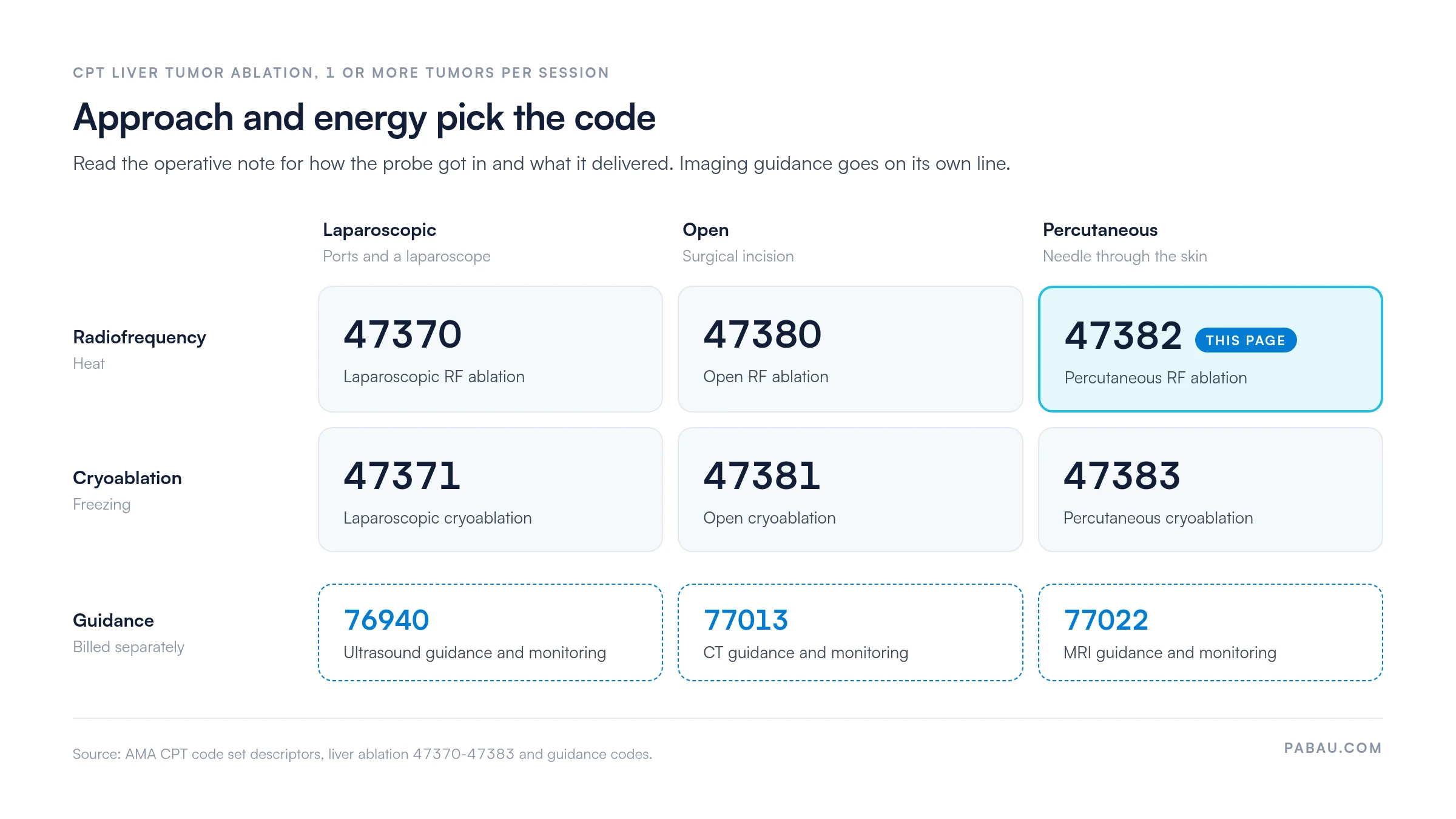
Don’t report 47382 and 47383 for the same lesion in one session. If the physician converts from a percutaneous to an open approach, the note must say why. The code then follows the approach that completed the ablation.
Check the operative note before coding. If it describes ‘laparoscopic port placement’ or a ‘surgical incision’, 47382 is wrong. The percutaneous route means needle-only skin entry, with no trocar or laparoscope. When in doubt, query the physician before you submit.
Payers check that the diagnosis supports liver ablation. Each Medicare Administrative Contractor (MAC) sets its covered diagnoses in its Local Coverage Determination (LCD) or billing article. That list is usually narrower than the full range of liver tumor codes.
Coverage rules differ by MAC jurisdiction. Check your MAC’s current LCD in the CMS Medicare Coverage Database, and confirm its covered diagnosis list. A diagnosis outside that list brings a medical necessity denial.
Medicare covers 47382 when the patient meets the applicable coverage criteria, and commercial payers publish their own. Most policies weigh the same factors:
Medicaid coverage varies by state, and many programs require prior authorization. Verify the payer’s rules before you schedule the procedure.
Most commercial payers require prior authorization for 47382. Insurance eligibility verification alone won’t cover it, because the request has to justify the ablation itself. Medicare doesn’t require prior authorization for 47382. It still denies claims that miss its coverage criteria.
A complete request usually includes:
Payer forms and timelines change often, so confirm each payer’s requirements before submission. For the wider workflow, see our guide to the prior authorization process.
47382 is a global surgical procedure, so it normally takes no professional or technical component modifier. Modifiers 26 and TC split the imaging guidance codes instead. Modifier 59 only helps where the NCCI edit allows it.
Medicare payment comes from the CMS Physician Fee Schedule. At the 2026 conversion factor of $33.4009, the national non-facility rate is about $3,430. The facility rate, paid when the physician works in a hospital or ASC, is about $641.
These are national figures before geographic adjustment. Check your local rate in the CMS lookup or the FastRVU 2026 RVU lookup tool.
Nearly all of the difference between the two rates is practice expense. In an office setting, the practice supplies the generator and electrode, and the non-facility rate reflects that cost. The 10-day global period covers related follow-up visits after the procedure. CMS updates RVUs every year, so pull current figures before you quote them.
Run through this list before the claim leaves the practice. Auditors look for each item, because the approach is what separates 47382 from 47380 and 47370.
Once every item checks out, send the claim electronically. The clearinghouse’s edits then catch format and code errors before the payer sees the claim.
Take an illustrative case. A patient with hepatocellular carcinoma has two lesions, 2.1 cm and 2.8 cm, in segments 6 and 7. The tumor board recommends ablation over resection, and the payer approves the authorization.
The radiologist ablates both lesions through the skin in one session, under ultrasound guidance. The claim then carries:
Two lines of 47382 would be the classic mistake here. Had the case converted to an open incision, the ablation line would have become 47380 instead.
47382 draws heavy scrutiny because of medical necessity rules, prior authorization and documentation detail. A solid denial management process for this code starts with the procedure documentation.
The remittance advice explains each rejection with CARC and RARC codes. Our reference to medical billing denial codes decodes them.
Audit your 47382 denials every quarter against your MAC’s LCD. Group the last 90 days of denials by reason. Documentation, prior authorization and coding errors each need a different fix, so tackle them one at a time.
Many practices still track ablation authorizations in a spreadsheet and chase claim status by phone. One missed approval becomes a denial that’s hard to overturn.
Pabau, a practice management platform with built-in claims management software, records prior authorization on the patient’s case. It warns your team when a case has no authorization on file, before the procedure goes ahead.
For US practices, claims go out electronically through Claim.MD, the clearinghouse Pabau integrates with. Claim.MD runs its edits before the payer sees the claim, so errors come back while they’re still quick to fix.
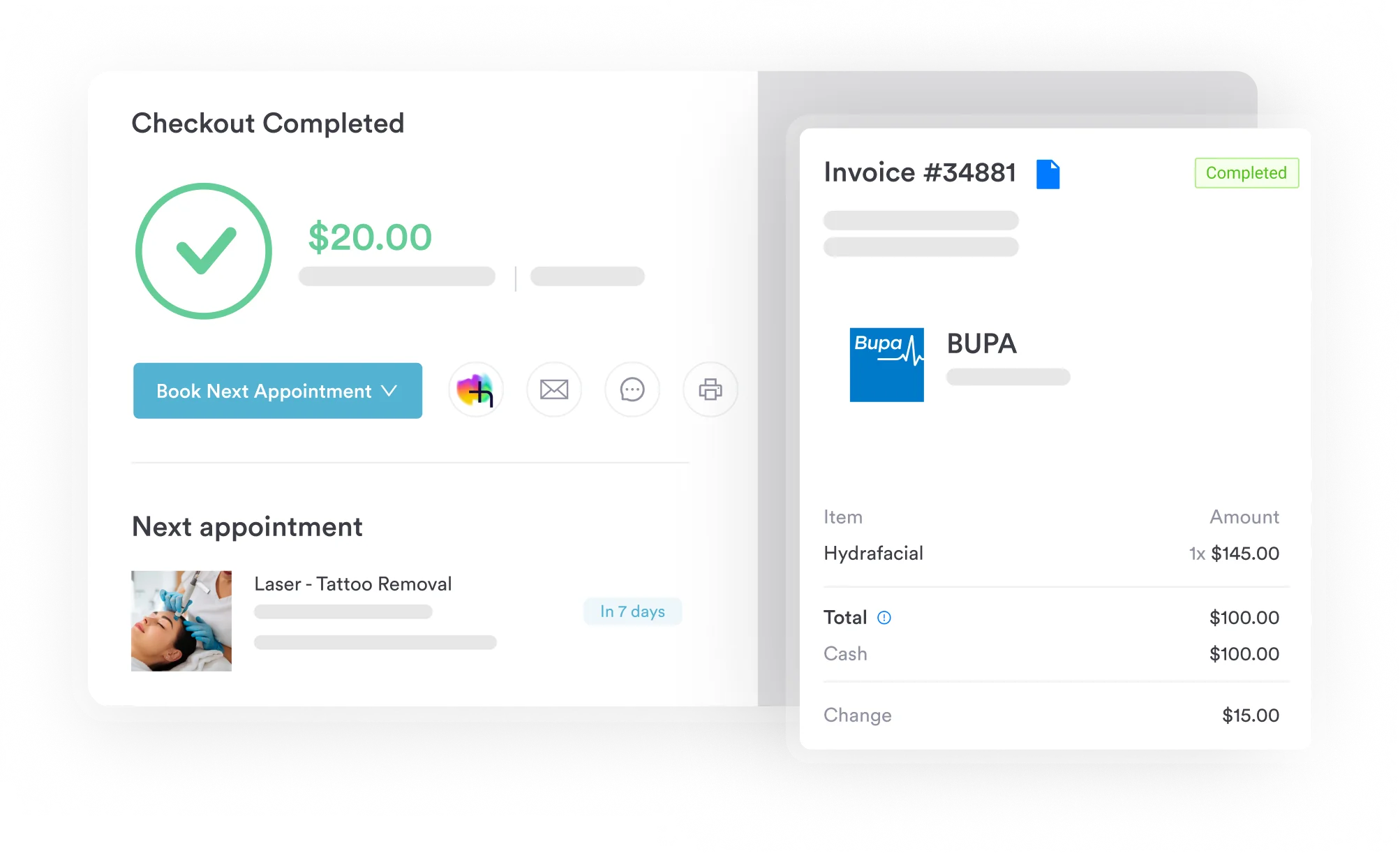

Pabau records prior authorization on each case and warns you when it’s missing. US claims go out through Claim.MD, which runs its edits before the payer does.

Most 47382 problems start before the claim is built. The operative note must state the percutaneous route, name the guidance modality and count the lesions. Authorization has to be on file before the patient arrives.
If you change one habit, check the approach and the guidance code against the note before every submission. That one check prevents the wrong-code denials that cost a full resubmission cycle. Then refresh your LCD criteria and RVU figures each January.
Book a demo to see how Pabau tracks ablation authorizations and sends 47382 claims electronically through Claim.MD.

Need to understand how clearinghouse submission works? Medical claims clearinghouse guide explains electronic submission from practice to payer.
Tracking down what a denial code means on your remittance? Electronic remittance advice explained covers how to read ERA files and act on CARC codes.
Building a revenue cycle workflow for interventional radiology? Revenue cycle management overview outlines the billing process end to end, including where high-cost codes need extra controls.
Preparing a 47382 authorization request? Medical prior authorization form gives you a template for the request.
Choosing a tool to track authorizations? Prior authorization software compares options for managing requests and approvals.
Yes, when it’s done through the skin. CPT has no separate code for liver microwave ablation, and AMA guidance reports it with the radiofrequency ablation codes. Open and laparoscopic routes use 47380 and 47370.
Both describe radiofrequency ablation of liver tumors. 47380 is the open approach through a surgical incision, while 47382 is percutaneous, through the skin. Don’t report both for the same lesion in one session.
It depends on the approach. Percutaneous cryoablation is 47383, laparoscopic is 47371, and open is 47381. Like 47382, each covers one or more tumors per session.
No. 47382 is a global surgical procedure with no separate professional and technical components. Modifiers 26 and TC belong on guidance codes 76940, 77013 and 77022 when the physician and facility bill separately.
No. Moderate sedation has been reported separately since 2017. The physician doing the ablation bills 99152, plus 99153 for each extra 15 minutes. A second provider bills 99156 and 99157 instead.




