CPT code 85651: Erythrocyte sedimentation rate, non-automated
CPT code 85651: Definition, descriptor, and code summary CPT code 85651 is the p...

Last Updated: Nov 24, 2026
77013 is the CPT code for computed tomography guidance for, and monitoring of, parenchymal tissue ablation. It covers CT used to place the ablation probe and to watch the ablation zone until the procedure ends.
The ablation itself is billed under its own code, such as 47382 for liver or 50592 for kidney. CT used only to position a needle is 77012 instead, and the two are not reported together for the same session.
Let Pabau's smart automation suggest the right codes, reduce claim denials, and keep your practice compliant—effortlessly.
Automate repetitive tasks and focus on what matters most—your patients.
Reduce coding errors and ensure compliance with the latest regulations.
Clean claims, fewer denials, and faster reimbursements.
Powerful insights and reporting to help your practice thrive.
HIPAA compliant SOC 2 certified GDPR-compliant Trusted by 4,000+ clinics worldwide

CPT Code 77013 describes CT guidance and monitoring for parenchymal tissue ablation, while 77012 covers CT guidance for needle placement only.
Under NCCI, 77012 is not reported with 77013 for the same session, so check the current edit table before billing both.
Report 77013 only with ablation codes that leave imaging guidance out of their descriptor, such as 47382, 50592 and 50593.
Every 77013 claim needs a permanent image record and a separate written guidance report.
Pabau’s claims management software sends US claims through Claim.MD and tracks prior authorizations on the patient’s case.
CPT Code 77013 is the American Medical Association code for “Computed tomography guidance for, and monitoring of, parenchymal tissue ablation.”
It is a CT guidance and monitoring code, reported by the physician who provides the guidance throughout the ablation. AAPC’s 77013 code summary confirms it reports only the CT guidance and monitoring, while the ablation takes its own code.
Three elements are embedded in that descriptor. First, the imaging modality is computed tomography specifically. Second, the guidance covers both positioning and ongoing monitoring throughout the therapeutic procedure. Third, the target is parenchymal tissue, meaning solid organ tissue such as liver, lung or kidney, rather than a simple needle-placement event. The code covers the physician’s guidance work from probe entry to the end of the ablation.
CPT Code 77013 applies when CT imaging guides a therapeutic ablative procedure on parenchymal tissue. The CT guidance must be integral to and concurrent with the therapeutic procedure, not a standalone pre-procedure scan or a separate diagnostic study.
The ablation itself may use radiofrequency (RFA), microwave energy or cryoablation, but not every method has its own CPT code at every site. Some ablation codes also include imaging guidance in their descriptor, which rules out a separate 77013. The table below shows the common pairings by body site.
One critical boundary: CPT Code 77013 does not apply when CT is used only for pre-procedure planning. Nor does it apply when another imaging modality guides the ablation. The CT must be the dominant guidance modality used during the ablative procedure itself. Each companion ablation code has its own descriptor in the CPT code library, so check whether it already includes imaging guidance.
77013 covers CT guidance during therapeutic ablation, including ongoing monitoring of the ablation zone. CPT 77012 covers CT guidance for needle placement only, without that monitoring component. This is the most consequential distinction in CT guidance coding. Under NCCI, the two codes are not reported together for the same session, so check the current edit table.
The practical test: If CT imaging continues after probe placement to confirm ablation zone adequacy during the procedure, 77013 is the correct code. If CT is used only to position a needle and imaging stops once the needle is seated, 77012 applies instead.
When CT is the dominant imaging modality that guides and completes an ablation, CPT Code 77013 is correct, not 76940 or 76942. Those two are the ultrasound codes for ablation monitoring and needle guidance. The imaging modality and the service it performed decide the code, as the grid below shows.
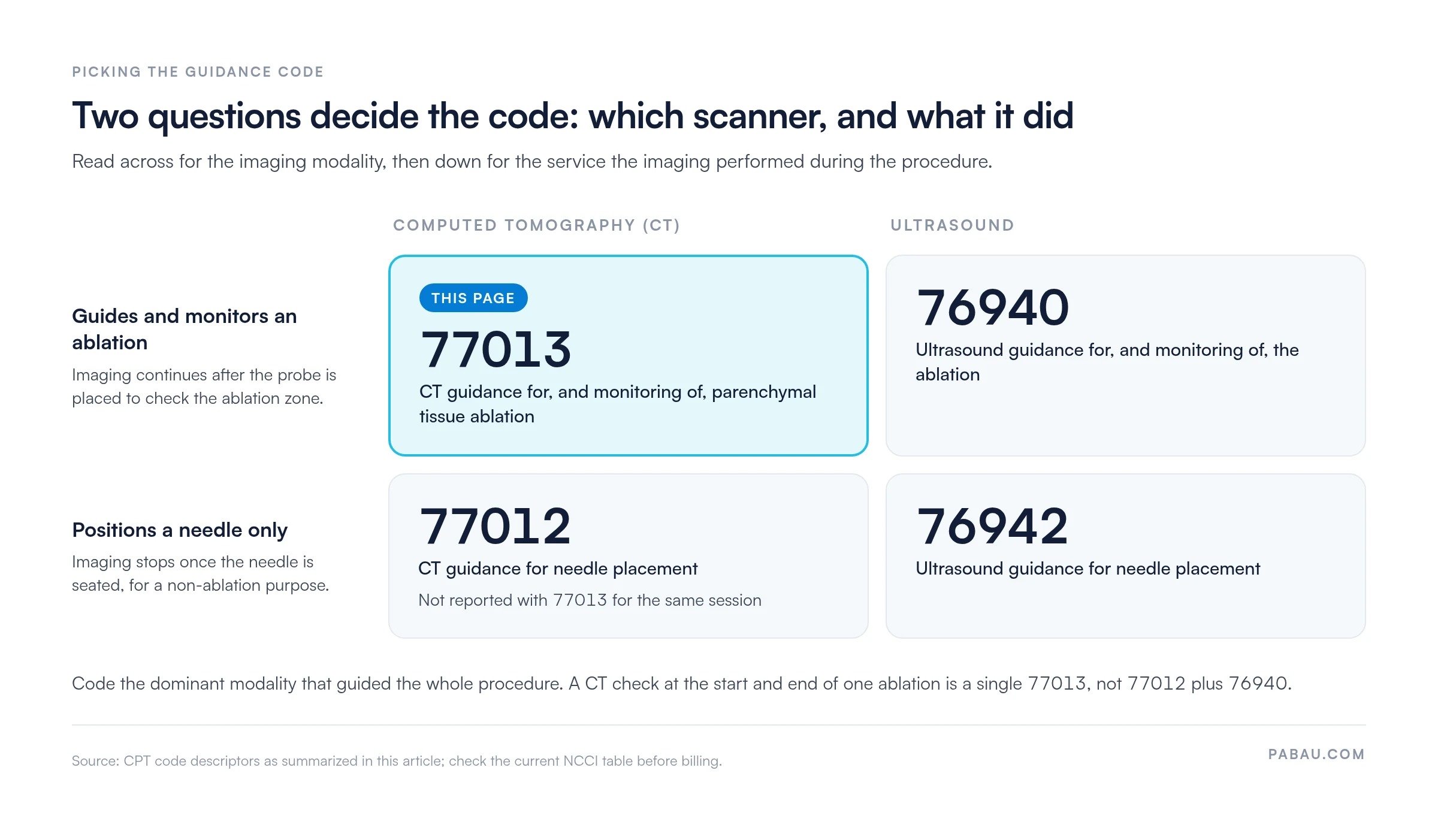
A common coding ambiguity: CT validates probe trajectory at the start of a microwave ablation and confirms the ablation zone at the end. That is a single CPT Code 77013 encounter. It is not 77012 plus 76940. Report the dominant imaging modality that guided the entire procedure.
Before coding the guidance service, confirm in the operative report which imaging modality was listed as the primary guidance tool throughout the ablation. If CT appears in the technique section and ultrasound is used only for incidental checks, CT is dominant and 77013 is correct.
Every CPT Code 77013 claim requires a permanent image record and a separate written guidance report. Missing either one is the fastest path to a denial. Claims management software that tracks each claim from submission to payment helps high-volume ablation programs spot these denials early.

The documentation package must address five elements. Under medical billing compliance rules, each element is a separate audit point.
Practices using superbill-based workflows should confirm the superbill lists the CT guidance service on its own line, separate from the therapeutic ablation code. Merging both services into one line leaves the payer unable to match each service to its documentation.
Medicare reimburses CPT Code 77013 through the Medicare Physician Fee Schedule (MPFS). Payment rates vary by geographic location via the Geographic Practice Cost Index (GPCI) adjustment and change each calendar year. Always retrieve current rates from the CMS Physician Fee Schedule lookup tool before quoting a reimbursement amount to a provider.
The table below shows how the RVU components for CPT Code 77013 split across billing arrangements. Payment is calculated as total RVUs multiplied by the annual conversion factor, adjusted by GPCI locality.
Use the FastRVU 2026 RVU lookup to retrieve current work, practice expense, and malpractice RVU values for CPT Code 77013. It also calculates Medicare reimbursement by locality.
Three modifier scenarios apply to CPT Code 77013. Choosing incorrectly between global and split-component billing is the most common modifier error on these claims.
The National Correct Coding Initiative (NCCI) bundles several guidance codes with CPT Code 77013 when billed on the same date of service. Understanding these edits prevents both undercoding and unbundling violations. Run the NCCI edit check before submission on every ablation claim, because the edit table changes each quarter.
Prior authorization for CPT Code 77013 follows the authorization for the therapeutic ablation procedure. Payers who require pre-auth for the ablation (codes such as 47382 or 50593) typically extend that authorization to the guidance code. The guidance cannot occur without the therapeutic procedure.
Medicare does not require separate prior authorization for 77013. Commercial payers vary. When submitting an authorization request for the therapeutic ablation, the authorization package should include:
A clean claim submission for CT-guided ablation requires that the authorization number covers all procedure codes on the claim, including 77013.
Denials on CPT Code 77013 cluster around six patterns. Each has a corrective action that can be built into the pre-submission workflow. Robust denial management workflows catch most of these before the claim leaves the practice.
Every CPT Code 77013 claim must carry an ICD-10-CM diagnosis code identifying the lesion or condition that warranted ablation. The table below covers the most common pairings by body site. Selecting the most specific available code reduces medical necessity denials and supports LCD compliance for CT-guided ablation procedures.
Use the most specific ICD-10-CM subcode available. For lung malignancy, specify laterality (C34.11 right upper lobe, C34.12 left upper lobe) rather than defaulting to unspecified codes. Payer LCDs for ablation procedures often list covered diagnosis codes explicitly. Verify the code against the applicable MAC’s LCD before submission.
Cross-reference your planned ICD-10-CM diagnosis code against the applicable MAC Local Coverage Determination for CT-guided ablation before billing. MACs publish covered-diagnosis lists with each LCD, and an unlisted code is a straightforward medical-necessity denial even when the clinical record fully supports the procedure.
Without a claims system, a coder checks each 77013 claim by hand. They read the operative note, confirm CT was the dominant modality, and look up the NCCI table before the claim goes out. An authorization covering only the ablation code is easy to miss in that routine.
Pabau, a practice management platform with built-in insurance billing, sends US claims through Claim.MD as CMS-1500/837P claims. Eligibility checks and ERA remittances come back into the same system. That way the ablation code and the 77013 line are tracked together from submission to payment.
Prior authorization codes, dates and sessions sit on the patient’s case, with a warning when one is missing. Your team spots a missing auth before the payer does, so the guidance line isn’t denied on its own.

Pabau sends US claims through Claim.MD and tracks prior authorizations on the patient’s case. Your 77013 line and its ablation code go out together, with the auth on file.

Code 77013 only when CT placed the probe and kept watching the ablation zone until the procedure ended. Before the claim goes out, check the ablation code’s descriptor, the NCCI table and the guidance report.
The trade-off is speed against certainty. Coding from the operative note alone is quick, but a missing image record or a stray 77012 turns a paid claim into an appeal. A short check at release costs less than an appeal.
For an ablation program that bills these claims weekly, book a demo to see Pabau keep CT-guided ablation claims, authorizations and remittances in one place.

Need a foundation for your claims workflow? Claim.MD clearinghouse overview explains how electronic claim submission and ERA processing work for US practices.
Worried about claim rejections before they happen? Denial codes in medical billing covers CARC codes and how to interpret remittance advice for faster appeals.
Billing both CPT and ICD codes on the same claim? Medical billing fundamentals explains how CPT procedure codes and ICD-10 diagnosis codes interact on a CMS-1500 claim.
Using CT to plan radiation therapy instead? CPT code 77014 covers CT guidance for placing radiation therapy fields.
CPT Code 77013 is the code for computed tomography guidance for, and monitoring of, parenchymal tissue ablation. It is a CT guidance and monitoring code, reported by the physician who provides the guidance from probe placement to the end of the ablation. The claim needs a permanent image record and a separate written guidance report.
CPT 77013 covers CT guidance and monitoring throughout an ablation. CPT 77012 covers CT guidance for needle placement only, ending once the needle is positioned. Under NCCI, 77012 is the column-2 code, so it is not reported with 77013 for the same session.
Report 77013. CPT 76940 is for ultrasound monitoring during ablation, so it applies when ultrasound is the dominant imaging modality. When CT validates probe trajectory and monitors the ablation zone throughout the procedure, 77013 is correct whichever ablation method was used.
Yes, Medicare covers CPT Code 77013 when medically necessary and billed with ICD-10-CM diagnosis codes that link to a covered ablation indication. Payment rates are set by the Medicare Physician Fee Schedule and vary by geographic location. Retrieve current rates from the CMS MPFS Look-Up Tool for your locality.
Yes, when the ablation code does not include imaging guidance. Liver codes 47382 and 47383 and kidney codes 50592 and 50593 are reported with 77013 on the same claim. Codes whose descriptor includes imaging guidance when performed, such as lung code 32998, take no separate 77013. 77012 is not reported with 77013 for the same session, and for 76942, check the current NCCI table.
Modifier 26 is used when a hospital-based radiologist bills only for image interpretation and reporting. Modifier TC is used by the facility for the technical component. No modifier applies when a freestanding practice bills globally.