HCPCS code V2599: Other type contact lens billing guide
What is HCPCS code V2599? HCPCS code V2599 is the Level II supply code for a con...

Last Updated: Oct 20, 2026
41115 is the CPT code for excision of lingual frenum (frenectomy). It covers surgical removal of the band of tissue under the tongue, usually followed by a sutured closure. If the surgeon only cuts the band, the correct code is its neighbor, 41010.
Ankyloglossia (Q38.1) is the usual diagnosis, but payers pay only when the chart shows a functional problem. That means documented feeding or speech impairment and a failed trial of conservative care. Some payers also treat the procedure as dental or cosmetic. The sections below show how to pick the right frenum code, pair the diagnosis, and keep the claim clear of denials.
Let Pabau's smart automation suggest the right codes, reduce claim denials, and keep your practice compliant—effortlessly.
Automate repetitive tasks and focus on what matters most—your patients.
Reduce coding errors and ensure compliance with the latest regulations.
Clean claims, fewer denials, and faster reimbursements.
Powerful insights and reporting to help your practice thrive.
HIPAA compliant SOC 2 certified GDPR-compliant Trusted by 4,000+ clinics worldwide

CPT code 41115 is excision of the lingual frenum, so the operative note must show the band was removed, not just released.
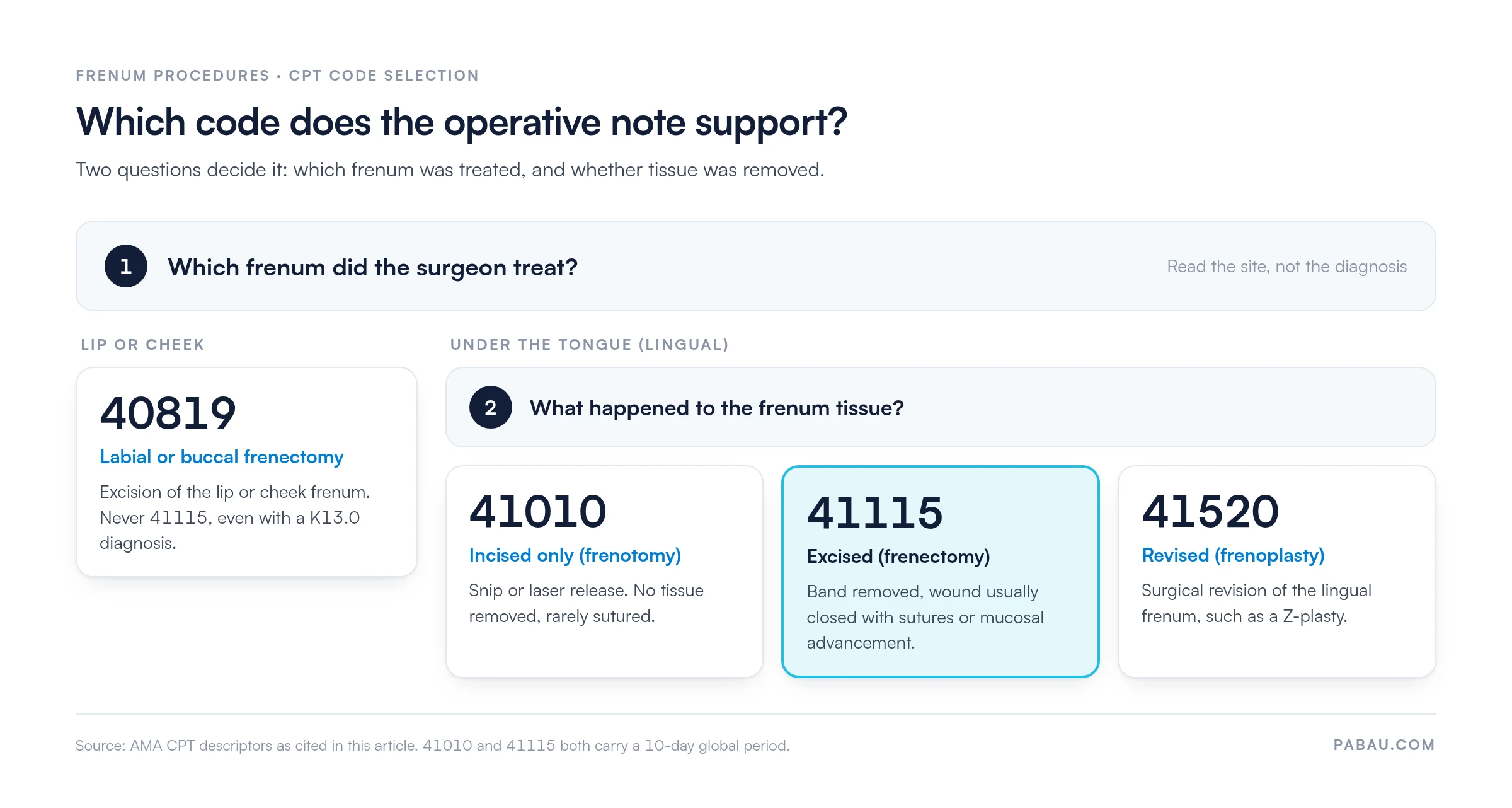
A frenotomy (incision only) is CPT 41010, a lip or cheek frenum is 40819, and a Z-plasty revision is 41520.
Ankyloglossia (Q38.1) is the core diagnosis, and it needs documented feeding or speech impairment behind it.
K13.0 is a lip disease code, so it supports 40819 for a labial frenum rather than 41115.
Some Medicare contractors treat frenectomy as dental or cosmetic, so check the local coverage determination before surgery.
CPT code 41115 is the American Medical Association’s code for excision of lingual frenum (frenectomy). The surgeon removes the lingual frenulum, the band of tissue that tethers the underside of the tongue to the floor of the mouth. The wound is then usually closed with sutures or a mucosal advancement.
That removal is what defines the code. A frenotomy only cuts the band, and it’s billed as 41010. Clinical notes use frenulectomy, frenectomy and frenuloplasty loosely, so confirm in the operative note that tissue came out before you assign 41115.
In the AMA’s CPT code set, 41115 sits in the 41000-41599 tongue and floor of mouth subsection. Its neighbors there include 41010 and the tongue lesion codes 41110-41114.
Ankyloglossia, or tongue-tie, is the usual reason a surgeon performs 41115. The frenum attaches too far forward or is too short, so the tongue can’t move freely. Payers want to see what that restriction does to the patient, not just that it exists.
Payers also expect proof that conservative treatment came first. Lactation consultant records, a speech therapy evaluation, or a documented trial of stretching exercises all strengthen the case.
CPT 41010 is incision of the lingual frenum (frenotomy), while CPT 41115 is excision. An incision releases the frenum, and an excision takes it out. Mixing the two up is one of the most frequent errors on these claims.
Here’s a quick test you can run on any operative note. A scissor snip or laser release with no specimen and no sutures is almost certainly 41010. Excised tissue plus a closed wound points to 41115.
The diagram below adds the two neighboring codes that get confused with both.
The ICD-10-CM code matters as much as the CPT code. Many payers auto-deny 41115 when the diagnosis falls outside the covered indications in their medical policy.
The K13.0 row catches people out. When the chart describes a lip frenum, the procedure is 40819, and the claim should carry that code instead of 41115.
Before submitting, check which diagnoses each payer’s policy accepts. BCBSM’s policy 80226 and Aetna’s Dental Clinical Policy Bulletin both list the ICD-10 codes they cover for frenum surgery.
Medicare coverage for CPT code 41115 isn’t automatic. Some Medicare Administrative Contractors (MACs) treat frenectomy as a non-covered dental or cosmetic service. Without a Local Coverage Determination (LCD) setting medical necessity criteria, the claim may fall outside Part B.
Before you submit, check the CMS Physician Fee Schedule search tool and your MAC’s LCD database. If no active LCD covers the procedure in the patient’s state, expect a denial. When coverage is in doubt, give the patient an Advance Beneficiary Notice (ABN) before surgery.
Run an eligibility check before the procedure date as well. A coverage problem costs far less to find at scheduling than on the remittance.
Modifier mistakes are a frequent cause of 41115 denials. Watch which line each one belongs on, because -25 never goes on 41115 itself.
Check the National Correct Coding Initiative (NCCI) edit table before billing 41115 with another oral surgery or E&M code on the same date. CMS updates those edits every quarter.
Commercial payer rules carry more weight on frenum procedures than on most surgical codes. Several major plans publish written policies on when they’ll pay for frenectomy, and the criteria differ.
Pull the current policy from the payer’s provider portal before you submit. Bulletins change annually, and so can prior authorization rules between plan years. Where a plan routes frenum surgery through the dental benefit, the claim usually goes on the ADA dental claim form rather than the CMS-1500.
Most 41115 problems start well before anyone picks a code. Here’s the path a clean claim takes, and where each step tends to break.
Documentation is what separates a paid 41115 claim from an audit finding. Together, the pre-op chart and the operative note must show why surgery was needed, what was done, and that simpler care came first.
A clean claim submission routine catches the missing details auditors look for. Run each 41115 chart through this list before it goes out.
Consistent medical billing compliance standards across all your surgical codes also limit exposure when a payer audits frenum claims in bulk.
Flag CPT 41115 claims for a documentation review before they reach the clearinghouse. Two audit findings come up again and again. One is an operative note that describes incision rather than excision, which points to 41010. The other is a pre-op chart with no record of conservative treatment. Catching both before submission removes two of the most common denial triggers on this code.
Denials on 41115 follow a predictable pattern. Most can be prevented with better documentation and workflow, which beats working appeals afterward.
Structured denial management workflows that track reason codes at the claim level surface the patterns fastest. If a remittance code is unfamiliar, our guide to medical billing denial codes explains what each one means.
Medicare pays CPT code 41115 through the Medicare Physician Fee Schedule (MPFS) relative value unit (RVU) method. There are three RVU components: work, practice expense, and malpractice. Each is adjusted for geography, then multiplied by the annual conversion factor CMS publishes.
Use the FastRVU 2026 RVU lookup tool and the AAPC Codify CPT lookup to pull current RVU values for your locality. Rates change every January 1. The table below shows how the rate is built, not what any payer will pay.
Commercial payer rates for CPT 41115 commonly exceed Medicare rates, varying by contract. If you use a superbill for oral surgery encounters, confirm that 41115 carries the correct global period flag before it generates the claim.
Pull the MPFS non-facility rate for CPT 41115 from the CMS Physician Fee Schedule search tool each January. That’s when the new conversion factor takes effect. Contracts set as a percentage of Medicare adjust on their own. A practice billing from a fixed fee schedule has to update its chargemaster, or it may undercharge from January onward.
In many oral surgery and ENT practices, a 41115 claim crosses several systems. The schedule lives in one tool and the op note in another, and then someone keys the claim into a clearinghouse portal. Every re-entry is a chance to drop an authorization number or mistype a code.
Pabau, the practice management platform we build, keeps those steps in one patient record. Its claims management software pre-fills the claim from that record and checks required fields before the claim can be sent.
Through the Claim.MD clearinghouse, Pabau runs real-time eligibility checks, submits the claim, and tracks its status. Remittances post back to the same record, so your team can spot a coverage problem before surgery day instead of after.

Pabau checks eligibility in real time and submits CPT claims through the Claim.MD clearinghouse, built from the patient record. Coverage problems surface before surgery, not on the remittance.

Treat 41115 as a documentation code first and a surgical code second. The procedure is simple. Payment depends on what the chart can prove: a lingual frenum, removed tissue, and a functional problem that conservative care didn’t fix.
If your operative note template doesn’t prompt for the tissue excised and the closure method, fix that first. It’s the cheapest change you can make, and it stops future claims from being recoded as 41010.
Want eligibility checks and claim submission running from the same record as the op note? Book a demo to see how Pabau handles surgical CPT claims for oral surgery and ENT practices.

Need to understand the clearinghouse behind your CPT claim submissions? Our Claim.MD clearinghouse guide explains how electronic claim routing, payer edits, and ERA processing work for surgical procedure codes.
Seeing repeated denials across your surgical billing? Denial codes in medical billing breaks down the CARC and RARC codes on your remittances and how to respond to each one.
Want to confirm eligibility before the procedure date? Insurance eligibility verification covers the 270/271 transaction process and what to check for surgical procedures with variable coverage.
Waiting on payer approval before scheduling surgery? The prior authorization process walks through each step from request to approval, and what slows it down.
Appealing a denied frenectomy claim? Our medical appeal form template gives you a structured letter for contesting a denial with the right supporting evidence.
Yes, if the laser removed the frenum. CPT describes what was done, not the instrument used. A laser that excises the band is 41115, while a laser that only releases it is 41010. The operative note should say which one happened.
No. The lingual frenum is a single midline structure, so 41115 is reported once per session. Modifier 50 is only for procedures performed on both sides of the body.
Dentists usually report CDT code D7960 for a frenulectomy and D7963 for a frenuloplasty. Those codes go on the ADA dental claim form. CPT 41115 belongs on a medical claim, such as the CMS-1500.
Not routine ones. The 10-day global period folds normal follow-up into the surgical payment. Many practices report CPT 99024 at no charge to track the visit. An unrelated problem in that window can be billed with modifier 24.
No. Neither 41115 nor 41010 has an age limit, so the same codes apply to infants and adults. Most newborn procedures are simple releases, which makes them 41010. Infant claims often pair Q38.1 with P92.5.