HCPCS code C1731: Catheter billing, OPPS reimbursement, and denial guide
HCPCS code C1731: Official descriptor and code series context HCPCS code C1731 i...

Last Updated: Oct 8, 2026
40819 is the CPT code for excision of frenum, labial or buccal (frenumectomy, frenulectomy, frenectomy). In plain terms, it covers removing the fold of tissue that ties the upper or lower lip, or the cheek, to the gum.
The anatomical site is the detail that matters most on the claim. Tongue-tie work belongs to 41010 or 41115, and mixing those codes up is a common cause of payer denials on frenectomy claims. A mismatched ICD-10 diagnosis or an undocumented functional problem can sink the claim too. The sections below show how to get each of those right before the claim goes out.
Let Pabau's smart automation suggest the right codes, reduce claim denials, and keep your practice compliant—effortlessly.
Automate repetitive tasks and focus on what matters most—your patients.
Reduce coding errors and ensure compliance with the latest regulations.
Clean claims, fewer denials, and faster reimbursements.
Powerful insights and reporting to help your practice thrive.
HIPAA compliant SOC 2 certified GDPR-compliant Trusted by 4,000+ clinics worldwide

CPT code 40819 covers excision of the lip or cheek frenum, whether the surgeon uses a scalpel, electrosurgery or a laser.
Tongue-tie work uses different codes, 41115 for a lingual excision and 41010 for an incision-only release.
A lip frenotomy that releases the tissue without removing it is 40806, not 40819.
Payers often deny 40819 as cosmetic unless the chart documents a functional problem, such as a diastema, gum recession or denture interference.
Never pair 40819 with Q38.1, because ankyloglossia describes the tongue and triggers a diagnosis-procedure mismatch.
CPT code 40819 is the procedure code for excising the labial or buccal frenum. That is the band of tissue tying the lip or cheek to the gum. The American Medical Association places it in the Surgery section, Digestive System subsection (codes 40490-49999). Within that subsection, it sits in the Vestibule of Mouth range (40800-40899).
The official descriptor reads: Excision of frenum, labial or buccal (frenumectomy, frenulectomy, frenectomy). All three names in brackets report under this one code, as long as the work happens at the lip or cheek.
CPT 40819 covers complete removal of the labial frenum, which connects the upper or lower lip to the gum. It also covers the buccal frenum, which connects the cheek to the gum. Both sit in the oral vestibule, the soft tissue between the lips or cheeks and the alveolar ridge.
Three surgical techniques all report under 40819, provided the site is labial or buccal:
So a laser frenectomy on the upper lip is 40819. Use the same laser on the tongue, though, and the claim needs a different code.
Frenum procedures split along two lines. The first is where the frenum sits, and the second is whether the surgeon removed tissue or only cut it. CPT 40819 owns one corner of that grid, as the chart below shows.
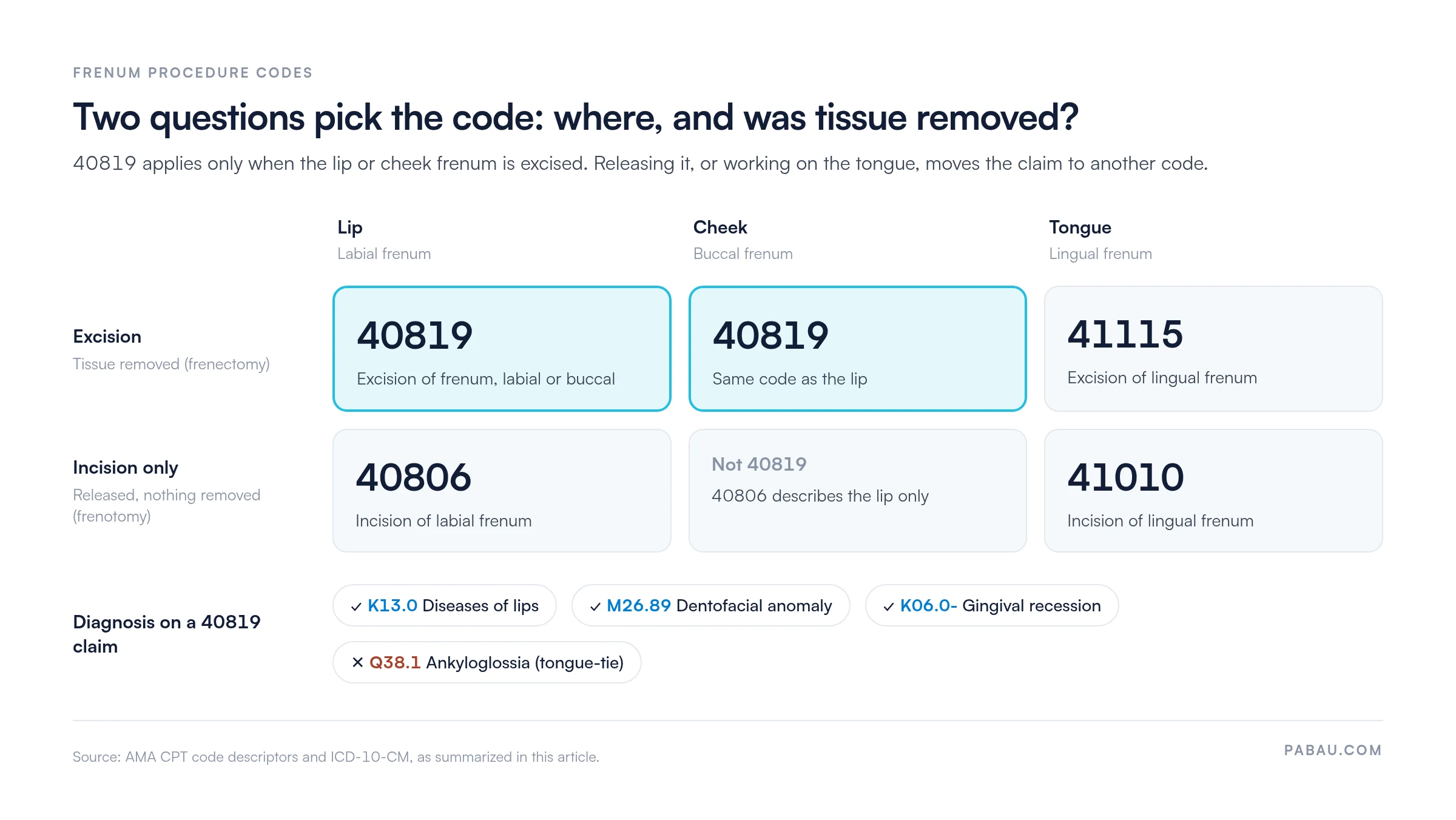
The lingual pair trips up even experienced coders. An incision that releases the tongue without removing tissue is 41010. An excision that removes a segment of the lingual frenum is 41115. Either way, the operative report has to say plainly which one happened.
Practices treating pediatric tongue-tie (ankyloglossia) make this mistake most often. A parent asks for a “frenectomy,” the biller searches for a frenectomy code, and 40819 shows up first. For a tongue-tie excision, however, the correct code is 41115. Billing 40819 for tongue work is a coding error that invites an audit.
Every 40819 claim needs an ICD-10-CM code that establishes medical necessity. That diagnosis should describe the problem the frenum causes, rather than the procedure itself.
Don’t pair 40819 with Q38.1 (ankyloglossia). That code describes tongue-tie, a lingual condition, so it can’t support a lip or cheek procedure. Payer edits catch the mismatch automatically. Knowing the medical billing workflow from encounter to claim helps you spot it before the claim leaves the practice.
Run a diagnosis-procedure check on every 40819 claim before it goes out. Confirm the ICD-10 code describes a lip, cheek or gum condition, not ankyloglossia (Q38.1). Software catches the obvious mismatches, but the operative note is what an auditor reads.
Most commercial payers treat frenectomies as potentially cosmetic. Without documented functional impairment, a 40819 claim is likely to be denied under a cosmetic exclusion. These indications typically support medical billing compliance for this code:
Many commercial payers also require prior authorization before a 40819 procedure. Call the payer’s provider line and confirm the rules for each patient’s plan, ideally at scheduling. A clear prior authorization process stops this denial before the patient is even in the chair.
Medicare coverage for 40819 is limited. It’s generally not covered as a standalone service under Medicare Part B unless it’s part of a medically necessary surgical case. Even then, coverage depends on the Local Coverage Determination (LCD) in the provider’s Medicare Administrative Contractor (MAC) jurisdiction.
After wrong code selection, an incomplete operative note is a frequent reason these claims stall. To support a clean claim, the 40819 operative report should include each of these:
A superbill that captures both the CPT and ICD-10 codes at the point of service cuts transcription errors between the visit and the claim.
Modifier -22 (Increased Procedural Services) applies when the procedure took substantially more effort than usual, for example because of prior scarring. The operative note must describe the specific difficulty. Expect to send a cover letter, because payers routinely ask for records before paying more.
Modifier -51 (Multiple Procedures) applies when 40819 is performed alongside another distinct procedure in the same session. It orders payment, so place it on the secondary, lower-value procedure unless payer rules say otherwise. On its own, it doesn’t get a claim past an NCCI bundling edit.
Most 40819 denials start well before anyone builds the claim. Here’s the path a clean claim follows, and the point where each step tends to break.
Medicare pays 40819 through the Resource-Based Relative Value Scale (RBRVS). Work, practice expense and malpractice RVUs are added together and multiplied by the annual conversion factor. A Geographic Practice Cost Index (GPCI) then adjusts the total for your location.
Use the CMS Physician Fee Schedule lookup tool to pull current facility and non-facility rates for your MAC jurisdiction. Rates reset every January 1, so never hardcode them into billing guides or fee schedules.
Sending claims through a clearinghouse speeds up adjudication. It also returns remittance data in structured 835 files, so you can compare each payment with the fee schedule amount you expected.
Wrong code selection, an unsupported diagnosis and missing prior authorization cause many 40819 denials. A structured denial management process tracks each reason code, so patterns show up before they cost serious revenue.
Next, review the medical billing denial codes payers attach to rejected 40819 claims, known as CARC and RARC codes. Then build an appeal template for each denial category you see more than twice a quarter.
Yes, 40819 can be reported alongside other oral procedures in the same session, as long as the services are separate and distinct. NCCI edits, maintained by CMS, decide which code pairs trigger automatic bundling denials. CMS updates them quarterly, so check current pairs before the procedure.
Three combinations come up most often:
Modifier -59 (Distinct Procedural Service) is the right choice when an NCCI edit would otherwise bundle two legitimate, separately documented services. The operative note must show different anatomical sites, separate incisions or distinct parts of the encounter. Without that evidence, the modifier invites an audit rather than a payment.
Check NCCI edits quarterly, not annually. CMS updates the edit tables four times a year, so a code pair that cleared in Q1 may be bundled by Q3. Bookmark the CMS NCCI page and set a reminder for each quarterly release.
Frenectomy billing usually breaks at the handoffs. The surgeon writes the note, someone re-keys the codes into a claim, and a third person chases the authorization number.
In Pabau, the practice management and billing platform we build, the CPT and ICD-10 codes attached to the visit pre-fill the claim form. Built-in code libraries let staff look up 40819 and its diagnosis without leaving the patient record. The claim also won’t send until required fields, such as the authorization number, are complete.
For US practices, Pabau’s claims management software submits through Claim.MD, our clearinghouse integration, to thousands of US payers. It runs real-time eligibility checks, tracks each claim’s status and posts ERA remittances, so your team sees a denial while it’s still easy to fix.

Pabau pre-fills claims from the patient record, checks eligibility and tracks every 40819 claim through to ERA posting. See how it fits your oral surgery or aesthetic practice.

Get the site right and most of 40819 falls into place. A lip or cheek excision is 40819, while the tongue belongs to 41010 or 41115. A lip release with nothing removed is 40806.
From there, the claim depends on the operative note and the diagnosis. When the chart shows a functional problem and the note says what was removed, payers have little reason to push back. That costs a few extra minutes of documentation, which is far cheaper than an appeal.
Book a demo to see how Pabau carries your codes from the chart into a clean, trackable frenectomy claim.

Need to understand how clearinghouse claims processing works? Medical claims clearinghouse guide explains how electronic claims flow from practice to payer and why clearinghouse validation catches errors before adjudication.
Want to reduce denial rates across your billing team? Building a clean claim outlines the documentation and coding elements that prevent the most common payer rejections.
Billing multiple codes in one surgical encounter? Understanding the 837 electronic claim file covers how multi-code claims are structured and sent to commercial payers and Medicare.
Tired of chasing payer approvals by phone? Best prior authorization software compares tools that help practices request and track approvals before the procedure date.
Use CPT 40806 for an incision of the labial frenum, where the surgeon releases the tissue without removing it. CPT 40819 applies only when the frenum is excised. If the note says the frenum was “released” or “clipped,” 40819 is the wrong code.
Dental claims use CDT code D7961 for a buccal or labial frenectomy and D7962 for a lingual one. Both replaced D7960 on January 1, 2021. CPT 40819 is for medical claims, so confirm which plan you’re billing first.
Yes. CPT 40819 carries a 90-day global period on the Medicare Physician Fee Schedule. Routine follow-up visits in that window are included in the surgical payment, so they aren’t billed separately.
Coverage is limited. Medicare generally doesn’t pay for 40819 as a standalone service unless it’s part of a medically necessary surgical case. Even then, the decision follows the Local Coverage Determination in your MAC jurisdiction, so check it before scheduling.
No. A laser frenectomy of the lip or cheek is still 40819, the same as a scalpel or electrosurgical excision. The code changes with the site and with whether tissue was removed, never with the tool.