

HCPCS Code Q4185: Cellesta flowable amnion billing guide
HCPCS Code Q4185: definition and official descriptor HCPCS Code Q4185 is the Lev...

Last Updated: Nov 20, 2026
F2640 is the CCSD code for freeing of adhesions of tongue, a procedure that releases tissue restricting tongue movement. It sits in chapter 6, face, mouth, salivary and thyroid, of the CCSD Schedule, the standard procedure code set for UK private healthcare.
A claim under F2640 rests on a clinical record that names the tongue as the site and shows functional impairment. Each insurer sets its own fee and cover for the code, so confirm both before treatment.
Let Pabau's smart automation suggest the right codes, reduce claim denials, and keep your practice compliant—effortlessly.
Automate repetitive tasks and focus on what matters most—your patients.
Reduce coding errors and ensure compliance with the latest regulations.
Clean claims, fewer denials, and faster reimbursements.
Powerful insights and reporting to help your practice thrive.
HIPAA compliant SOC 2 certified GDPR-compliant Trusted by 4,000+ clinics worldwide

CCSD code F2640 covers freeing of adhesions of the tongue in the UK private healthcare schedule, under chapter 6, face, mouth, salivary and thyroid.
The CCSD Group, with representatives from Bupa, Vitality, AXA Health and Aviva, maintains the schedule, but each insurer sets its own fees and cover.
A tongue mobility assessment, signed consent and an operative note naming the tongue as the site support the claim if an insurer queries it.
Pabau’s digital forms and claims management, which sends UK claims through Healthcode, keep the F2640 record and the invoice in one place.
CCSD code F2640 carries the official descriptor “Freeing of adhesions of tongue” in the UK’s CCSD schedule. CCSD stands for Clinical Coding and Schedule Development. The CCSD Schedules hold the standard procedure codes for the UK private healthcare sector. F2640 covers surgery whose main purpose is releasing lingual adhesions that restrict tongue movement. That includes a simple division of the frenulum and a more extensive release of scar tissue or post-surgical bands.
The descriptor does not distinguish between techniques such as sharp dissection, diathermy or laser. What matters for correct use of F2640 is that the clinical record establishes tongue adhesion as the reason for the procedure. The same technique used at another site, such as the lip, needs a different CCSD code.
Freeing of adhesions of the tongue is a minor oral surgical procedure, usually performed under local anesthesia. General anesthesia is sometimes used for very young or anxious patients. The technique varies with the nature of the adhesion being released.
A frenotomy (simple division) is a straight incision through the frenulum, typically with scissors or a scalpel, removing little or no tissue. A frenectomy (excision) removes part of the frenulum and may involve sutures. Both fall within F2640 when the site is the tongue and the purpose is releasing adhesions. Aftercare instructions cover diet, wound hygiene and, in some cases, tongue exercises to keep the released range of motion.
The primary indication for CCSD F2640 is ankyloglossia (tongue-tie), a congenital restriction of the lingual frenulum that impairs function. The clinical record should show evidence of that impairment before the procedure goes ahead, because an insurer may ask to see it.
The threshold for intervention is still debated, particularly in newborns. A structured assessment before surgery gives the record a defensible basis if an insurer reviews the claim.
F2640 is site-specific. It applies when the adhesions released are on the tongue, so a frenulum procedure on the lip needs a different CCSD code. Look that code up in the schedule rather than reusing F2640. Our guides to CCSD procedure codes cover many of the neighboring codes.
Two neighboring tongue codes show where the line falls. A tongue lesion removed for histology is coded as an excision of lesion, F2310, and a tongue flap as F2660. Surgery further back in the throat uses ear, nose and throat codes instead, such as E2100 repair of pharynx.
The CCSD schedule flags unacceptable combinations, meaning codes that should not normally be billed together. The CCSD Group describes these as non-exhaustive guidelines, and each insurer decides whether to apply them. Always confirm codes against the current CCSD schedule, which you can search after logging in to the CCSD website.
Check the insurer’s own schedule of procedures before treatment, as well as the CCSD schedule. A code can sit in the CCSD schedule without an insurer covering it, so confirm the patient’s cover for F2640 first.
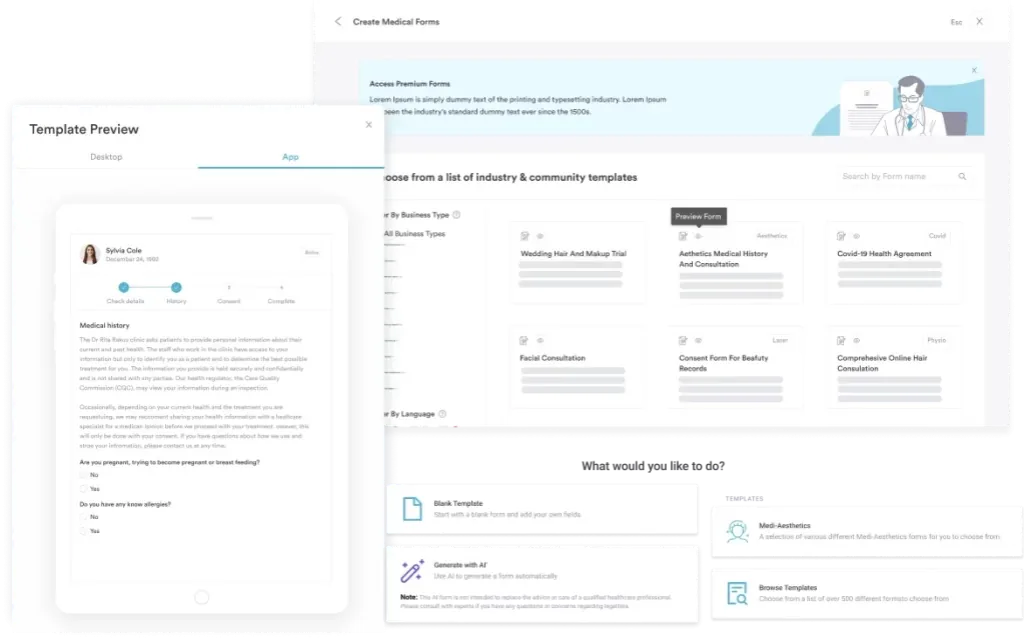
Incomplete clinical documentation is a common reason for an insurer to query a CCSD F2640 claim. The insurer does not see the procedure, so the clinical record is its only evidence that the code fits. Digital clinical forms that capture structured assessment data at the point of care help keep the record complete at billing time.
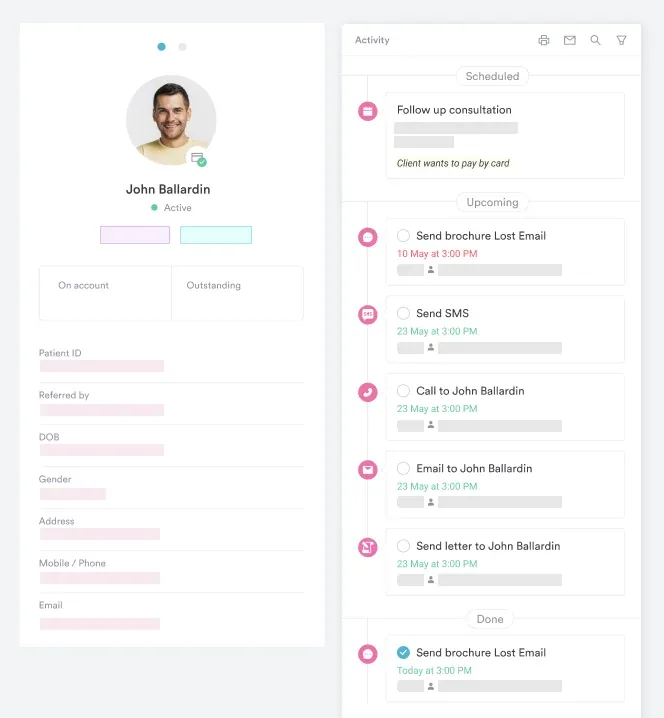
Storing these records in a structured patient record before you send the claim means the information is ready if the insurer asks for supporting notes.
Fees and cover for CCSD F2640 are set by each UK private medical insurer, not by the CCSD schedule. The CCSD Group states that it does not discuss or determine fees, so no single figure applies.
A code’s place in the CCSD schedule does not guarantee cover either. The CCSD Group notes that a listed code may not appear in an individual insurer’s own schedule. Bupa, for example, publishes its own schedule of procedures and maximum fees for recognized consultants and anesthetists. Our guide to Bupa CCSD codes explains how its fee rules work.
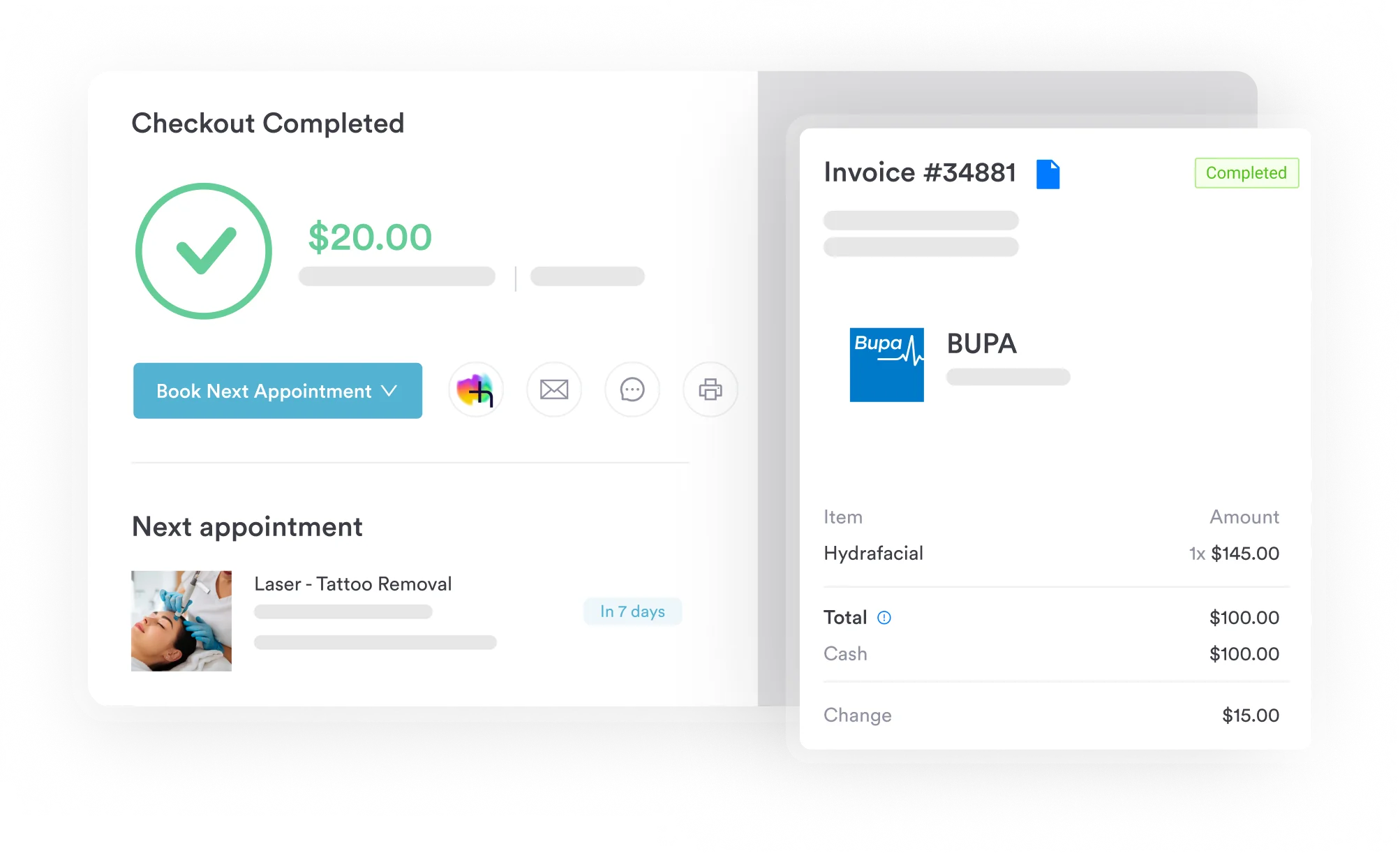
Patients should confirm their cover with their insurer before the appointment. Claims management software that sends claims electronically through Healthcode cuts rekeying and keeps each F2640 invoice tied to its clinical record.
Usually, yes. UK private insurers expect members to authorize planned treatment before it happens. AXA Health, for example, asks members to contact it to authorize treatment and then confirms whether the specialist is covered.
Authorization does not guarantee payment. The claim still needs the correct code and a clinical record that supports it.
CCSD F2640 claims tend to be rejected for a predictable set of reasons. Most are preventable with structured documentation and five checks between the assessment and the invoice.
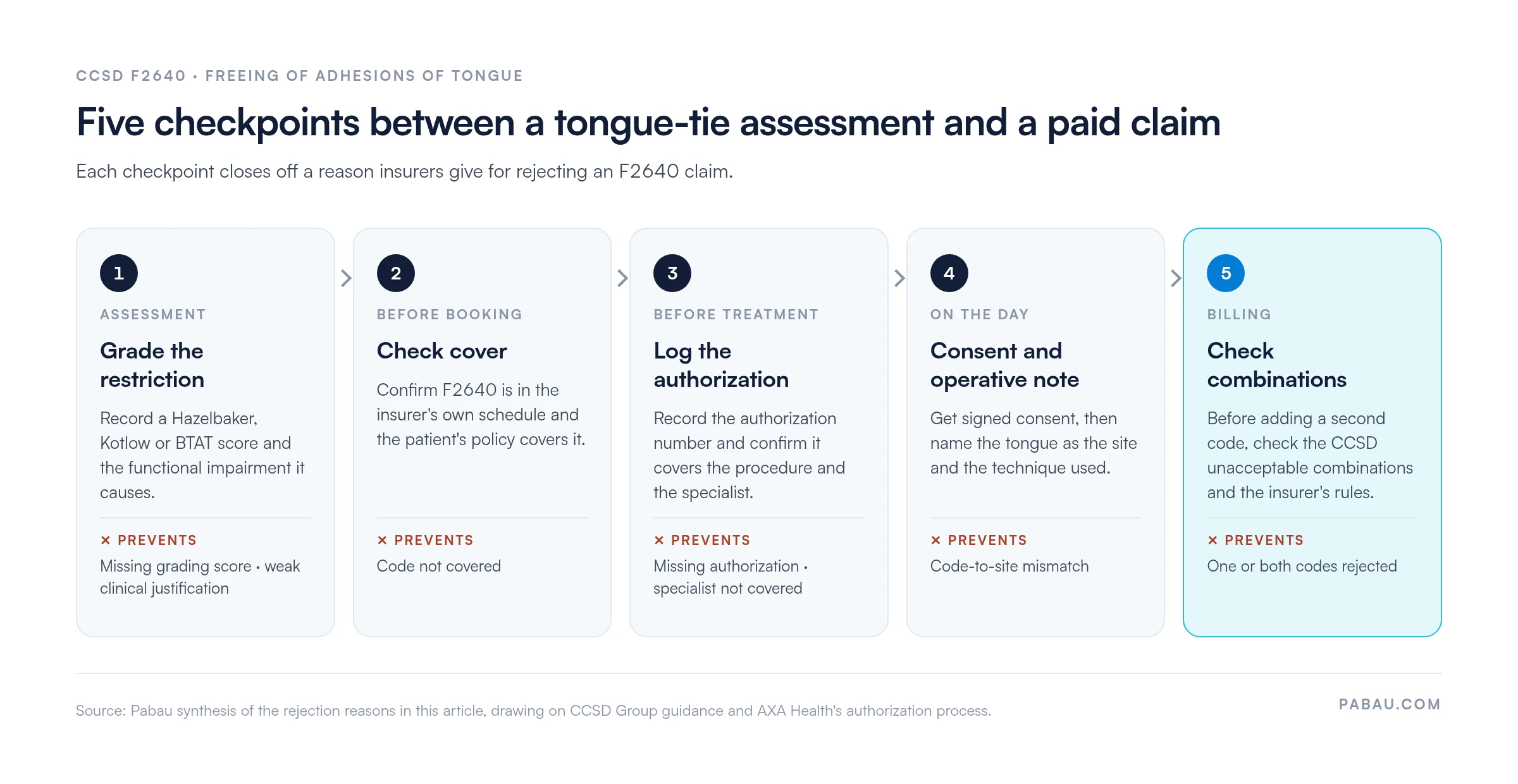
The table pairs each rejection reason with its cause and the fix that prevents it.
Challenging a rejection: When an insurer rejects a claim on clinical grounds, ask what it needs and send the full clinical record. Include the grading score and any speech and language therapy or lactation reports. Follow the insurer’s published query process, and keep a written note of every contact.
Whether F2640 can be billed alongside other codes on the same day depends on the CCSD schedule’s unacceptable combinations and the insurer’s own rules. Getting this wrong can lead the insurer to reject one or both codes.
Consultations: Whether a same-day consultation can be billed separately is the insurer’s decision. Record it as a distinct assessment that came before the decision to operate, and check the insurer’s rules before billing both.
Second procedures: The CCSD technical guide says no common clinical intervention should routinely need more than one code. If you plan to bill a second procedure code, contact the insurer first, as the guide advises.
Anesthesia: Local anesthetic is part of the procedure and is not billed on its own. Where an anesthetist gives a general anesthetic, the anesthetist bills separately under the insurer’s rules.
Two sites: Do not bill F2640 alongside a lip frenulum code unless two separate procedures were performed and recorded. Billing two codes for one release can look like unbundling to the insurer.
Before billing F2640 with a second code, check whether the CCSD schedule marks the pair as an unacceptable combination. Each insurer chooses whether to apply these combinations, so confirm with the insurer too.
Many practices keep the tongue-tie assessment on paper, the consent form in a scanned file and the claim in an insurer portal. That split makes an insurer query slow to answer.
Pabau, the practice management platform we build, keeps the mobility assessment, consent form and operative note on the patient’s record. Its claims management sends UK claims through Healthcode, so the invoice and its supporting notes stay linked.
The result is an F2640 claim you can back up quickly when an insurer asks for evidence.

Pabau’s digital forms and claims management help practices capture assessment, consent and operative notes before billing F2640 and other CCSD codes.

CCSD code F2640 is simple to apply when the clinical record is built to support the claim from the start. That means a recognized grading score, a recorded functional impairment, signed consent and an operative note that names the tongue as the site.
The trade-off is a few extra minutes of documentation before surgery. In return, the practice avoids chasing an insurer for payment after the event. Book a demo to see how Pabau keeps CCSD F2640 records and UK insurer claims together.

Billing other CCSD codes for Bupa patients? Bupa CCSD procedure codes covers how Bupa uses the schedule, its fee rules and its claim requirements.
Removing a tongue lesion rather than releasing adhesions? CCSD code F2310 covers excision or destruction of a lesion of the tongue.
Planning a tongue flap? CCSD code F2660 explains coding and billing for first-stage and second-stage tongue flaps.
CCSD code F2640 covers freeing of adhesions of the tongue in the UK private healthcare schedule. It includes frenulum division (frenotomy) and frenulum excision (frenectomy) when restricted tongue mobility is the confirmed indication. The descriptor is technique-neutral, so sharp dissection, diathermy and laser release all fall under it.
A frenotomy divides the frenulum without removing tissue, while a frenectomy removes part of the frenulum and usually needs sutures. Both can fall under CCSD F2640 when the tongue is the site. The operative note should say which technique was used, so the insurer can match it to the code.
UK private insurers and providers use CCSD codes. The schedule is maintained by a group with representatives from Bupa, Vitality, AXA Health and Aviva. A code’s place in the schedule does not guarantee cover, because each insurer keeps its own schedule and sets its own fees. Check the patient’s insurer before treatment.
Usually, yes. UK private insurers such as AXA Health ask members to authorize planned treatment before it happens, and the patient receives an authorization number. Check that it covers the procedure itself, not only the first consultation. Authorization does not guarantee payment, so the code and clinical record still need to match.
The usual reasons are a missing assessment score, weak evidence of functional impairment or a code that does not match the site. Missing authorization and a code the insurer does not cover are also common. To challenge a rejection, ask the insurer what it needs and send the full clinical record. Include the grading score and any speech and language therapy or lactation reports.
It depends on the insurer. Record the consultation as a separate assessment that came before the decision to operate. Then check the insurer’s rules on billing a consultation and a procedure on the same day before you send both codes.
CCSD F2640 is used at any age. That includes newborns whose tongue-tie causes breastfeeding difficulties, children whose restricted tongue movement affects speech and adults with congenital or acquired adhesions. Check the patient’s policy terms, because cover depends on the insurer rather than the code.





