



CCSD code G5100: Bypass of duodenum billing guide
CCSD code G5100 bills a bypass that leaves the duodenum in place CCSD code G5100...

Last Updated: Oct 16, 2026
CPT Code 36410 is the procedure code for venipuncture that needs the skill of a physician or other qualified health care professional. It applies only to patients age 3 years and older. The American Medical Association’s CPT code set lists it as a separate procedure, billed when a routine draw is not clinically feasible.
This guide covers the official descriptor and how 36410 differs from CPT 36415. It also covers the documentation payers expect, applicable modifiers, 2026 Medicare payment, and the billing errors behind most denials.
Who performed the draw is the defining criterion. A routine phlebotomist draw that is not clinically feasible moves the service to 36410. A physician or other qualified health care professional must perform or directly supervise it. Otherwise the more commonly billed CPT 36415 applies.

CPT Code 36410 covers venipuncture requiring the skill of a physician or other qualified health care professional, for patients age 3 and older.
CPT 36415 covers routine venipuncture by any trained staff member, so 36410 applies only when clinical complexity requires a qualified clinician.
Documentation must show why the standard draw was not feasible, which clinician performed or supervised it, and the patient’s age.
Medicare pays 36410 under the Physician Fee Schedule. CPT 36415 carries no RVUs and is paid a flat $9.34 specimen collection fee.
Practice management software like Pabau flags missing 36410 documentation before submission and files the claim electronically through the Claim.MD clearinghouse.
The AMA CPT codebook words the descriptor in five clauses, and each one controls a different part of the claim. Read the left column of the table below from top to bottom and you have the descriptor in full.
The code sits within the CPT 36400 series covering venipuncture and transfusion procedures. It is not a surgical code and carries no global period. Each medically necessary draw may be reported separately, subject to payer frequency limits and Correct Coding Initiative (CCI) edits.
CPT 36415 covers routine venipuncture, described as collection of venous blood by venipuncture. It carries no clinician requirement and no age restriction. It is the code most practices use for standard lab draws performed by nurses, medical assistants, or phlebotomists.
Two errors dominate this code family. The first is billing 36415 for a draw that a physician or other qualified professional had to handle, which leaves money on the table. The second is billing 36410 when no such clinician took part, which is upcoding. The code follows who performed or supervised the draw at the time, and hindsight about difficulty carries no weight.
CPT Code 36410 applies when routine venipuncture by non-physician staff is not clinically feasible and a qualified clinician must intervene. Confirm all three of the following before billing it.
The clinician’s presence is the billable element here, and a few other Medicare codes are built the same way. CPT 99183 pays a physician for attending and supervising each hyperbaric oxygen therapy session, which demands physical presence rather than office-suite availability.
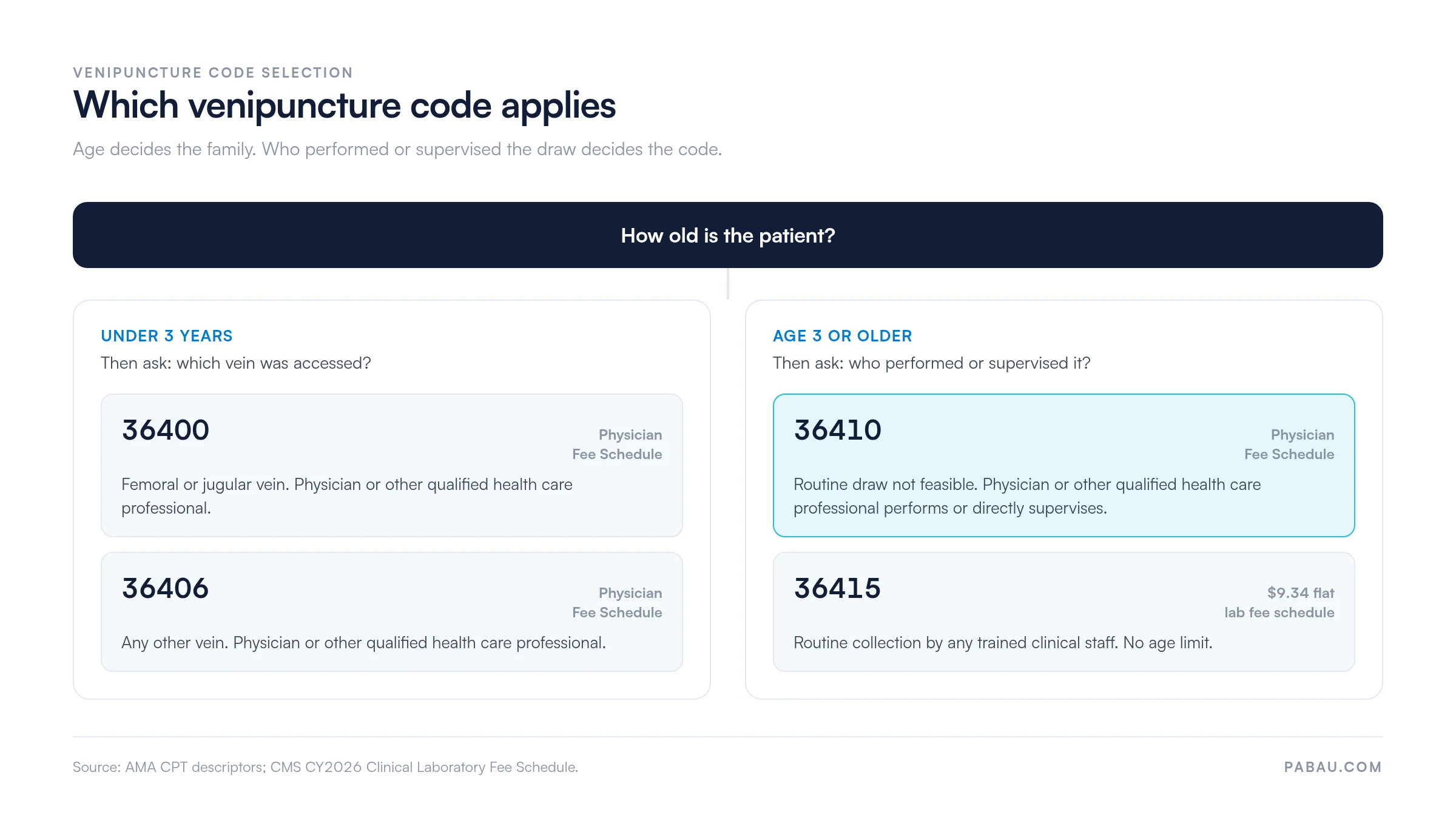
The four venipuncture codes sort on two questions, asked in this order: the patient’s age, then who performed or supervised the draw. Each code here covers blood drawn from a vein. Access placed to start an infusion is reported with 36000 instead. The chart below runs that sequence end to end.
Confirm coverage for the date of service before you code. Some commercial payers treat 36410 as non-covered under certain plan exclusions. Pre-authorization or an advance beneficiary notice (ABN) may be needed before you bill Medicare for a draw that may not be covered.
Weak documentation is the leading cause of 36410 denials. Treat it as a three-element test. The record must confirm why the standard draw was impossible, which clinician handled it, and that the patient was old enough. All three have to be in the note for the claim to survive an audit.
Use this checklist when reviewing charts before you submit a 36410 claim. Compliance starts in the clinical note, well before the claim form is built.
Capturing these fields at the point of care lowers audit risk. Reconstructing them from memory at billing time is where most 36410 notes fall apart.
CPT Code 36410 may need a modifier when it is billed alongside other services on the same date, or when a specific payer rule applies. The table below covers the modifiers most relevant to venipuncture billing. Verify current guidance with each payer, since commercial plans sometimes deviate from Medicare rules.
One CCI risk is worth flagging. When 36410 is billed on the same date as certain evaluation and management codes, CMS NCCI edits may bundle the venipuncture into the E/M service. Modifier -59 or an X-modifier on 36410 can bypass that edit. Use it only where the draw was a separate, distinct service with its own documentation.
Medicare pays CPT Code 36410 under the Physician Fee Schedule, because the code carries work, practice expense, and malpractice relative value units (RVUs). CPT 36415 is not paid that way at all. It carries no RVUs and holds status indicator X, which puts it outside the fee schedule.
For 36415, Medicare instead pays a flat specimen collection fee of $9.34 under the CY2026 Clinical Laboratory Fee Schedule. For 36410, use the CMS Physician Fee Schedule lookup tool to retrieve the 2026 rate for your locality. The conversion factor and the geographic practice cost indices (GPCIs) adjust the final payment by region.
CPT Code 36410 has two distinct Medicare payment rates, set by the place-of-service (POS) code reported on the claim.
Reporting the wrong POS code for 36410 generates an overpayment when a non-facility rate is claimed for a hospital-based service. It generates an underpayment the other way round. Verify the POS code before every submission, especially in multi-location practices where the same clinician works across facility and non-facility sites.
Most 36410 denials trace back to one of five preventable errors. Recognizing these patterns is the first step toward a clean claim submission.
Run a monthly query on your 36410 claims to separate facility from non-facility settings. If 36410 claims with POS 21, 22, or 23 return at the non-facility rate, your billing system has the wrong place-of-service code. One fix removes a recurring source of overpayment risk.
CPT Code 36410 sits in a family of venipuncture codes separated by patient age and access site. Choosing between them means knowing the patient’s age and which vein was used. The AAPC Codify CPT lookup carries the full descriptor language for each one, and our CPT code directory covers the procedures you bill alongside them.
Note that 36400 and 36406 are age-specific codes for patients under 3, not harder versions of 36410. Age is the controlling factor, not complexity. A genuinely difficult draw in a 2-year-old uses 36400 or 36406, however much skill it took.
When the clinical note and the claim form live in separate systems, the three-element test gets completed after the fact. That is when the reason for complexity goes missing, or the supervising clinician’s name never reaches the claim. Billing staff then chase details that nobody wrote down.
Practice management software like Pabau closes that distance at the point of care. Pabau’s claims management software connects the clinical note directly to the claim. Billing staff see whether the required 36410 fields are populated before the claim is transmitted. Multi-location practices gain the most, because clinicians handle complex draws at sites with different POS codes.
Pabau submits 36410 and other CPT claims in the 837P format through Claim.MD, our US clearinghouse partner, which reaches thousands of payers. Built-in CPT and ICD-10 catalogues and real-time eligibility checks sit in the same workflow, so the coder is not switching systems mid-claim.
Denial reasons return as CARC codes on the electronic remittance advice. Your billing team can then separate the 36410 claims that failed on documentation from those that failed on eligibility or payer policy. Each group gets fixed in one pass.
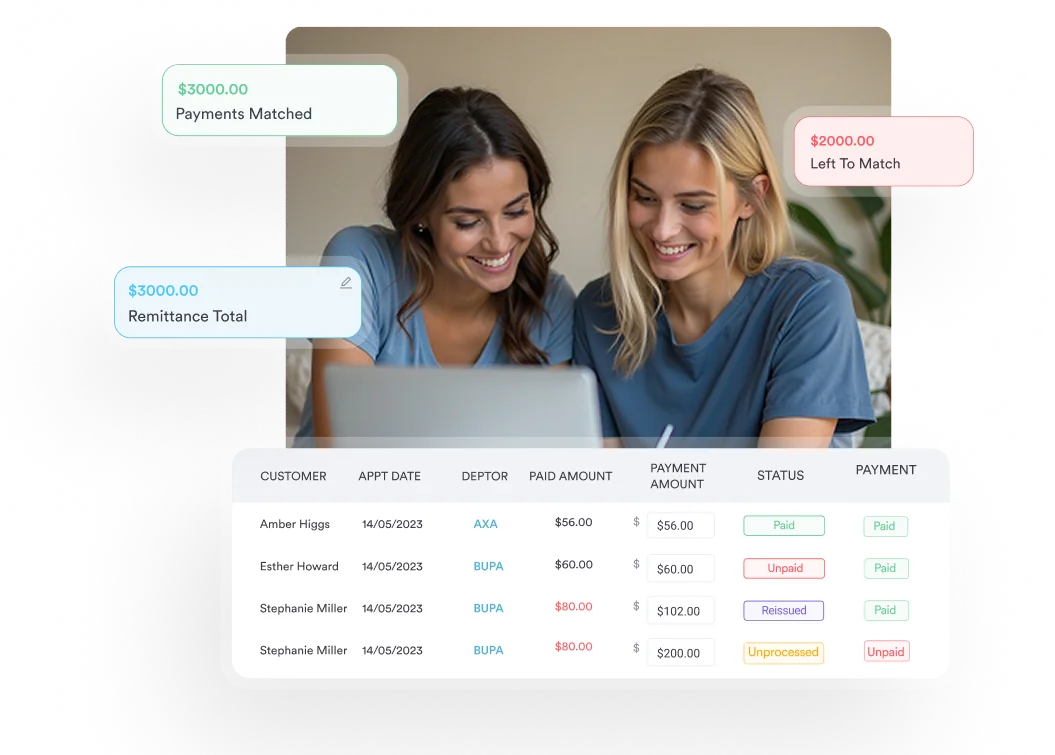

Pabau flags missing clinician documentation, applies the right POS code, and submits 36410 claims through Claim.MD. Your team catches errors before the payer does.

CPT Code 36410 turns on one auditable fact. Did a physician or other qualified health care professional perform or supervise the draw, and does the note say so? Practices that bill it cleanly record the clinician’s name, the reason for complexity, and the patient’s age while the patient is still in the room.
The payoff per claim is modest and the audit exposure is not. A documented 36410 pays more than a routine 36415 collection, which Medicare settles at a flat $9.34. An undocumented one can invite a refund request years later.
Decide today which of your last fifty venipuncture claims would survive that review. Book a demo to see how Pabau keeps venipuncture documentation and claim submission inside one workflow.

Need to understand how claims reach payers? Medical claims clearinghouse overview explains how the clearinghouse layer validates and routes CPT claims before they reach Medicare or commercial payers.
Want to reduce denials systematically? Denial codes in medical billing breaks down the CARC and RARC codes that appear on 835 remittances when 36410 claims are rejected.
Looking for the full billing picture? Best medical billing software for US practices compares the platforms that handle venipuncture claim workflows end to end.
CPT Code 36410 reports venipuncture that needs the skill of a physician or other qualified health care professional, in patients aged 3 years and older. It applies when a routine draw by other staff is not clinically feasible, because of collapsed veins, complex anatomy, or the patient’s condition. Routine venipuncture is CPT 36415 instead.
A physician or other qualified health care professional must either perform the draw or directly supervise it. Under CMS rules, direct supervision means that clinician is in the office suite and immediately available. Being on call or elsewhere in the building does not meet the threshold, and will not support the claim on audit.
CPT Code 36410 applies only to patients aged 3 years and older. Patients under 3 require CPT 36400 for the femoral or jugular vein, or CPT 36406 for another vein site. Both are pediatric-specific codes that also need the skill of a physician or other qualified health care professional. Billing 36410 for a patient under 3 is a coding error that payers flag.
Use CPT 36415 whenever a nurse, medical assistant, or phlebotomist performs a routine venipuncture without a qualified clinician taking part. That holds however difficult the draw turns out to be. Billing 36410 afterwards, because the draw proved harder than expected, is upcoding without contemporaneous documentation.



