HCPCS code J3471: Hyaluronidase ovine injection billing guide
HCPCS code J3471: Descriptor, code type, and quick-reference data HCPCS code J34...

Last Updated: Oct 14, 2026

CPT code 96360 describes intravenous infusion for hydration, initial, 31 minutes to 1 hour – it requires clinical medical necessity, not elective wellness use.
The minimum billable threshold is 31 minutes. Infusions of 30 minutes or less are not reportable under any payer, including Medicare.
Never report 96360 as a concurrent infusion service. When hydration runs alongside a therapeutic infusion, use the add-on code 96361 for each additional hour only.
Pabau’s claims management software helps IV therapy clinics track infusion duration, attach documentation, and reduce 96360 claim denials.
Most IV hydration claim denials trace back to one of three mistakes: billing a 30-minute infusion as if it met the 31-minute threshold, reporting 96360 as a concurrent service, or submitting without adequate medical necessity documentation. CPT code 96360 is one of the more scrutinized codes in the hydration and infusion family, according to the CMS Physician Fee Schedule. Payers routinely exclude elective wellness services, and 96360 sits squarely at that boundary with medically necessary treatment. This guide covers the code description, billing rules, documentation requirements, reimbursement data, modifiers, and the relationship between 96360 and its add-on code, CPT code 96361. A pre-authorization number has to reach the claim, and a missing reference is a common avoidable denial.
This guide is written for clinic administrators, medical billers, and healthcare providers working in settings where IV hydration is a billable service – including primary care offices, infusion centers, urgent care clinics, and IV therapy practices. If you run an IV therapy clinic, understanding 96360 billing is foundational to clean claim submission.
CPT code 96360 describes intravenous (IV) infusion for hydration purposes, covering the initial service window of 31 minutes to 1 hour. The American Medical Association (AMA), which maintains the Current Procedural Terminology (CPT) code set, places 96360 within the Medicine Services and Procedures section, codes 96360-96379, which collectively describe hydration, therapeutic, prophylactic, and diagnostic injections and infusions.
The Centers for Medicare and Medicaid Services (CMS) developed the hydration codes 96360 and 96361 to report specific therapeutic interventions. They apply to patients presenting with dehydration and volume loss that requires clinically necessary intravenous fluid. The code targets genuine medical need. Medicare and most commercial payers typically exclude elective IV wellness drips from coverage.
The code applies to prepackaged IV fluids and electrolyte solutions used specifically for hydration. Common examples include normal saline (0.9% NaCl) and Lactated Ringer’s solution. In facility settings, billers use HCPCS code J7030 to separately report the normal saline supply. Note that 96360 covers the administration service, not the drug or fluid itself. Separate supply codes apply depending on the payer and setting.
For clinics exploring IV hydration as a clinical service line, understanding both the administration code and the relevant supply codes is essential. Reviewing IV hydration business requirements in your state adds another compliance layer to this picture.
CPT code 96361 is the add-on code paired with 96360. Billers use it to report each additional hour of IV hydration beyond the initial 31-minute-to-1-hour window. Both codes work together, but they are not interchangeable. Practitioners cannot always bill them alongside each other in the way they sometimes assume.
| Code | Description | Type | Minimum time |
|---|---|---|---|
| 96360 | IV infusion, hydration; initial, 31 minutes to 1 hour | Base code | 31 minutes |
| 96361 | IV infusion, hydration; each additional hour | Add-on code | Each additional hour beyond the first |
The add-on structure means billers never report 96361 without 96360. The reverse is not always true, however. If hydration runs alongside a therapeutic infusion, 96360 cannot serve as the primary code. This is one of the most common billing errors in infusion clinic settings and triggers National Correct Coding Initiative (NCCI) edits.
Staff at mobile IV therapy businesses face this complication regularly, particularly when a patient receives both a hydration drip and a therapeutic vitamin infusion in the same encounter.
Track infusion start and stop times in your clinical documentation system. If a hydration infusion runs less than 31 minutes, it is not reportable under 96360 or any other code. Build your intake workflow to capture this data automatically so no billable minutes slip through.
Billing 96360 correctly means following a clear set of rules. These govern when the code applies, what it cannot appear alongside, and what documentation must support the claim. Noridian Medicare, one of the major Medicare Administrative Contractors (MACs), specifies that billers should not report 96360 as a concurrent infusion service. The Medi-Cal billing manual carries the same rule, and CMS coverage article A54635 reinforces it.
When a patient receives IV hydration at the same time as a therapeutic or prophylactic infusion, payers treat the hydration as concurrent. In this scenario, 96360 is not the correct code for the hydration component. The therapeutic infusion codes (96365-96379) govern the primary service instead. Payer rules determine whether billers can capture hydration separately. Reporting 96360 as the primary code in concurrent situations frequently causes claim denials and NCCI edit conflicts.
Hydration infusions of 30 minutes or less are not reportable. This threshold appears in both the Medi-Cal billing manual and published infusion coding education materials from Noridian. The minimum is 31 minutes for the initial service. If the infusion stops before that point for any clinical reason, no administration code applies. Document the actual start and stop time in the patient record regardless — both for audit purposes and for quality of care tracking.
Where the infusion happens affects reimbursement. Office settings, infusion centers, and outpatient hospital departments each carry different place of service (POS) codes. They may also attract different facility versus non-facility payment rates. In facility settings, the hospital or infusion center submits a separate claim for the technical component using revenue code 260. The physician may then bill separately for the professional component. A single claim typically covers both in a non-facility physician office. Confirm the correct POS code with your MAC before billing to prevent systematic underpayment.
Applying these rules consistently across your team requires documented protocols and ideally, software that prompts for the right fields at the point of care. Clinics following IV therapy clinic best practices typically build billing rules directly into their intake and clinical documentation workflows.

Pabau helps IV therapy clinics capture infusion times, attach medical necessity documentation, and submit clean claims. See how our claims management tools work in a live demo.

For flat-fee practices, software built for direct primary care tracks these services without generating insurance claims.
Medical necessity is the central documentation requirement for 96360. Payers — including Medicare, Medicaid, and most commercial insurers — require the clinical record to support the decision to administer IV hydration. A standing order or protocol alone is not sufficient. The note must show that the patient presented with dehydration, volume loss, or another clinically supported indication for IV fluid therapy.
The diagnosis on the claim shapes how a payer reads that necessity. Hydration given for vomiting in pregnancy carries an obstetric diagnosis, and mild hyperemesis gravidarum starting before 20 completed weeks is reported as O21.0.
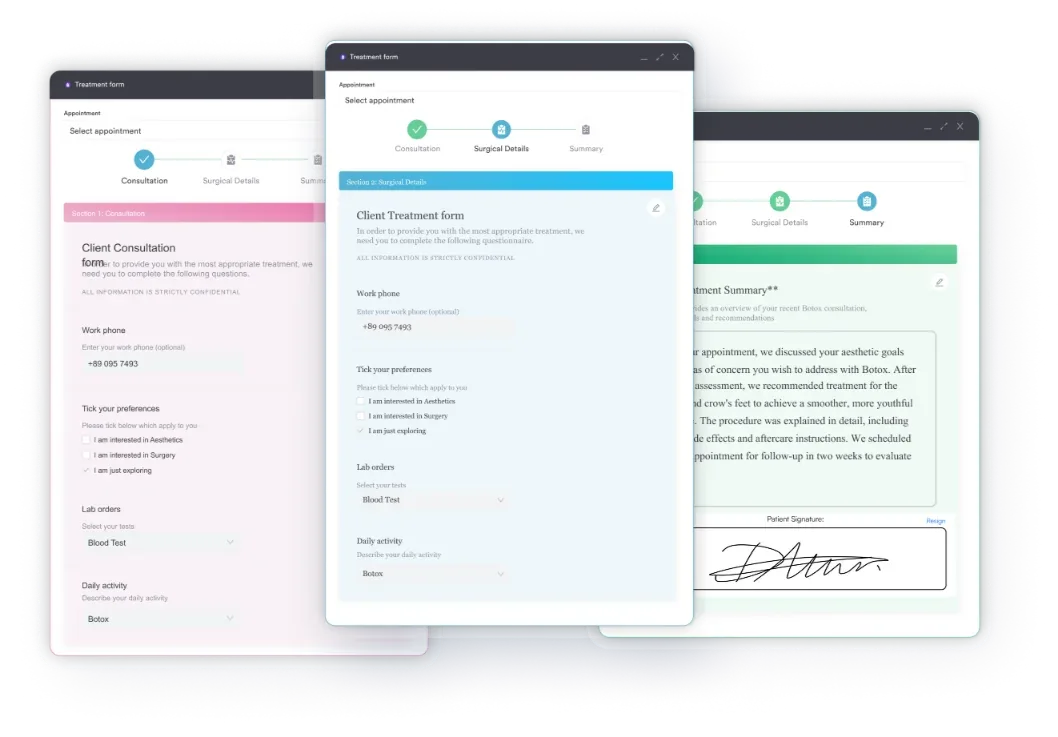
Using structured IV therapy intake forms that capture these fields in real time reduces the manual charting burden and creates an audit-ready record. Pair digital intake forms with your billing system so that documentation gaps trigger a hold before the team submits the claim.
Pabau’s digital forms let IV therapy clinics build condition-specific intake workflows. These capture all required billing fields — infusion times, clinical indications, and practitioner signatures — directly in the patient record.
Reimbursement for CPT code 96360 varies by payer, geography, and setting. The Medicare Physician Fee Schedule sets a national base rate, which MACs then adjust using geographic practice cost indices (GPCIs). For the most current payment amounts, use the CMS Physician Fee Schedule lookup tool. It provides searchable, locality-specific data by code, year, and place of service. The FastRVU 2026 RVU lookup tool lets you retrieve work, practice expense, and malpractice RVU values for 96360, along with calculated Medicare reimbursement estimates.
Medicare and Medicaid apply coverage criteria that most commercial plans mirror, but the details vary. Blue Cross Blue Shield plans follow NCCI guidelines, for example, but may add their own medical necessity criteria beyond the Medicare standard. State Medicaid programs — such as Medi-Cal in California and Louisiana Medicaid — publish maximum allowable units per day. They may also restrict 96360 to specific diagnosis codes. Always verify with the patient’s specific payer before the encounter, not after. The AAPC Codify CPT lookup is a practical tool for confirming code descriptions and reviewing coding notes across payer contexts.
Medicare and most commercial payers do not cover elective IV hydration drips under 96360. This includes the Myers’ cocktail, vitamin C infusions, and similar wellness protocols. Payers treat these as non-covered services when the clinical indication is wellness or optimization rather than diagnosed dehydration or medically necessary fluid replacement. Practices offering both medical and elective IV services must clearly separate billing for each. Insurance claims apply only to medically necessary services. Bill elective services directly to the patient at the point of care. Mixing these in a single claim is both a billing error and a compliance risk.
Run a payer eligibility check and benefits verification before every IV hydration appointment. Confirm whether the patient’s plan covers 96360 under the presenting diagnosis, and document that verification in the chart. This single step can eliminate the majority of post-service denial appeals.
Modifier requirements for 96360 vary by payer. Always confirm them against the specific plan’s billing guidelines. The most common modifiers in infusion billing include:
Not all scenarios require a modifier. When 96360 is the only service on the claim and clearly serves as the primary infusion, no modifier is typically necessary. The most common error is adding modifiers defensively without first checking whether the payer’s CCI edits actually bundle the codes in question. Use the PGM Billing CPT lookup tool to cross-reference code pairs before appending modifiers.
For practices managing multiple infusion service lines. This matters most for practices operating in multiple states, where MAC policies on modifier application differ.
Claim denials for 96360 follow predictable patterns. Identifying the root cause for each denial type lets practices fix the upstream documentation or workflow issue rather than re-submitting the same claim.
Practices that track denial reason codes systematically and route them back to the originating workflow step resolve far more denials permanently than those that re-submit case by case. A strong EMR for IV therapy surfaces denial trends by code, provider, and payer so the practice manager can act on patterns rather than individual claims.
If your practice also offers mobile IV therapy or is considering expanding services, reviewing IV therapy marketing strategies alongside billing optimization helps ensure that new patient volume is matched by clean claim workflows from the start.
96360 rarely stands alone on an infusion claim. Knowing where it sits in the wider code family prevents the hierarchy errors that cause concurrent-billing denials. Only one service per encounter is the “initial” code, and CPT ranks therapeutic and diagnostic infusions above hydration, so a therapeutic push or infusion takes the initial slot when both are performed.
When a therapeutic infusion (96365) or IV push (96374) runs in the same visit as hydration, report that service as the initial code and capture the hydration time with add-on 96361, not 96360. Building these pairing rules into your claims management software stops the wrong code landing in the initial slot.
IV therapy clinics face a specific documentation and billing challenge: the service is time-sensitive, clinically variable, and highly payer-dependent. Manual workflows — whether paper charts, standalone billing software, or generic EHRs not built for infusion — tend to leave gaps that become denial patterns. Pabau’s claims management software connects clinical documentation directly to billing. Staff capture the fields that determine whether a 96360 claim succeeds at the point of care, not after the fact.
For practices wanting to build a stronger clinical and operational foundation. A structured onboarding process means your team configures billing rules and clinical documentation templates before submitting the first claim, not after the first denial.
To see how the workflow applies to your specific clinic setup, book a demo with the Pabau team.

Billing syringe supplies too? Sterile syringe billing guide explains HCPCS code A4206 and why Medicare Part B incident-to rules bundle syringes into the injection payment.
Billing 2 cc syringes too? 2 cc syringe billing guide covers HCPCS code A4207 for a sterile 2 cc syringe and the NCCI bundling rules to check first.
Billing 3 cc syringes too? 3 cc syringe billing guide covers HCPCS Code A4208 for a sterile 3 cc syringe within the A4206 to A4232 supply code range.
CPT code 96360 is straightforward in concept but demanding in execution. The 31-minute minimum, the concurrent infusion exclusion, and the medical necessity requirement are each a potential denial point if any one of them is missed. Clinics that build these rules into their intake and documentation workflows – rather than relying on billing staff to catch errors post-encounter – see cleaner claims, fewer appeals, and more predictable revenue.
Pabau’s practice management platform gives IV therapy clinics the documentation structure and claims management tools to get 96360 billing right from the first appointment. To see it in practice, book a demo with the Pabau team.
CPT code 96360 reports intravenous infusion for hydration, covering the initial 31 minutes to 1 hour. It applies to clinically necessary IV fluid therapy for dehydration or volume loss — not elective wellness infusions.
96360 covers the initial hydration infusion period of 31 minutes to 1 hour. 96361 is the add-on code for each additional hour and cannot be reported without 96360 as the base.
A minimum of 31 minutes is required — infusions of 30 minutes or less are not reportable under any CPT code. Document exact start and stop times in every patient record.
Not as a concurrent service. When hydration runs alongside a therapeutic infusion, the therapeutic code takes precedence and payer rules determine whether a separate hydration line applies.
Not always — when 96360 is the only service and clearly the primary infusion, no modifier is needed. Use Modifier 59 or XU only when NCCI bundling edits apply, and confirm with each payer first.
Rates vary by locality and place of service. Use the CMS Physician Fee Schedule lookup tool at cms.gov for current payment amounts by jurisdiction.
Yes, but not both as initial services. CPT hierarchy ranks a therapeutic IV push (96374) above hydration, so 96374 is reported as the initial service and the hydration time is captured with add-on code 96361, not 96360. Append a distinct-service modifier only if the payer’s NCCI edits require it.
No. 96361 is an add-on for each additional hour of hydration and always needs a primary infusion code on the same claim. That primary is usually 96360, but under CPT hierarchy it can be a therapeutic or diagnostic infusion code when one is performed in the same encounter.