CCSD code F4600: Incisional drainage of salivary gland abscess
CCSD code F4600: what the descriptor covers CCSD code F4600 covers incisional dr...

Last Updated: Oct 20, 2026
31653 is the CPT code for EBUS-guided bronchoscopy that samples three or more mediastinal and/or hilar lymph node stations or structures. The bronchoscope may be rigid or flexible, and fluoroscopic guidance is included when performed.
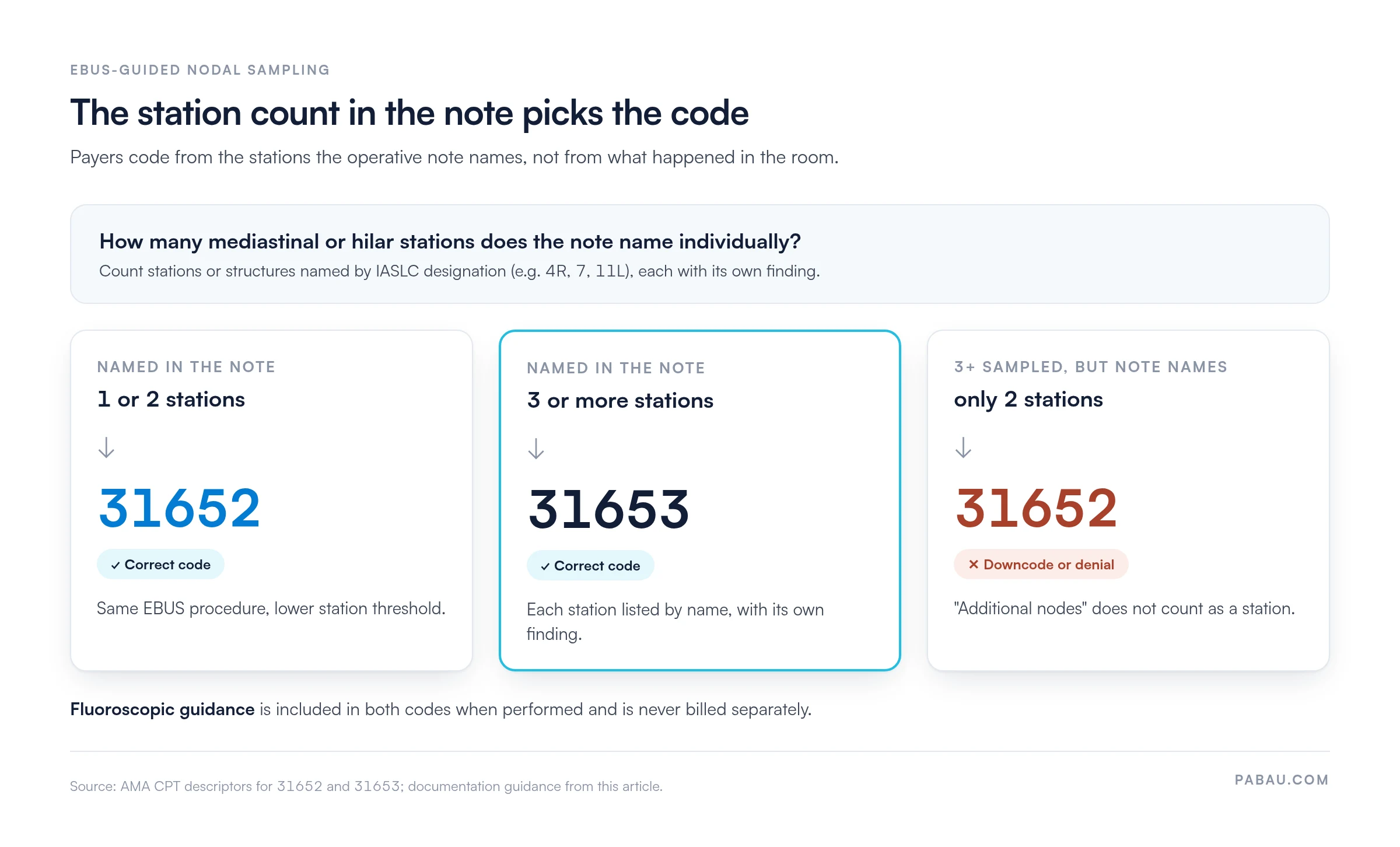
CPT 31652 covers the same procedure for one or two stations, so the station count decides the code and the Medicare payment. An operative note that names fewer than three stations typically downcodes to 31652 or draws a denial, even when more were sampled.
Let Pabau's smart automation suggest the right codes, reduce claim denials, and keep your practice compliant—effortlessly.
Automate repetitive tasks and focus on what matters most—your patients.
Reduce coding errors and ensure compliance with the latest regulations.
Clean claims, fewer denials, and faster reimbursements.
Powerful insights and reporting to help your practice thrive.
HIPAA compliant SOC 2 certified GDPR-compliant Trusted by 4,000+ clinics worldwide

CPT code 31653 requires EBUS-guided sampling of three or more mediastinal or hilar stations or structures. One or two stations code to 31652 instead.
The 31653 descriptor includes fluoroscopic guidance when performed, so you cannot bill it separately.
The operative note must name each lymph node station sampled. A vague reference such as ‘multiple stations’ typically downcodes to 31652 or draws a denial.
Pabau, the practice management platform we build, submits claims electronically through its Claim.MD integration and tracks claim status and ERA remittances.
CPT code 31653 is the procedure code for EBUS-guided bronchoscopy that samples three or more mediastinal and/or hilar lymph node stations or structures. The AMA descriptor begins “Bronchoscopy, rigid or flexible, including fluoroscopic guidance, when performed” and then adds the EBUS element. That element reads “with endobronchial ultrasound (EBUS) guided transtracheal and/or transbronchial sampling (eg, aspiration[s]/biopsy[ies]), 3 or more mediastinal and/or hilar lymph node stations or structures.”
The code sits within the 31615-31661 bronchoscopy range of the CPT code set that the American Medical Association (AMA) maintains.
Three elements must all be present for 31653 to apply. First, the bronchoscope needs EBUS capability, so real-time ultrasound shows each lymph node before the proceduralist samples it. Second, sampling must use transtracheal or transbronchial aspiration or biopsy. Third, the proceduralist must sample and document three or more distinct mediastinal or hilar stations or structures.
The only clinical distinction between 31652 and 31653 is the number of lymph node stations sampled. CPT 31652 applies when one or two mediastinal or hilar stations are sampled via EBUS guidance. CPT code 31653 applies when three or more stations are sampled in the same session. Otherwise, the procedure is identical.
For example, a common coding error occurs when the proceduralist samples three stations, but the operative note names only two and refers vaguely to additional nodes. As a result, the payer counts two stations and typically downcodes to 31652 or denies the claim. The fix is to name each station sampled (e.g., station 4R, 7, 11L) with an individual finding for each, as the diagram below shows.
Several codes in the 31615-31661 range are billed alongside or confused with CPT code 31653. Knowing which are separately billable and which NCCI edits bundle prevents underpayment and audit risk.
Check current NCCI edit files before billing any code pair. CMS updates bundling rules quarterly, so an edit that applied last year may have changed. The AAPC Codify CPT lookup shows current code pair edit status alongside official descriptors.
Also, lavage and endobronchial biopsy each carry their own pairing rules, which the 31624 and 31625 pages explain. Therefore, check the relevant one before you append modifier 59 to either code.
Modifier 59, or its more specific counterpart XS, is the main modifier used with CPT code 31653. It unbundles a co-billed code when that service is clinically distinct. As a surgical procedure, 31653 has no separately billed imaging read, so you do not routinely use modifiers 26 and TC. Still, confirm the PC/TC indicator on the CMS Physician Fee Schedule.
Modifier 59 is the modifier most likely to trigger a post-payment audit. Therefore, reserve it for cases where the operative note documents a different anatomic site, a separate session, or a distinct clinical indication. For example, a transbronchial lung biopsy, which you report as 31628, samples lung tissue rather than lymph nodes. In that case, the note should name the lobe you biopsied.
Before appending modifier 59 to a code billed with 31653, confirm the operative report names the distinct site, distinct session, or distinct clinical reason. A modifier without supporting documentation is audit bait. Build a pre-billing documentation checklist that flags any 31653 claim carrying modifier 59 for a compliance review before submission.
CMS National Correct Coding Initiative (NCCI) edits govern which procedure codes you cannot bill together without a modifier. For CPT code 31653, two bundling points matter most. First, diagnostic bronchoscopy (31622) is always bundled, because the EBUS procedure includes a diagnostic inspection. Second, the descriptor itself includes fluoroscopy when performed, so you cannot bill it separately.
Run that NCCI review before the claim goes out through your claims management software. Otherwise, a bundled pair that surfaces after submission becomes a denial to work instead of a quick correction.
Because CMS updates NCCI edit files quarterly, check the current status of any code pair before billing. Chapter V of the CMS NCCI Policy Manual covers respiratory system codes, including bronchoscopy pairs, and is the main reference here. Finally, build a quarterly NCCI update review into your practice’s billing compliance routine.
CPT code 31653 reimbursement under Medicare is higher than 31652, reflecting the greater clinical complexity of sampling three or more lymph node stations. CMS sets reimbursement rates annually in the Physician Fee Schedule (PFS) final rule, and they vary by geographic area. Therefore, check current payment amounts in the CMS Physician Fee Schedule lookup tool before quoting rates to patients or payers, since figures change each January 1.
Medicare pays the physician for 31653 at one of two rates. In a hospital outpatient department or an ambulatory surgical center, the physician receives the MPFS facility rate, and the facility bills its own fee separately. However, the higher non-facility rate, which adds practice expense RVUs for equipment and staff, applies only when the proceduralist performs it in the office (POS 11).
Pabau sends claims electronically through its Claim.MD clearinghouse integration and tracks each claim’s status. In addition, ERA remittances come back against the claim, so a 31653 payment below the expected RVU-based amount is easy to spot and appeal.
Medicare typically covers EBUS-guided bronchoscopy when it is medically necessary for lung cancer staging, a mediastinal mass, or suspected sarcoidosis or other granulomatous disease. “Medically necessary” in this context means imaging (CT chest or PET scan) has found lymphadenopathy that needs tissue confirmation before clinicians can make treatment decisions.
However, commercial payer prior authorization requirements vary. Most major insurers require the following before authorizing CPT code 31653:
Prior authorization is not universally required for Medicare fee-for-service. Medicare Advantage plans, however, frequently impose authorization requirements that mirror commercial payer policies. Therefore, confirm requirements with each specific plan before scheduling the procedure.
Correct ICD-10-CM pairing is critical for claim acceptance and prior authorization. The diagnosis code must justify the medical necessity of sampling three or more lymph node stations via EBUS. Also, check all codes against the current ICD-10-CM tabular list, as code descriptions and validity change annually.
Use CrossCoder to verify CPT-to-ICD-10 medical necessity crosswalks. Then confirm that the selected diagnosis code supports the procedure under the payer’s local coverage determination (LCD).
Poor documentation is a leading reason payers downcode CPT code 31653 claims to 31652 or deny them. The operative note must let an auditor confirm, without outside help, that three or more distinct lymph node stations were sampled under EBUS guidance.
The procedural note needs the following elements for a clean claim submission:
CPT code 31653 denials trace back to six causes, from station-count documentation to payer policy limits. Each has a specific fix.
Sorting 31653 denials by reason code in your denial management workflow shows whether station-count problems are isolated or systemic. Likewise, tracking those codes against operative note completeness tells you whether to fix documentation or coding. For the CARC codes that accompany these rejections, see our guide to medical billing denial codes.
Run a monthly audit of all 31653 claims by denial reason code. If station-count denials account for more than 20% of rejections, the documentation problem is systemic rather than individual. Schedule a brief training session with proceduralists to review IASLC station nomenclature and note the requirement to name each station explicitly in the operative report.
Billing an EBUS case often means reading the station count from a dictated note, then keying the claim into a separate clearinghouse portal. Every rekeyed field then becomes a chance for the code on the claim to drift from the note.
In Pabau, treatment notes, invoices and claims sit on the same patient record. Pabau pre-fills the claim from data already on that record and sends it electronically through the Claim.MD integration. Its status and ERA remittances then come back to the same record.
Your coders still choose the code and check the NCCI edits, while Pabau handles submission and follow-up. As a result, you rekey less and see in one place which 31653 claims payers paid, short-paid or denied.

Pabau submits claims electronically through its Claim.MD integration and tracks status and ERA remittances. Pulmonology practices see 31653 denials and short payments early.

Treat the operative note as the source of the code. When each station is named with its own finding, 31653 holds up on review. In contrast, when the note says “multiple stations,” expect a downcode to 31652 or a denial, however many nodes were sampled.
Therefore, the practical step is a pre-billing check on every EBUS claim. Count the named stations, confirm the diagnosis supports nodal sampling, and add modifier 59 only where the note documents a distinct service. That check takes minutes per case and protects the higher payment that three-station sampling earns.
Pabau keeps the note, invoice and claim on one patient record and tracks each claim through to remittance. Book a demo to see how it fits your pulmonology billing workflow.

Need to understand how claims reach payers? Medical claims clearinghouse guide explains how electronic claims are validated and routed before reaching Medicare or commercial payers.
Concerned about ERA reconciliation after EBUS claims? Electronic remittance advice explained covers how 835 ERA files map denial reason codes back to specific procedure lines.
Want to verify eligibility before scheduling? Insurance eligibility verification covers the checks that confirm coverage and authorization status before the procedure date.
Adding a lung biopsy to the same session? CPT code 31628 covers transbronchial lung biopsy coding and how it pairs with other bronchoscopy codes.
CPT code 31653 covers EBUS-guided bronchoscopy with transtracheal and/or transbronchial sampling of three or more mediastinal and/or hilar lymph node stations or structures. Fluoroscopic guidance is included when performed. It applies when a pulmonologist or thoracic surgeon uses an ultrasound-equipped bronchoscope to aspirate or biopsy nodes at three or more stations in one session.
CPT 31652 applies when one or two lymph node stations are sampled under EBUS guidance. CPT code 31653 applies when three or more stations are sampled. The procedure is otherwise identical. The station count named in the operative note decides the code. A note that fails to name each station risks a downcode to 31652, even when more stations were sampled.
CMS publishes the work RVU for CPT code 31653 each year in the Medicare Physician Fee Schedule final rule. It is higher than the work RVU for 31652. Check the current year’s wRVU in the CMS Physician Fee Schedule lookup tool or the FastRVU lookup tool. Values update each January, and prior-year figures produce incorrect payment calculations.
CPT code 31653 is most often denied or downcoded for four reasons. The note names fewer than three stations, prior authorization is missing, the ICD-10-CM pairing is invalid, or a co-billed code lacks modifier 59 support. Structured denial tracking by CARC reason code identifies which issue is systemic versus case-specific.