CPT Code 31653: EBUS With 3+ Mediastinal Stations
CPT code 31653: Official descriptor and clinical scope CPT code 31653 is the pro...

Last Updated: Oct 20, 2026
31625 is the CPT code for bronchoscopy, rigid or flexible, including fluoroscopic guidance, when performed, with bronchial or endobronchial biopsy of one or more sites. It's billed once per session, however many sites are sampled.
The code covers tissue taken from the airway wall. Diagnostic bronchoscopy, 31622, is already included, so it isn't reported alongside 31625. Transbronchial lung biopsy has its own code, 31628.
Let Pabau's smart automation suggest the right codes, reduce claim denials, and keep your practice compliant—effortlessly.
Automate repetitive tasks and focus on what matters most—your patients.
Reduce coding errors and ensure compliance with the latest regulations.
Clean claims, fewer denials, and faster reimbursements.
Powerful insights and reporting to help your practice thrive.
HIPAA compliant SOC 2 certified GDPR-compliant Trusted by 4,000+ clinics worldwide

CPT code 31625 covers rigid or flexible bronchoscopy with bronchial or endobronchial biopsy at one or more sites, with fluoroscopic guidance included when performed.
Bill one unit per session, however many sites or bronchi are sampled. Transbronchial lung biopsy is a different code, 31628, with add-on 31633 for each additional lobe.
CPT treats 31622 as a separate procedure that’s already included in 31625, so don’t report the pair together. Modifier -59 is reserved for a genuinely distinct or staged encounter.
Practice management software like Pabau submits and tracks 31625 claims through Claim.MD, but your coders still choose the code and any modifier.
CPT code 31625 is defined by the American Medical Association. The official descriptor reads: Bronchoscopy, rigid or flexible, including fluoroscopic guidance, when performed; with bronchial or endobronchial biopsy(s), single or multiple sites. Three elements of that descriptor carry billing consequences.
First, “rigid or flexible” means the code applies regardless of scope type. Second, “including fluoroscopic guidance, when performed” means fluoroscopy is bundled into 31625 and can’t be billed separately. It still has to be documented when used. Third, “single or multiple sites” means that biopsy of more than one location doesn’t create a second billable unit.
A bronchoscopy with biopsy starts with a flexible or rigid scope advanced through the mouth or nose into the tracheobronchial tree. The physician inspects the airways and takes tissue samples with biopsy forceps. Fluoroscopic guidance, when used, lets the physician position the forceps at a specific site under live imaging.
The procedure note feeds the superbill, so it must capture every element payers look for.
Payers review the operative report against six documentation requirements to determine medical necessity and correct code assignment. Missing any one can generate a medical necessity denial or a request for additional records.
Payers apply a simple standard to bronchoscopy documentation. If it isn’t in the procedure note, they treat it as if it didn’t happen.
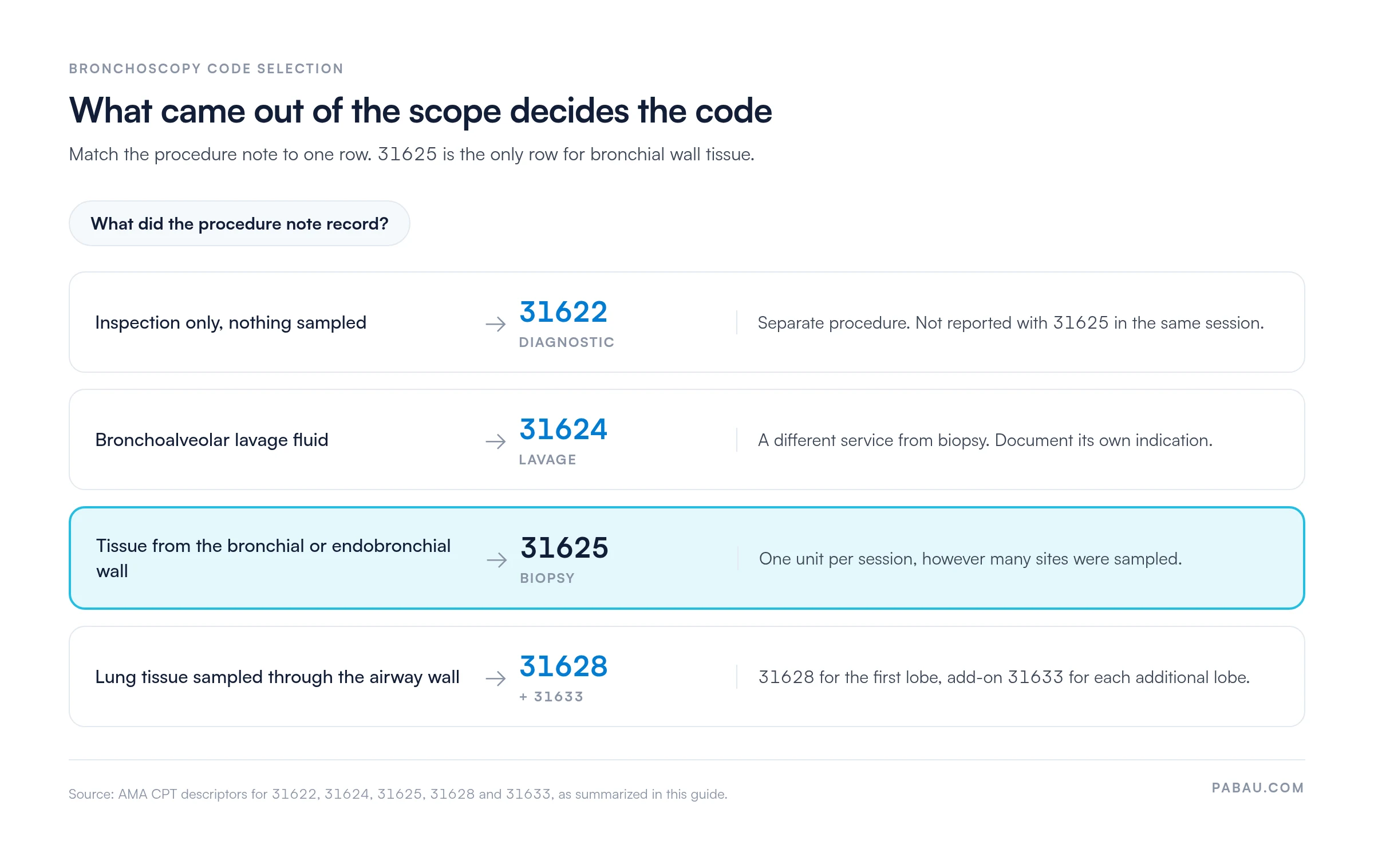
The bronchoscopy code family runs from diagnostic-only 31622 to the transbronchial add-on 31633. Selecting the wrong code is a frequent source of bronchoscopy denials. The usual mistakes are 31622 when a biopsy was taken, or 31625 when only a lavage was performed. According to the AAPC’s CPT code lookup, each code has a distinct clinical trigger.
Key distinctions: 31625 captures tissue from the bronchial or endobronchial wall. If the forceps pass through the bronchial wall into the lung parenchyma, that’s a transbronchial biopsy coded to 31628 for the first lobe. Add 31633 for each additional lobe. Confusing bronchial wall sampling with transbronchial lung sampling is a frequent upcoding risk on audit.
The chart below maps each finding in the procedure note to its code.
CPT code 31625 is billed once per bronchoscopy session, however many biopsy sites are sampled. That holds even when biopsies come from both the left and right bronchi.
The phrase “single or multiple sites” in the official descriptor is the controlling language. Two units of 31625 on the same date of service is a duplicate billing error that NCCI edits will deny.
The add-on code 31633 covers additional lung lobes sampled transbronchially. It’s reported once for each lobe beyond the first, with 31628, not 31625.
Say a pulmonologist biopsied the right middle lobe bronchial wall and then lavaged the left lower lobe. The claim carries 31625 for the biopsy and 31624 for the lavage, not two units of 31625. Check the current NCCI table for the pair before adding any modifier.
Run a monthly audit of every 31625 claim billed with more than one unit. That single query catches duplicate billing before payers do. Filter your claims report by CPT code and unit count across the billing period.
Modifier selection for CPT code 31625 determines whether claims pay, deny, or trigger an audit. Payers apply National Correct Coding Initiative (NCCI) edits, which automatically fold lower-value codes into the main code billed on the same date.
The pairing that tempts coders most is 31622 with 31625. CPT labels 31622 a separate procedure, and it’s already part of any bronchoscopy with biopsy. So the pair generally shouldn’t be reported together at all, with or without modifier -59.
Modifier -59 is the most frequently misapplied modifier on bronchoscopy claims. It’s legitimate only when the documentation shows a genuinely distinct service, such as a separate session. Appending -59 just to get past a bundling edit is a compliance violation.
The CMS Medicare Physician Fee Schedule sets annual payment rates for CPT code 31625 that vary by place of service. Non-facility rates (office or outpatient clinic) are typically higher because the practice bears the overhead. Facility rates are lower because the hospital outpatient department, ambulatory surgery center (ASC) or inpatient facility bills separately for resources.
The figures below reflect 2025 national average rates, and CMS updates them each January. Verify current values directly through the CMS MPFS lookup before billing.
Use the FastRVU lookup tool to calculate location-adjusted reimbursement for 31625 with your practice’s geographic practice cost index (GPCI).
Prior authorization requirements for CPT code 31625 vary by payer type and plan. Medicare fee-for-service doesn’t require prior authorization for bronchoscopy with biopsy in most clinical scenarios. Documentation must still support medical necessity under the applicable Local Coverage Determinations (LCDs). Medicare Advantage plans and commercial insurers are more complex, so check authorization as part of eligibility verification at scheduling.
When authorization is obtained, record the authorization number on the claim and in the patient’s chart. Claims submitted without a required authorization number are denied on a technical basis. Those denials are harder to overturn on appeal than medical necessity denials.
Most denials on CPT code 31625 are preventable. The medical billing denial codes payers return on bronchoscopy claims cluster around four root causes. They are unbundling, duplicate billing, missing documentation, and missing authorization. Knowing the trigger for each denial type lets practices fix the cause instead of appealing claim by claim.
Denial management for bronchoscopy claims works best when practices track denial reasons by code rather than by claim volume. A recurring reason on 31625 usually points to one fixable habit in the procedure note or the charge entry.
Bronchoscopy with biopsy rarely appears as a standalone claim. Pulmonologists often perform additional procedures in the same session, and the pathologist bills separately for the specimens. Knowing which companion codes NCCI bundles and which are separately billable is essential for a clean 837 electronic claim. Check each pair against the current NCCI table before the claim leaves the practice.
Pathology codes (88305, 88307) are submitted by the laboratory or pathologist as a separate claim. The bronchoscopist doesn’t report pathology codes. Including pathology on the physician’s claim generates an unbundling denial.
Review NCCI edit tables quarterly for bronchoscopy code pairs. CMS updates NCCI edits four times a year, and bundling rules for the bronchoscopy family change periodically. A pairing that passed last quarter may need different documentation this quarter.
In many pulmonology practices, a coder checks the procedure note against the code by hand. The claim is then re-keyed into a clearinghouse portal, and rejections get chased through a separate inbox.
Pabau’s claims software for specialty practices keeps the procedure note, the diagnosis and the charge on one patient record. The claim is pre-filled from data already on that record and submitted through Pabau’s Claim.MD integration.
Your coders still choose the CPT code and any modifier. Claim.MD returns clearinghouse edit responses and claim status, and remittances come back with their denial reason codes. Your team sees why a 31625 claim was rejected and fixes that cause instead of guessing.
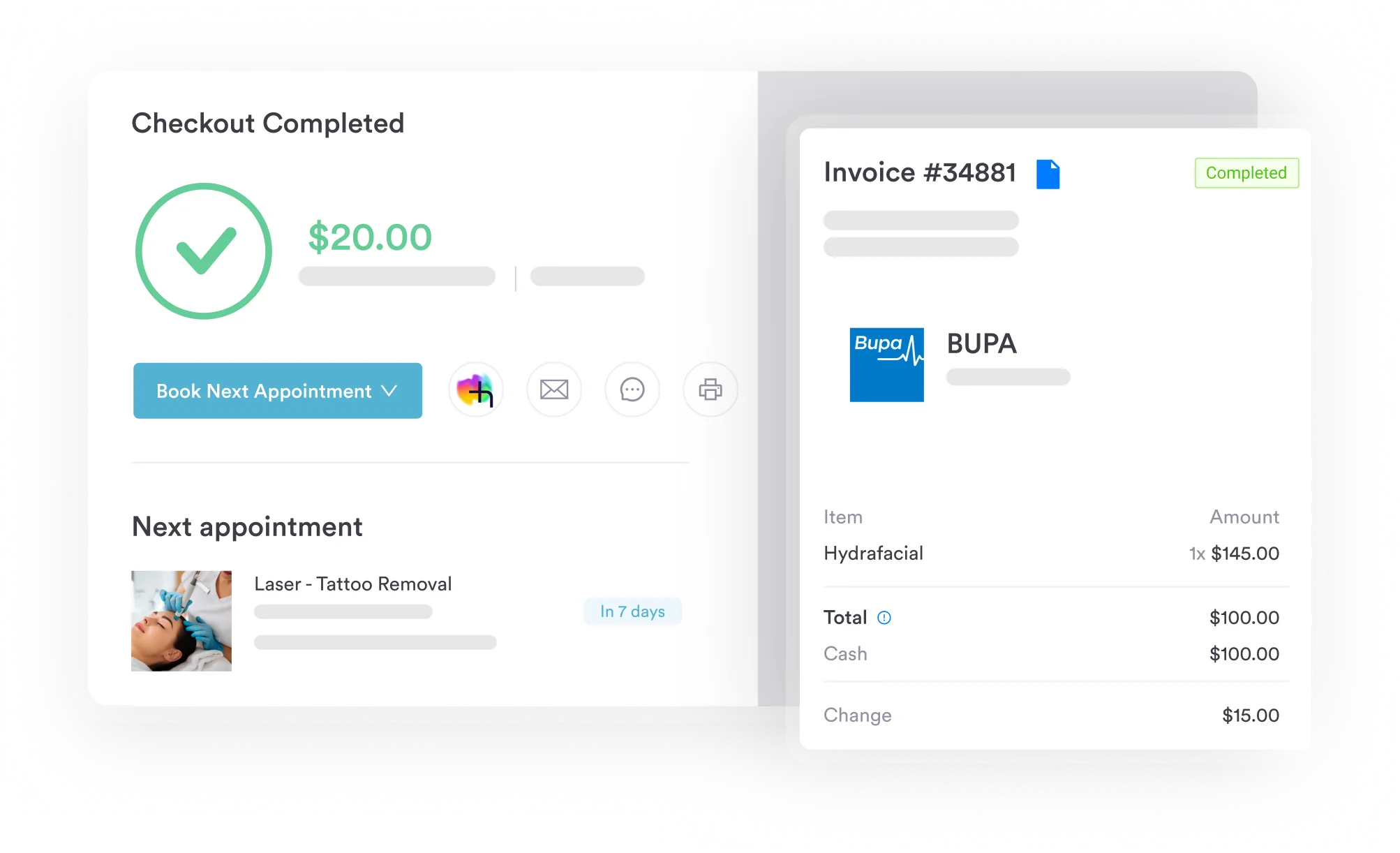

Pabau keeps the procedure note, diagnosis and charge on one record, then submits and tracks bronchoscopy claims through Claim.MD. Your team sees each rejection reason and fixes it faster.

Correct billing for CPT code 31625 starts with the procedure note, not the code list. The specimen type decides between 31625, 31624 and 31628, and the unit count stays at one.
The habit worth breaking is reaching for modifier -59 whenever 31622 lands on the same claim. Drop 31622 instead, and keep -59 for the rare encounter the documentation genuinely separates.
Practices that settle those two decisions at the note stage spend far less time on appeals. Book a demo to see how Pabau keeps bronchoscopy notes, charges and claim status on one record.

Need a framework for managing claim denials across your pulmonology practice? Denial management in healthcare covers the systematic approach to tracking, appealing, and preventing claim rejections.
Want to understand how electronic claims move from submission to payment? Electronic remittance advice (ERA) explains how 835 remittance files carry CARC codes back to your billing team after every adjudicated claim.
Looking for a clean-claim checklist before submission? What is a clean claim outlines the elements every bronchoscopy and procedure claim must include to avoid preventable rejections.
Filing bronchoscopy claims electronically? What is an 837 file? walks through the electronic claim format that carries 31625 and its companion codes to the payer.
Auditing your billing against federal rules? Medical billing compliance explains the laws behind unbundling and modifier misuse, with a downloadable checklist.
CPT code 31625 is the procedure code for rigid or flexible bronchoscopy with bronchial or endobronchial biopsy at one or more sites. Fluoroscopic guidance is included when performed. It’s used when a physician advances a bronchoscope into the airway and takes tissue samples from the bronchial or endobronchial wall.
No. CPT 31625 is billed once per session regardless of the number of biopsy sites sampled. The descriptor language “single or multiple sites” explicitly covers multi-site sampling under one unit. Billing two units for bilateral bronchial sampling is a duplicate billing error that NCCI edits will deny.
The procedure note must include the clinical indication, the scope type (rigid or flexible), the anatomical sites biopsied, and the specimen count. It also records fluoroscopic guidance when used, plus the procedure findings. Vague documentation such as “multiple sites biopsied” without anatomical detail increases audit risk and medical necessity denial rates.
The most common companion codes are 31624 for bronchoalveolar lavage and 31628 for transbronchial lung biopsy of the first lobe. Add-on 31633 covers each additional lobe and is reported with 31628. The laboratory bills pathology code 88305 separately, and the anesthesiologist reports anesthesia. Diagnostic bronchoscopy, 31622, is included in 31625 and isn’t billed with it.