CCSD Code S1740: Large myocutaneous flap billing guide
CCSD Code S1740: Definition and clinical scope CCSD Code S1740 covers the elevat...

Last Updated: Nov 13, 2026
Billable Code
31615 is the CPT code for tracheobronchoscopy through an established tracheostomy incision. The scope enters through the existing stoma and can inspect both the trachea and the bronchi under this one code.
Access route decides the code. 31615 applies only when the scope passes through the stoma, not the mouth or nose. Payers down-code the claim to 31622 when the note does not record the stoma as the access point.
Let Pabau's smart automation suggest the right codes, reduce claim denials, and keep your practice compliant—effortlessly.
Automate repetitive tasks and focus on what matters most—your patients.
Reduce coding errors and ensure compliance with the latest regulations.
Clean claims, fewer denials, and faster reimbursements.
Powerful insights and reporting to help your practice thrive.
HIPAA compliant SOC 2 certified GDPR-compliant Trusted by 4,000+ clinics worldwide

CPT code 31615 covers tracheobronchoscopy through an established tracheostomy incision, not the oral or nasal route billed with CPT 31622.
The procedure note must explicitly document the stoma as access point and the extent of inspection (trachea only or trachea plus bronchi).
For 2026, Medicare assigns 31615 a work RVU of 1.79 and a 000 global period, paying about $173 non-facility and $102 facility nationally.
Pabau, the practice management platform we build, turns those note requirements into structured fields so the claim matches the procedure.
CPT code 31615 describes tracheobronchoscopy through an established tracheostomy incision. The American Medical Association (AMA) publishes this code within the 31600-31899 trachea and bronchi range (endoscopy codes begin at 31615). During the procedure, a flexible or rigid bronchoscope passes through the existing tracheostomy stoma. The physician inspects the tracheal lumen and, when clinically indicated, advances into the mainstem bronchi.
The code’s “tracheobronchoscopy” wording covers inspection of the trachea and the bronchi through the stoma. A trachea-only look and a look that continues into the bronchi both report as 31615. No add-on code is needed for bronchial inspection done through the stoma in the same session.
CPT code 31615 bundles the diagnostic visual inspection of the trachea and bronchi when performed through the established stoma. The bundled services include: Introduction of the scope, traversal of the tracheal lumen, and visual examination of bronchi if performed. No separate endoscopy charge is billable for the same session via the same access route.
Services outside 31615 that can be reported separately, with appropriate documentation and modifier use:
The key exclusion to watch: Bronchoscopy codes 31622 through 31652 describe procedures performed via the standard orotracheal route. That block also holds therapeutic codes such as 31641, which covers bronchoscopic tumor destruction.
Reporting 31615 alongside those codes for the same session triggers NCCI bundling edits. Modifier 59 or an X modifier can override the edit when the procedures are distinct and separately documented. The documentation must then establish different access routes or non-overlapping service times.
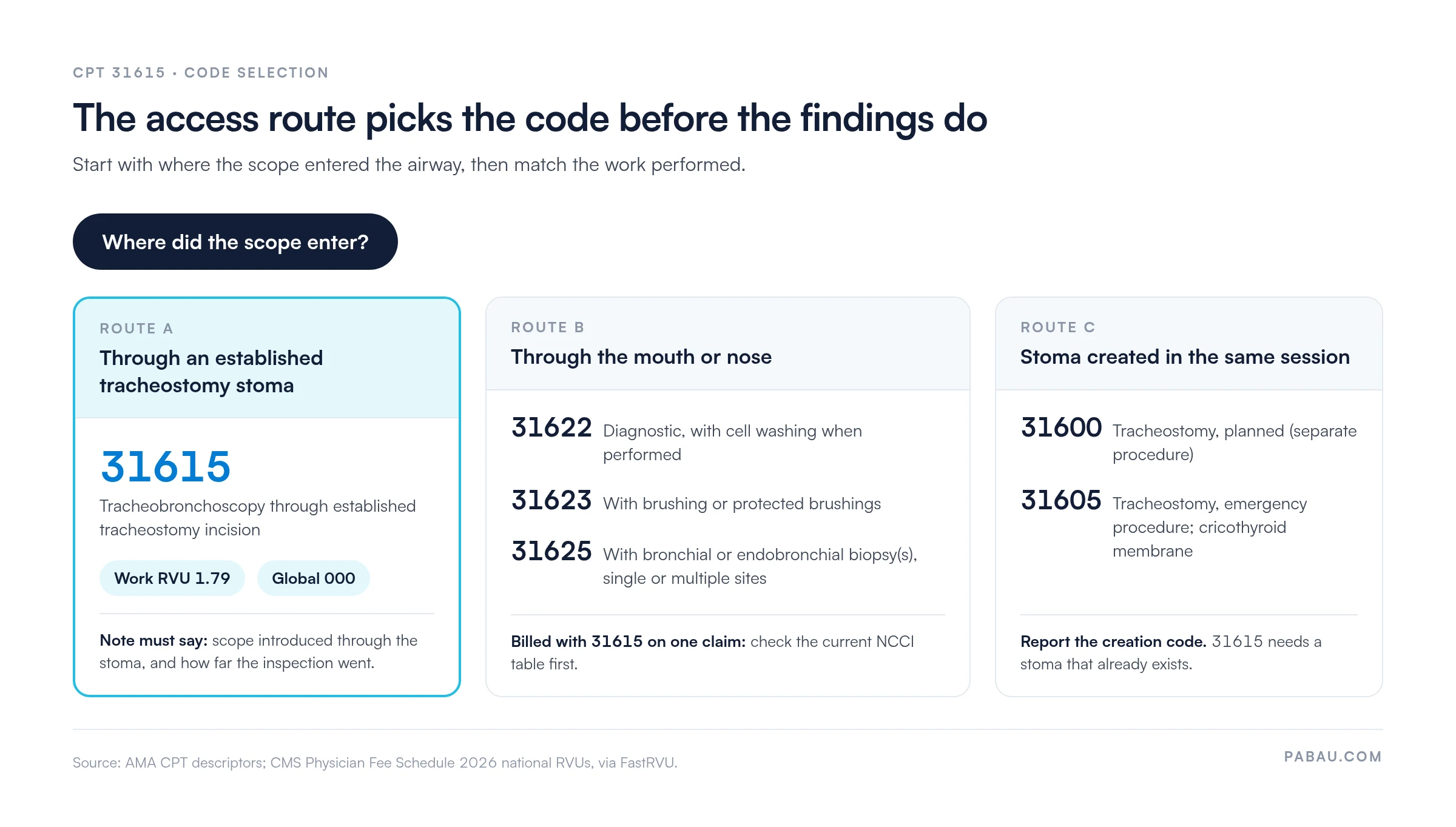
The access route separates 31615 from every other bronchoscopy code in this family. Standard diagnostic bronchoscopy uses the oral or nasal route, while CPT code 31615 uses the stoma. This table covers the codes coders most often confuse with 31615.
The practical rule: If the operative note does not state that the scope was introduced through the stoma, 31615 cannot be billed. Payers audit the access route. A note that reads “flexible bronchoscopy performed” without specifying stoma entry will be assigned 31622.
That code carries a different payment rate and a different NCCI edit set. The decision path below shows how the entry point and the work performed settle the code.
Medical necessity for CPT code 31615 is established through the paired ICD-10-CM diagnosis code. Payers and Medicare Administrative Contractors (MACs) validate that the diagnosis supports the clinical indication for a tracheoscopy via stoma.
Local Coverage Determinations (LCDs) vary by MAC jurisdiction, so the list below reflects commonly accepted pairings. Verify each one against the applicable LCD before treating it as definitive.
Z93.0 (tracheostomy status) functions as a secondary code that corroborates the access route. Pair it with the primary diagnosis, such as J95.03 for a malfunctioning stoma or J98.11 for atelectasis. That pairing strengthens the medical necessity link and makes a necessity denial less likely.
Always list Z93.0 (tracheostomy status) as a secondary diagnosis on CPT 31615 claims. It tells payers the patient has an established stoma, which backs up the access route and heads off medical necessity queries before they become denials.
Payer audits on CPT 31615 focus on three questions: Was there a tracheotomy stoma? Was the scope introduced through it? What was inspected? A stoma created in the same session never supports 31615. When that tracheostomy was planned, it is reported as 31600. A tube change through a fresh stoma, before the fistula tract has formed, is a separate service billed as 31502.
The operative or procedure note must answer all three before it can support a clean claim. In Pabau, a structured procedure note template captures these elements on every case, and the claims management software carries them onto the claim.
Required documentation elements for CPT 31615:
Notes that document findings without specifying access route, or that use the generic phrase “bronchoscopy performed,” leave the coder unable to distinguish 31615 from 31622. The physician’s language in the note is the billing record. Vague documentation cannot be corrected retroactively during an appeal without risking an allegation of improper amendment.
Medicare pays CPT code 31615 from the Medicare Physician Fee Schedule (MPFS), which the Centers for Medicare and Medicaid Services (CMS) updates annually. Rates vary by geographic location through the Geographic Practice Cost Index (GPCI) adjustment.
The figures below are the 2026 national values at a conversion factor of $33.4009. Verify current payment in the CMS MPFS Look-Up Tool before quoting payers or patients.
Exact dollar amounts depend on the conversion factor (CF) for the year and your GPCI locality. Use the FastRVU look-up tool to calculate location-adjusted payment rates from the CMS data file. For claim submission, Pabau connects to the Claim.MD clearinghouse, which sends 837P transactions and returns Electronic Remittance Advice (ERA) responses. That cuts the manual reconciliation work for billing staff.
Commercial payers negotiate their own fee schedules, which may be higher or lower than Medicare. Always verify contracted rates in your payer agreements before estimating patient responsibility.
Medicare does not currently require prior authorization for CPT code 31615 as a standard policy, but commercial and Managed Medicaid payers vary considerably. Some plans require pre-authorization for all inpatient and outpatient endoscopy procedures. Others apply it only to elective cases.
A claim sent without a required authorization comes back with denial code CO-15, so routing authorizations before the procedure saves rework. The list of medical billing denial codes explains how payers word that rejection and its neighbors.
When prior authorization is required for CPT 31615, the supporting submission typically needs:
For urgent tracheoscopy, such as acute stoma malfunction or hemorrhage, many payers accept a retrospective authorization request within a short window after service. Document the clinical urgency in the procedure note. Payers reviewing a retro-auth request check whether the case could have waited.
The National Correct Coding Initiative (NCCI) governs bundling between CPT 31615 and other endoscopy codes. CMS updates NCCI edits quarterly, so verify the specific column-1/column-2 pairs in the current NCCI table rather than a static reference.
31615 sits in the endoscopy block (31615-31661) of the 31600-31899 trachea and bronchi range. The core principle there: Endoscopy codes of the same body system performed in the same operative session are bundled at the highest-valued procedure.
Sound medical billing compliance practices require checking the quarterly NCCI table before billing multiple endoscopy codes together.
The X modifiers (XE, XS, XP, XU) are more specific than modifier 59 and are preferred by CMS when the distinction is clear.
XS (separate structure) applies when 31615 and an orotracheal bronchoscopy code cover anatomically distinct portions of the airway via different access routes. The documentation must state each route explicitly. Modifier use without supporting documentation is an OIG audit risk.
Before billing 31615 alongside any code from 31622-31652, run the code pair through the current quarterly NCCI table on the CMS website. NCCI edits update four times per year. A pair that allowed modifier override last quarter may have changed. Build the quarterly table review into your coding quality calendar.
Most denials on CPT code 31615 follow predictable patterns. Each one maps to a documentation or coding decision that was made upstream. Effective denial management strategies start by finding which documentation element the payer is questioning. The fix then happens at the point of note capture, not at the appeals desk.
A first-pass clean claim for CPT 31615 takes the right ICD-10 pair and a note naming the stoma as access route. It also takes a pre-submission NCCI check whenever other endoscopy codes share the claim. The AAPC Codify platform includes NCCI bundling indicators alongside the CPT descriptor, which can support pre-submission checks.
In many practices, the physician dictates a free-text note and a coder reads it days later to choose between 31615 and 31622. If the note never says the scope went through the stoma, the coder has to query the physician or watch the payer down-code the claim.
Pabau replaces that hand-off with a structured procedure template. Access route, scope type, extent of inspection, indication and findings can be required fields. The note is then complete before the coder opens it. The ICD-10 pairing, including Z93.0, sits on the same patient record.
Claims then go out through the Claim.MD clearinghouse as 837P files, and remittance comes back as ERA. Your billing team spends its time on claims that need judgment instead of chasing missing note details.

Pabau captures the stoma access route, scope type and findings in a structured procedure note, then submits the 31615 claim through the clearinghouse. Fewer claims come back down-coded to 31622.

Treat the access route as the first fact a 31615 claim needs, ahead of the diagnosis and the modifier. If the note names the stoma, 31615 pays at its own rate under its own edits. If it does not, the claim drops to 31622 and any appeal starts from a weak note.
The cheapest fix sits upstream. Add the access route to the procedure template once. Then audit a sample of 31615 claims against their notes each quarter, alongside the NCCI table check. Clean notes also shorten every later step of revenue cycle management, from coding to payment posting.
Book a demo to see how Pabau turns tracheostomy procedure notes into claims that hold up on the first pass.

Need a clearinghouse for CPT claims? The Claim.MD clearinghouse explains how 837P claims and ERA responses move between your practice and payers.
Confused about denial codes on remittance advice? Denial codes in medical billing covers the CARC and RARC codes that appear when endoscopy claims are rejected.
Billing tracheostomy supplies as well? HCPCS code A4623 covers the tracheostomy inner cannula and how to bill it.
Coding a therapeutic bronchoscopy? CPT code 31641 covers bronchoscopic tumor destruction and relief of stenosis.
CPT code 31615 is the procedure code for tracheobronchoscopy through an established tracheostomy incision. It covers diagnostic inspection of the trachea and, when performed, the mainstem bronchi through an existing stoma rather than the oral or nasal route.
The access route is the defining difference. CPT 31615 uses an established tracheostomy stoma, while CPT 31622 uses the mouth or nose. Both may inspect the trachea and bronchi, but the entry point decides the code and which NCCI edits apply when both appear on one claim.
Commonly accepted ICD-10-CM codes include J95.00-J95.03 (tracheostomy complications), J98.11 (atelectasis), and J98.09 (other diseases of bronchus, not elsewhere classified). Z93.0 (tracheostomy status) works as a secondary code. Verify each pairing against the Local Coverage Determination for your MAC jurisdiction, as covered indications vary by payer.
Medicare does not require prior authorization for CPT 31615 as a standard national policy. Commercial and Managed Medicaid payers vary, and some require pre-authorization for all elective endoscopy procedures. Check each payer’s rules before scheduling non-urgent tracheoscopy. For urgent cases, file a retrospective authorization request within the payer’s allowed window.
Five denial reasons recur on this code. The note omits the stoma as access route, so the payer down-codes to 31622. The ICD-10 pairing does not support medical necessity. An NCCI edit fires when 31615 and 31622 share a claim without a valid modifier. A commercial payer’s prior authorization is missing, or the note lacks scope type, findings, or extent of inspection.
CPT code 31615 is the tracheobronchoscopy code when the procedure goes through an established tracheostomy. Its official descriptor reads “Tracheobronchoscopy through established tracheostomy incision.” One code covers inspection of the trachea and bronchi through the stoma in the same session.