Pabau Engage inbox

Pabau Engage is here: every patient conversation in one inbox.

Learn more
CPT Code

CPT code 32674 – VATS mediastinal lymphadenectomy


Code Definition

32674 is the CPT add-on code for thoracoscopy, surgical; with mediastinal and regional lymphadenectomy (list separately in addition to code for primary procedure). It covers the systematic removal of named mediastinal and regional lymph node stations during a VATS procedure, most often a lung resection for cancer staging.

32674 is reported only with an eligible primary code on the same claim, such as 32663 for a VATS lobectomy. It carries a ZZZ global period and is exempt from modifier 51.

Section
10004-69990 Surgery
Subsection
30000-32999 Respiratory system
Code range
32601-32674 Thoracoscopy (video-assisted thoracic surgery [VATS])
Billable
No
Code also known as
VATS mediastinal lymphadenectomy, VATS lymph node dissection, thoracoscopic mediastinal lymphadenectomy, VATS lymphadenectomy
Save time. Improve accuracy. Get paid faster.
Automate coding with Pabau

Let Pabau's smart automation suggest the right codes, reduce claim denials, and keep your practice compliant—effortlessly.

  • AI-powered code suggestions
  • Real-time compliance checks
  • Faster claims, fewer denials
Why practices choose Pabau
Save hours every week

Automate repetitive tasks and focus on what matters most—your patients.

Improve accuracy

Reduce coding errors and ensure compliance with the latest regulations.

Get paid faster

Clean claims, fewer denials, and faster reimbursements.

Grow with confidence

Powerful insights and reporting to help your practice thrive.

HIPAA compliant SOC 2 certified GDPR-compliant Trusted by 4,000+ clinics worldwide

Key takeaways

Key takeaways

CPT Code 32674 reports a VATS mediastinal and regional lymphadenectomy as an add-on to an eligible primary procedure, such as 32663 for a VATS lobectomy.

It carries a ZZZ global period, is never reported alone and never takes modifier 51.

Missing IASLC station detail in the operative note is a common audit finding, so the note should name every station dissected.

The 2026 national Medicare rate is $195.40 (5.85 total RVUs at the $33.4009 conversion factor), before GPCI adjustment.

Pabau, our practice management platform, submits CMS-1500 claims through Claim.MD and tracks each claim’s status and remittance.

CPT Code 32674: Official description and classification

CPT Code 32674 is the add-on code for a thoracoscopic (VATS) mediastinal and regional lymphadenectomy, reported with an eligible primary procedure on the same claim. The American Medical Association descriptor reads “Thoracoscopy, surgical; with mediastinal and regional lymphadenectomy (list separately in addition to code for primary procedure).” As a result, 32674 is never the lead code on a claim.

First, the table below summarizes the attributes coders need before building a claim.

AttributeValue
Code number32674
Code typeAdd-on code (+ symbol in CPT book)
CPT sectionSurgery: Respiratory system, lungs and pleura, thoracoscopy (VATS)
Global periodZZZ (no global period of its own; the service sits inside the primary procedure’s global package)
Modifier 51 exemptYes. Add-on codes are never reported with modifier 51.
Clinical contextVATS mediastinal lymph node dissection, most often for lung cancer staging

Is CPT Code 32674 an add-on code?

Yes. CPT Code 32674 is a designated add-on code, marked in the AMA CPT book with a plus (+) symbol. Its parenthetical says to “list separately in addition to code for primary procedure.” As a result, four billing rules follow.

  • Cannot be reported alone. A claim submitting only 32674 will be denied. Therefore, the primary VATS procedure code must appear on the same claim.
  • No modifier 51. The AMA exempts all add-on codes from the multiple-procedure modifier. However, coders often append modifier 51 to 32674, which triggers a denial or downcoding.
  • ZZZ global period. 32674 has no global period of its own, because the service is part of the primary procedure’s global package. As a result, it generates no separate postoperative period.
  • Eligible primaries and NCCI edits. First, CPT parentheticals define the eligible primary codes. Also, National Correct Coding Initiative (NCCI) and CMS add-on code edits are updated quarterly, so verify them before submitting.

Eligible primary procedure codes for CPT Code 32674

The CPT parenthetical for 32674 lists the eligible primary codes, and lung resections make up most of it, in both VATS and open forms. A VATS lobectomy, for example, is reported with 32663 as the primary and 32674 as the add-on. However, the AMA can revise the parenthetical each year, so check the current CPT edition before you build the claim.

CPT CodeDescription
32663Thoracoscopy, surgical; with lobectomy (single lobe)
32666Thoracoscopy, surgical; with therapeutic wedge resection (eg, mass, nodule), initial unilateral
32667Thoracoscopy, surgical; with therapeutic wedge resection, each additional resection, ipsilateral (add-on)
32669Thoracoscopy, surgical; with removal of a single lung segment (segmentectomy)
32670Thoracoscopy, surgical; with removal of two lobes (bilobectomy)
32671Thoracoscopy, surgical; with removal of lung (pneumonectomy)
32480Removal of lung, other than pneumonectomy; single lobe (lobectomy)
32482Removal of lung; bilobectomy
32484Removal of lung; segmentectomy
32486Removal of lung; with sleeve resection
32488Removal of lung; completion pneumonectomy
32503Resection of apical lung tumor (eg, Pancoast tumor); without chest wall reconstruction
32504Resection of apical lung tumor (eg, Pancoast tumor); with chest wall reconstruction
32505Thoracotomy; with therapeutic wedge resection (eg, mass, nodule), initial

CPT 32674 vs. similar thoracoscopy codes

The 32671-32674 code range covers several distinct thoracoscopic procedures, and confusing them leads to denials. In addition, a needle biopsy is a different service: it is reported with 32408, which replaced 32405 in 2021. Finally, the table below shows where each code’s scope differs from 32674.

CPT CodeProcedureCode typeKey distinction
32674Mediastinal and regional lymphadenectomyAdd-onDissection of mediastinal and regional lymph node stations; must accompany a primary resection code
32671Thoracoscopy, surgical; with removal of lung (pneumonectomy)StandaloneWhole-lung resection, not nodal dissection; reportable alone
32672Thoracoscopy, surgical; with resection-plication of emphysematous lung for lung volume reductionStandaloneLung volume reduction, not nodal dissection
32673Thoracoscopy, surgical; with resection of thymus, unilateral or bilateralStandaloneThymus, not mediastinal lymph nodes; distinct anatomy and indication
32408Core needle biopsy, lung or mediastinum, percutaneous, including imaging guidanceStandaloneNeedle sampling only, not dissection; replaced 32405 in 2021

Pro Tip

Check whether the operative note describes systematic dissection of multiple named lymph node stations or only sampling of selected nodes. Only a dissection of mediastinal and regional stations supports CPT Code 32674. A percutaneous core needle biopsy is 32408, and the open-thoracotomy lymphadenectomy is the add-on 38746.

Overall, those distinctions reduce to three checks, run in order, before 32674 goes on the claim.
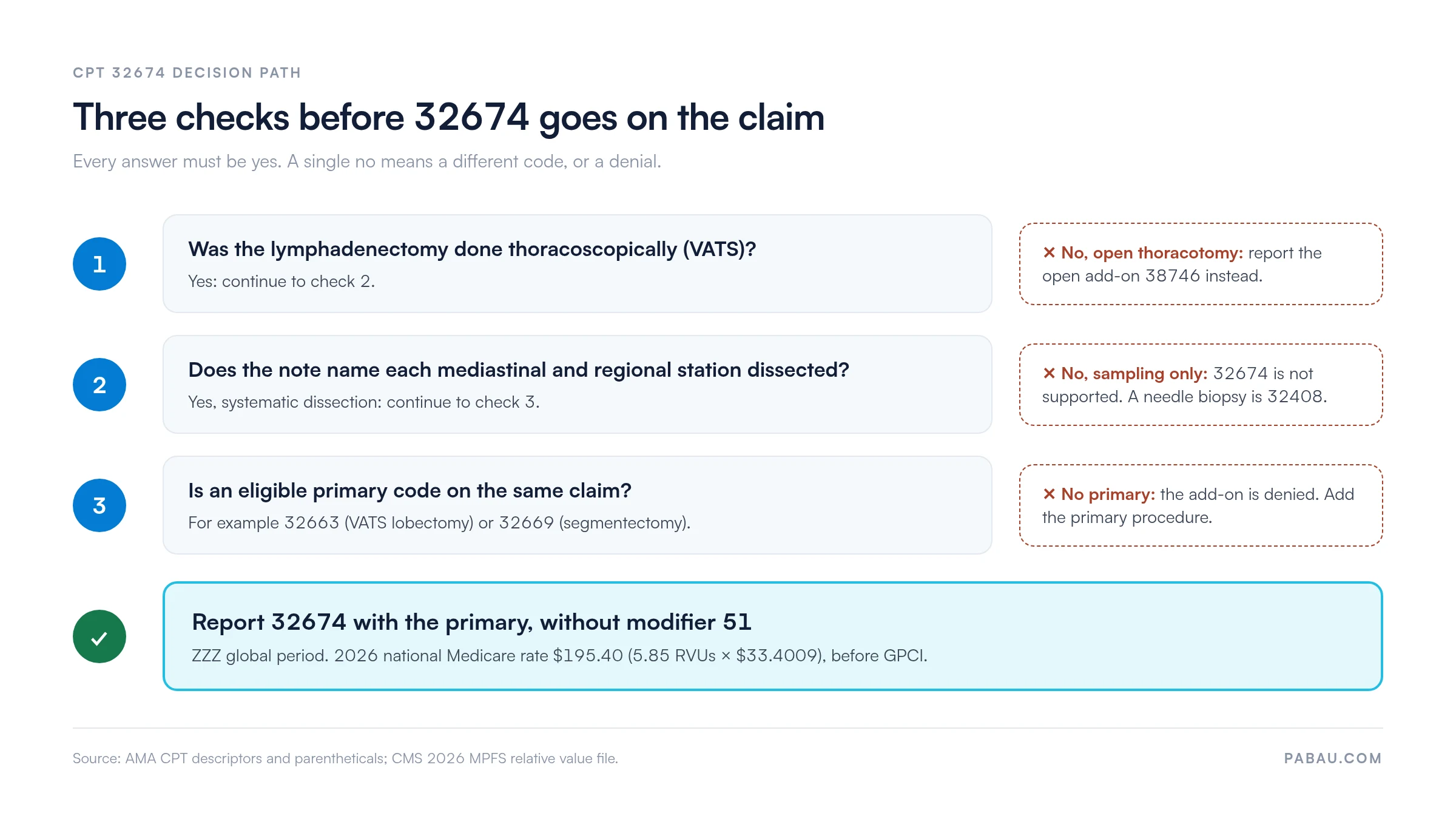
Decision path for CPT 32674
A no at any of the three checks means a different code or a denial. Built from the AMA CPT descriptors and the CMS 2026 fee schedule.

Modifiers for CPT Code 32674

Modifier selection for an add-on code is tighter than for standalone procedures. For that reason, the table below covers each modifier a thoracic biller is likely to meet with 32674. It gives the correct usage and the denial risk of getting it wrong.

ModifierUse on 32674?Guidance
51 (multiple procedures)NeverAdd-on codes are explicitly exempt from modifier 51. Appending it causes the payer to reduce payment incorrectly or deny the code outright.
59 (distinct procedural service)With cautionUsed when a payer’s bundling edit incorrectly groups 32674 into the primary procedure. Documentation must establish the lymphadenectomy as a distinct service. Use only when a payer-specific policy requires it; do not apply as a blanket bypass.
62 (two surgeons)When applicableBoth surgeons append modifier 62 when two surgeons of different specialties operate together on the lymphadenectomy. Each surgeon bills 32674-62 separately. Check the MPFS co-surgeon indicator and payer policy first.
80 (assistant surgeon)When applicableAn assistant surgeon bills 32674-80. Verify that the primary procedure is payable to an assistant before applying this modifier. Payer policies differ by code and plan.

Medicare reimbursement under the 2026 fee schedule

As an add-on code, CPT Code 32674 is paid only when the primary VATS procedure is separately payable by Medicare. The values below come from the 2026 Medicare Physician Fee Schedule (MPFS) relative value file, before geographic practice cost index (GPCI) adjustment. Then confirm local figures using the CMS MPFS lookup tool or the FastRVU 2026 RVU lookup for your locality.

RVU ComponentValue (2026 national)
Work RVU4.02
Facility PE RVU0.81
Malpractice RVU1.02
Total RVU (facility and non-facility)5.85
National payment, before GPCI$195.40 at the $33.4009 conversion factor ($196.37 at the $33.5675 qualifying APM factor)
Payment settingFacility (hospital or ASC); the add-on follows its primary procedure
GPCI adjustmentApplies. Local rates differ from the national figure.

Commercial payer payment for CPT Code 32674 varies by payer contract and plan. In fact, some commercial payers bundle the lymphadenectomy into the primary resection code under their own fee schedule rules, regardless of NCCI edit status. Therefore, review each payer’s contract terms for VATS add-on code payment policy.

In addition, practices using Pabau can submit claims through Claim.MD, our US clearinghouse partner, which sends CMS-1500 claims and runs real-time eligibility checks.

When building the claim, generating a superbill that links the primary code and 32674 helps. As a result, it keeps the add-on from going out without its parent on the same date of service.

Payer requirements and prior authorization

Most payers do not require a separate prior authorization for CPT Code 32674 when the primary VATS procedure is already authorized. In other words, payers treat the add-on as part of the surgical session, not a separate service needing its own review. That said, authorization policies differ by payer and plan, so confirm with each payer before assuming coverage extends automatically.

However, payers that do review medical necessity for 32674 typically look for the following before accepting the claim.

  • Pathology or clinical suspicion of malignancy. Mediastinal lymphadenectomy is used mainly for lung cancer staging and treatment. Therefore, the ICD-10 diagnosis code on the claim must reflect a confirmed or suspected thoracic malignancy.
  • Pre-operative imaging. A CT or PET-CT supporting the indication for lymph node dissection is expected in the medical record. In fact, payers may request this during a post-payment audit even if they do not require it for pre-authorization.
  • Clear staging reason. The operative note must establish why systematic nodal dissection was performed, not simply sampled. For example, “We performed a systematic mediastinal lymphadenectomy for staging purposes” with named stations is the target language.
  • Surgeon credentials. Some payers restrict VATS lymphadenectomy codes to board-certified thoracic surgeons. Therefore, verify credentialing requirements per payer contract.

Common denial reasons for CPT Code 32674 and how to appeal

Five denial patterns recur on 32674 claims, and each has a specific appeal path. Therefore, a solid denial management workflow can resolve them at first appeal when the correct records go in upfront.

  1. Billed without a primary VATS code. The add-on rule is absolute: No primary code, no payment. To appeal, resubmit with the correct primary procedure code (e.g. 32663 or 32669) on the same date of service. Then confirm the clearinghouse sent both codes together.
  2. Payer bundled 32674 into the primary procedure. Some commercial payers apply their own bundling edits that go beyond NCCI. First, appeal with a copy of the NCCI edit table showing the pairing is payable. Also add the operative note confirming the lymphadenectomy was a distinct service. In addition, modifier 59 may be required per that payer’s policy.
  3. Modifier 51 added in error. Remove modifier 51 and resubmit. Also include a brief appeal letter noting that AMA CPT guidelines classify 32674 as an add-on code exempt from modifier 51 under the multiple-procedure rules.
  4. Missing lymph node stations in the operative note. Because this is a frequent audit trigger, the operative note must name each dissected station by IASLC number or anatomical label. “Lymph nodes were removed” is not sufficient. To appeal, send an amended operative note or surgeon statement that names each station dissected.
  5. ICD-10 diagnosis mismatch. The diagnosis code must support medical necessity for lymphadenectomy. For example, a benign neoplasm of the lung (D14.3x) paired with 32674 will usually be denied. To appeal, confirm that the correct malignancy code (C34.x or C77.x) was submitted. However, if the indication is appropriate despite a non-malignant diagnosis, send clinical documentation supporting medical necessity.

Our guide to denial codes decodes the CARC reason codes your payer returns on the remittance advice. Then match each one to the appeal path above.

Documentation that supports the code

Incomplete operative note documentation is a common audit finding on 32674 claims. In fact, the IASLC lymph node map defines 14 numbered mediastinal and regional stations. Therefore, an operative note that names each dissected station by number gives payers and auditors no room to dispute the work performed.

For this reason, a clean claim submission for 32674 depends on the operative note capturing every element below before the claim is built.

Documentation elementWhy it matters for coding
Named lymph node stations (IASLC map)Establishes that mediastinal and regional stations were systematically addressed, not sampled
En-bloc dissection confirmedDistinguishes 32674 (dissection) from node sampling or a needle biopsy (32408). Dissection language is what supports the code.
Number of nodes removed per stationThe pathology report must reconcile with the operative note. A mismatch between counts raises audit flags.
Specimen labelingEach station’s specimen must be labeled separately and sent to pathology. The chain of custody supports medical necessity.
Surgeon attestationThe dictating surgeon must personally attest to performing the lymphadenectomy, not delegate it without documentation
ICD-10 diagnosis linkageThe cancer or malignancy diagnosis must be listed and linked to both the primary procedure code and 32674 on the claim form

Practices subject to Recovery Audit Contractor (RAC) review should reconcile node counts between the operative note and the pathology report before billing. In addition, a billing compliance review of VATS operative note templates at least once a year reduces this exposure.

ICD-10 diagnosis codes commonly paired with CPT Code 32674

The diagnosis code on the claim must establish medical necessity for mediastinal lymphadenectomy. Because lung cancer is the main clinical driver, the ICD-10-CM codes below cover the presentations most often billed alongside 32674.

ICD-10-CM CodeDescriptionNotes
C34.10Malignant neoplasm of upper lobe, bronchus or lung, unspecified sideSelect laterality-specific subcode (C34.11 right, C34.12 left)
C34.30Malignant neoplasm of lower lobe, bronchus or lung, unspecified sideLower lobe primary; select the laterality-specific subcode (C34.31 right, C34.32 left)
C77.1Secondary malignant neoplasm of intrathoracic lymph nodesUsed when mediastinal nodal involvement is confirmed on pathology or imaging
C34.90Malignant neoplasm of bronchus or lung, unspecified sideUse only when laterality cannot be determined; specificity preferred
R04.2HemoptysisMay appear as a secondary diagnosis; a primary symptom code alone does not support medical necessity for lymphadenectomy

Payers expect the primary malignancy code to be listed first, with nodal involvement and any secondary diagnoses following. For example, do not sequence a symptom code (R04.2) as the primary diagnosis on a 32674 claim. Otherwise, the payer will flag the claim for medical necessity review.

How Pabau supports 32674 claims and documentation

The 32674 errors in this guide start before the claim is built: a primary code left off, or an operative note without named stations. For that reason, Pabau keeps the clinical note, the invoice and the claim in the same patient record, so the biller works from the documentation the surgeon signed.

Configurable clinical note templates let you add a field for each IASLC station dissected, so stations get recorded at the point of care. The biller then builds the CMS-1500 claim from the invoice, with the primary code and 32674 on the same claim.
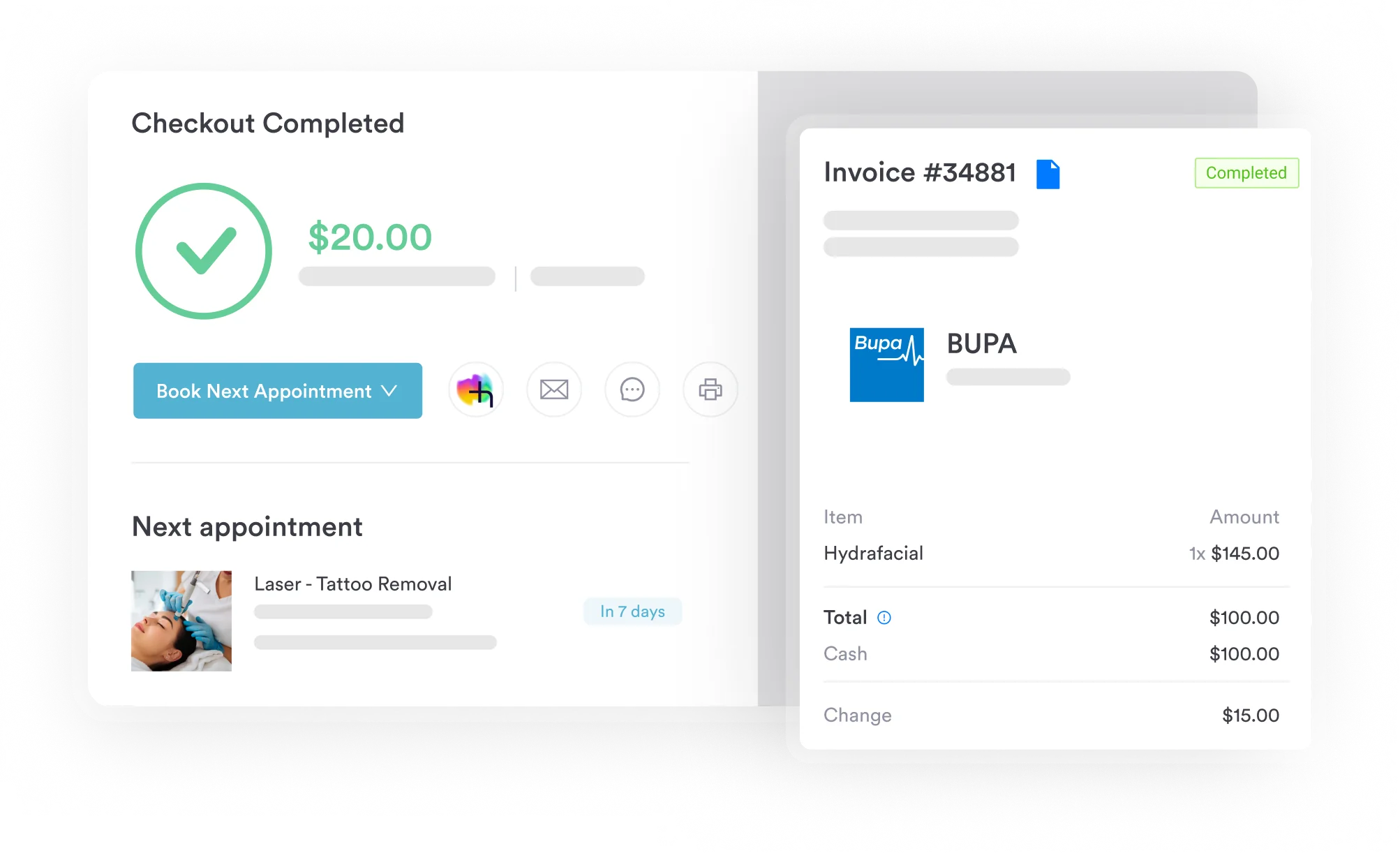
Pabau checkout screen next to a completed invoice with the patient's insurer attached
Pabau attaches the patient’s insurer to the completed invoice, so the 32674 claim is built from billing data already on file.

Our claims management software sends each claim through Claim.MD after a real-time eligibility check. Claim status and remittances flow back into Pabau, so a denied 32674 claim stays visible until someone works the appeal.

Submit and track every 32674 claim in one place

Pabau submits CMS-1500 claims through Claim.MD after a real-time eligibility check, then tracks each claim’s status and remittance. Your billing team can follow every 32674 claim from submission to payment.

Pabau claims management dashboard

Conclusion

Treat 32674 as a documentation code first and a billing code second. When the operative note names each station dissected and the primary resection sits on the same claim, the add-on pays. However, when either is missing, the claim enters an appeal cycle that an amended note may not rescue.

Build station fields into your VATS operative note template now, and recheck the CPT parenthetical and NCCI edits each quarter. After all, a few minutes of station-level dictation per case protects a $195 national add-on payment. Finally, book a demo to see how Pabau handles claim submission and tracking for your practice.

Continue your research

Continue your research

Want to understand how medical billing clearinghouses work? Medical claims clearinghouse guide explains how claims move from practice to payer and where errors get caught.

Building a process to keep claims error-free? Revenue cycle management overview covers the end-to-end workflow from encounter to payment posting.

Need to understand the 837 electronic claim format? 837 file billing guide walks through the EDI transaction structure used for CMS-1500 and institutional claims.

Frequently asked questions

What does CPT Code 32674 cover?

CPT Code 32674 covers a thoracoscopic (VATS) mediastinal and regional lymphadenectomy. That is the video-assisted dissection and removal of lymph nodes from named mediastinal and regional stations, usually during a lung resection. Therefore, it is billed in addition to the primary procedure code and is not payable on its own.

What are the most common CPT Code 32674 modifiers?

Modifier 51 is never used on 32674, because add-on codes are exempt from the multiple-procedure modifier. Modifier 59 may apply when a payer’s bundling edit groups 32674 into the primary procedure, provided documentation supports a distinct service. Likewise, modifiers 62 (two surgeons) and 80 (assistant surgeon) apply as they do for other thoracic codes.

Is CPT Code 32674 an add-on code?

Yes. CPT Code 32674 is an add-on code, marked with a + symbol in the AMA CPT book, and carries a ZZZ global period. Therefore, it must be reported with an eligible primary procedure code and cannot be reported alone.

Does CPT Code 32674 require prior authorization?

Most payers do not require separate prior authorization for CPT 32674 when the primary VATS procedure is already authorized. Instead, they treat the add-on as part of the same surgical session. Policies differ, especially on commercial plans with their own bundling rules, so confirm with each payer first.
Avatar photo
Despina Petrushevska
Content Writer

Despina Petrushevska is a content writer covering aesthetics, dermatology, and clinic operations, known for making detailed clinical concepts clear and engaging. Outside of work, she enjoys photography, weekend getaways, and finding inspiration in everyday experiences.
×