



HCPCS code E0198: Water pressure pad billing guide
HCPCS code E0198 is a water pad for a standard mattress HCPCS code E0198 is the ...

Last Updated: Oct 13, 2026
CPT Code 31624 is a bronchoscopy procedure code that covers bronchial alveolar lavage (BAL), including fluoroscopic guidance when performed. Pulmonologists and respiratory care teams use it to report saline instilled into a targeted lung segment. The aspirated fluid then goes to the laboratory for analysis.
According to the American Medical Association, CPT Code 31624 sits within the endoscopy procedures on the trachea and bronchi subsection of the Respiratory System. In 2026, Medicare pays roughly $286 for the code in an office and roughly $121 in a hospital or ambulatory surgical center.

CPT Code 31624 describes rigid or flexible bronchoscopy with bronchial alveolar lavage, distinct from the diagnostic-only base code 31622.
The 2026 Medicare non-facility rate is roughly $286 and the facility rate is roughly $121, though amounts vary by geographic locality.
The practice expense RVU creates that difference, which makes a place-of-service error one of the costliest mistakes on this code.
Modifier 59 is the most frequently required modifier, and modifier 52 applies only when the BAL is abandoned before sample collection.
Pabau links clinical documentation to the billing workflow, so bronchoscopy claims carry the detail payers ask for.
CPT Code 31624 is defined by the AMA as: Bronchoscopy, rigid or flexible, including fluoroscopic guidance, when performed; with bronchial alveolar lavage.
The phrase “when performed” means fluoroscopic guidance is optional. Where it is used, this code already captures it, so it cannot be billed separately.
The code sits in CPT section 31615-31654, which covers endoscopy of the trachea and bronchi. It applies to both rigid and flexible bronchoscope approaches. The defining clinical feature is the lavage. Saline is instilled into one or more lung segments and aspirated back, collecting cells and fluid for analysis.
Bronchial alveolar lavage is a diagnostic and therapeutic procedure performed through a bronchoscope. The physician advances the scope into the airway until it wedges into a subsegmental bronchus. Sterile saline is then instilled in aliquots, typically 20-60 mL per wash, and aspirated back into a collection trap.
The collected fluid contains cells, microorganisms, proteins, and particulate matter from that lung region. Laboratory analysis can identify bacteria, fungi, mycobacteria, malignant cells, and markers of inflammatory or fibrotic lung disease. BAL is commonly used to investigate suspected infection, interstitial lung disease, and pulmonary malignancy.
In an interstitial lung disease workup, the lavage often accompanies a transbronchial lung biopsy. That biopsy has its own code, 31628, which covers a single lobe.
The CMS Physician Fee Schedule sets the Medicare payment rates for CPT Code 31624. Rates differ by place of service. Non-facility covers an office or outpatient practice, while facility covers a hospital or ambulatory surgical center. Geographic adjustment factors apply on top, so rates in San Francisco run meaningfully higher than rates in rural Mississippi.
Always verify current rates using the CMS Physician Fee Schedule Lookup Tool or your MAC’s jurisdiction-specific fee file. National averages are published in January and apply through December 31 of each year. Reading the remittance advice from each payer confirms what lands in the account for every 31624 claim.
RVUs are the building blocks of Medicare payment. The FastRVU 2026 RVU lookup tool publishes current work, practice expense, and malpractice values for 31624. The table below shows each component in both places of service.
Work and malpractice RVUs stay the same in both settings. Practice expense does not, and that single component is why the office rate runs more than double the facility rate. Each total is then multiplied by the 2026 CMS conversion factor, which is $33.40 for clinicians outside an advanced APM and $33.57 for qualifying participants.
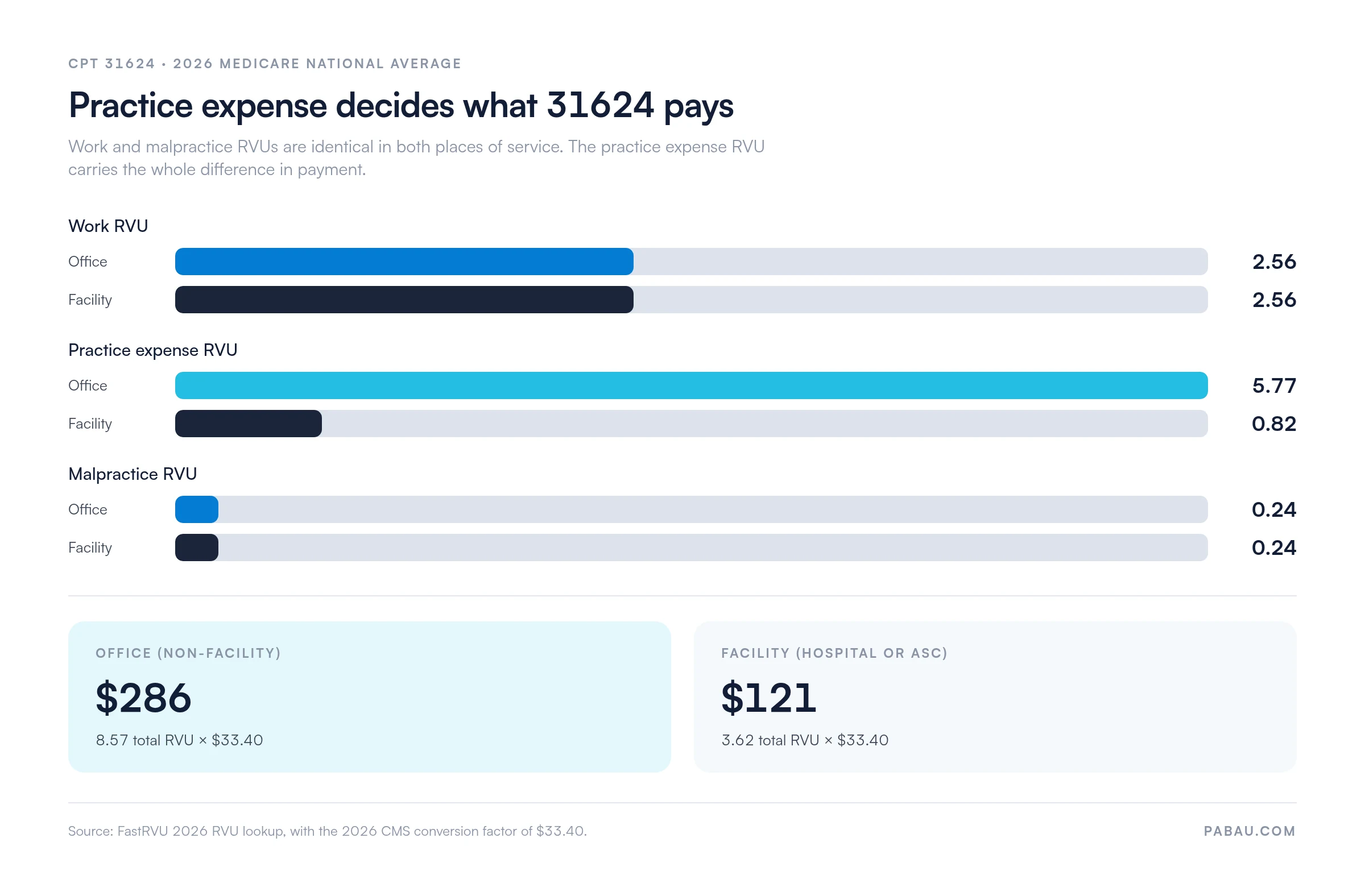
RVU values are updated annually in the CMS Final Rule. Verify against the current year’s published data rather than a prior-year figure, because both the component values and the conversion factor change.
Modifier errors sit among the top denial triggers on 31624 claims. The table below shows which modifier applies in each scenario, and what the operative note has to support.
The American Association for Bronchology and Interventional Pulmonology (AABIP) has issued position statement guidance on modifier 52 for bronchoscopy codes.
A bronchoscopy may be terminated early for patient tolerance, hemodynamic instability, or technical failure. Where that happens before the lavage sample is collected, modifier 52 tells the payer that a reduced service was delivered.
The operative note then has to document what was and was not accomplished. A note that reads “procedure incomplete” will not support the modifier. Four details belong in it:
Without that specificity, payers will either deny the claim or apply an audit flag for review.
Payers read the operative note before they pay a 31624 claim. Every element below should appear in that note before the claim is submitted. Payer policy asks for documentation that supports the code billed, not only the diagnosis.
A structured procedure note template reduces the risk of a missing element. Where the note and the claim sit in one system, the claim cannot leave the practice before the record is complete.
CPT Code 31622 is the base diagnostic bronchoscopy code, while CPT Code 31624 adds bronchial alveolar lavage to that base procedure. The distinction matters for billing, because 31622 cannot be upgraded to 31624 by adding the word “lavage” to the note.
The most common coding error here is billing both 31622 and 31624 for the same session. Because 31624 includes the diagnostic bronchoscopy as part of the procedure, adding 31622 constitutes unbundling.
CPT Code 31624 belongs to a family of bronchoscopy codes, each defined by the additional service performed during the scope. Reading the full family helps coders select the most accurate code and avoid undercoding or unbundling. The AAPC Codify CPT lookup carries the complete descriptor for each code in this range.
Audit your 31624 claims quarterly. Pull every session where 31622 and 31624 appear on the same date of service. Any pairing without a documented separate indication is an unbundling flag. Then check the denial codes on those claims to see whether payers are auto-bundling and adjusting the payment down.
The National Correct Coding Initiative (NCCI) administers the bundling edits that govern how bronchoscopy codes interact. Reading these edits before submission prevents the most costly claim errors in pulmonology billing.
The core bundling rule: 31622 (diagnostic bronchoscopy) bundles into 31624. When BAL is performed, 31624 is the correct and complete code. Bill both on the same date without a distinct clinical rationale, and the NCCI edit rejects the lower-valued code, typically 31622.
Modifier 59 sits on the biopsy code, not on 31624. The billing guide for 31625 sets out the modifier and documentation rules that apply to the biopsy itself.
NCCI edits are updated quarterly, so the guidance here reflects general principles. Verify the current edit pair table through CMS before submitting claims. Building that check into the pre-submission workflow catches a bad pairing before the payer does.
Medical necessity for CPT Code 31624 must be supported by a diagnosis code that clinically justifies bronchial alveolar lavage. The ICD-10-CM codes below are the most frequently paired diagnoses. Payer LCDs may specify approved diagnosis lists that differ by MAC jurisdiction.
The diagnosis usually sharpens once the lavage culture returns. A pneumonia coded to J18.9 before the procedure moves to J13 once the organism comes back as pneumococcus. The claim should then carry the specific code.
Always verify that the submitted ICD-10 code aligns with your MAC’s LCD for bronchoscopy. Some MACs publish accepted diagnosis lists that restrict coverage to particular codes. Submitting with a non-covered diagnosis is the fastest path to a medical necessity denial.
Bronchoscopy claims fail more often than a routine office visit, mostly on bundling and documentation. A workflow that reads the denial codes on each remittance catches the pattern before it turns into write-offs.
Catching these at submission rather than at appeal is what lifts first-pass resolution on bronchoscopy claims. Each denial avoided also removes a rework cycle from the billing team’s queue.
Equipment claims close that window earlier still. Whether K0878 needs prior authorization turns on the DME MAC jurisdiction, and retroactive approval is rarely granted once the chair is delivered.
Manual bronchoscopy billing asks the coder to reconstruct the procedure from a dictated note. They then check NCCI edits in a separate reference tool, select modifiers from memory, and match ICD-10 codes to payer-specific LCDs. Each hand-off is a point where errors enter the claim.
Practice management software like Pabau closes those hand-offs. Pabau’s claims management software links the clinical record directly to the billing workflow. Procedure note templates can be configured to prompt for the elements that support a 31624 claim: segment lavaged, volume instilled, fluoroscopy use, and specimen disposition.
Claims then go out electronically through Claim.MD, Pabau’s integrated US clearinghouse, which reaches thousands of payers. Its built-in CPT and ICD-10 catalogs validate each claim before submission, so a missing modifier surfaces on screen rather than on a remittance.
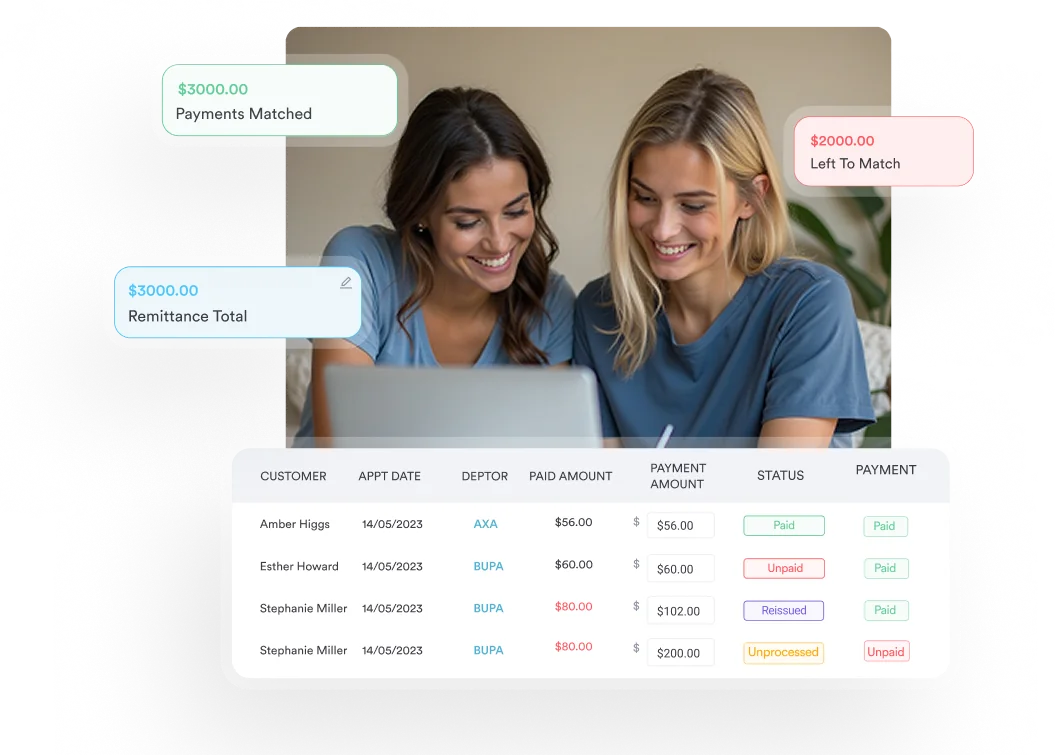
Eligibility checks can run before the bronchoscopy date, so a non-covered diagnosis surfaces ahead of the procedure instead of weeks after it. Remittance posting then closes the loop from claim submission through payment, and the denial reasons land against the same patient record.

Pabau links clinical documentation to the billing workflow, so the detail behind a CPT Code 31624 claim is captured at the point of care.

Most of what goes wrong on a 31624 claim is decided before it is submitted. Two habits fix the bulk of it. Bill 31624 alone when lavage was performed, and make the operative note name the segment, the volume, and the specimen’s destination.
The place-of-service field deserves the same attention, because the office and facility rates sit about $165 apart on this code. Getting that field wrong costs more than any modifier error on the page.
Pabau’s integrated documentation and claims workflows remove the manual steps that introduce those errors. Book a demo to see how it handles bronchoscopy billing in a pulmonology or respiratory care practice.

Need a clearinghouse that handles CPT claim validation? Medical claims clearinghouse overview explains how clearinghouse routing reduces rejected claims before they reach the payer.
Worried about claim denials across your procedure codes? Denial codes in medical billing covers the most common CARC and RARC codes your team will encounter after a 31624 rejection.
Looking to understand how 837P files work for electronic claim submission? 837 file guide walks through the electronic claim transaction format used for professional claims including bronchoscopy codes.
CPT Code 31624 is used to report bronchoscopy with bronchial alveolar lavage (BAL). Sterile saline is instilled into a lung segment and aspirated, collecting cells and fluid for laboratory analysis. It applies to both rigid and flexible bronchoscope approaches, and includes fluoroscopic guidance when performed.
CPT 31622 covers diagnostic bronchoscopy with inspection only, while CPT 31624 adds bronchial alveolar lavage to that inspection. 31624 subsumes the diagnostic component. Billing both for the same session is considered unbundling, and will result in a claim edit or denial.
Modifier 59 applies when 31624 is billed alongside another bronchoscopy code, to establish that a distinct service was performed at a separate anatomical site. Modifier 52 applies when the BAL is discontinued before sample collection is complete. Modifiers 26 and TC apply in split-billing scenarios.
The 2026 Medicare national average non-facility rate for CPT 31624 is approximately $286, and the facility rate is approximately $121, per the FastRVU 2026 lookup. Actual payment varies by locality under the CMS Geographic Practice Cost Index. Verify current rates with the CMS Physician Fee Schedule Lookup Tool.
Yes, in some cases. CPT 31623 (brushings) and 31625 (biopsy) may be billed alongside 31624 with modifier 59, where both services were performed at distinct anatomical locations. CPT 31622 cannot be billed with 31624 on the same date for the same session. Verify current NCCI edit pairs through CMS first.
Yes. Modifier 52 signals a reduced service when the bronchoscopy is terminated before the BAL is complete. The operative note must specify what was and was not accomplished. That means the reason for early termination, how far the scope advanced, and whether any lavage fluid was recovered.



