

CPT code 48152: Whipple procedure without pancreatojejunostomy
CPT code 48152: Official description and procedure overview CPT code 48152 descr...

Last Updated: Nov 13, 2026
31654 is the CPT add-on code for bronchoscopy with transendoscopic endobronchial ultrasound (EBUS) during a diagnostic or therapeutic intervention for peripheral lesions. Fluoroscopic guidance is included when performed, and the code is listed in addition to the primary procedure code.
It covers radial-probe EBUS used to reach and sample a peripheral pulmonary lesion, as distinct from the mediastinal-station codes 31652 and 31653. Billing errors on this code follow three recurring problems. Claims go out without an eligible primary bronchoscopy code, or peripheral EBUS gets confused with mediastinal EBUS. The third is a procedure note that fails to show the target was peripheral.
Let Pabau's smart automation suggest the right codes, reduce claim denials, and keep your practice compliant—effortlessly.
Automate repetitive tasks and focus on what matters most—your patients.
Reduce coding errors and ensure compliance with the latest regulations.
Clean claims, fewer denials, and faster reimbursements.
Powerful insights and reporting to help your practice thrive.
HIPAA compliant SOC 2 certified GDPR-compliant Trusted by 4,000+ clinics worldwide

CPT 31654 describes EBUS bronchoscopy for peripheral lesions, not mediastinal stations, and that distinction decides which EBUS code you bill.
31654 is an add-on code billed with a primary bronchoscopy code, such as 31622 to 31625, 31628 or 31629. Without one, payers deny the claim as an add-on without an eligible primary procedure code.
The 31654 descriptor bundles fluoroscopic guidance, so you cannot report it separately on the same date.
Report each of 31652, 31653 and 31654 only once per session. Also, 31654 can pair with either mediastinal code when you sample both sites.
Pabau, the practice software we build, tracks and submits claims through Claim.MD, with eligibility checks and ERA remittances alongside each claim.
CPT code 31654 is the add-on endobronchial ultrasound (EBUS) code for reaching and sampling peripheral lung lesions during bronchoscopy. The official American Medical Association (AMA) descriptor reads:
“Bronchoscopy, rigid or flexible, including fluoroscopic guidance, when performed; with transendoscopic endobronchial ultrasound (EBUS) during bronchoscopic diagnostic or therapeutic intervention(s) for peripheral lesion(s) (List separately in addition to code for primary procedure).”
Three elements of this descriptor carry billing weight. First, “including fluoroscopic guidance, when performed” bundles fluoroscopy, so you cannot report a separate imaging guidance code alongside 31654. Second, “peripheral lesion(s)” limits the code to targets outside the mediastinum. Third, the “List separately in addition to” instruction confirms add-on status.
CPT 31654 bundles the EBUS guidance component and fluoroscopic imaging into a single add-on payment. However, the services it leaves out decide as many claims as the ones it includes.
Included in 31654:
Excluded from 31654:
The AMA parenthetical instructions in the CPT codebook name the primary codes 31654 may accompany. If you bill it with a code outside that list, payers deny the claim as an add-on without an eligible primary procedure code.
Each clinical step below leaves a trace in the operative note, and coders check those traces against the code being billed.
That final step decides whether the claim holds up. For example, a thin operative note leaves the payer no evidence that the target was peripheral, however well the procedure went.
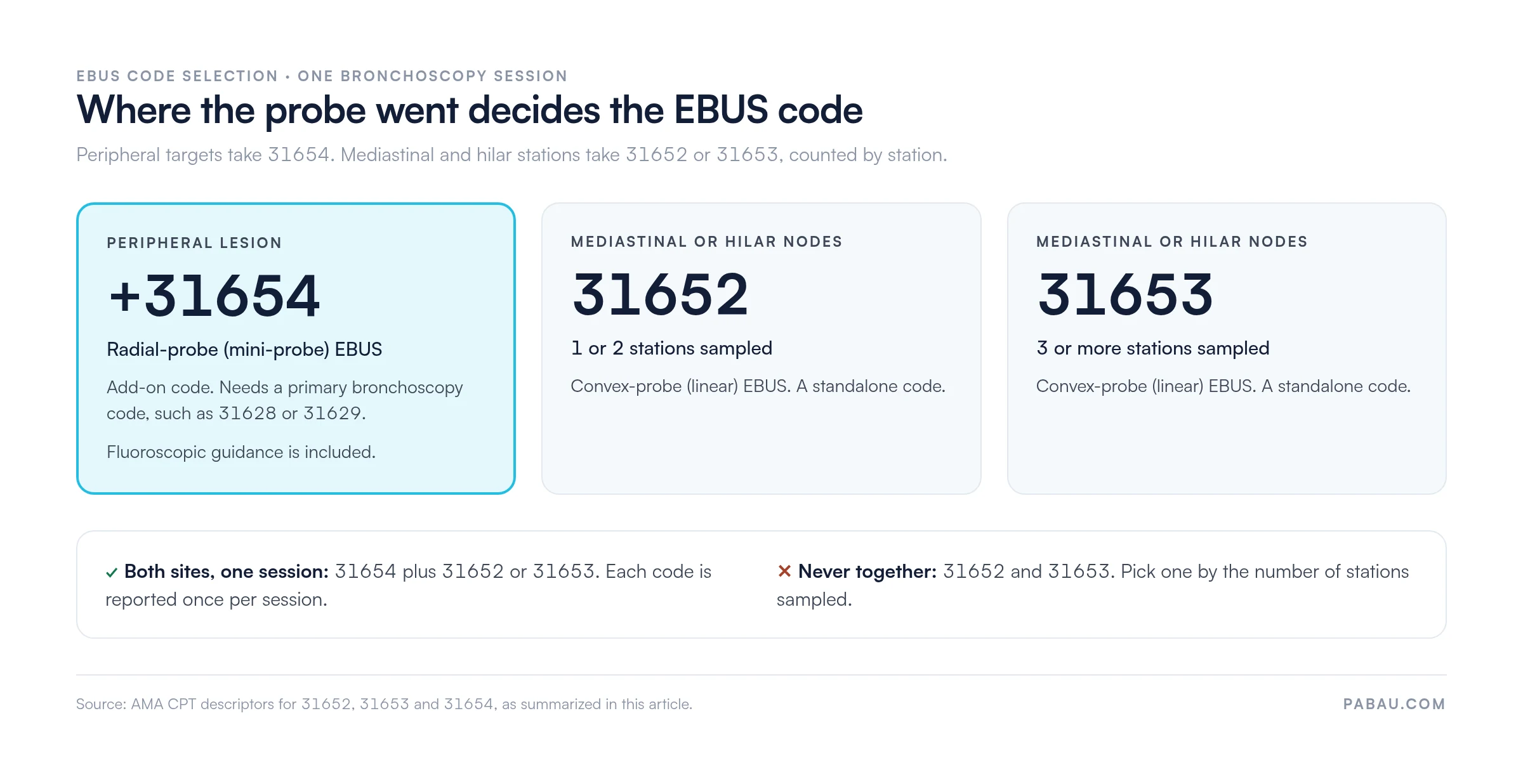
The three EBUS codes cover three different targets. 31652 and 31653 are standalone convex-probe codes, while 31654 alone is an add-on. Picking the wrong one trips NCCI edits and looks like upcoding to payers who audit bronchoscopy claims.
You bill either 31652 or 31653 based on station count, never both. However, you can report 31654 alongside either one when the bronchoscopist samples both peripheral and mediastinal targets in the same session.
Report each of 31652, 31653 and 31654 only once per session, however many lesions or passes the note records. Also, append modifier 59 when the NCCI edit requires it, and document each distinct site and the EBUS technique used at each. Finally, the panel below sets the three codes side by side.
As an add-on code, CPT 31654 requires a payable primary bronchoscopy code on the same claim. The AMA parenthetical instructions in the current CPT codebook name the eligible primary codes, including the ones below. Without one, payers deny the claim as an add-on without an eligible primary procedure code.
The table lists common primary codes, not every eligible one. When the peripheral lesion is sampled by transbronchial lung biopsy, 31628 is the primary code that 31654 is billed with.
Therefore, always verify the current-year AMA CPT codebook for the complete parenthetical list. The list has changed in prior annual updates, so billing from an outdated edition is a common source of denials.
Payers reviewing CPT 31654 claims look for specific language in the procedure note, beyond confirmation that bronchoscopy was performed. Clean claim submission for this code depends on seven documentation elements.
In addition, the diagnosis on the claim has to match that indication. A solitary pulmonary nodule found on CT is reported with ICD-10-CM R91.1, linked to the 31654 line when it is the reason for the procedure. Once pathology confirms a primary lung cancer, later claims carry a C34 code. Code C34.90 is kept for a record that names no site or side.
Pulmonology billing compliance requirements mean this documentation must be in the record before the claim is submitted. In contrast, late addenda carry much more audit risk.
Run a documentation checklist before every 31654 submission. If the operative note does not use the word ‘peripheral’ and does not describe EBUS probe findings at the lesion site, hold the claim. Send it back for a compliant addendum first.
CPT 31654 is an add-on code, which removes some of the modifier complexity that applies to standalone procedure codes. However, a few modifiers still apply in common situations.
Add-on codes are not subject to the multiple-procedure payment reduction that applies to independent procedures, so you do not append modifier 51 to 31654. Likewise, Medicare does not reduce add-on code payment based on a bilateral reduction either. When the NCCI edit calls for modifier 59 on 31654, documentation must clearly describe the two distinct target sites.
CPT 31654 carries its own RVU value as an add-on code. Because it is an add-on, its payment escapes the multiple-procedure reduction that cuts second and later independent procedures in a session. The CMS Physician Fee Schedule lookup tool is the best source for current payment amounts, which change every year and vary by locality.
Use the FastRVU 2026 lookup tool to retrieve current work, practice expense, and malpractice RVU values by modifier and setting. Key payment concepts for 31654:
Once a payer pays a 31654 claim, check the remittance against the expected amount for your locality. Pabau, through Claim.MD, returns ERA remittances so your team can reconcile payments against what was expected.
Prior authorization for EBUS peripheral-lesion bronchoscopy is not uniform across payers. Medicare does not require prior auth for most EBUS procedures, but commercial insurers frequently do, and their policies differ from plan to plan.
When a commercial payer requires prior auth and the practice does not obtain it, payers rarely reverse the resulting denial on appeal. Instead, build a standing prior-auth step into EBUS bronchoscopy scheduling rather than chasing authorizations after the procedure.
EBUS peripheral-lesion claims fail for common reasons. In fact, knowing the denial pattern before submission is the cheapest form of denial management.
For specific denial codes in medical billing, review the ERA after each denial. CARC 4 means the action is inconsistent with the procedure code billed. Meanwhile, CARC 97 means payment is included in the allowance for another service, the usual signal of an NCCI bundling edit on a 31654 claim.
The 31654 errors in this guide start before the claim exists. For example, a missing primary code, a vague operative note and an automatic modifier 59 are coding and documentation decisions your team makes.
Pabau takes over once those codes are set. Its claims software for practices tracks and submits claims through Claim.MD, to payers on the Claim.MD payer list. Eligibility checks, claim tracking and ERA remittances run through Claim.MD as well.
When payers deny a 31654 line, the CARC and RARC codes come back on the remittance. Your team can then spot a repeat pattern, such as a missing modifier on every 31654 and 31652 pair, and fix it at the source.
Audit your 31654 denials quarterly. Pull every claim for the code over 90 days and group the denials by reason. Fix the top two categories at the process level rather than appealing claim by claim.

Pabau tracks and submits claims through Claim.MD, with eligibility checks, claim tracking and ERA remittances in one place. Your team spends less time chasing claim status by phone.

CPT 31654 pays for one thing: radial-probe EBUS that reaches a peripheral lesion. The claim holds up when the operative note proves the target was peripheral and an eligible primary code sits on the same claim.
Start with the note template, because a coder cannot add what the bronchoscopist did not write. Then keep modifier 59 for the cases where the NCCI edit asks for it, instead of every 31654 and 31652 pair.
Pabau handles the step after coding, with eligibility checks, claim tracking and ERA remittances through Claim.MD. Book a demo to see how a pulmonology claim moves from submission to payment in Pabau.

List Item #1
List Item #2
CPT code 31654 is an add-on bronchoscopy code for endobronchial ultrasound (EBUS) guidance used to reach and sample a peripheral pulmonary lesion. It includes fluoroscopic guidance when performed and you must bill it with an eligible primary bronchoscopy code.
Yes, CPT 31654 is an add-on code, and the AMA CPT codebook marks it with the plus (+) symbol. It cannot be reported alone, so you list it with a primary bronchoscopy code, including 31622 to 31625, 31628 or 31629. Without one, payers deny the claim as an add-on without an eligible primary procedure code.
CPT 31652 covers convex-probe EBUS sampling of 1-2 mediastinal or hilar lymph node stations, and 31653 covers 3 or more stations. 31654 is the add-on for radial-probe EBUS to a peripheral pulmonary lesion. The target site decides the code, not the number of passes at the peripheral site.
No. The CPT 31654 descriptor includes fluoroscopic guidance when performed, so the add-on code payment bundles fluoroscopy. Billing a separate fluoroscopic guidance code, such as 76000 or 77002, alongside 31654 on the same claim results in a bundling edit denial.
Medicare reimbursement for CPT 31654 varies by locality, by facility vs. non-facility setting, and with the annual CMS Physician Fee Schedule update. Rates change on January 1 each year. Use the CMS Physician Fee Schedule lookup tool to retrieve current RVU values and payment amounts for your locality.



