CPT Code 31653: EBUS With 3+ Mediastinal Stations
CPT code 31653: Official descriptor and clinical scope CPT code 31653 is the pro...

Last Updated: Oct 20, 2026
Billable Code Specific Code
31628 is the CPT code for bronchoscopy, rigid or flexible, including fluoroscopic guidance, when performed; with transbronchial lung biopsy(s), single lobe. It covers one or more forceps biopsies taken from a single lung lobe in one session.
Each additional lobe biopsied in the same session is reported with add-on code +31632, never a second unit of 31628. Fluoroscopy is included in the code, and NCCI edits bundle diagnostic bronchoscopy 31622 into it.
Let Pabau's smart automation suggest the right codes, reduce claim denials, and keep your practice compliant—effortlessly.
Automate repetitive tasks and focus on what matters most—your patients.
Reduce coding errors and ensure compliance with the latest regulations.
Clean claims, fewer denials, and faster reimbursements.
Powerful insights and reporting to help your practice thrive.
HIPAA compliant SOC 2 certified GDPR-compliant Trusted by 4,000+ clinics worldwide

CPT code 31628 covers flexible or rigid bronchoscopy with transbronchial lung biopsy of a single lobe. Add-on code +31632 covers each additional lobe in the same session.
Fluoroscopic guidance is included in the code descriptor when performed and cannot be billed separately under a standalone fluoroscopy code.
Documentation must name the specific lobe biopsied, the specimen count, and whether fluoroscopy was used, because a missing element is a common denial trigger.
CPT 31629 is transbronchial needle aspiration of the airway, not the additional-lobe add-on, so it never stands in for +31632.
Pabau’s claims management software helps pulmonology and respiratory practices track claim status, manage NCCI-related denials, and submit clean claims through Claim.MD.
CPT code 31628 carries an official descriptor from the American Medical Association. It reads: Bronchoscopy, rigid or flexible, including fluoroscopic guidance, when performed; with transbronchial lung biopsy(s), single lobe. It sits within the endoscopy subsection of the trachea and bronchi codes (31615-31654), which share the same base bronchoscopy service.
The CPT structure for bronchoscopy codes is hierarchical. Every code in the family includes the basic bronchoscopic insertion, advancement, inspection, and withdrawal as bundled components.
The key clinical components this code captures are:
“Single lobe” is the primary billing limitation. If biopsy samples come from more than one pulmonary lobe, add-on code +31632 is reported for each additional lobe beyond the first.
The distinction between 31628 and 31632 is purely anatomical. It turns on how many lobes were biopsied during the same bronchoscopic session. CPT code 31628 is the primary (base) code reported when biopsy is taken from one lobe. CPT 31632 is an add-on code reported for each additional lobe biopsied beyond the first.
If a pulmonologist biopsies the right upper lobe and the left lower lobe in one session, the correct billing is 31628 + 31632. Biopsying three lobes means 31628 + 31632 x2 (reported twice). Never report 31632 without 31628, because it cannot be billed as a standalone code. Never report two units of 31628 for a two-lobe biopsy.
Don’t confuse +31632 with 31629. CPT 31629 is transbronchial needle aspiration of the trachea, main stem or lobar bronchus, a different technique that is coded on its own.
The grid below maps each sample taken in one bronchoscopy session to the code it takes, including the lobe counts that trip up most claims.
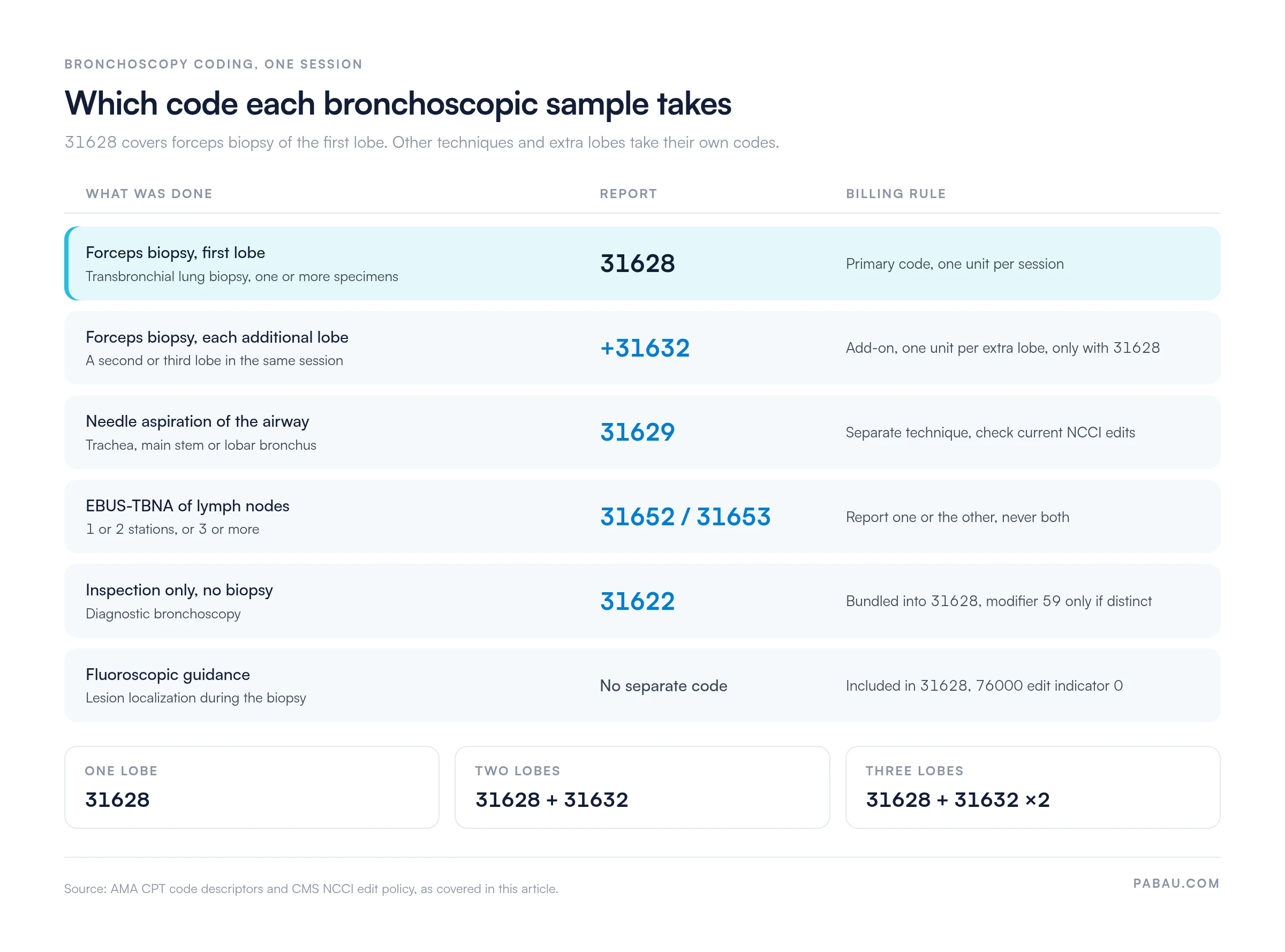
Knowing where 31628 sits in the bronchoscopy code family prevents unbundling errors. It also shows when additional codes can be legitimately reported in the same session. The same add-on and bundling logic runs across the whole trachea and bronchi endoscopy subsection.
Forceps that sample the bronchial wall rather than the lung tissue beyond it put the claim on 31625, not 31628.
The most common error is billing 31622 alongside 31628 without justification. Per NCCI edit policy, 31622 (diagnostic bronchoscopy) is considered a component of any bronchoscopy that includes a diagnostic or therapeutic service.
When the bronchoscopy is performed purely to access the biopsy site, 31622 is bundled into 31628. It can only be reported separately with modifier 59 and documentation of a distinct service at a separate site in the same session.
Run 31628 against your payer’s NCCI edit table before billing 31622 in the same session. NCCI edits are updated quarterly, so a pair that was separately reportable last year may now require modifier 59 or be fully bundled. Check CrossCoder or your clearinghouse edit tool each quarter.
Modifier selection for CPT code 31628 affects claim acceptance, payment calculation, and audit risk. Using claims management software with built-in modifier logic reduces the risk of rejected or downcoded bronchoscopy claims. Below are the modifiers most commonly applied with this code.
Inadequate operative notes are a leading cause of CPT code 31628 claim denials. The operative report must contain all of these elements to survive an audit or retrospective review.
Meeting the clean claim standard for 31628 means the operative report must affirmatively state the following before the claim goes out:
Medical necessity for CPT code 31628 is established through an appropriate ICD-10-CM diagnosis code. Payer LCD policies specify which diagnoses support coverage. Pairing 31628 with a code outside the covered diagnoses list is a routine denial cause.
The superbill should capture the primary diagnosis and any relevant secondary codes before the claim is submitted. A solitary nodule on CT is coded R91.1, while other nonspecific lung-field findings take R91.8. Transbronchial biopsy also grades lung transplant rejection, and that diagnosis is coded T86.810.
Medicare covers CPT code 31628 when it meets Local Coverage Determination (LCD) medical necessity criteria established by the applicable Medicare Administrative Contractor (MAC). Checking that framework first keeps a claim from being denied on medical necessity before anyone reads the operative note.
Coverage rules vary by MAC jurisdiction. Before performing elective bronchoscopy with transbronchial biopsy, verify the applicable LCD for your region. Common Medicare medical necessity requirements include:
Commercial payers generally follow similar criteria but often add prior authorization requirements. Many major commercial insurers require pre-authorization for elective bronchoscopy with biopsy, and the rules vary by plan and change often.
Always verify directly with the specific plan before scheduling. Prior authorization requirements also apply in some Medicaid managed care plans.
Medicare reimbursement for CPT code 31628 varies by practice setting and geographic locality. The CMS Medicare Physician Fee Schedule lookup tool is the authoritative source for current payment rates. The figures below are general national averages, so verify them against the current fee schedule year before billing.
Geographic payment localities adjust final reimbursement up or down. High-cost areas (e.g., Manhattan, San Francisco) pay above the national average, and rural and lower-cost regions pay below it.
Use the FastRVU lookup tool to calculate locality-adjusted payments for your specific region. Verify current rates through the CMS MPFS lookup before publishing fee schedules or quoting expected reimbursement to patients.
Treat fee schedule figures as estimates until the electronic remittance advice (ERA) confirms what was paid.
Claim denials for CPT code 31628 follow predictable patterns. Effective denial management starts by identifying the root cause rather than reflexively resubmitting. These are the denial triggers pulmonology billing teams encounter most often:
The CMS National Correct Coding Initiative (NCCI) governs which codes can be billed together and under what circumstances. For CPT code 31628, the NCCI edit table establishes several column 1/column 2 pairs that pulmonology billing teams must know. Knowing these pairs prevents bundling errors before they become denials.
Clearinghouse edit checks, such as those in Claim.MD, flag NCCI conflicts before a claim reaches the payer.
NCCI edits are updated quarterly by CMS. The rules below reflect established policy. Before billing a combination, verify its current edit status in the live NCCI table or a tool like CrossCoder.
Outpatient Prospective Payment System (OPPS) packaging rules add another layer for hospital outpatient settings. Certain ancillary services, such as moderate sedation and pathology specimen handling, may be packaged into the primary procedure’s APC payment. The facility cannot bill those separately.
The physician’s professional fee is still billed separately under the MPFS. If you bill both the facility and professional components of one session, confirm which services are packaged at the OPPS level. That avoids duplicate billing on the facility side.
Use the AAPC Codify NCCI edit lookup alongside your quarterly NCCI table review. Modifier indicator 0 means no modifier can unbundle the pair. Billing both codes anyway is unbundling, not a fixable modifier error. Verify the indicator before appealing a bundling denial.
Without a check before submission, a missing lobe name or a 31622 bundling conflict surfaces when the denial arrives. By then the operative note is weeks old, and the appeal means rebuilding the paper trail.
Pabau, the practice management platform we build, keeps the procedure note, diagnosis codes and claim in the same patient record. Claims go out through the Claim.MD clearinghouse integration, whose edit checks flag NCCI conflicts before the payer sees them.
Payments are tracked against the expected fee schedule amount. An underpaid 31628 or a dropped +31632 line shows up while it is still easy to appeal. Your billing team spends less time reworking bronchoscopy claims and more time on the next procedure day.

Pabau helps respiratory practices manage bronchoscopy claims, track NCCI edits, and submit clean claims through Claim.MD. See how Pabau handles the billing complexity so your team focuses on patient care.

CPT code 31628 rewards precision more than volume. Name the lobe, count the specimens and state whether fluoroscopy was used, and the most common denial triggers are gone before the claim is built.
The rule worth remembering is that every extra lobe adds +31632, never a second 31628. A separate 31622 needs a documented, distinct service. Build those two checks into your coding review and multi-lobe sessions stop being guesswork.
Book a demo to see how Pabau helps pulmonology practices get bronchoscopy claims paid on the first submission.

Billing a lavage in the same session? CPT code 31624 covers bronchoscopy with bronchial alveolar lavage and when it is reported alongside a biopsy.
Coding a single nodule found on CT? ICD-10 code R91.1 explains the solitary pulmonary nodule diagnosis that often supports medical necessity for 31628.
Need to understand how clearinghouse edits catch NCCI conflicts before submission? How Claim.MD clearinghouse processing works explains the pre-submission edit checks that flag bundling errors automatically.
Want a step-by-step guide to building cleaner claim submissions? Clean claim submission best practices covers the documentation and coding standards that prevent first-pass denials.
Looking to understand how denial patterns affect revenue cycle performance? What is revenue cycle management covers how bronchoscopy denials fit into the broader billing lifecycle.
CPT code 31628 covers bronchoscopy, rigid or flexible, with transbronchial lung biopsy of a single pulmonary lobe. It includes the bronchoscopic procedure itself, the forceps biopsy of tissue from one lobe, and fluoroscopic guidance when used for lesion localization.
CPT 31628 is the primary code for transbronchial lung biopsy of the first lobe biopsied. CPT 31632 is an add-on code reported with 31628 for each additional lobe biopsied in the same session. A two-lobe biopsy bills as 31628 + 31632, and a three-lobe biopsy as 31628 + 31632 x2.
No. CPT 31629 is transbronchial needle aspiration biopsy of the trachea, main stem or lobar bronchus, a different technique from forceps lung biopsy. The add-on for each additional lobe biopsied is +31632.
No. The AMA descriptor reads “including fluoroscopic guidance, when performed,” so 31628 is billable whether or not fluoroscopy is used. When fluoroscopy is performed, it is bundled into 31628 and cannot be reported under a standalone fluoroscopy code. The operative note should state whether fluoroscopy was used either way.
Generally no. CMS NCCI edits bundle diagnostic bronchoscopy (31622) into 31628 because the base bronchoscopic service is already included. Modifier 59 applies only when the diagnostic bronchoscopy is a distinct service at a separate anatomical site, with operative note documentation to support it. Modifier indicator 1 means the edit can be bypassed with that documentation. It does not make routine dual billing acceptable.
The modifiers most often used with CPT code 31628 are 59, LT/RT and 22. Modifier 59 marks a distinct procedural service when 31622 is separately justified. LT or RT shows laterality where the payer requires it, and 22 flags substantially increased procedural work. Modifier 51 applies when 31628 is performed with other non-add-on surgical procedures in the same session.
Most 31628 denials trace back to five causes. Three are coding errors: A thin operative note, extra lobes billed without +31632, and 31622 billed without modifier 59. A thin note is one missing the lobe, specimen count or fluoroscopy status. The other two are missing prior authorization and an ICD-10 code outside the payer’s covered indications.