HCPCS Code Q4175: Billing, coverage, and documentation guide
HCPCS Code Q4175: Code Description and Product Identity HCPCS Code Q4175 is the ...

Last Updated: Nov 20, 2026
31629 is the CPT code for a bronchoscopy with transbronchial needle aspiration biopsy of the trachea, main stem bronchus, lobar bronchus or lung.
The scope may be rigid or flexible, and fluoroscopic guidance is included when it is used. One unit covers every needle pass in the first lobe sampled. Each additional lobe takes add-on code 31633, and a forceps lung biopsy is coded 31628 instead.
Let Pabau's smart automation suggest the right codes, reduce claim denials, and keep your practice compliant—effortlessly.
Automate repetitive tasks and focus on what matters most—your patients.
Reduce coding errors and ensure compliance with the latest regulations.
Clean claims, fewer denials, and faster reimbursements.
Powerful insights and reporting to help your practice thrive.
HIPAA compliant SOC 2 certified GDPR-compliant Trusted by 4,000+ clinics worldwide

CPT code 31629 reports a bronchoscopy with transbronchial needle aspiration biopsy, and fluoroscopic guidance is bundled into the code.
CPT 31628 reports a forceps lung biopsy instead, so the biopsy instrument decides between the two codes, not the lobe count.
Add-on code 31633 covers each additional lobe sampled by needle, and it can only be reported with 31629 as the primary code.
Pabau’s claims software submits 31629 claims through the Claim.MD clearinghouse and tracks eligibility, prior authorizations and ERA remittances on the patient record.
CPT code 31629 is the code for a bronchoscopy with transbronchial needle aspiration biopsy of the trachea, main stem bronchus, lobar bronchus or lung.
AAPC’s Codify entry for 31629 places it among the endoscopy codes for the trachea and bronchi, 31615 through 31654. Fluoroscopic guidance is part of the code when it is used. Each additional lobe sampled by needle is reported with add-on code 31633.
The American Medical Association (AMA) publishes the full descriptor:
Bronchoscopy, rigid or flexible, including fluoroscopic guidance, when performed; with transbronchial needle aspiration biopsy(s), trachea, main stem bronchus(i), lobe(s) of bronchus(i), lung(s).
AMA CPT descriptor for 31629
The code bundles scope insertion, navigation to the target and needle aspiration from one or more sites in a single session. Fluoroscopic guidance is included too, when the physician uses it. Payers expect the operative report to document these elements together.
Bundled (cannot be billed separately):
Not included (may be separately reportable):
Payers deny 31629 claims far more often for incomplete operative reports than for wrong code selection. The operative note must demonstrate medical necessity and document every element the code descriptor requires.
The ICD-10-CM Official Guidelines for Coding and Reporting base code assignment on the documentation by the patient’s provider. So the diagnosis on the claim has to match the indication in the note. For bronchoscopy with transbronchial needle biopsy, the operative report should contain:
Each documentation element maps to a denial trigger. Missing lobe documentation causes 31633 add-on denials. Missing needle-instrument language causes payers to default to 31628 reimbursement rates.
Run a documentation checklist before the claim drops. Confirm the operative report names the biopsy instrument (needle or forceps), identifies at least one anatomical site, and says whether fluoroscopy was used. Missing any of these three elements is the fastest path to a preventable denial on 31629 claims.
CPT 31629 and 31628 are the pair coders mix up most often in pulmonary procedure coding. The difference is the biopsy instrument and technique, not the number of lobes sampled. When a cytology brush is the only sampling tool in the note, the claim is coded as code 31623 instead.
The audit signal is the wording of the note. If the operative report says “forceps,” 31628 applies. If it says “needle aspiration” or “TBNA,” 31629 applies. Lobe count only decides how many add-on units follow, as the chart below shows.
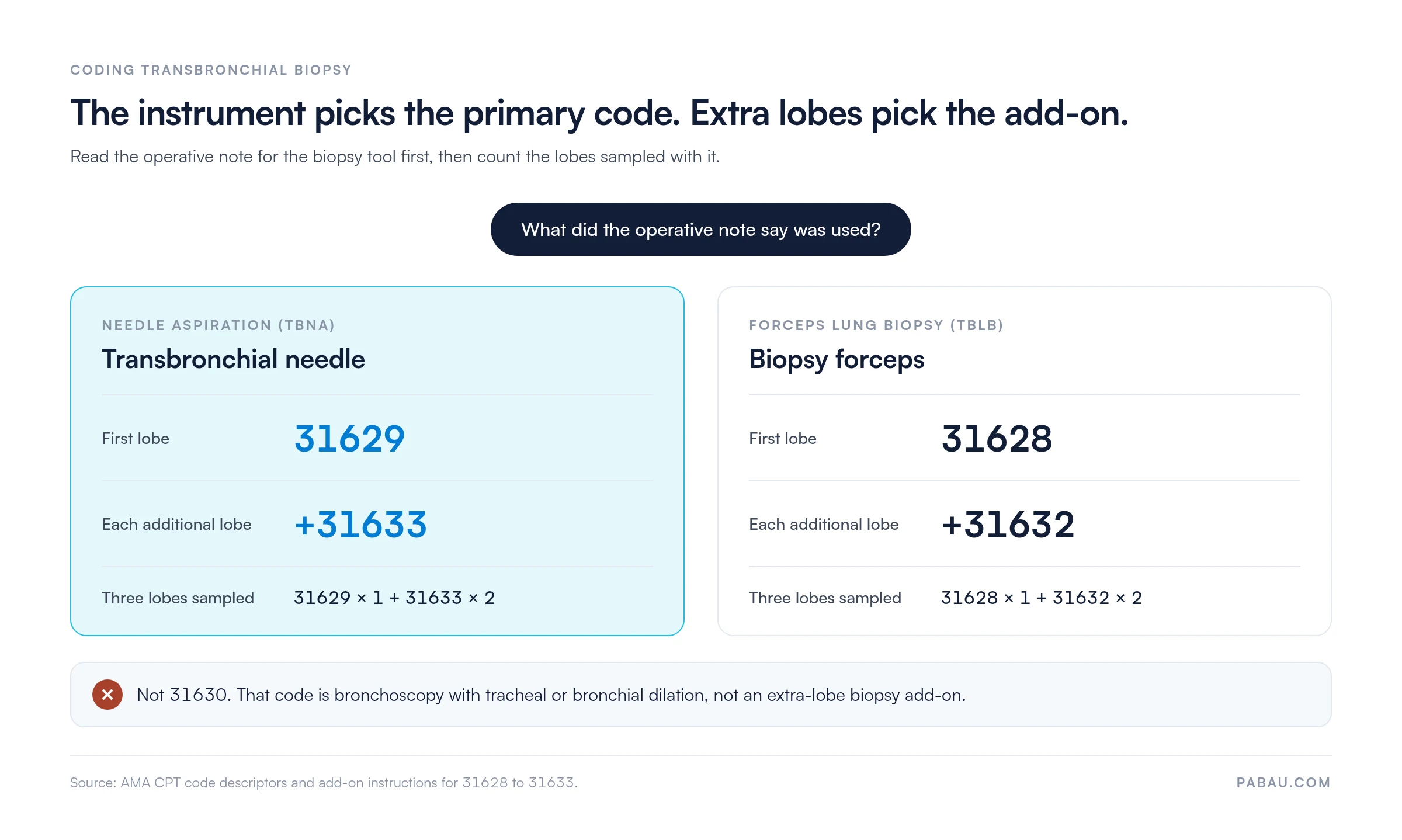
One payer rule sits on top of that logic. Billing both primary codes on the same date needs the documentation described in the modifiers section below.
Bronchoscopy codes sit in the 31615 to 31654 range of the CPT code set. Knowing where 31629 sits in that range prevents unbundling denials and missed add-on revenue.
CPT 31633 is the add-on code for each additional lobe sampled by needle beyond the first. Report it once per extra lobe, not once per additional needle pass within the same lobe.
Here is a worked example. A patient has transbronchial needle aspiration of the right upper lobe and right lower lobe in one session. Bill 31629 x1 for the first lobe plus 31633 x1 for the second. If three lobes are sampled, bill 31629 x1 plus 31633 x2. The AMA’s CPT parenthetical under 31633 confirms it is reported with 31629 only.
Modifier selection decides whether a same-session claim pays or denies. Three modifiers matter for 31629, and -59 comes up most, usually when an endobronchial biopsy billed as 31625 shares the date.
When modifier -59 supports a same-session 31629 and 31628 claim, the operative report must name both instruments, needle and forceps. It must also name the separate anatomical targets. A single operative note describing only one instrument type will not support both codes.
Payers check the linked ICD-10-CM diagnosis against their Local Coverage Determination (LCD) before approving transbronchial biopsy.
The diagnosis must reflect a condition that calls for needle aspiration biopsy through a bronchoscope. A solitary nodule coded R91.1 is the most common pairing, and treatment-resistant pneumonia is coded J18.9.
LCD-covered diagnoses vary by Medicare Administrative Contractor (MAC) jurisdiction. What one MAC accepts as sufficient medical necessity documentation may not satisfy another. Verify the applicable LCD for your jurisdiction before submitting.
CMS has not issued a National Coverage Determination (NCD) specifically for bronchoscopy with transbronchial biopsy. Coverage is governed by MAC-issued Local Coverage Determinations. This means reimbursement and medical necessity criteria differ by region.
The figures below are 2026 national values from the Medicare Physician Fee Schedule (MPFS). Geographic practice cost indices (GPCIs) adjust payment by locality. Verify current rates using the CMS Physician Fee Schedule lookup tool, as rates update each January 1.
The non-facility rate is almost three times the facility rate, because it carries the practice expense of doing the procedure outside a hospital. Confirm current figures using the FastRVU 2026 RVU lookup tool or the CMS MPFS tool directly.
Original Medicare (traditional fee-for-service) does not list bronchoscopy with transbronchial biopsy in its prior authorization program as of 2024. However, MAC LCDs may require specific pre-procedural documentation before coverage is confirmed.
Most 31629 denials are preventable. The five patterns below cover the usual rejections in pulmonology billing, driven by NCCI edits and LCD medical-necessity rules. Our billers’ denial code guide decodes each remark code in more depth.
The National Correct Coding Initiative publishes quarterly updates to its edit pairs. The edits most relevant to 31629 are:
Check your ERA remittances after every 31629 claim. The CARC denial code on the 835 transaction tells you exactly which NCCI edit fired. CO-97 on a bronchoscopy claim almost always means a bundling violation. Map it back to the edit pair in the CMS NCCI policy manual, so you fix the root cause and not just the one claim.
Most rework on a 31629 claim starts after submission. A coder learns about a missing lobe note or an unrecorded authorization only when the remittance comes back with a CO-16 or CO-15.
Pabau, the practice management platform we build, keeps the operative note, the claim and the payer response on one patient record. Its claims software for pulmonologists sends CMS-1500 and 837P claims through the Claim.MD clearinghouse. Eligibility checks run from the same screen before the procedure date.
Prior authorizations are tracked on the patient’s case, with the auth code, dates and sessions, and Pabau warns you when one is missing. ERA remittances come back into Pabau too, so a CO-97 bundling denial sits next to the claim that triggered it.

Pabau submits CPT 31629 claims through the Claim.MD clearinghouse and checks eligibility before the procedure. Prior authorizations and ERA remittances are tracked on the same patient record.

The biopsy instrument settles a 31629 claim before any other coding choice. If the note says needle, the claim is 31629 plus one 31633 for each further lobe. If it says forceps, the claim is 31628 and 31632, and no lobe count changes that.
The add-on is where revenue leaks. A three-lobe needle biopsy billed as a single 31629 leaves two units of 31633 unpaid. Reporting 31630 instead bills a dilation that never happened.
So check the operative note before the claim drops, not after the remittance. Book a demo to see how Pabau tracks bronchoscopy claims from authorization to payment.

Need help managing claim denials systematically? Denial management in healthcare covers how to build a denial prevention workflow that reduces rework across all procedure codes.
Want to understand how clearinghouses fit into the billing cycle? Medical claims clearinghouse guide explains how clearinghouses validate, route, and report on claim status before payer adjudication.
Looking for a plain-language breakdown of ERA remittances? Electronic remittance advice explained walks through how to read 835 ERA files and interpret CARC denial codes.
CPT code 31629 covers bronchoscopy with transbronchial needle aspiration biopsy of the trachea, main stem bronchus, lobe of bronchus, or lung. Fluoroscopic guidance is included when performed. The code bundles scope insertion, needle biopsy technique, and fluoroscopy into a single billable service.
CPT 31628 uses biopsy forceps to take a core tissue sample from the lung parenchyma. CPT 31629 uses a transbronchial needle to aspirate from bronchial walls, peribronchial nodes, or lung tissue. The instrument and sampling technique determine which code applies, not the lobe count or whether fluoroscopy was used.
Yes, fluoroscopic guidance is bundled into CPT 31629 and cannot be billed separately. The AMA descriptor states “including fluoroscopic guidance, when performed.” NCCI edits also bundle CPT 76000 and CPT 77001 into 31629 as column 2 codes, with no modifier override.
CPT 31633 is the add-on code for each additional lobe sampled by needle beyond the first. Report it once per extra lobe in the same session. CPT 31627 (navigational bronchoscopy) may also be reported as an add-on when electromagnetic navigation is documented. Neither add-on can be reported without a primary bronchoscopy code.
Original Medicare does not require prior authorization for bronchoscopy with transbronchial biopsy under traditional fee-for-service as of 2024. Medicare Advantage plans commonly do require prior auth; verify with the specific plan before scheduling. Some Medicaid MCOs also require prior authorization regardless of diagnosis.
Billing both on the same date is payer-dependent. When both needle aspiration and forceps biopsy are performed at distinct anatomical sites in a single session, modifier -59 may allow separate reporting. The operative note must name both instruments and specify the separate sites. Verify the applicable MAC LCD before billing both codes together.