

CCSD code G5100: Bypass of duodenum billing guide
CCSD code G5100 bills a bypass that leaves the duodenum in place CCSD code G5100...

Last Updated: Oct 16, 2026
30802 is the CPT code for ablation, soft tissue of inferior turbinates, unilateral or bilateral, any method; intramural. It covers radiofrequency, coblation, laser, or other energy delivered beneath the mucosa to shrink enlarged inferior turbinates.
One unit covers one or both sides in the same session, so modifier 50 doesn't apply. The operative note must confirm submucosal energy delivery, which separates 30802 from superficial ablation (30801) and submucous resection (30140).
Let Pabau's smart automation suggest the right codes, reduce claim denials, and keep your practice compliant—effortlessly.
Automate repetitive tasks and focus on what matters most—your patients.
Reduce coding errors and ensure compliance with the latest regulations.
Clean claims, fewer denials, and faster reimbursements.
Powerful insights and reporting to help your practice thrive.
HIPAA compliant SOC 2 certified GDPR-compliant Trusted by 4,000+ clinics worldwide

CPT code 30802 covers intramural (submucosal) ablation of the inferior turbinates, on one or both sides, by any method.
Report one unit whether one or both turbinates are treated, and add LT or RT only when a payer contract asks for them.
30802 differs from 30801 (superficial ablation) by technique depth, so the operative note must confirm submucosal energy delivery.
30802 carries a 10-day global period in every setting and 2.03 work RVUs, against 1.11 for 30801.
Pabau, the practice management platform we build, tracks modifiers, links ICD-10 codes, and submits claims electronically through Claim.MD.
CPT code 30802 reports intramural ablation of the inferior turbinates, on one or both sides, by any method. The American Medical Association’s CPT code set gives its official descriptor as follows.
“Ablation, soft tissue of inferior turbinates, unilateral or bilateral, any method (eg, electrocautery, radiofrequency ablation, or tissue volume reduction); intramural (ie, submucosal).”
The intramural qualifier separates this code from 30801, its superficial sibling. The device passes through the mucosa into the submucosal tissue, leaving the mucosal surface itself untreated. That device may be a radiofrequency probe, coblation wand, laser fiber, or microdebrider.
Inferior turbinate hypertrophy causes chronic nasal obstruction when the submucosal tissue and venous sinusoids stay permanently engorged. Reducing that submucosal volume is the clinical goal. The intramural approach delivers controlled thermal or mechanical energy into the tissue. That triggers fibrosis and volume reduction while the mucosal lining above stays intact.
The operative note must document each of these steps explicitly. When it leaves out the intramural language, auditors can reclassify a 30802 claim down to 30801.
30801 and 30802 describe the same anatomical target but different tissue depths. 30801 applies ablative energy to the mucosal surface only. 30802 delivers that energy intramurally, beneath the mucosa, into the submucosal tissue. The operative note has to support the distinction, because a payer won’t infer it from the device used.
The AAPC Codify CPT lookup reflects that 30802 carries a higher work RVU than 30801 (2.03 vs 1.11). That difference pays for the extra technical work of intramural tissue access. When a note says only “cauterized the turbinate” without stating depth, auditors default to the lower-value 30801. Specific documentation protects the reimbursement.
CPT 30140 covers submucous resection of the inferior turbinate, a more extensive procedure that physically removes submucosal tissue. 30802 removes no tissue and shrinks the turbinate through energy delivery instead. American Academy of Otolaryngology guidance and the AAPC Otolaryngology Coding Alert treat them as distinct surgical approaches. The two codes can’t be used interchangeably.
Payers watch closely for upcoding from 30802 to 30140. If the operative note describes energy delivery without tissue excision or bony work, billing 30140 isn’t supported. It exposes the practice to overpayment recovery and audit risk. The decision path below shows how the note picks between 30801, 30802, and 30140.
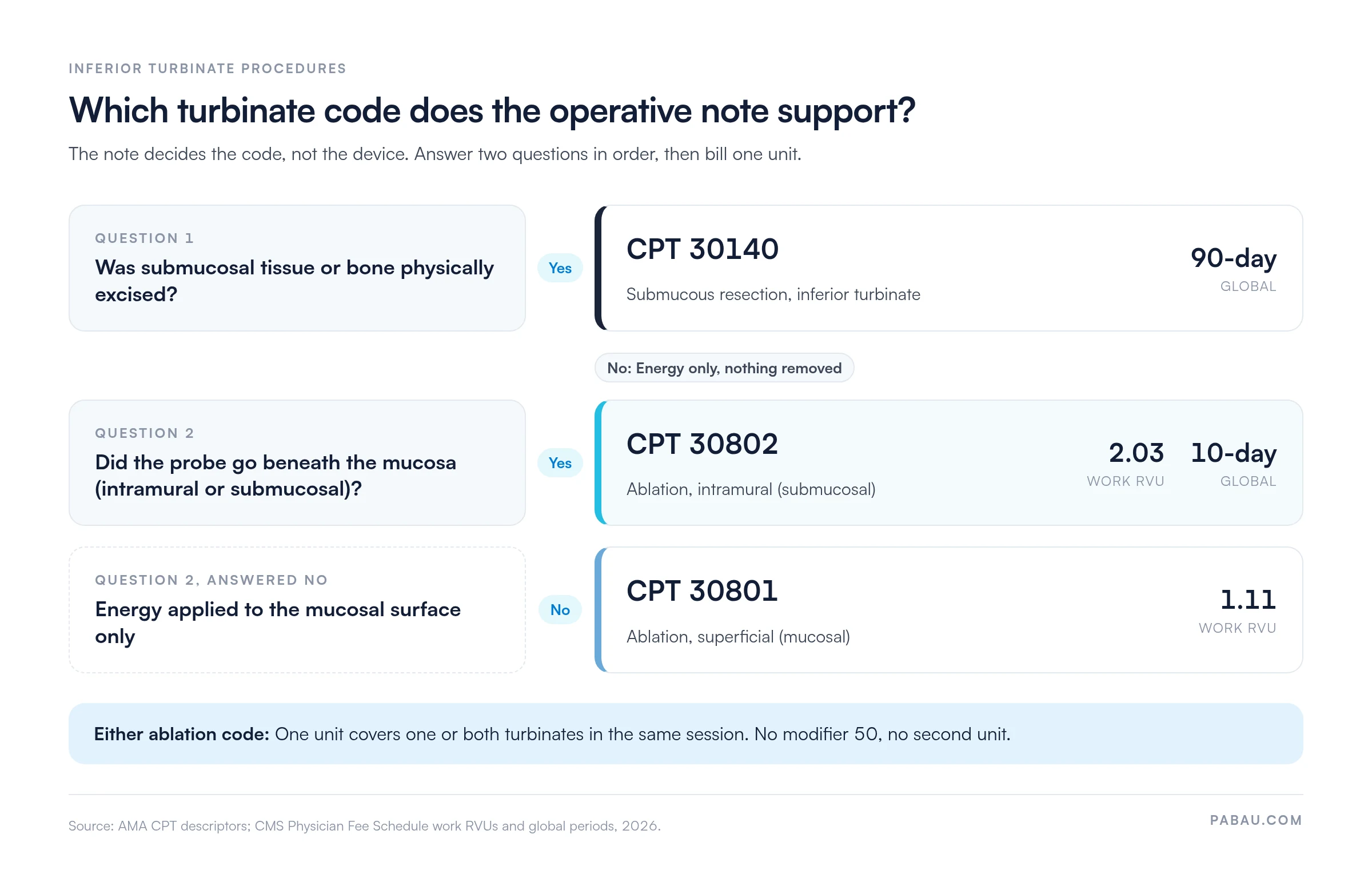
Bill one unit of CPT 30802 whether you treat one inferior turbinate or both in the same session. The official descriptor reads “unilateral or bilateral,” so a single unit covers either case. Billing two units or appending modifier 50 doubles the claim and triggers payer rejection.
Always check payer-specific contracts before applying LT or RT. For most payers, these modifiers are informational on this code. Modifier 50 is different, because it changes payment. Don’t use it on 30802 under Medicare or most commercial payer rules, since the “unilateral or bilateral” wording already pays both sides at one unit.
Medical necessity documentation needs a diagnosis code that confirms the clinical indication. In most cases it also needs evidence that conservative measures have failed. The following codes from the ICD-10-CM code set are the primary supports for inferior turbinate ablation claims.
Most payers require chart notes confirming that medications were trialed before they authorize turbinate ablation. Typical trials are nasal corticosteroids, antihistamines, and saline irrigation. Document the treatment duration and the patient’s response in the pre-operative note, not just in the day-of procedure record.
Document conservative treatment failure in a dated progress note from a prior visit, not in the procedure note itself. Auditors look for a clear treatment timeline: Diagnosis, medications trialed with duration, patient response, and the decision to proceed with ablation. A failed-treatment history that first appears in the day-of-surgery note won’t satisfy most payer medical necessity criteria.
CPT code 30802 reimbursement under the CMS Medicare Physician Fee Schedule varies by practice setting and geographic locality. The RVUs below are national figures before geographic adjustment. Check them against the current fee schedule each year, because CMS updates payment amounts every January.
Use the FastRVU 2026 lookup tool to pull current work, practice expense, and malpractice RVUs for code 30802. It applies your geographic adjustment factor for you.
Where 30802 is performed has a direct impact on physician payment. The Medicare Physician Fee Schedule pays more when the procedure happens in the physician’s office, the non-facility setting. Its practice expense RVU of 6.02 covers the equipment, supplies, and support staff the practice pays for.
In an ambulatory surgery center or hospital, the facility receives its own separate payment under the facility fee schedule. The physician’s practice expense RVU drops to 3.17, so the physician’s payment drops with it.
For ENT practices with in-office coblation or radiofrequency equipment, performing 30802 in the office captures the full non-facility rate where it’s clinically appropriate. Place of service code 11 (office) triggers non-facility rates. POS 22 (outpatient hospital), POS 24 (ASC), and POS 21 (inpatient hospital) trigger facility rates.
Prior authorization (PA) requirements for CPT 30802 vary by payer and plan type. Traditional Medicare doesn’t require PA for most turbinate ablation procedures, but many commercial payers do. Typical requirements look like this.
A PA request should carry the ICD-10 diagnosis codes, with J34.3 as primary. Add dated progress notes on the failed conservative treatment trial and the ENT surgeon’s procedure recommendation. Some payers also want objective evidence, such as rhinomanometry results or nasal endoscopy images. A consistent medical billing compliance workflow captures this before the procedure date, so the claim isn’t denied for lack of pre-authorization.
Complete documentation decides whether a 30802 claim pays cleanly or becomes an audit finding. Every element below must appear in the operative or procedure note before the claim goes out. Pabau’s error-catching claims management keeps the procedure record and the claim together, so missing fields show up before billing.
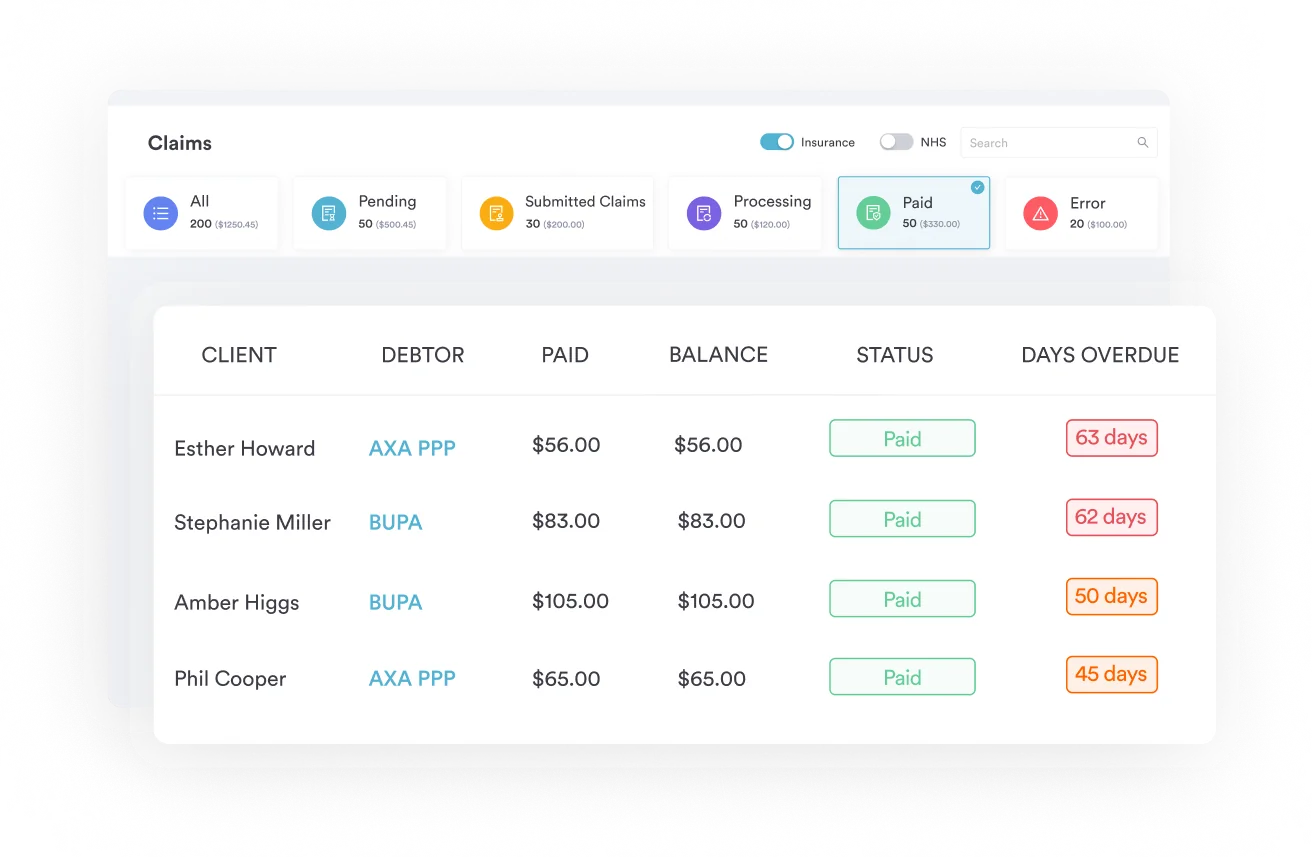
Generating an ENT superbill straight from the procedure record cuts transcription errors between the clinical note and the claim. When structured fields in the procedure template fill the superbill, the codes carry through without retyping. Technique language, laterality, and diagnosis codes reach the claim exactly as the clinician recorded them.
Most denials on 30802 cluster around a handful of preventable errors. The table below maps each common denial to its root cause and the fix.
Strong denial management workflows flag 30802 claims for pre-submission review against these six patterns. Catching a duplicate-modifier error before submission takes seconds. Fixing a denied claim through appeals costs 15-30 minutes of staff time per claim. A clean claim submission process checks laterality, modifier logic, and ICD-10 linkage before the claim leaves the practice. That stops most 30802 denials at the source.
CPT 30802 can be billed with septoplasty, CPT 30520, using modifier 59 or XS, but never with 30801 or 30140 on the same turbinate. National Correct Coding Initiative (NCCI) edits govern which codes pair and whether an unbundling modifier is allowed. CMS publishes the NCCI edits and updates them quarterly. Key rules for 30802 are below.
Verify the current edit status against the CMS tables before assuming a modifier unbundles a pair. Building that check into your billing workflow reduces the unbundling errors that attract payer audits.
In many ENT practices, a coder reads a free-text operative note, then rekeys the code, units, and diagnosis into a separate billing tool. Each handoff is a chance to add modifier 50, drop the intramural language, or link the wrong diagnosis.
Pabau keeps the procedure record and the claim in one system. Its built-in CPT catalogs cut keying errors, modifiers are tracked on the claim, and ICD-10 codes link to the procedure. Claims then go out electronically through the Claim.MD clearinghouse, for office and facility place-of-service codes alike.
After payment, electronic remittance advice shows what each payer paid against the expected rate. So you can spot a downcode to 30801 or a missed non-facility rate the week it happens, not at year-end.

Pabau connects clinical documentation, claim submission, and remittance reconciliation in one workflow. See how ENT practices use it to cut 30802 denials and bill the right setting rate.

A paid 30802 claim depends more on the operative note than on the device. Name the submucosal energy delivery, bill one unit, and point back to a dated record of failed medical therapy. That gives the payer what it needs.
The trade-off is effort up front. A templated operative note and a pre-submission check take a few minutes per case. A downcode to 30801 costs almost half the work RVU on every claim it touches.
Book a demo to see how Pabau ties each turbinate procedure note to a clean, correctly coded claim.

Weighing ablation against resection? CPT code 30140 covers submucous resection billing, its 90-day global period, and the documentation payers expect.
Need to understand how claim denials get resolved? Denial management in healthcare walks through the appeal and root-cause workflow for common billing denials.
Want to see how clearinghouse submission works? Claim.MD clearinghouse guide explains how electronic claim submission reduces manual errors and speeds up payment.
Looking to tighten up your superbill process? Superbill setup guide shows how structured superbills carry documentation straight into clean claim submission.
CPT code 30802 bills intramural (submucosal) ablation of the inferior turbinates, covering one or both sides in a single session. ENT surgeons use it when radiofrequency, coblation, or laser energy goes beneath the mucosa. The goal is to shrink the turbinate and relieve nasal obstruction caused by hypertrophy.
CPT 30801 covers superficial (mucosal) ablation, while CPT 30802 covers intramural (submucosal) ablation with the probe inserted beneath the mucosa. The operative note must state the depth, because ambiguous language defaults to the lower-value 30801 on audit. NCCI edits bar billing both for the same turbinate in the same session.
CPT 30802 is billed as one unit whether one or both turbinates are treated, because the official descriptor reads “unilateral or bilateral.” Don’t bill two units or append modifier 50, since that creates a duplicate claim denial. Check payer-specific requirements before applying LT or RT.
CPT 30802 carries 2.03 work RVUs, with a practice expense RVU of 6.02 in the office and 3.17 in a facility. The dollar amount depends on your locality and the current year’s conversion factor. Check it in the CMS Physician Fee Schedule lookup, because rates change each January.
It depends on the payer. Traditional Medicare generally doesn’t require PA, but most Medicare Advantage plans and commercial payers (BCBS, Aetna, UHC) do. Criteria typically include documented turbinate hypertrophy, a failed nasal steroid trial of 4-8 weeks, and an ENT consultation note.
Yes, CPT 30802 and CPT 30520 can be billed together when both procedures are performed and documented independently. Apply modifier 59 or XS to 30802 to mark it as distinct from the septoplasty. Each procedure needs its own technique description, because a combined narrative doesn’t support separate billing.
CPT 30140 covers submucous resection, where submucosal tissue is physically excised, while CPT 30802 uses energy-based ablation without removing tissue. 30140 usually needs an OR or ASC and carries a 90-day global period. 30802 is often done in-office with a 10-day global period. Billing 30140 for energy-only ablation is upcoding.



