



CCSD code G5100: Bypass of duodenum billing guide
CCSD code G5100 bills a bypass that leaves the duodenum in place CCSD code G5100...

Last Updated: Oct 16, 2026

CPT code 30140 covers submucous resection of the inferior turbinate, partial or complete, by any method.
The code applies only when the surgeon removes submucosal bone or soft tissue and leaves the mucosa intact.
NCCI edits bundle 30930 into 30140, so a separate outfracture needs modifier 59 or XS plus its own documented indication.
Medicare pays roughly $153 in a facility and $294 in an office setting, on 2.93 work RVUs.
Practice management software like Pabau flags NCCI conflicts on a 30140 claim before it reaches the payer.
CPT code 30140 is the billing code for submucous resection of the inferior turbinate, partial or complete, any method. ENT surgeons report it when they remove submucosal bone and soft tissue and leave the overlying mucosa intact.
Two details decide whether the claim is paid. The operative note has to record that the mucosa was preserved, and the outfracture has to be handled correctly against the NCCI bundle with 30930.
This guide covers the descriptor, 2026 Medicare rates and RVUs, the related turbinate codes, bilateral reporting, modifier use, and the ICD-10 crosswalk.
The American Medical Association (AMA) assigns 30140 to submucous resection of the inferior turbinate, partial or complete, any method. It sits in the Excision Procedures on the Nose section of the CPT codebook, codes 30100 to 30160.
The phrase “any method” in the long description is deliberate. It covers radiofrequency ablation, microdebrider-assisted resection, and conventional surgical excision under one code. What matters is that the approach removes submucosal tissue rather than simply outfracturing the turbinate.
The inferior turbinates are bony shelves projecting from the lateral nasal wall, covered in mucosa. Chronic inflammation, allergic rhinitis, or anatomical variation can enlarge them.
Once enlarged, they obstruct airflow and cause nasal congestion that medication does not resolve. Submucous resection removes submucosal bone and soft tissue while preserving the overlying mucosa.
CPT code 30140 applies when the surgeon works beneath the mucosal surface. That separates it from a simple outfracture (30930) and from full excision including mucosa (30130). All three look similar in the operating room and differ only in tissue layer and technique, which is where coders go wrong.
All four fall under CPT code 30140, because the unifying criterion is submucosal access rather than the instrument used.
Selecting the correct inferior turbinate reduction code means separating three closely related procedures. Payers audit these pairings, because the codes carry different values and different NCCI edit relationships.
The distinction is a tissue layer, not a technique. The diagram below shows what each of the three codes leaves behind, and what the operative note has to say for each one.
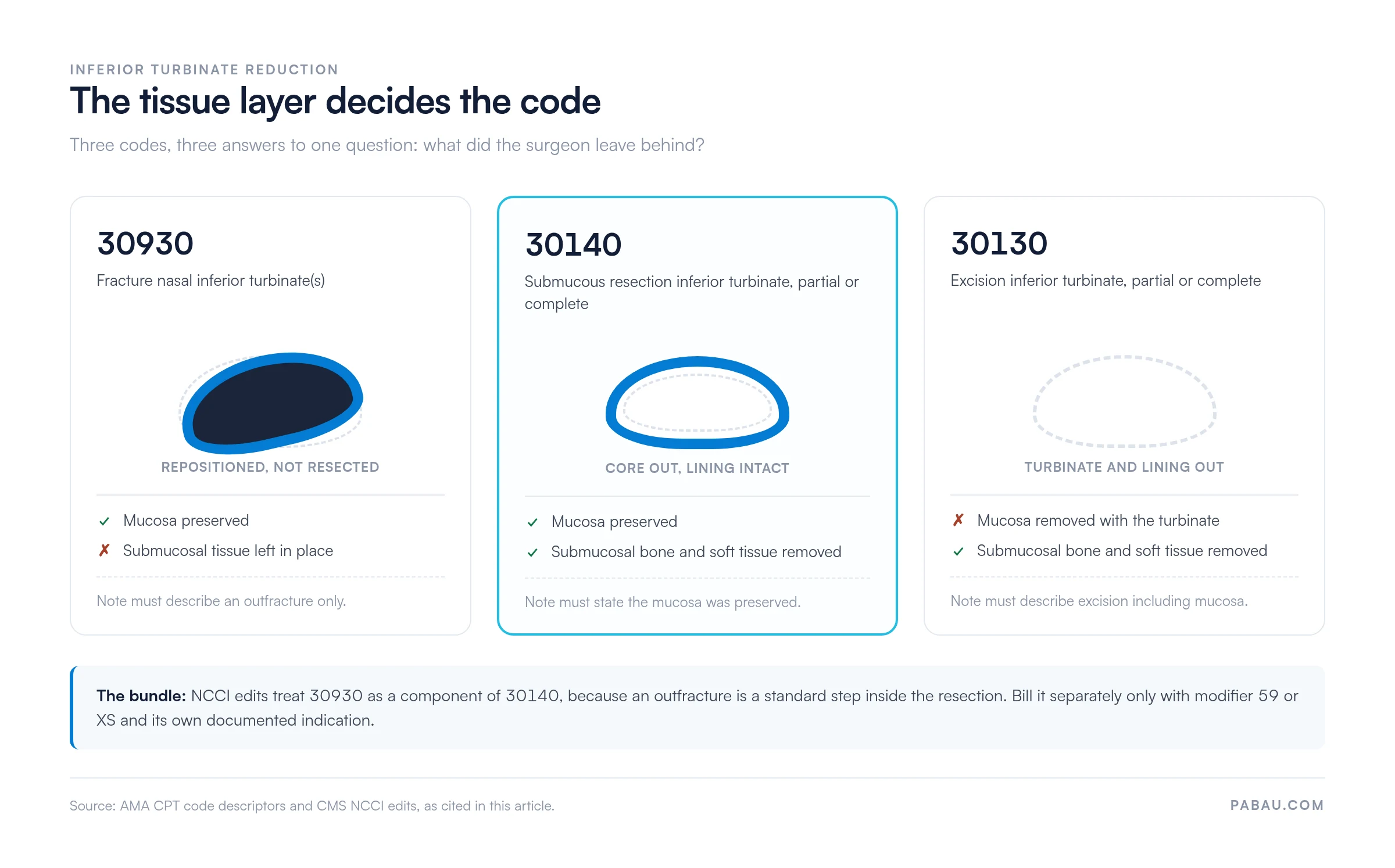
The operative note has to state whether the mucosa was preserved (30140) or excised with the turbinate (30130). Without that language, payers default to the lower-valued code or deny the line outright.
Septoplasty (30520) and 30140 are frequently performed together. The American Academy of Otolaryngology-Head and Neck Surgery confirms the two codes may be billed together when the procedures are medically distinct and separately documented. Check the current NCCI edit tables before billing the pair, since edit status changes with quarterly CMS updates.
When billing the pair, the operative note has to document each procedure’s clinical indication separately. Septal deviation alone does not justify turbinate reduction. The surgeon has to record an independent finding, such as bilateral inferior turbinate hypertrophy causing nasal obstruction, that makes 30140 necessary on its own.
This is the denial scenario ENT practices hit most often. CMS NCCI edits bundle 30930 (fracture of inferior turbinate) into 30140, because an outfracture counts as a standard step within a submucous resection. When both codes appear on one claim, payers typically pay 30140 and deny 30930 as included.
This pairing shows up near the top of most ENT rejection reports. It is worth tracking alongside the other denial codes in billing your practice sees. Coders who catch the conflict before submission skip the appeals cycle entirely.
Modifier 59, or the X modifier XS for a distinct anatomical site, can override the bundle. It applies only when the fracture was a genuinely separate procedure from the resection. The modifier is not a billing shortcut, and payers may audit its use and request the operative note.
Before submitting any claim pairing 30140 with 30930, check the current CMS NCCI Procedure-to-Procedure edit table for the pair. CMS updates NCCI edits quarterly, in January, April, July and October. An edit that allowed modifier 59 last quarter may have changed. Verify at cms.gov before billing.
Inferior turbinate hypertrophy commonly affects both nasal passages, so bilateral reduction is a frequent surgical scenario. How 30140 is reported for a bilateral case depends on its Medicare bilateral surgery indicator.
Per CMS MPFS data, 30140 carries a bilateral surgery indicator that governs how bilateral work is reported and paid. Verify the current indicator in the CMS Physician Fee Schedule lookup tool before billing.
The indicator decides whether the code is reported once with modifier 50, or on two lines with RT and LT modifiers. Most commercial payers follow Medicare’s bilateral rules, but individual contracts vary.
Medicare reimbursement for 30140 is calculated using the Resource-Based Relative Value Scale (RBRVS). The total payment combines three RVU components multiplied by the annual conversion factor. That figure is then adjusted by a Geographic Practice Cost Index (GPCI) for the practice location.
The rates below are national averages, and actual payment varies by locality. Verify current figures with the CMS Physician Fee Schedule lookup tool and the FastRVU 2026 RVU lookup.
Non-facility rates are higher because CMS assumes the practice absorbs the equipment and staff overhead when the procedure happens in the office.
In a hospital or ambulatory surgical center, CMS pays the facility separately, so the physician component drops. Submitting 30140 with the wrong place-of-service code is a common error, and it produces either an underpayment or an overpayment recovery later.
Payers require a medically necessary diagnosis code linked to 30140. The primary ICD-10-CM code is usually J34.3 (hypertrophy of nasal turbinates), with supporting diagnoses for nasal obstruction and related conditions.
Check your payer’s Local Coverage Determinations (LCDs) for turbinate procedures before submitting, since covered diagnoses vary by Medicare Administrative Contractor.
A mismatched diagnosis code fails the payer’s automated medical necessity edits. Pairing a chronic sinusitis code with a turbinate hypertrophy procedure is the classic version of that error, and it produces denials in volume. The same linkage rule reaches laboratory codes, where HCPCS code P2028 is denied when the linked diagnosis does not support the test.
The operative note is the primary evidence a payer reviews when it audits a 30140 claim. Three documentation failures account for most turbinate reduction denials:
A note that covers the five points below survives an audit on its own terms, without a supplementary letter from the surgeon.
A standing operative note template for inferior turbinate procedures reduces variation between surgeons. It prompts each one to confirm tissue layer, technique, laterality, and medical necessity before the note is signed.
Practices billing UK private insurers code turbinate work from the CCSD schedule rather than CPT. There, dividing adhesive bands between the turbinate and septum is coded E0440. The same operative note wording decides it, since divided adhesions and resected tissue are separate procedures.
Most 30140 denials are preventable. ENT coders know the rules perfectly well. The trouble is that the rules get checked after the claim has already gone to the payer, and pre-submission edit checking is what changes that.
Pabau’s claims management software surfaces NCCI bundling conflicts at the point of charge entry. When a coder enters 30140 alongside 30930 without a modifier, the system flags the pair before the claim is transmitted.
The coder attaches the modifier and the supporting documentation in the same workflow, instead of finding out 30 days later in a denial letter.
For billing teams handling high ENT claim volumes, that pre-submission layer cuts rework and shortens the collection cycle. The Claim.MD integration routes 837P claims directly to thousands of US payers, and eligibility checks run before the day of surgery.
After adjudication, remittance advice posts automatically, so reconciliation sits in one dashboard instead of several payer portals. Together those steps turn denial management into a pre-submission task rather than an appeals queue.

Pabau’s claims management software flags NCCI conflicts on 30140 and related ENT codes at the point of charge entry. See how ENT practices use it to clean up the billing workflow.

The tissue layer decides the code, and the operative note decides whether the payer believes it. Dictation that says “turbinate reduction” without naming the layer leaves 30140 indefensible on appeal, whatever happened in the operating room.
So the fix sits upstream of billing. Standardize the operative note template first, then let claim edits catch what the template misses. A practice that does both stops arguing with payers about 30930 and stops absorbing the underpayments it never noticed.
One trade-off is worth remembering. Modifier 59 buys a paid line today and an audit request later, so use it only where the note already earns it. Book a demo to see how Pabau flags NCCI conflicts on ENT claims before they reach the payer.

Need to understand how clearinghouse claims submission works end to end? Electronic claims via a clearinghouse explains how 837P files route from the practice to the payer and back.
Seeing repeated rejections across your ENT procedure codes? How the 837 file works in medical billing breaks down the transaction format payers require for electronic submission.
Want to prevent denials rather than appeal them? What makes a clean claim sets out the fields and checks that get a surgical claim paid on first submission.
Building an audit-ready documentation process for surgical codes? Medical billing compliance requirements covers the records a payer or auditor expects to find.
CPT code 30140 is the billing code for submucous resection of the inferior turbinate, partial or complete, any method. ENT surgeons report it when they reduce inferior turbinate size by removing submucosal bone and soft tissue. The overlying mucosa stays intact. It is typically billed to treat nasal obstruction caused by inferior turbinate hypertrophy.
The AMA long description is: “Submucous resection inferior turbinate, partial or complete, any method.” The short description is “Submucous resect inferior turbinate.” The phrase “any method” means the code covers radiofrequency ablation, microdebrider resection, coblation, and conventional surgical submucosal resection.
Medicare pays roughly $153 in a facility setting and roughly $294 in a non-facility setting, before geographic adjustment. Those figures come from 2.93 work RVUs, 0.43 malpractice RVUs, and practice expense RVUs of 1.23 in a facility or 5.44 in an office. Verify the current locality rate in the CMS Physician Fee Schedule lookup tool.
Yes, bilateral inferior turbinate submucous resection can be billed, but the reporting method depends on the Medicare bilateral surgery indicator for the code. Verify the current indicator in the CMS Physician Fee Schedule lookup tool. Medicare typically pays bilateral same-date procedures at 150% of the single-procedure rate. Commercial payers may require modifier 50 or separate lines with RT and LT modifiers.
Yes, when the procedures are medically separate and documented independently. The operative note must record a distinct clinical indication for each one: septal deviation for 30520 and turbinate hypertrophy for 30140. Verify the current NCCI edit status for the pair at the time of billing, since edit relationships change with quarterly CMS updates. Some commercial payers require prior authorization when the codes are combined.
NCCI edits bundle 30930 (fracture of inferior turbinate) into 30140, because an outfracture counts as part of the submucous resection technique. Payers pay 30140 and deny 30930 as included. If the fracture was a distinct, separately documented procedure, modifier 59 or XS may override the bundle. That requires explicit operative note language and may trigger a post-payment audit.
The primary ICD-10-CM code is J34.3 (hypertrophy of nasal turbinates). Supporting diagnoses include J34.89 (other specified disorders of nose), J30.1 (allergic rhinitis due to pollen), and J30.9 (allergic rhinitis, unspecified). When 30140 is billed alongside septoplasty, J34.2 (deviated nasal septum) is added. Check your MAC’s Local Coverage Determination for covered diagnoses before submitting.



