



CCSD code G5100: Bypass of duodenum billing guide
CCSD code G5100 bills a bypass that leaves the duodenum in place CCSD code G5100...

Last Updated: Oct 16, 2026

CPT code 30520 reports septoplasty or submucous resection of the nasal septum, with or without cartilage scoring, contouring, or graft replacement.
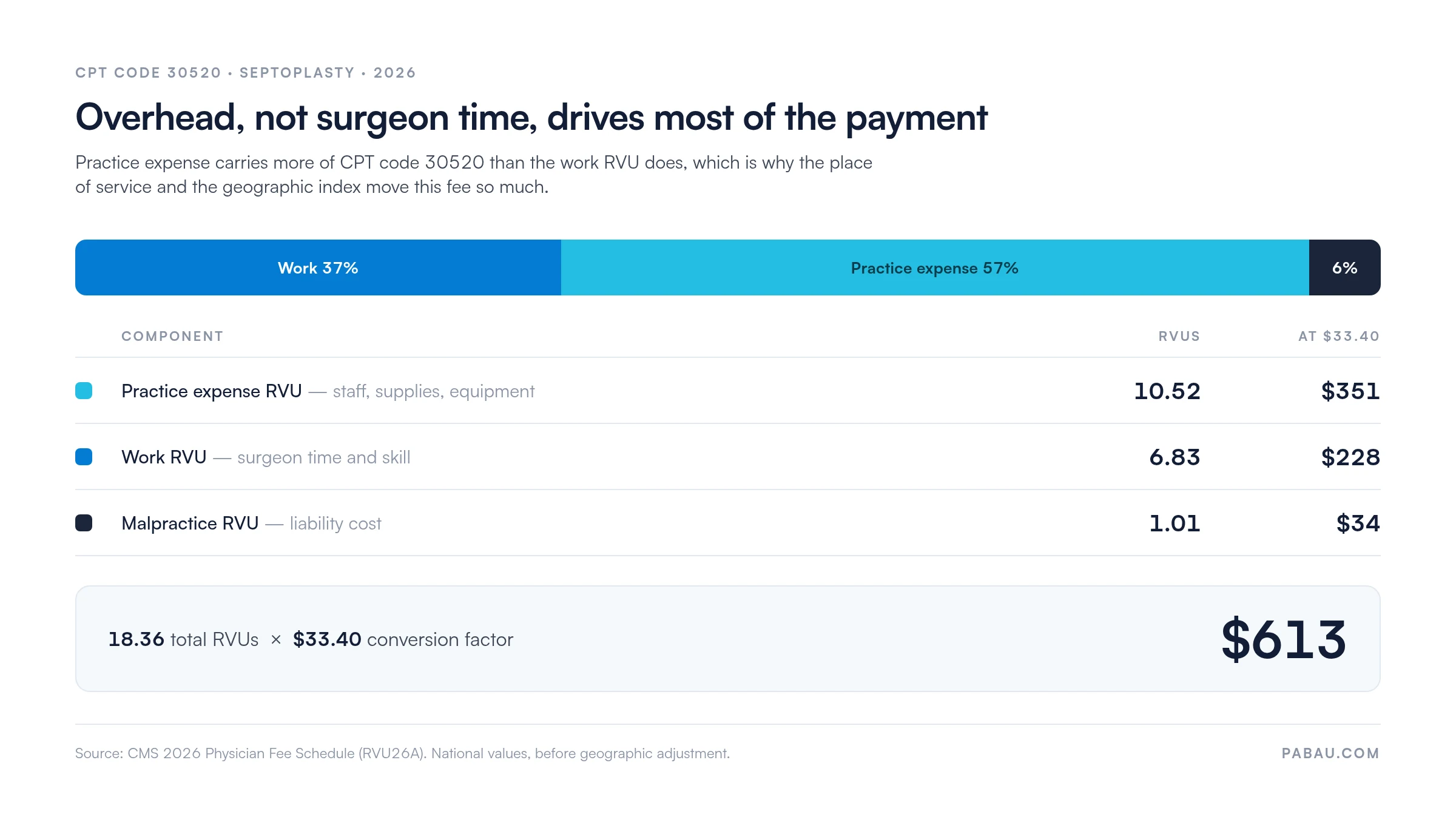
The 2026 Medicare national average is about $613 at the facility rate, from 18.36 total RVUs times the $33.40 conversion factor.
Coverage turns on medical necessity, so document failed conservative therapy, symptom duration, and objective exam findings before surgery is booked.
CPT 30520 carries a 90-day global period, and same-day turbinate reduction needs modifier 59 or XS plus distinct operative documentation.
Practice management software like Pabau pre-fills the CMS-1500 from the patient record and validates claim-required fields before submission.
CPT code 30520 is the billing code for septoplasty, the surgical repair of a deviated nasal septum. The descriptor covers submucous resection, with or without cartilage scoring, contouring, or a graft.
On the payment side, one figure matters most. CPT 30520 carries 18.36 total RVUs, which works out to roughly $613 at the 2026 Medicare conversion factor.
The coding is where ENT claims come unstuck. Medical necessity, cosmetic reclassification, and same-day turbinate reduction account for most septoplasty denials. Each one is preventable with the right documentation, the right modifier, and a diagnosis code that matches the operative note.
The American Medical Association (AMA) publishes the official descriptor for 30520. It reads: “Septoplasty or submucous resection, with or without cartilage scoring, contouring or replacement with graft.”
One code therefore covers several surgical techniques. Which one the surgeon uses depends on what the septum needs once the flaps are elevated.
The septum is the wall of cartilage and bone dividing the two nasal passages. A deviation narrows one side, and patients report obstruction, disturbed sleep, and repeat sinus infections.
CPT 30520 captures the full correction, whether the surgeon resects tissue, scores the cartilage, or places a graft.
Sinus disease treated in the same session bills under its own endoscopy codes. CPT 31254 reports a nasal endoscopy with partial anterior ethmoidectomy, which is separate work from the septal repair.
Coverage for CPT code 30520 turns on a single question. Payers cover functional septoplasty and deny the cosmetic version, using the Social Security Act exclusion at Section 1862(a)(10).
Your office notes and operative report therefore have to make the functional purpose obvious.
Commercial payers publish their own medical necessity criteria for septoplasty. Aetna, UnitedHealthcare, and Blue Cross Blue Shield each set thresholds for symptom duration, failed conservative therapy, and objective findings. Those thresholds differ, so read the plan’s medical policy before the case is booked.
Payment for CPT code 30520 varies by place of service and geographic locality. The CMS Physician Fee Schedule lookup tool returns the current rate for your MAC region.
CMS published the CY2026 final rule on October 31, 2025, and it took effect on January 1, 2026. So the figures below are final.
CMS finalized two conversion factors for the year. Most practices are paid at $33.40 per RVU, while qualifying alternative payment model participants are paid at $33.57.
At the lower factor, 18.36 total RVUs comes to about $613 nationally before any geographic adjustment.
These figures come from the CMS 2026 relative value files, and CMS revises them every year. Verify the current values in the CMS relative value files, then apply the geographic index for your region.
The split inside that total matters more than the total itself. Practice expense carries the larger share of this code, so the setting and the locality move the fee more than the surgical work does.
Facility rates apply in a hospital outpatient department or an ambulatory surgery center. Non-facility rates apply to in-office procedures, though septoplasty rarely happens outside a surgical facility.
The RVU arithmetic above only governs codes paid on the physician fee schedule. A replacement-only part like K0050 is paid from the DMEPOS fee schedule, and only once the record confirms the payer covers the wheelchair it repairs.
Re-check CPT 30520 payment every January. CMS updates the fee schedule effective January 1, and MAC contractors issue mid-year guidance that can change what you collect. Pull the current rate from the CMS lookup tool before you reopen payer contract negotiations.
A missing or wrong modifier is a top denial trigger on septoplasty claims. The AAPC CPT code lookup lists modifier guidance beside each descriptor. Below are the ones that actually come up on 30520.
Same-day septoplasty and turbinate surgery is the highest-denial scenario in ENT billing. CPT 30140 covers submucous resection of the inferior turbinate, partial or complete. NCCI lists it in a column 1 and column 2 edit pair with 30520, so the two codes will not pass together unmodified.
The American Academy of Otolaryngology (AAO-HNS) has addressed the pairing directly for turbinate ablation, CPT 30801. Its guidance allows modifier 59 on 30801 to show that the two services were separate. It also tells coders to link a different diagnosis code to each CPT code.
One exception is easy to miss. Do not report 30801 with 30520 when the ablation only controls bleeding caused by the septoplasty. In that situation the cautery belongs to the septal procedure and stays bundled.
The clinical logic behind the edit is straightforward. Septoplasty corrects a structural deviation of the septum, while turbinate surgery treats compensatory hypertrophy of the inferior turbinate. Those are separate structures, and they need separate surgical steps and separate diagnoses.
ENT billers meet the same cluster of nasal codes in a single operative session. Knowing which one applies prevents undercoding on one claim and an NCCI denial on the next.
Practices billing UK private medical insurers work from the CCSD schedule instead of CPT. On that schedule, division of adhesions of the turbinate of the nose carries its own code, E0440.
Payers validate medical necessity from the diagnosis, so the pairing carries as much weight as the procedure code. A vague or mismatched diagnosis kills the claim before a human reviewer opens it.
Coders who need the surrounding diagnosis families can work from the full ICD-10-CM code library.
Never pair Z41.1, encounter for cosmetic surgery, with CPT 30520 on a claim you expect an insurer to pay. That code signals cosmetic intent and triggers an automatic denial. Every diagnosis on the claim has to match a finding documented in the record.
Clean septoplasty claims are built long before the patient reaches the operating room. The record has to satisfy the payer’s medical necessity criteria, support each diagnosis code, and hold up in a post-payment audit.
Templates do most of this work for you. An operative note template that prompts the surgeon for each required element cuts the dictation errors that invite a post-payment audit.
Prior authorization is where the most preventable septoplasty denials begin. Medicare fee-for-service does not require it for CPT 30520. Plans under Medicare Advantage often do, depending on the contract, and so do most large commercial payers.
Aetna, UnitedHealthcare, Blue Cross Blue Shield, and Cigna all ask for authorization on septoplasty in most regions. Requirements still shift by plan tier and by state. So verify with the specific plan before the surgery date goes into the calendar.
Other head and neck procedures split the same way. Parathyroidectomy, reported under CPT 60500, needs no authorization under Medicare fee-for-service, while commercial plans and Medicaid usually require one. Traditional Medicare does not routinely require authorization for tympanoplasty under CPT 69631, though Medicare Advantage and many state Medicaid programs do.
Other specialties lose authorizations on the same evidence point. Prior authorization for carotid endarterectomy under CPT 35301 typically requires a duplex or CTA report showing the degree of stenosis.
Flag CPT 30520 authorization requirements in the scheduling workflow, before the pre-operative appointment. Submitting the request 10 to 14 days ahead of surgery leaves room to answer an initial refusal. That is what protects you from a last-minute cancellation and lost OR time.
CPT code 30520 carries a 90-day global surgery period. Routine post-operative care tied to the septoplasty is bundled into the surgical fee for those 90 days. Anything billed on top needs a modifier that explains why.
That 90-day window applies to Medicare fee-for-service. Commercial payers may run a different global period, or none at all. Check the global period language in each contract before you schedule follow-up visits.
A 30520 claim passes through five hands before payment lands, and most denials trace back to one handoff. Here is the route it takes.
Stage four is where the trail usually goes cold. The authorization number lives in the scheduler’s inbox, and the coder never sees it.
Septoplasty denials follow a short and repeatable list. Practices that work through it methodically watch their first-pass acceptance rate climb.
Most of those failures are catchable before the claim leaves the building. Pre-submission scrubbing finds the missing field, the absent modifier, and the mismatched diagnosis while the record is still open.
ENT billing teams usually learn about a septoplasty problem after the payer does. The authorization number sits in an email thread. Someone retypes the diagnosis code from the operative note, and the claim leaves with a field missing.
Practice management software like Pabau reverses that order. Pabau’s claims management software pre-fills the CMS-1500 from the patient record. The CPT code attached to the service already sits on the charge line. A diagnosis such as J34.2 is seeded from the recorded problem list.
Coders confirm a descriptor against the built-in CPT and ICD-10 lookup libraries without leaving the claim. Pabau also checks that claim-required fields are complete before the claim can be sent. A missing authorization code surfaces inside the practice, not in a denial letter three weeks later.
For US practices, the Claim.MD integration runs real-time eligibility checks, tracks claim status, and posts electronic remittance advice. Payments and denials land in one dashboard, so billers spend less time in payer portals and the 30520 collection cycle gets shorter.

Pabau pre-fills the CMS-1500 from the record, checks claim-required fields before submission, and posts eligibility, status and remittance data through Claim.MD. Fewer septoplasty claims come back for a missing field.

CPT code 30520 pays well for a functional nasal procedure, and it is denied for reasons you can see coming. The functional versus cosmetic call, the NCCI pair with turbinate reduction, and the 90-day global period account for most of the trouble.
So build the controls into the workflow instead of the appeal. Verify authorization at scheduling, template the pre-op note, and give every procedure line its own diagnosis code. Those three habits cost far less than working a denial after the fact.
Pabau keeps those checks in the record where the claim is built, from the pre-op note through to the remittance. Book a demo to see how it handles ENT billing from scheduling all the way to payment.

Need the turbinate side of the same operative session? CPT code 30140 covers submucous resection of the inferior turbinate and the edits that come with it.
Want to see how a claim reaches the payer? Medical claims clearinghouse explained follows a claim from the practice to adjudication and shows where errors get caught.
Reading denials off the remittance? Electronic remittance advice explains how to read an ERA and spot denial patterns before they repeat.
Submitting professional claims electronically? The 837 file format explained walks through the transaction standard behind every CPT surgical claim.
Working a backlog of septoplasty denials? Denial management in healthcare sets out a process for triaging, appealing and preventing repeat denials.
Use the code for where the surgery actually happened. Place of service 21 covers inpatient hospital, 22 covers hospital outpatient, and 24 covers an ambulatory surgery center. The place of service decides whether Medicare pays the facility or non-facility rate, so a mismatch changes what you collect.
The facility bills its own claim, separately from yours. You report 30520 on a CMS-1500 under the physician fee schedule. The hospital or surgery center bills its own charges under the outpatient or ASC payment system. One procedure therefore produces two claims.
Modifier 78 covers an unplanned return to the operating room for a related procedure inside the global period. Payment covers the intraoperative work only, and the original 90-day period keeps running. Use modifier 58 instead where the second procedure was planned from the start.
Yes, provided the functional and cosmetic work are documented as separate procedures. Bill 30520 to the payer, then collect the cosmetic portion from the patient under a signed financial agreement. Where the septal repair is part of the rhinoplasty itself, report 30420 instead.



