CCSD code H4430: Examination of rectum under anaesthetic
CCSD code H4430 pays for the examination alone CCSD code H4430 is the UK private...

Last Updated: Oct 20, 2026

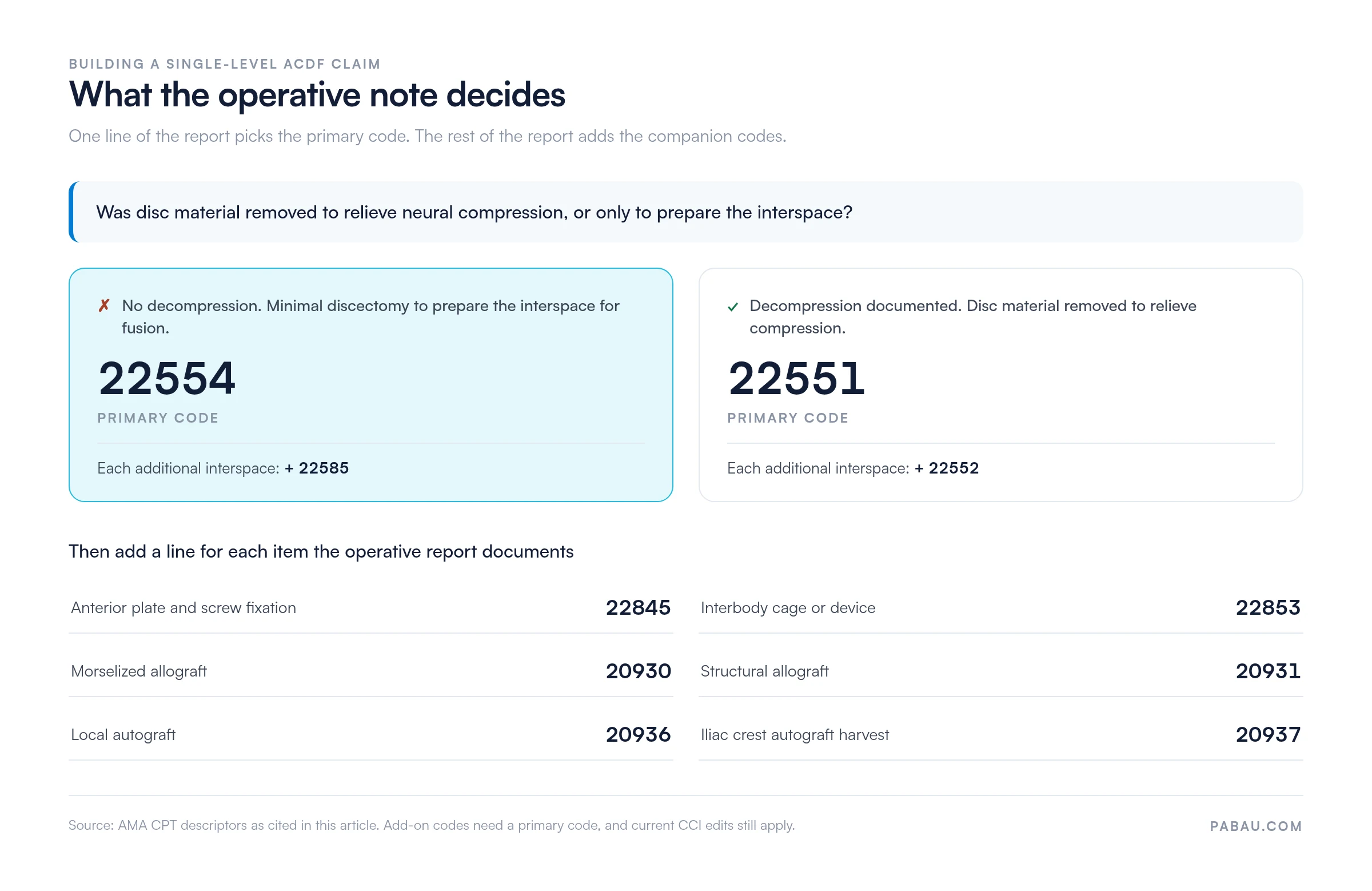
CPT Code 22554 covers anterior interbody arthrodesis below C2, including the minimal discectomy that prepares the interspace.
Add 22585 for each cervical interspace beyond the first, then 22845 for instrumentation and 22853 for an interbody device.
The code excludes decompression, so a documented decompression makes 22551 the correct primary code instead.
Practice management software like Pabau applies the modifier rules and add-on checks, so multi-code spine claims need less rework.
CPT Code 22554 is the primary procedure code for anterior interbody arthrodesis at the cervical spine below C2. The approach is anterior or anterolateral. The official American Medical Association (AMA) descriptor reads: Arthrodesis, anterior interbody technique, including minimal discectomy to prepare interspace (other than for decompression); cervical below C2.
That parenthetical is the billing crux of the code. It tells payers the disc removal was limited to interspace preparation, rather than a therapeutic decompression. If the operative report documents decompression, the code selection changes entirely.
This reference covers the modifiers, add-on codes, ICD-10 pairings, Medicare reimbursement, and documentation that a 22554 claim depends on. Medical billing workflows for spine surgery hinge on getting the decompression call right on the first submission.
Neurosurgeons and orthopedic spine surgeons submit CPT Code 22554 for a single-level anterior cervical discectomy and fusion (ACDF) below C2. The claim holds only when no distinct decompression was performed. According to the AAPC, the ACDF is one of the most commonly performed spine procedures in the US.
The code applies when all three procedural elements are present:
Single-level cases at C3-C4, C4-C5, C5-C6, or C6-C7 are the most frequent scenarios. Multi-level cases require appending 22585 for each interspace beyond the first.
Medical necessity for CPT 22554 depends on the supporting ICD-10-CM diagnosis. Payers and Medicare Administrative Contractors (MACs) review diagnosis codes against Local Coverage Determinations (LCDs) to confirm clinical appropriateness.
The diagnosis must match the operative indication documented in the pre-authorization and operative report.
MAC LCD review decides medical necessity, so the diagnosis code alone never secures payment. Documented failure of conservative care strengthens every claim, whether that care was physical therapy, chiropractic treatment, or injections.
Check your MAC’s Local Coverage Determination for spinal fusion before submitting 22554 claims. CMS Article A59668 outlines cervical fusion billing and coding requirements that override generic payer policies. MAC-specific rules on conservative treatment duration and imaging requirements frequently differ from national guidelines.
Modifier selection for 22554 depends on surgical circumstance and payer rules. Applying the wrong modifier, or omitting a required one, is a leading cause of claim rejection in spine surgery billing. Payer policies on modifier acceptance vary; always verify against the specific plan’s requirements before submitting.
A single-level ACDF rarely generates just one line on the claim. Instrumentation, interbody device placement, and bone graft codes are billed alongside 22554 when the operative report documents them. Each add-on code has specific pairing rules; none may be billed as a standalone procedure.
Bone graft code selection depends on graft type. Autograft codes differ by harvest site, and allograft codes differ by structural form. Conflating the two creates unbundling risk and questions about claim integrity.
Selecting the wrong primary code between 22554, 22551, and 22558 is the costliest mistake in spine surgery billing. The three codes cover similar procedures but differ in approach, anatomical site, and what the descriptor includes. Posterior cervical work sits outside all three, under codes such as 22100. Getting the choice wrong triggers a denial or a payer audit. Where a code carries an evaluation and management component, documented complexity sets the level billed. Every payer sets its own timely filing window, and a correctly coded claim still fails once that window closes.
The 22554 vs 22551 distinction is critical. Both codes cover anterior cervical interbody fusion below C2, but 22551 bundles decompression into the procedure. When a surgeon removes disc material specifically to decompress neural structures, 22551 is the correct code.
Billing 22554 against a note that documents decompression is under-coding. Billing 22551 when only minimal interspace prep was performed may trigger a medical necessity challenge.
The report’s language settles the primary code, and the same report decides every add-on line behind it.
Medicare payment for CPT Code 22554 varies by facility type, geographic location, and annual Physician Fee Schedule (MPFS) updates. Rates below reflect national averages; actual payments differ by MAC jurisdiction.
Always verify current rates through the CMS Physician Fee Schedule lookup before building reimbursement benchmarks.
The same lookup returns the Work, Practice Expense, and Malpractice RVU values for 22554 and its companion codes. When you submit electronically, the 837 claim file has to carry the correct place of service code. That code is what sets the facility or non-facility payment rate. Remittance data then shows whether a payer is underpaying 22554 across a run of claims.
Insufficient operative report documentation is a leading cause of post-payment audit recoupment for spinal fusion codes. The note must support every element of the code descriptor. Working from a checklist lets the billing team catch a missing element before submission rather than after a denial.
Handling medical billing compliance at the documentation stage costs less than unpicking denials afterwards. A structured operative note template aligned to 22554 requirements leaves the billing team far less to chase. A clean claim starts with the surgeon’s wording, long before anyone keys the codes in.
Denials on 22554 claims cluster around a predictable set of errors. Understanding them reduces rework and protects reimbursement timelines for surgical practices.
A standing denial management process catches these errors before they accumulate. Reading denial codes alongside remittance data shows which error is driving write-offs on spine claims.
A complex spine case generates a multi-line claim that needs modifier logic, add-on validation, and eligibility confirmation before it goes out. Doing each of those by hand is where the errors above come from, because nothing checks the claim against the operative note.
Practice management software like Pabau keeps that logic in one place. Its claims management software files through our Claim.MD integration, the US clearinghouse we submit through, and reaches thousands of US payers.
The integration handles CMS-1500 and 837P formats, eligibility verification, electronic remittance advice, and denial tracking with CARC reason codes. So a billing manager can see which error repeats across the practice’s spine claims instead of reading them one at a time.
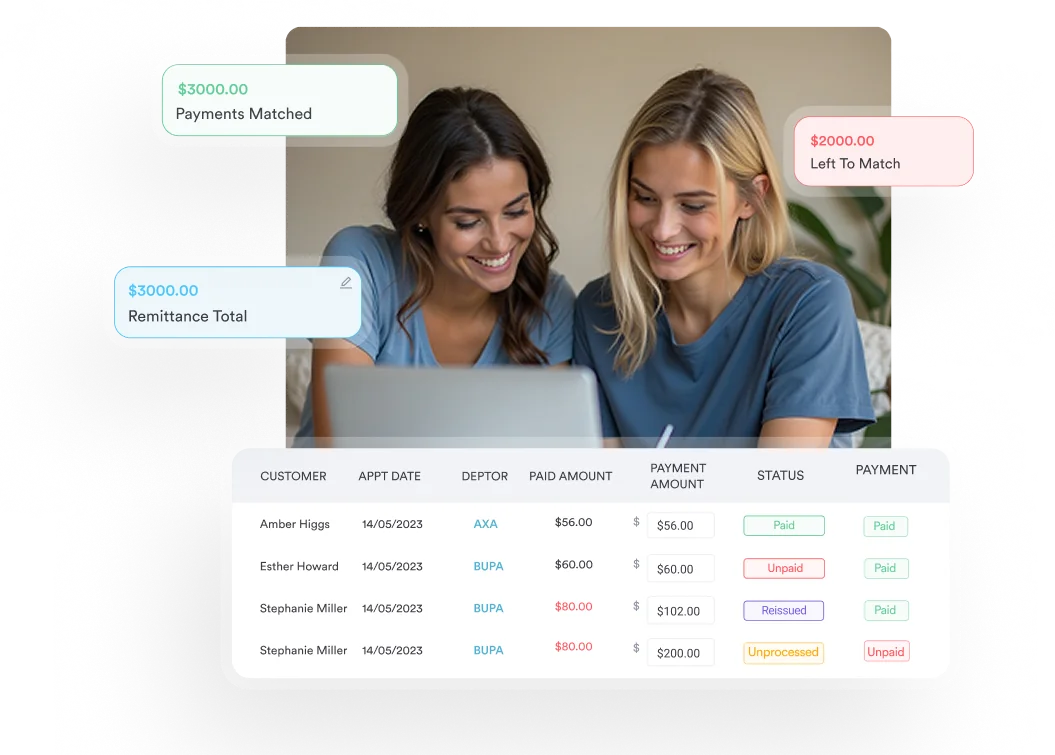
Administrators comparing medical billing software should test whether their current system carries the modifier automation and multi-code validation that spine work needs. Capturing 22554, its add-ons, and its modifiers in one structured entry is what keeps the back-end correction cycle short.

Pabau’s claims management applies your modifier rules, flags a missing add-on code before submission, and files electronic 837 claims through our Claim.MD clearinghouse integration. See how surgical practices build and track multi-code claims in one place.

The decompression question decides more of a 22554 claim than any modifier will. Answer it from the operative note rather than from what the surgeon usually does, and the rest of the claim falls into line behind it.
Everything after that is discipline. Each add-on needs wording that names the interspace, the implant, or the graft it stands for. Fix that at the note stage and the practice stops paying for it twice, once in rework and again in audit exposure.
Book a demo to see how Pabau builds, submits, and tracks a multi-code spine claim from one patient record.

Need to see how clearinghouse submission works end-to-end? Claim.MD clearinghouse overview covers how a claim routes from practice to payer and where errors get caught.
Weighing up clearinghouse options for a surgical practice? Claim.MD vs Office Ally compares the two on submission volume, denial handling, and cost.
Coding a posterior spinal osteotomy at the same session? 22214 sets out that descriptor and the documentation it needs.
Applying skeletal traction before the definitive procedure? 20650 walks through how the insertion is coded and documented.
CPT Code 22554 is the procedure code for anterior interbody arthrodesis at the cervical spine below C2. The approach is anterior or anterolateral, and the code includes the minimal discectomy that prepares the interspace for fusion. It is the primary code for a single-level anterior cervical discectomy and fusion when no decompression is documented.
CPT 22554 covers anterior cervical interbody fusion with minimal discectomy for interspace preparation only. It does not include decompression. CPT 22551 covers the same fusion but bundles decompression into the procedure. When the surgeon removes disc material to relieve neural compression, 22551 is the correct code. Billing 22554 against a note that documents decompression is a miscoding error that can trigger audits.
The primary CPT code for anterior cervical discectomy and fusion (ACDF) at one level below C2 without decompression is 22554. If decompression is performed, use 22551 instead. For each additional cervical interspace in a multi-level ACDF, append add-on code 22585.
Four add-on codes come up most often with 22554. They are 22585 for each additional cervical interspace, 22845 for anterior instrumentation, and 22853 for an interbody device or cage. Bone graft codes such as 20930 for morselized allograft or 20936 for local autograft are billed separately. Each add-on needs its own documentation in the operative report, and CCI edits still apply.
The operative report must name the anterior or anterolateral approach and the specific cervical levels treated. It must also describe interspace preparation, confirming the disc removal was not for decompression. Record the graft or interbody device type and any instrumentation placed. Pre-operative imaging and failed conservative treatment carry the medical necessity, and MAC LCD criteria such as CMS Article A59668 may ask for more.
CCI edits govern bundling for 22554 and its companion codes. Add-on codes 22585, 22845, and 22853 cannot be billed as standalone procedures. They each require a primary arthrodesis code. Bone graft codes 20930 and 20931 should not both be billed for the same graft site. Always verify current CCI edits for the applicable year before submitting a multi-code spine claim.