CCSD code H4430: Examination of rectum under anaesthetic
CCSD code H4430 pays for the examination alone CCSD code H4430 is the UK private...

Last Updated: Oct 20, 2026

CPT code 22100 covers partial excision of a posterior vertebral component for an intrinsic bony lesion at a single cervical segment.
The Medicare work RVU for CPT 22100 is 10.73, giving a total facility value of roughly 29.77 RVUs before geographic adjustment.
Add-on code 22103 must accompany 22100 for each additional vertebral segment excised, and 22103 cannot be reported on its own.
Documentation that names the exact cervical level, the structure excised, and the pathology specimen answers the top denial reasons.
Pabau’s claims management software tracks every submitted 22100 claim through to payment, so unpaid claims surface before the filing deadline.
CPT code 22100 covers partial excision of a posterior vertebral component for an intrinsic bony lesion at a single cervical segment. The posterior component is the spinous process, the lamina, or the facet. It is a facility-based surgical code with a 90-day global period, billed most often by orthopedic surgeons and neurosurgeons. Practices that age their receivables weekly catch claims approaching a filing limit while an appeal is still possible.
The word “intrinsic” is what decides most 22100 claims. The code pays for removing a lesion that arises inside the bone, such as a tumor, a cyst, or fibrous dysplasia. A laminectomy done to decompress the cord is a different procedure, even when the surgeon removes the same anatomy.
Region drives the code choice as well. Thoracic excisions take 22101 and lumbar excisions take 22102, while every additional segment takes add-on code 22103. A lesion sitting in the vertebral body rather than a posterior element points somewhere else entirely.
CPT code 22100 is defined by the American Medical Association (AMA), which maintains the CPT code set. The official descriptor reads: Partial excision of posterior vertebral component (eg, spinous process, lamina or facet) for intrinsic bony lesion, single vertebral segment; cervical.
Three elements decide whether this code fits. First, the excision must be partial, not complete removal of the vertebral element. Second, the indication must be an intrinsic bony lesion. That means a lesion arising from within the bone itself, such as a tumor, a cyst, or fibrous dysplasia.
A degenerative or compressive indication does not qualify on its own. Third, the procedure must involve a single cervical vertebral segment, with any further segments reported separately.
CPT 22100 is not a decompression code. Reporting it for a laminectomy done to relieve spinal cord compression misrepresents the procedure. That creates medical necessity exposure even when the operative note is otherwise complete.
The surgeon approaches the posterior cervical spine through a midline incision. After retracting the paraspinal musculature, the affected posterior vertebral component is identified at the target cervical level. The partial excision then removes the lesion-bearing portion of the spinous process, lamina, or facet.
Adjacent structural integrity is preserved, which is what separates this from a full resection. The excised tissue is typically sent for pathological analysis to confirm the lesion type and guide further management.
This is a facility-based procedure. Place of service codes 21 and 22 are the standard settings, covering inpatient hospital and outpatient surgical facilities. Non-facility billing is not typical for a procedure of this complexity.
Taking tissue for diagnosis without removing the lesion is a biopsy rather than an excision. Open vertebral body biopsy carries its own codes, such as CPT 20250 at the thoracic level.
A billing team reviewing the note has to tell a partial excision from a laminectomy. Without that reading, a miscoded claim goes out unchallenged. For 22100, the phrases “intrinsic bony lesion” and “partial excision” should both be traceable in the surgeon’s dictation.
The 22100 series covers one procedure across three spinal regions. Picking the wrong region code is a frequent error in spinal surgery billing. It happens most when the operative note covers several levels or names the region loosely.
The region follows the anatomical level of the excised segment, not the surgical approach or the incision. A lesion at the cervicothoracic junction needs the treated vertebral level named in the note. The note should also state whether that level counts as cervical or thoracic. Lumbar work in the same session takes CPT 22102.
CPT 22110 also treats an intrinsic bony lesion in the cervical spine, but it removes part of the vertebral body. CPT 22100 is limited to the posterior components. The structure named in the operative note therefore decides which of the two applies.
CPT 22110 also excludes decompression of the spinal cord or nerve roots. A note describing partial removal of the vertebral body, with no decompression, belongs to that family rather than to 22100.
When the surgeon excises more than one segment in the same session, 22103 is reported for each additional segment. The primary code comes first, whether that is 22100, 22101, or 22102. CPT 22103 cannot stand alone.
An example: the surgeon excises a lesion at C5 and a second at C7. The claim reads 22100 plus one unit of 22103. A third lesion at T1 adds a second unit of 22103, with no change to the primary code.
Not every excision family stacks this way. Soft tissue tumor excision is priced by lesion size and location instead, as with CPT 23073. Checking which rule applies avoids a unit denial on the add-on line.
Soft tissue tumor codes settle depth before size. CPT 22903 covers a subcutaneous abdominal wall tumor measuring 3 cm or more.
Reimbursement for 22100 runs off the Medicare Physician Fee Schedule. The Centers for Medicare and Medicaid Services updates that schedule every year. The RVU components below set the national payment rate before geographic adjustment. Verify current values with the CMS fee schedule tool.
The values above are approximate figures drawn from publicly available MPFS data. Confirm them against the current CMS file before billing, and use the FastRVU look-up tool to check a specific locality.
Geographic Practice Cost Indices adjust the work, practice expense, and malpractice components by region. The same 22100 claim therefore pays differently in San Francisco than in rural Mississippi.
CPT 22100 is billed almost entirely in a facility. The current fee schedule carries the same practice expense value for both settings, so the physician RVU total does not shift between them. What changes is that the hospital bills its technical costs separately.
Private payer rates typically run from 110% to 150% of Medicare, though this varies by contract and market. Confirm rates with each contracted payer before using Medicare as a proxy for expected revenue.
Modifier selection for 22100 depends on the surgical team and the claim context. Using a modifier incorrectly, or failing to append one when required, is a primary denial trigger for spinal surgery procedures.
Modifier -59 warrants particular caution. CMS treats -59 usage as a pattern of interest in audits, and its National Correct Coding Initiative edits are where the bundled pairs are published. Append it only when the operative record documents a distinct site, session, or encounter.
Reflexive -59 use to clear a bundling edit creates compliance exposure. A rejected pair usually returns with a specific denial code, which tells the biller whether the edit or the documentation was the problem.
Medical necessity for 22100 has to be supported by an ICD-10-CM diagnosis that reflects the underlying intrinsic bony lesion. The diagnosis carries the justification. The CPT code describes the procedure. A mismatch between the two is a leading denial trigger for this code.
Not every cervical ICD-10 code supports 22100. The diagnosis has to name a lesion arising in bone tissue, rather than pain, radiculopathy, or degenerative disc disease on its own. An unspecified bone disorder code such as M89.9 will not satisfy a medical necessity reviewer here.
Payers often route a cervical excision through prior authorization first. The diagnosis on the approved request should match the one that reaches the claim. Always confirm the pairing against the Local Coverage Determination for the practice’s Medicare Administrative Contractor.
CPT code 22100 has a 90-day global period, designated as a major surgical procedure by CMS. During those 90 days, related evaluation and management visits and minor procedures fall inside the surgical package. They cannot be billed separately unless a specific exception applies.
NCCI edits are updated quarterly by CMS. A code pairing that was permissible in Q1 may be bundled in Q2. Billing teams should cross-check the tables before each submission, because prior quarter experience is not a safe guide.
Fusion or instrumentation performed in the same session belongs to a separate code family, such as CPT 22802. The NCCI tables decide whether both codes can be billed on one claim.
Once the coding is settled, practice management software like Pabau handles the submission side. It sends the claim, tracks its status, and reconciles the payment against the invoice. Electronic claims in the US go out through the Claim.MD integration.
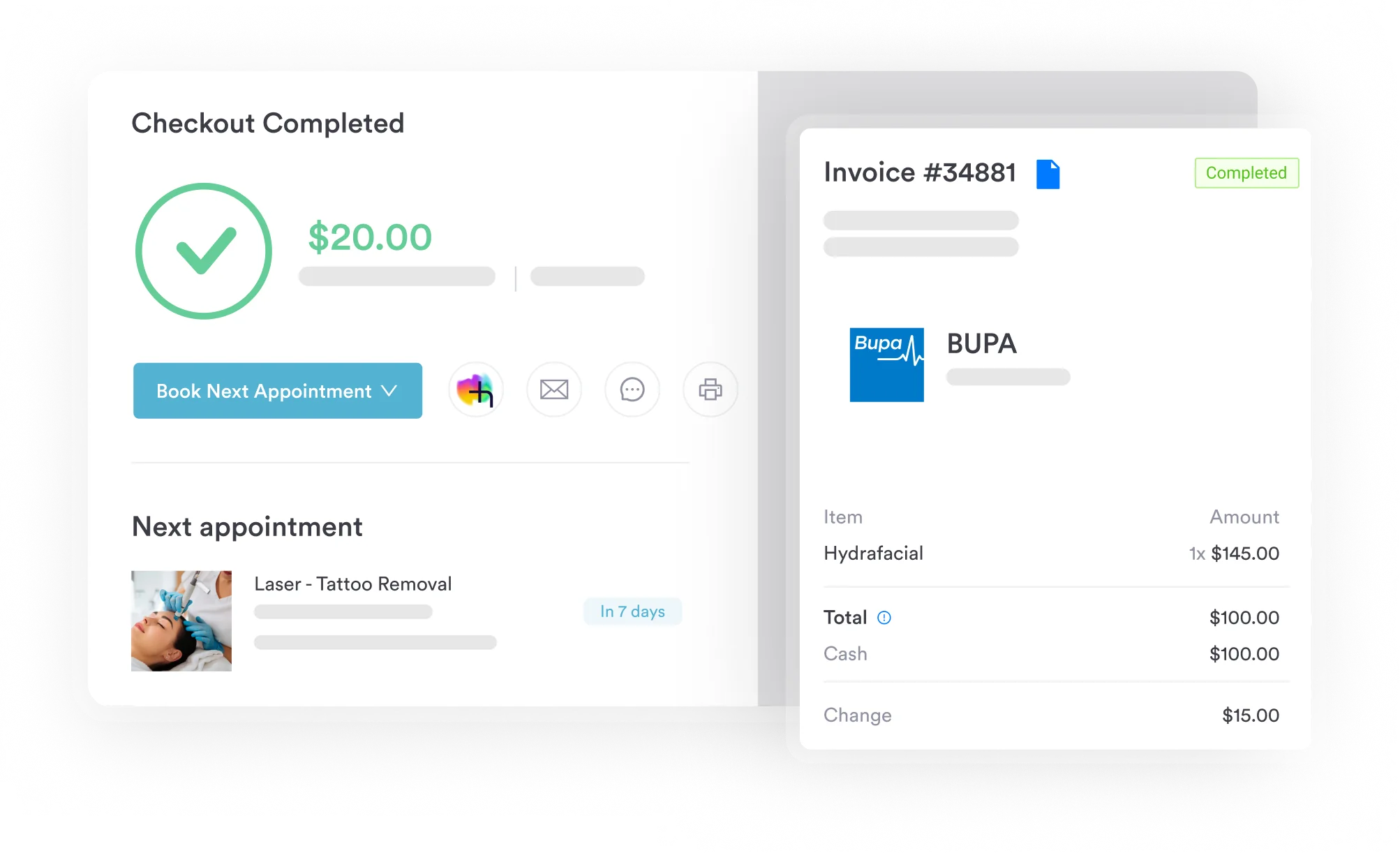
Every CPT 22100 claim is only as defensible as the operative documentation behind it. Payers reviewing spinal surgery excision claims look for specific elements in the operative note. Missing any of these creates grounds for denial or post-payment audit.
Structured note templates in medical records software prompt for these elements while the surgeon dictates. That keeps what the note says and what the claim needs in step. It also gives the biller one place to check before submission.
Post-payment audits on spinal surgery codes often turn on documentation that was too general to defend, rather than on the procedure itself. Medical billing compliance is therefore mostly a documentation exercise.
Operative notes hold protected health information, so the systems that store them fall under HIPAA compliance rules. For a group with several surgeons, practice management software features that centralize audit trails keep that review in one place.
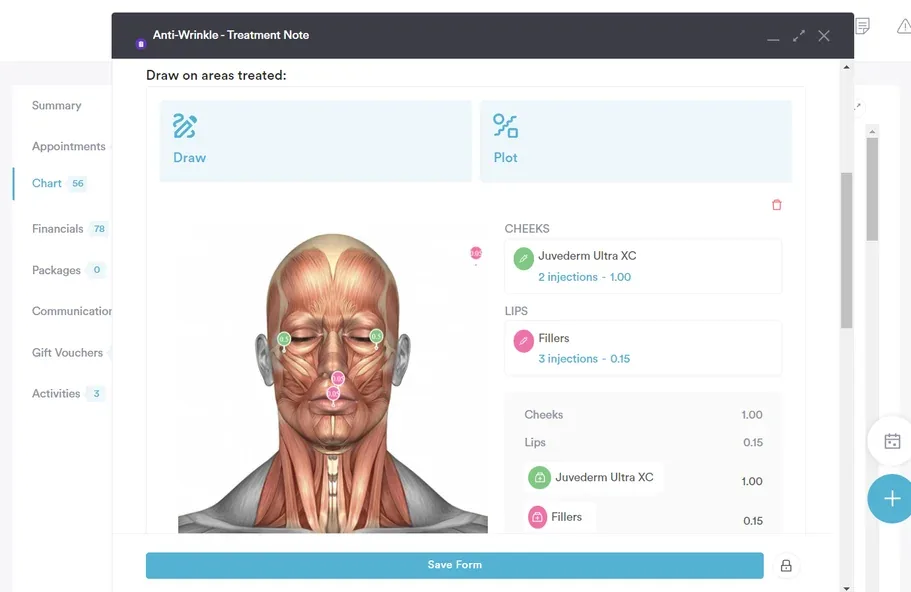
Run a pre-submission check on every 22100 claim. Pull the operative note and look for three things. Does ‘partial’ describe the excision extent? Is the exact cervical level named? Is a pathology specimen documented? Those three answers cover the most common documentation denials for this code.
Denials for 22100 follow a short list of patterns. Each one has a check that catches it before submission, which is what denial management means in practice. A clean claim review is where those checks belong.
Orthopedic and neurosurgery practices billing 22100 usually keep the coding rules in one place and the claim status in another. Modifier decisions, global period dates, and ICD-10 pairings end up in spreadsheets that nobody owns.
Pabau’s claims management software centralizes the submission side of that work. Every claim carries a status, so the billing team can see what is submitted, what is paid, and what came back rejected. Rejections stay visible until someone clears them.
Invoices route to the payer or the patient once the claim closes, which keeps the balance on one record. Payments reconcile against that invoice, so a group running several surgeons drops the second spreadsheet used to track who has been paid.
Practices also use Pabau for the operative documentation that feeds the claim. Structured note templates prompt surgeons for the cervical level, the excision extent, and the structure involved. Pabau Scribe, our AI scribe, drafts that note from dictation, so the detail reaches the record the same day.
Post-operative visits inside the global period still belong on the record even when they are not billed. Keeping them in the same system as the surgery gives physical therapy and sports medicine teams the full history when the patient reaches them.
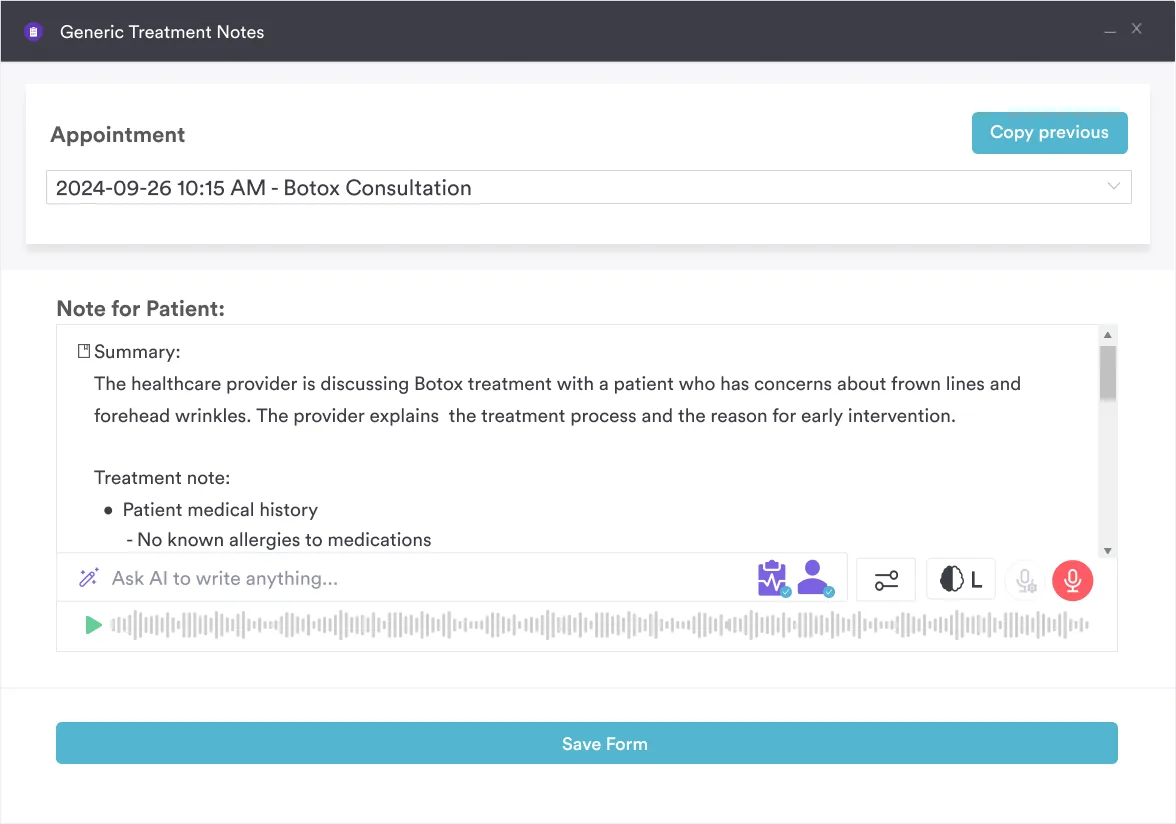

Pabau’s claims management gives your billing team one place to submit claims, follow their status, and reconcile payments. Rejections stay visible until someone clears them, so no claim sits unworked.

CPT 22100 is a narrow code, which is what makes it easy to get wrong. Confirm the region, confirm the lesion is intrinsic to bone, and confirm the note says “partial”. Those three checks resolve most of what payers push back on.
The trade-off worth remembering is the 90-day global period. It already pays for follow-up care you might otherwise bill, so scheduling and billing have to read the same calendar. A practice that gets that right stops writing off post-operative visits.
Every one of those checks sits in the pre-submission workflow rather than in the operating room. Book a demo to see how Pabau tracks 22100 claims from submission through to reconciled payment.

Coding a posterior cervical fusion instead? CPT 22600 sets out the arthrodesis billing rules, its global period, and the modifiers that come with it.
Harvesting graft material in the same session? CPT 20939 explains when bone marrow aspiration for spine surgery can be reported alongside the primary code.
Need the imaging that documents the lesion? CPT 72141 covers cervical spine MRI billing, including the rules on contrast and repeat studies.
Working from a disc diagnosis rather than a bony lesion? M51.9 shows why an unspecified disc code rarely survives a medical necessity review.
CPT code 22100 reports partial excision of a posterior vertebral component at a single cervical segment. The component is the spinous process, the lamina, or the facet, and the indication is an intrinsic bony lesion. Orthopedic surgeons and neurosurgeons bill it when they remove a lesion arising inside the cervical vertebral bone. That covers a benign tumor, a cyst, or fibrous dysplasia.
CPT code 22100 carries a 90-day global period, classifying it as a major surgical procedure. Routine post-operative evaluation and management visits inside that window sit in the surgical package. They cannot be billed separately unless modifier -24 or modifier -79 applies to an unrelated service.
CPT 22103 is reported alongside CPT 22100 for each additional vertebral segment excised in the same surgical session. Report 22100 for the primary cervical segment and 22103 once per additional segment. CPT 22103 cannot be submitted on its own, and it is exempt from the multiple procedure reduction that applies under modifier -51.
CMS NCCI edits bundle certain procedure codes with CPT 22100 to prevent duplicate billing. Modifier -59 can unbundle a pair when the second code was a distinct service at a separate site or session. That only holds where the operative documentation clearly supports the distinction. NCCI tables are updated quarterly, so verify the current edits before each claim cycle.
CPT 22100 covers partial posterior vertebral excision at the cervical level. CPT 22101 covers the same procedure at the thoracic level, and CPT 22102 covers the lumbar level. All three share add-on code 22103 for additional segments. The anatomical level of the excised segment decides which primary code applies, not the approach or the incision location.
The operative note has to identify the exact cervical vertebral level, such as C5, and describe the lesion as intrinsic to bone. It must also name the structure excised, whether that is the spinous process, the lamina, or the facet. Confirm that the excision was partial rather than complete, and document submission of a pathology specimen. For multi-segment cases, name each additional level individually to support CPT 22103 units.
Medicare reimbursement for CPT 22100 is calculated from roughly 29.77 total RVUs in a facility setting. That total is multiplied by the annual CMS conversion factor, then adjusted by the Geographic Practice Cost Index for the practice’s locality. Rates vary by region and are updated annually, so use the CMS Physician Fee Schedule look-up tool for current amounts.