CCSD code H4430: Examination of rectum under anaesthetic
CCSD code H4430 pays for the examination alone CCSD code H4430 is the UK private...

Last Updated: Oct 20, 2026

CPT code 22328 covers open treatment or reduction of each additional fractured vertebra or dislocated segment, through a posterior approach.
It is an add-on code, so it only ever appears on a claim alongside 22325, 22326, or 22327.
All four codes in the family use a posterior approach, so the spinal level is what separates 22325, 22326, and 22327.
Modifier 51 never applies to an add-on code. Modifier 62 for co-surgery is the one most often used here.
Practice management software like Pabau keeps the coded lines on the treatment record, so claims go out complete the first time.
CPT code 22328 is an add-on code for open treatment or reduction of each additional fractured vertebra or dislocated segment. The approach is posterior, and you report the code once for every segment treated beyond the first.
The code sits in the 22310 to 22328 family of open vertebral fracture codes, maintained by the American Medical Association (AMA) CPT Editorial Panel.
This reference covers the descriptor, the pairing rules, applicable modifiers, reimbursement components, ICD-10 pairings, NCCI edits, and the documentation an auditor will look for.
The official AMA descriptor comes in two parts. The parent portion reads: Open treatment and/or reduction of vertebral fracture(s) and/or dislocation(s), posterior approach, 1 fractured vertebra or dislocated segment.
The add-on portion reads: each additional fractured vertebra or dislocated segment (List separately in addition to code for primary procedure).
The plus symbol (+) in front of the code confirms its add-on status, so it never stands alone on a claim.
Add-on codes follow their own billing rules:
CPT 22328 must appear alongside one of three primary procedure codes. The primary code identifies the first fractured vertebra or dislocated segment treated. You then add 22328 once for each segment after that.
All three primary codes describe a posterior approach, so the spinal level is what separates them. The map below pairs each level with its primary code and the ICD-10 family that usually supports it.
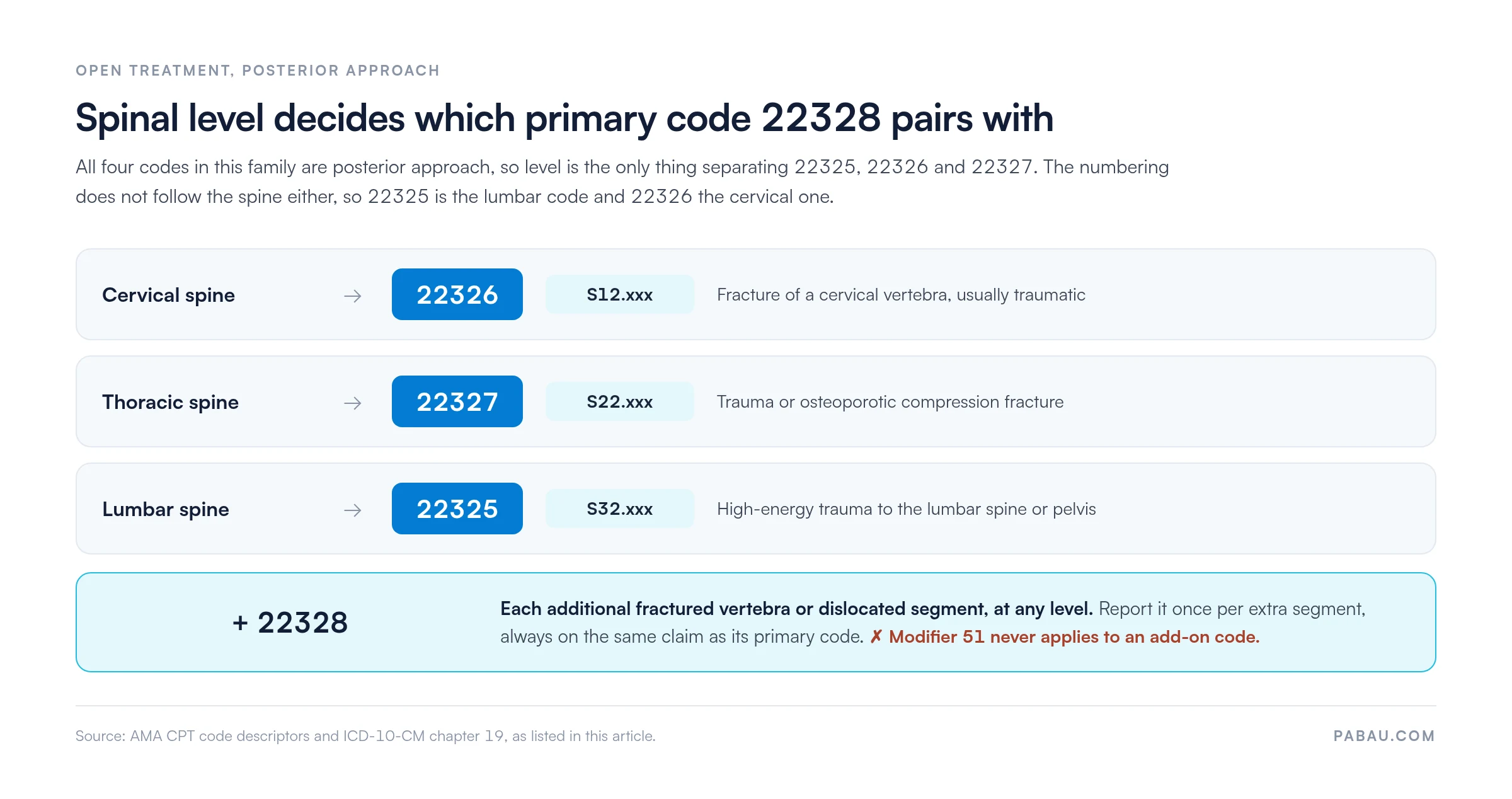
Modifier 51 is the other thing to watch. It signals multiple procedures, and it does not apply to add-on codes, so appending it to 22328 will cause a denial.
The 22325 to 22328 family covers open surgical treatment of vertebral fractures and dislocations at every spinal level. Spinal level drives the primary code choice, and the number of segments treated never does. The matrix below includes the closed treatment alternative for context.
For spine and orthopedic practices, the pairing itself is straightforward once the level is settled. Reporting 22327 for the first thoracic segment and 22328 for each additional thoracic segment is correct. Reporting 22328 with no primary code on the claim is always wrong.
CPT code 22328 needs a diagnosis code that supports medical necessity for open fracture or dislocation treatment. The ICD-10-CM codes below are the diagnoses most commonly paired with it. Always check the current CDC/NCHS ICD-10-CM lookup tool for the applicable fiscal year.
Fracture codes take a 7th character for episode of care. A marks the initial encounter, D a subsequent one, and S a sequela. S12.131D and S14.118S show how much that single character changes about an otherwise identical code.
Payers routinely audit fracture claims for 7th character completeness. A missing or incorrect character is a common trigger for medical necessity denials on spine surgery claims. That makes it worth a standing check in denial management.
When two vertebral levels are treated on the same date, document each level separately in the operative report. A single reference to ‘multilevel’ treatment, without identifying each individual segment, may not satisfy payer documentation requirements for CPT code 22328.
As an add-on code, 22328 carries different modifier rules from a standard surgical code. Modifier 51 is explicitly excluded. The table below covers the modifiers that do apply.
When modifier 62 applies, both surgeons report 22328 with the modifier appended, and each receives roughly 62.5% of the global fee. Confirm co-surgery eligibility with the payer first, because commercial plans do not all follow Medicare’s co-surgery rules.
Medicare pays for 22328 using relative value units (RVUs). The RVU total is multiplied by the annual conversion factor and by the geographic practice cost index (GPCI) for the practice location.
The Centers for Medicare and Medicaid Services (CMS) updates these values every calendar year. Check the current figures in the CMS Physician Fee Schedule lookup tool before you quote a rate to anyone.
As an add-on code, 22328 is usually reimbursed below its primary counterparts in the 22325 to 22327 range. The incremental work at each additional segment is smaller than the work at the first. For current wRVU and payment figures, cross-reference CMS data against the AAPC Codify CPT lookup.
The National Correct Coding Initiative (NCCI) publishes quarterly edit tables listing code pairs that cannot be billed together on the same date. Check the current CMS NCCI tables before submitting a spinal fracture claim, since the edits change four times a year.
Key NCCI considerations for 22328:
Practices that cross-reference NCCI tables by hand add lag and error risk to every claim. Claims management software keeps the coded lines, the operative note, and the submission in one place. A biller can then verify the pairing without leaving the patient record, and fewer claims get held back at the claim scrubbing stage. Payment posting from a remittance file is faster than manual entry and keeps the adjustment reasons attached. If the encounter included an assessment and a plan, the evaluation and management component needs its own documentation.
The operative report is the supporting document for every 22328 claim. Auditors look for specific elements before payment stands, and a missing element is grounds for denial or recoupment.
The medical documentation practices that work best here start with a structured operative template. It prompts the surgeon to capture each required element before the report is closed.
For sports medicine practices handling spinal trauma, that template doubles as the audit trail. Keeping the same structure across every surgeon is a practical piece of billing compliance.
The errors below account for most rejections on this add-on code, and each one is a process fix rather than a payer argument. Working from a published list of denial codes makes them easier to spot in remittance data.
Run a pre-submission NCCI edit check on every 22328 claim line. Confirm a primary code is present, and that modifier 51 is absent. Then check that each additional segment is named in the operative report. Those three checks catch most 22328 denials before they leave the practice.
In most practices the coded lines start life in one place and get re-entered somewhere else. The surgeon dictates the operative report, a coder reads it and picks the codes, and a biller re-keys them into the claim. Every hop is a chance for 22328 to lose its primary code.
Practice management software like Pabau keeps all of it on one record. The treatment note, the coded procedure lines, and the invoice sit against the same patient file. A biller checks the pairing where the clinical detail already lives, instead of chasing a dictation.
From there the claim goes out electronically through our Claim.MD integration, and it is scrubbed before it reaches the payer. Format problems and missing pairings come back the same day, rather than in a remittance weeks later.
Reporting closes the loop. If 22328 shows up rarely against a volume of multi-level cases, that is revenue the practice earned and never billed. If it shows up too often, that is an audit exposure worth finding before a payer does.

Pabau holds the treatment note, the coded procedure lines, and the claim on one patient record. Your billers check a pairing in seconds, and claims leave the practice complete the first time.

22328 is a small code with a short rule set, and that is exactly why it gets missed. A surgeon who treats three levels and bills one has not made an error anyone will flag. The claim pays, and the second and third segments are simply never charged.
So the habit worth building is a narrow one. Make the operative report name every level it treated, every time. That single habit decides whether 22328 is billable at all, and no downstream check can substitute for it.
The trade-off is worth naming. Documenting to that standard adds a minute or two per case, and it is the only version of this code that survives an audit. Book a demo to see how Pabau keeps coded lines, operative notes, and claims on one patient record.

Coding a femur fracture from the same trauma? S72.466E walks through laterality, displacement, and the 7th character choice.
Handling a humerus shaft fracture claim? S42.332G shows how healing status drives the 7th character on a fracture code.
Coding a routine prostate screening visit? ICD-10 code Z12.5 covers the correct starting code for a prostate cancer screening visit, and the denial risks around it.
Coding a Nexplanon removal visit? ICD-10 code Z30.46 covers Nexplanon removal encounters, from a routine three-year removal to an early or complication-driven extraction.
CPT code 22328 is an add-on code for open treatment or reduction of each additional fractured vertebra or dislocated segment. The approach is posterior, and the code is always reported with a primary code from 22325 to 22327. It cannot be used alone.
Yes. CPT 22328 is designated as an add-on code with a plus symbol (+). It is reported once for each additional vertebral segment treated beyond the first, and it is exempt from modifier 51.
CPT 22328 must be reported with 22325 for the lumbar spine, 22326 for the cervical spine, or 22327 for the thoracic spine. All three are posterior approach codes, so the spinal level decides which one applies. The primary code covers the first segment treated, and 22328 covers each one after that.
Modifier 62 applies when two surgeons each perform a distinct portion of the procedure. Modifier 80 or 82 covers an assistant surgeon, and AS covers a non-physician practitioner acting as assistant. Modifier 51 never applies to an add-on code.
Yes. Open reduction of spondylolisthesis at additional vertebral levels supports 22328. Report it once for each segment treated beyond the first. ICD-10-CM code M43.1x should support the claim, with the primary procedure code covering the first segment treated.
NCCI edits for CPT 22328 are updated quarterly by CMS. The key rule is that 22328 requires a valid primary code in column 1. Without one, the claim rejects automatically. Some instrumentation codes may also have edit relationships with 22328, depending on the current quarterly table. Check the CMS NCCI tables before submission.