ICD-10 code S61.201A: Open wound of left index finger without nail damage
ICD-10 code S61.201A covers a left index finger wound of unstated type ICD-10 co...

Last Updated: Oct 16, 2026
Billable Code Specific Code
S72.466E is the billable ICD-10-CM code for nondisplaced supracondylar fracture with intracondylar extension of lower end of unspecified femur, subsequent encounter for open fracture type I or II with routine healing.
It is reported at a subsequent encounter, after an open Gustilo type I or II fracture, when healing is routine. Every element of that description carries a coding consequence.
The audience is medical coders, orthopedic clinicians, and billing teams handling distal femur fracture claims.
One mix-up dominates lookups for this code. S72.466E is frequently quoted as a medial condyle fracture of the left femur, and it is neither. Medial condyle fractures sit in the S72.43x series, and the unspecified 6th character here means no side was documented at all.
Let Pabau's smart automation suggest the right codes, reduce claim denials, and keep your practice compliant—effortlessly.
Automate repetitive tasks and focus on what matters most—your patients.
Reduce coding errors and ensure compliance with the latest regulations.
Clean claims, fewer denials, and faster reimbursements.
Powerful insights and reporting to help your practice thrive.
HIPAA compliant SOC 2 certified GDPR-compliant Trusted by 4,000+ clinics worldwide

S72.466E is a billable ICD-10-CM code for a nondisplaced supracondylar femur fracture with intracondylar extension, side not specified.
The 7th character E means a subsequent encounter for an open Gustilo type I or II fracture that is healing routinely.
The 6th character 6 means the record never named a side; use S72.464E for right and S72.465E for left.
S72.466E is not a medial condyle code. The medial condyle series is S72.43x, where S72.435E covers the nondisplaced left condyle.
Practice management software like Pabau validates ICD-10-CM codes before submission and files claims through its Claim.MD integration.
Each character in S72.466E encodes a distinct attribute. Misreading any one of them produces a code that does not match the documented condition. That creates a compliance risk, and code accuracy is part of HIPAA compliance for medical offices.
The 6th character does double duty in this subcategory. It carries displacement status and laterality at the same time. That is why 1 through 3 are the displaced codes and 4 through 6 are the nondisplaced ones. A quick check on the AAPC Codify ICD-10-CM lookup confirms the breakdown against the official tabular list.
S72.466E is the seven-character end point of a five-level chain. Reading the chain from the top is the fastest way to confirm you have the right code before you submit.
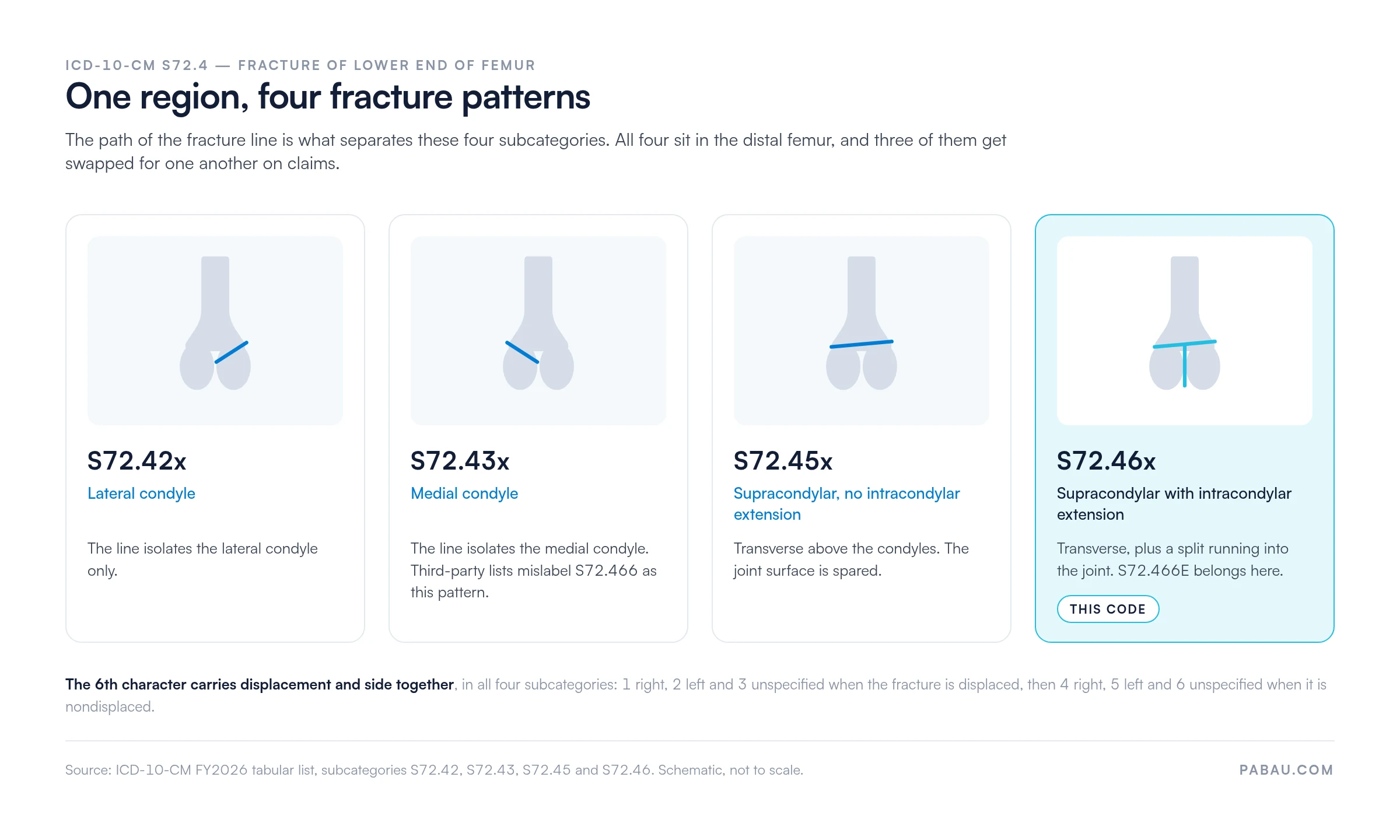
Two branches of that chain trip coders up. S72.45 covers the same supracondylar region without intracondylar extension, and S72.43 covers the medial condyle itself. Both describe a distal femur fracture, and neither is interchangeable with S72.46.
The supracondylar region is the flared metaphysis of the distal femur, immediately above the medial and lateral condyles. A supracondylar fracture crosses that flare. When the fracture line also runs down between the condyles, it has intracondylar extension. At that point the injury is intra-articular, meaning it reaches the knee joint surface.
That distinction is what separates S72.46 from S72.45. It matters clinically as well as for coding, because a fracture line reaching the joint surface changes the treatment plan and the long-term outlook. Nondisplaced means the fracture lines are present but the fragments remain in acceptable alignment.
Set side by side, those subcategories differ only in where the fracture line travels.
Rehabilitation after these fractures runs for months, so the follow-up visits that generate S72.466E claims are often shared between orthopedics and therapy. Teams in sports medicine practices see the same pattern in high-impact injuries and manage the same long recovery arc.
Character E applies at a follow-up visit, once active treatment has ended. The original fracture must have been open, with a Gustilo type I or II wound. Healing must also be progressing normally. All three conditions have to hold. The 7th character is the most frequently miscoded element on traumatic fracture claims.
Per the ICD-10-CM Official Guidelines for Coding and Reporting, Section I.C.19.c, the 7th character reflects the phase of care rather than the type of visit. Active treatment covers the emergency department visit, surgery, and the initial casting or splinting encounter. Everything after that is subsequent, provided no complication is documented.
Two defaults are worth memorizing. A fracture not documented as open or closed is coded as closed. Character D then applies rather than character E, so the index note matters. Open fracture 7th characters for the femur, forearm, tibia and fibula follow the Gustilo classification. The wound grade therefore has to come from the record.
The closed-fracture counterpart of S72.466E is S72.466D. If the original injury was closed and is now healing normally at follow-up, D is the correct choice. Coders who work across code families will recognize the same 7th character logic elsewhere in the trauma chapter, as in chapter, as in S12.131D.
Document healing status explicitly at every follow-up visit. Phrases such as ‘healing progressing as expected’ or ‘callus formation visible on imaging’ support 7th character D or E directly. Where healing status is absent, a payer can read the note as delayed healing (G) or nonunion (K).
S72.466E names no side, and that is the main reason claims carrying it get questioned. The ICD-10-CM guidelines allow an unspecified-laterality code only when the record genuinely does not identify the side. On a follow-up visit, the side is almost always knowable.
By the time a patient reaches a subsequent encounter, three documents already name the leg. The initial encounter note, the imaging report, and the operative report all identify it. A reviewer who sees an unspecified-side code on that timeline reads it as a documentation failure rather than a clinical finding.
That is why S72.466E is best treated as a query trigger, not a resting place. Ask the provider to confirm the side, then move to the specific code. Some payer edits reject unspecified-laterality trauma codes outright, and unspecified codes also weaken the specificity of your quality and risk reporting.
Clinicians rarely write the tabular description word for word. These are the phrasings that commonly map to S72.466E. They hold only where the note supports an open type I or II history, routine healing, and no documented side.
None of these phrasings replaces the provider’s own words. Code from what the record states, and query anything the description leaves open, especially the side and the original wound grade.
The S72.46 subcategory holds six base codes, split by displacement and side. The neighboring subcategories describe different fracture patterns in the same region, and they are the codes most often confused with S72.466.
Per CMS ICD-10-CM coding guidance, payers expect the highest level of specificity the documentation supports. Falling back to S72.409 when the imaging report clearly describes intracondylar extension is a specificity error, and it can trigger a claim edit.
The WHO ICD-10 framework underpins the US clinical modification. Claim submission itself is governed by the ICD-10-CM Official Guidelines, published each year by the National Center for Health Statistics and CMS. For traumatic fractures, the rules below apply directly.
The clinical note supporting S72.466E should carry each element below. A missing element weakens the code at audit, and the laterality element decides whether S72.466E is the right code at all.
S72.466E is usually the first-listed diagnosis on a follow-up orthopedic visit. When the same visit covers rehabilitation, the fracture code still sequences first. Additional codes for associated conditions, such as knee stiffness or pain, follow it.
Each coded condition has to be documented and addressed during the encounter, which is a core requirement of medical billing compliance. Claims carrying S72.466E then route through the standard orthopedic pathway on the CMS-1500 or 837P format.
Distal femur fracture codes generate a disproportionate share of claim edits, and most of them cluster around the 6th and 7th characters. These are the errors orthopedic coding teams hit most often.
A working denial management workflow catches these before submission rather than after rejection. Front-end edits cut the rework cost on fracture claims. The malunion and nonunion characters behave the same way on other open fractures, such as S52.042Q.
Run a 90-day look-back on every S72.46x claim and sort by the 6th and 7th characters. Any unspecified-side code on a follow-up visit, any A beyond the first encounter date, and any G without a delayed-healing note is an audit liability. Fixing the pattern prospectively beats managing retrospective denials.
S72.466E pairs with evaluation and management CPT codes for orthopedic follow-up, typically 99213 or 99214 for an established patient. It also pairs with physical therapy CPT codes when the visit includes therapeutic services. The diagnosis code establishes medical necessity, and the CPT code describes what was done.
Supplies and procedures from the index episode do not belong on the follow-up claim. Casting material is billed under A4590 at the encounter where the cast was applied. Soft-tissue coverage of the open wound, reported with a code such as 15271, sits with that episode as well.
Medicare, Medicaid and commercial payers all require full seven-character specificity on fracture claims under HIPAA transaction standards. Confirm the code against the current fiscal year’s tabular list before you submit.
Distal femur fractures generate long rehabilitation episodes, so the diagnosis code has to stay consistent across orthopedics and therapy.
In physical therapy EMR software workflows, that consistency is what keeps continuity of care documentation defensible. Medical billing fundamentals explain where diagnostic code errors enter the revenue cycle in the first place.
In most orthopedic practices, the 7th character is chosen from memory or copied from the last claim. Laterality gets carried forward the same way. That is how an unspecified-side code such as S72.466E survives on a follow-up visit where the imaging report named the leg months earlier.
Practice management software like Pabau closes that loop by keeping the code next to the clinical note that has to support it. The ICD-10-CM catalogue sits inside the record, so the coder selects from valid seven-character codes rather than a spreadsheet. Incomplete or invalid codes are flagged before the claim leaves the practice.
From there, electronic claims via Claim.MD carry the diagnosis fields through on CMS-1500 and 837P submissions, and remittances come back into the same system. Pabau’s claims management software ties that clearinghouse workflow to the client record.
The outcome is fewer reworked fracture claims and a shorter path from follow-up visit to payment. Your coders spend their time on the queries that matter, such as confirming the side, instead of chasing rejections a front-end edit could have caught.

Pabau validates ICD-10-CM codes inside the clinical record, flags incomplete submissions, and files electronic claims through Claim.MD across Medicare, Medicaid and commercial payers.

S72.466E covers one narrow scenario. The fracture is a nondisplaced supracondylar break with intracondylar extension, and the record names no side. The visit is a follow-up after an open type I or II injury that is healing normally. Two of those elements are where claims go wrong. The 6th character invites a laterality query, and the 7th character is the most miscoded element on any fracture claim. The 1500 claim form and its electronic equivalent ask for the same data in a different layout.
Treat the unspecified side as a question to resolve, not a code to submit. Confirm the original wound grade before you choose between characters D and E.
Both checks belong in a documentation checklist and in front-end claim validation. To see how that validation works in an orthopedic or musculoskeletal practice, book a demo with the Pabau team.

Need to see how electronic claims reach payers? Claim.MD clearinghouse explains how clearinghouse validation works in US medical billing.
Billing an ERCP add-on code? ERCP visualization billing guide covers the add-on code for direct visualization during cholangioscopy or pancreatoscopy, which never bills alone.
Want to verify coverage before the follow-up visit? Insurance eligibility verification outlines real-time eligibility checking workflows.
Billing gastrointestinal reconstruction surgery? GI reconstruction billing guide covers the code for reconstruction after esophagectomy using colon interposition or small intestine reconstruction.
Billing a laparoscopic gastric bypass? Laparoscopic gastric bypass billing covers the code for minimally invasive Roux-en-Y gastric bypass with a roux limb of 150 cm or less.
S72.466E is a billable ICD-10-CM code for a nondisplaced supracondylar fracture with intracondylar extension of the lower end of the unspecified femur. The 7th character E places the visit at a subsequent encounter, after an open Gustilo type I or II fracture, with healing progressing routinely. The unspecified 6th character means the record does not name a side.
No. Medial condyle fractures of the femur are coded in the S72.43x series, not S72.46x. The nondisplaced left medial condyle code with the same 7th character is S72.435E. S72.46x describes a supracondylar fracture whose line extends between the condyles into the knee joint, which is a different fracture pattern. Several third-party code lists repeat this mislabel, so check the tabular list.
Yes. S72.466E carries all seven required characters, so it is valid for HIPAA-covered claim submission. The six-character base code S72.466 is not billable on its own. Billable does not mean optimal here. The unspecified side makes the code less specific than the documentation usually allows.
Both codes describe a subsequent encounter with routine healing, and the difference is the original wound. S72.466D applies when the fracture was closed. S72.466E applies when it was open with a Gustilo type I or II wound. The answer comes from the initial encounter record, not from the follow-up note. A fracture never documented as open or closed is coded as closed, which points to D.
S72.464E is the right femur code and S72.465E is the left femur code. In the S72.46x nondisplaced series, the 6th character 4 means right, 5 means left and 6 means unspecified. Use the laterality-specific code whenever the record names a side, since it is the more specific option and payers expect it.
The 7th character E designates a subsequent encounter for an open fracture type I or II with routine healing. It confirms three things at once. Active treatment has ended, the original fracture was open with a Gustilo type I or II wound, and healing is routine. The closed-fracture equivalent at a subsequent encounter with routine healing is 7th character D.
Only when no part of the record identifies the side. The ICD-10-CM guidelines direct you to the unspecified-laterality code when the documentation does not state right or left. At a follow-up visit that is rare, because the initial note, the imaging report and the operative report normally all name the leg. Query the provider before you submit an unspecified-side code.