ICD-10 Code S52.101P: Right radius fracture with malunion
ICD-10 Code S52.101P: definition and code details ICD-10 Code S52.101P is a bill...

Last Updated: Oct 19, 2026
Billable Code Specific Code
S42.332G is the billable ICD-10-CM code for displaced oblique fracture of shaft of humerus, left arm, subsequent encounter for fracture with delayed healing.
Let Pabau's smart automation suggest the right codes, reduce claim denials, and keep your practice compliant—effortlessly.
Automate repetitive tasks and focus on what matters most—your patients.
Reduce coding errors and ensure compliance with the latest regulations.
Clean claims, fewer denials, and faster reimbursements.
Powerful insights and reporting to help your practice thrive.
HIPAA compliant SOC 2 certified GDPR-compliant Trusted by 4,000+ clinics worldwide

ICD-10 code S42.332G describes a displaced oblique fracture of the shaft of the humerus, left arm, at a subsequent encounter with delayed healing
The 7th character G is distinct from D for routine healing and K for nonunion. It has to reflect the healing status documented at that visit
Laterality sits in the 5th character position, so the note has to name the left arm before the code can be assigned
Practice management software like Pabau keeps the coded encounter and the claim in one record, so nothing is rekeyed on the way to the payer
S42.332G is a billable, encounter-specific ICD-10-CM diagnosis code valid for HIPAA-covered transactions in fiscal year 2026. It carries six clinical elements at once. Each one has to be supported by documentation before the code can be assigned.
The CMS ICD-10-CM code page publishes the annual tabular list that confirms effective dates and billable status for every S42 code. Check it against the applicable fiscal year before you submit.
A displaced oblique fracture of the humeral shaft means the fracture line runs diagonally across the bone. The two fragments have also moved out of their normal alignment. Both the oblique morphology and the displacement have to be documented by the treating provider before the code holds up.
The humeral shaft runs from just below the surgical neck to just above the medial and lateral epicondyles. Oblique fractures here usually follow a direct blow, a twisting injury, or a fall on an outstretched arm. Rehabilitation runs long, so physical therapy practices and sports medicine practices often bill several follow-up encounters for one injury.
The 7th character records the encounter rather than the injury, so it can change from one visit to the next. Character G designates a subsequent encounter for a fracture healing more slowly than expected. It is one of six encounter-type characters available on fracture codes in the S category.
Two questions settle the choice at any given visit, and the chart below runs through both.
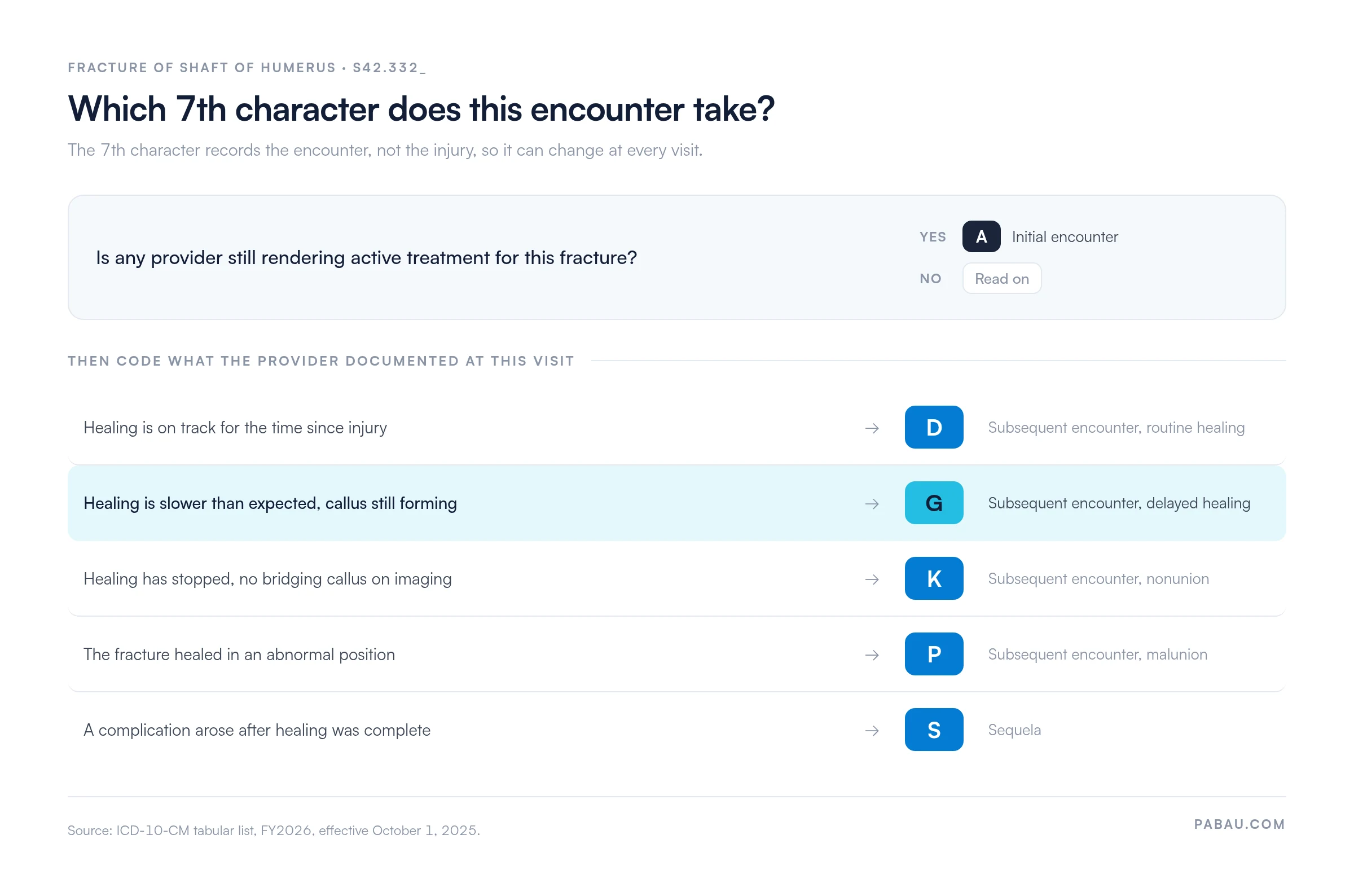
Delayed healing is clinically distinct from nonunion. Under G, the fracture is still moving toward union, only slower than expected, usually with partial callus visible on imaging. Under K, the healing process has stopped altogether.
Treating the two as interchangeable produces either upcoding or undercoding, and both carry compliance risk. The CDC ICD-10-CM web tool carries the official tabular definition of each 7th character value.
The Official Guidelines treat “subsequent” as any encounter after active treatment has finished. Character A still applies when a new provider sees the patient while the fracture is in active treatment. The same encounter logic runs through the other fracture chapters, although long-bone codes such as S72.466E add separate characters for open fractures. A Medicare claim is adjudicated against local coverage policy, which varies by contractor.
S42.332G sits inside a strict classification hierarchy. Reading it from the top down is the quickest way to confirm that the most specific code has been selected.
Every character narrows the code further, and S42.332G leaves nothing unspecified. That means it can go out as it stands, as either a primary or a secondary diagnosis, with no additional characters needed.
Several codes sit right next to S42.332G in the tabular list. Confusing laterality, displacement status, or fracture morphology is a common denial trigger. The table below maps the siblings coders reach for most often.
The AAPC Codify lookup handles crosswalk and sibling navigation for the whole S42.3 family. Where the tabular list classes a shaft fracture as other rather than oblique, spiral, transverse, or comminuted, the sequela code is sequela code is S42.399S.
Checking the operative note’s laterality, displacement status, and healing assessment against this table catches most selection errors before the claim is built. Segmental fractures, which break the shaft in two places, sit outside this table in their own subcategory. A displaced segmental fracture of the right humeral shaft with delayed healing takes ICD-10 code S42.361G.
Clinical notes and operative reports rarely use the ICD-10-CM descriptor word for word. These alternate phrasings all map to S42.332G when they describe the left arm at a subsequent visit with documented delayed healing.
Query the provider when the note says only “slow healing” or “healing concerns”. The clinical threshold has to be established in words before character G can stand in place of character D.
Read the imaging report and the provider’s assessment separately at every subsequent encounter. A provider may document delayed healing in the assessment while the imaging is read as expected progress. The 7th character has to reflect the documented status at the time of the encounter. A conflict between the two should trigger a provider query before you assign G.
Four elements have to appear in the medical record before S42.332G can be assigned. Miss any one of them and the claim is exposed to a medical necessity denial or a downcoded response.
Those four elements are far easier to capture when the note has a fixed shape. A progress note template gives a busy provider exactly that. Build the healing-status line into the template and it stops being something a coder has to chase.
Practice management software like Pabau keeps the coded encounter and the claim in one record. Its claims management tools submit electronically through Pabau’s Claim.MD integration, where payer-specific edits run before the claim reaches the insurer.
The mechanics of clean claim submission are worth learning once. Fracture codes repay it, because the same four documentation elements decide almost every denial.
These are the errors that trigger denials and audit flags on S42.332G claims. Each one has a documentation fix that costs a great deal less than a rework.
A pre-submission check for character, laterality, and morphology consistency catches most of this. Denial management for fracture codes becomes predictable once the error patterns are mapped.
Denial codes tell you which payer response maps to which coding defect. Consistent medical billing compliance routines for fracture documentation shorten the correction cycle from weeks to days.
Build a five-question fracture checklist into the encounter note workflow. Is the morphology documented? Is the displacement status confirmed? Is laterality explicit? Is the encounter confirmed as subsequent? Has the provider recorded healing as delayed, routine, or nonunion? Running those five questions at note completion catches most S42.332G errors before the claim is generated.
Orthopedic practices usually find a fracture coding error twice. The first time is when the biller builds the claim. The second is weeks later, when the remittance comes back and someone has to work out which encounter it belongs to.
Pabau keeps charting, coding, and billing in the same client record. The 7th character a provider recorded at the visit is the one that reaches the claim form. Nobody rekeys it into a separate billing system.
Claims leave Pabau electronically through the Claim.MD clearinghouse, and their status flows back into that same record. Your billers can see which fracture claims were accepted, rejected, or paid without opening a second portal.
So a delayed-healing follow-up billed on Monday is confirmed or flagged inside the week. That is the difference between correcting a 7th character while the note is fresh and rediscovering it in next month’s denial report.
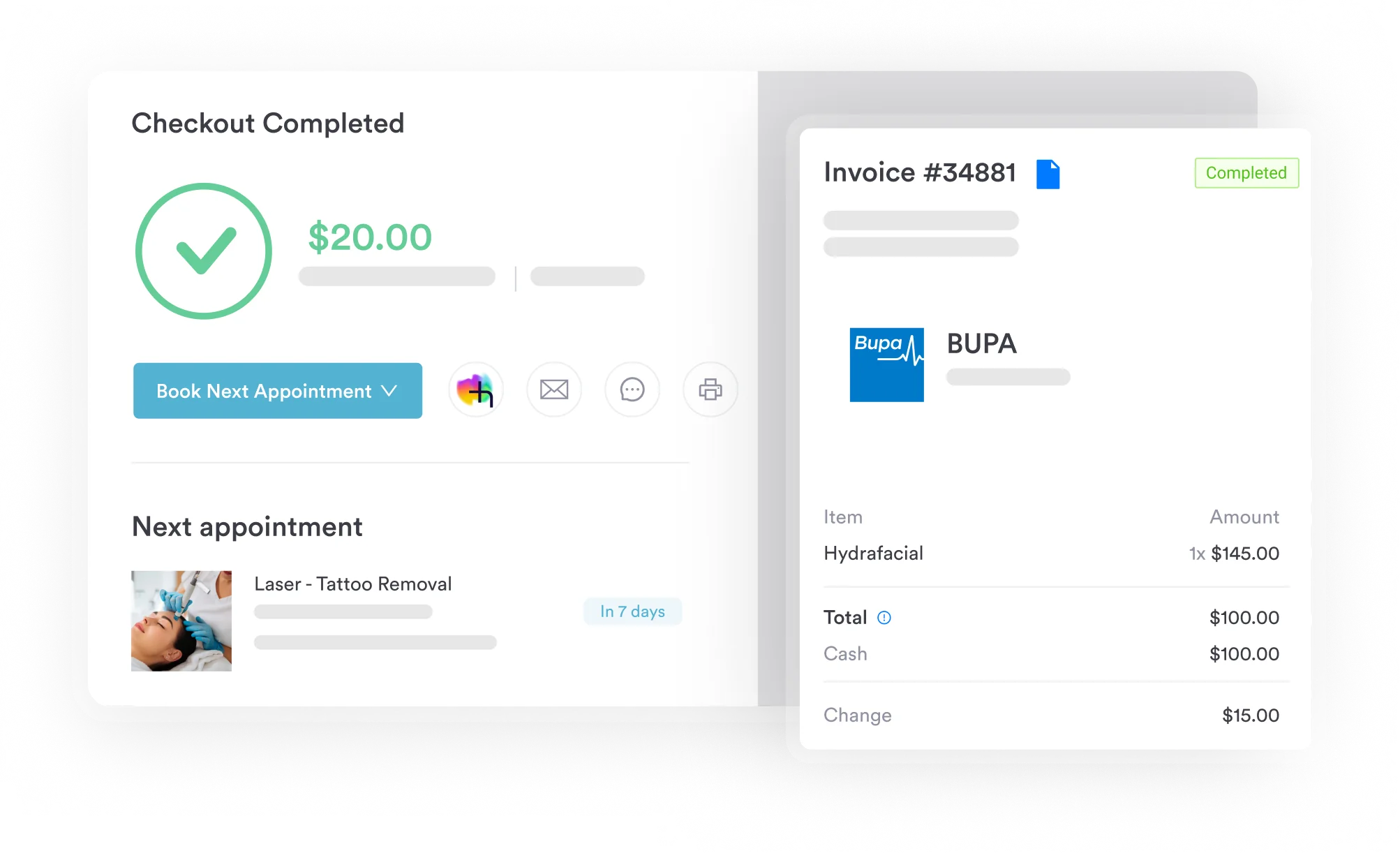

Pabau keeps charting, coding, and claim submission in one client record, and sends claims electronically through Claim.MD. Your billers can track every fracture claim to payment without a second system.

Character selection on S42.332G is a documentation problem before it is a coding problem. Once the provider’s assessment names delayed healing in words, the 7th character follows on its own and there is nothing left to judge.
So the work worth doing sits upstream of the claim. Agree on the wording providers use for delayed union, then put a healing-status line in the follow-up note. The coder stops guessing between D, G, and K.
The trade-off is a slightly longer note in exchange for a claim that survives review. Book a demo to see how Pabau keeps coded encounters and claim status in one record for orthopedic and musculoskeletal practices.

Coding a fracture that has stopped healing altogether? ICD-10 Code S72.435M works through the nonunion 7th character on a long-bone fracture.
Handling a fracture that healed in the wrong position? ICD-10 code S52.042Q covers malunion coding on an open forearm fracture, including the open-fracture characters.
Coding a different part of the humerus? ICD-10 Code S42.452A sets out the lateral condyle codes, where laterality and displacement work the same way.
Billing soft-tissue injuries of the arm as well? ICD-10 code S46.921A explains how muscle and tendon injuries of the upper arm are classified.
S42.332G is a billable ICD-10-CM code for a displaced oblique fracture of the shaft of the humerus, left arm. The 7th character G marks a subsequent encounter where the provider has documented delayed healing rather than routine progress.
Yes, S42.332G is a billable and specific ICD-10-CM code valid for HIPAA-covered transactions in fiscal year 2026, effective October 1, 2025. It can be submitted as a primary or secondary diagnosis on CMS-1500 and 837P claim forms, with no additional specificity codes needed.
Code delayed healing when the treating provider explicitly documents that the fracture is healing more slowly than expected. Imaging usually supports it, showing partial or insufficient callus for the time since injury. Do not infer delayed healing from the images alone, because the provider’s assessment has to state the finding. Query the provider whenever the documentation is ambiguous.
Follow-up management of a humeral shaft fracture with delayed healing is usually billed with evaluation and management codes 99213 to 99215. If the provider moves to surgery for a delayed union, two humeral shaft codes apply. CPT 24515 covers open treatment with plate and screw fixation, and CPT 24516 covers intramedullary nailing. Select the CPT code from the procedure performed, independently of the ICD-10-CM diagnosis.