

CPT Code 30801: Superficial turbinate ablation billing guide
CPT Code 30801: Official descriptor and procedure overview The American Medical ...

Last Updated: Nov 27, 2026
W2930 is the CCSD code for removal of skeletal traction from bone. It covers taking out a Steinmann pin or Kirschner wire passed through bone to hold a limb in traction. Removal follows the end of the traction episode.
Bupa places W2930 in fee band MINOR 3, with a surgeon fee of £138. Applying the traction is a separate code, W2910. Removal of skin traction, an external fixation frame (W3030) or internal fixation (W2830) does not fall under W2930.
Let Pabau's smart automation suggest the right codes, reduce claim denials, and keep your practice compliant—effortlessly.
Automate repetitive tasks and focus on what matters most—your patients.
Reduce coding errors and ensure compliance with the latest regulations.
Clean claims, fewer denials, and faster reimbursements.
Powerful insights and reporting to help your practice thrive.
HIPAA compliant SOC 2 certified GDPR-compliant Trusted by 4,000+ clinics worldwide

CCSD Code W2930 covers removal of skeletal traction from bone, such as Steinmann pins and Kirschner wires, and never skin traction.
Bupa places W2930 in fee band MINOR 3 with a £138 surgeon fee, and AXA Health lists it as a Minor procedure.
Application of skeletal traction is W2910, removal of external fixation is W3030, and removal of internal fixation is W2830.
Insurers expect an operative note recording the device, site, laterality and anaesthetic before they pay a W2930 claim.
Pabau, a practice management platform with UK insurer claims, keeps the procedure note and the CCSD-coded claim in one patient record.
CCSD Code W2930 is the code UK private medical insurers use to pay a surgeon for removal of skeletal traction from bone. AXA Health’s chapter 16 code list gives W2930 that exact descriptor and rates it a Minor procedure.
The code covers taking out a pin or wire passed directly through cortical bone during an earlier traction episode. Removal of skin traction falls outside it.
W2930 sits in chapter 16 of the CCSD schedule, which covers bones, joints and connective tissue, in its external fixation and traction section. Its neighbour W2910 covers application of skeletal traction to bone, so the two codes bracket one traction episode.
Confirm the exact code for each event in the CCSD code library rather than applying W2930 to any traction-related event.
Skeletal traction uses metal pins or wires passed directly through bone to apply a pulling force along a limb axis. This anchoring method is mechanically superior to skin traction for fractures requiring sustained force, particularly femoral shaft fractures, calcaneal injuries, and unstable pelvic fractures. An undisplaced femoral neck fracture that is pinned in situ is a separate procedure, coded W1912.
The two devices most commonly removed under CCSD Code W2930 are:
Removal steps broadly follow this sequence:
Removal under local anaesthetic is clinically appropriate for many patients and does not reduce the billable status of W2930. However, the choice of anaesthetic must be documented, because some payers query general anaesthetic claims when local anaesthetic would have been standard.
CCSD Code W2930 becomes the correct code when a patient who previously received skeletal traction attends for formal pin or wire removal. The code applies whether removal happens on the ward, in a treatment room, or in theatre, provided a consultant orthopaedic surgeon performs or supervises it.
Common clinical scenarios that generate a W2930 event:
When removal occurs intra-operatively as part of a larger procedure, such as nailing a femoral fracture, it may be bundled within the principal operative code. Whether a separate W2930 claim is appropriate then depends on the payer, so check the insurer’s bundling guidance before submitting.
Incomplete documentation is a common reason W2930 claims stall. UK private insurers expect the operative or procedure note to contain specific clinical detail before they accept the claim. A note that reads only “traction pin removed” is routinely insufficient.
A W2930 operative note should include all of the following:
Pre-authorisation is a separate requirement from documentation quality. Most UK private insurers require prior authorisation for orthopaedic procedures, though the threshold for traction-related codes varies by insurer and by episode timing. Confirm pre-auth status with the payer before the procedure, because retrospective authorisation is not guaranteed.
The Bupa CCSD code schedule includes payer-specific guidance on which W-chapter procedures need prior authorisation under Bupa’s rules.
The most common coding error involving CCSD Code W2930 is applying it to a scenario that belongs under a neighbouring code. The table below maps the codes most likely to appear alongside or instead of W2930.
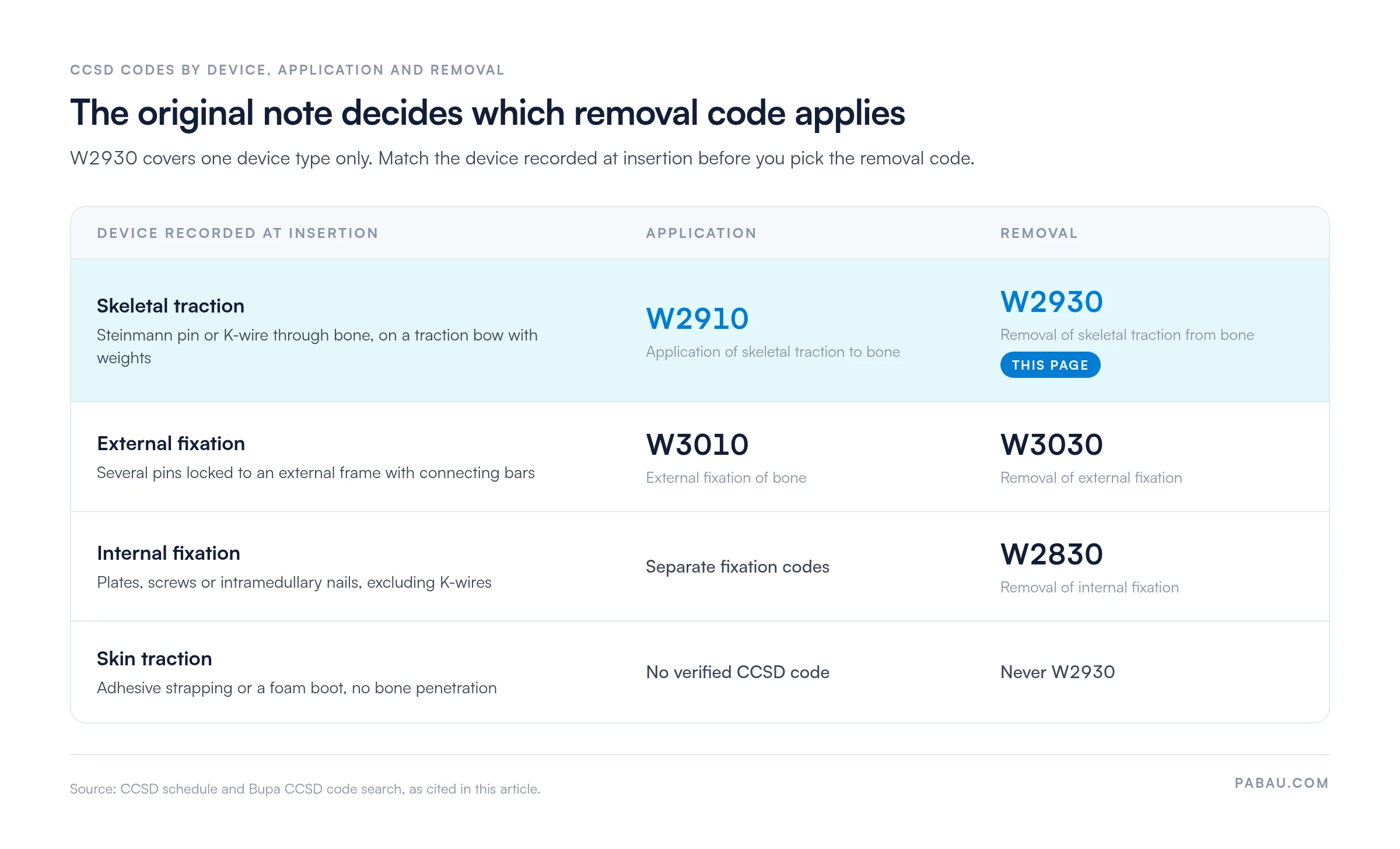
Plates, screws and nails come out under W2830, which excludes K-wires. Code numbers change when the schedule is revised, so verify each one against the current CCSD technical guide before submitting. The chart below sets each device beside its application and removal code.
External fixators and skeletal traction pins are both bone-anchored metal devices, so confusion between their removal codes is understandable. The clinical distinction matters because the procedures are not equivalent in complexity.
Skeletal traction (W2930) uses a single smooth pin or wire passed through bone and connected to a traction bow and weights. Removal is relatively straightforward once the weights are off.
External fixation frames use multiple bone-anchored pins connected to an external scaffold, with torque locking and multiple insertion sites. Their application is W3010, and their removal is W3030, which typically needs a theatre setting. An Ilizarov frame applied for a secondary non-union or mal-union, osteotomy included, is billed as code W3040.
When the frame holds a closed reduction of a short-bone fracture, the application falls under W2580 instead. Applying W2930 to external fixator removal is a miscoding that most payers will query or deny on inspection.
Check the operative note for the original procedure when coding removal. If the original note documents a traction bow and weights, W2930 applies. If it documents an external fixation frame with multiple pins and connecting bars, W3030 applies. The source document settles the question.
UK private insurers that accept CCSD-coded claims include Bupa, Aviva, AXA Health, and Vitality Health. Each has its own fee schedule and submission requirements, and reimbursement for W2930 varies by insurer and tariff year.
Bupa places W2930 in fee band MINOR 3, with a surgeon fee of £138. AXA Health lists it as a Minor procedure with a £150 procedure fee and a £142 general anaesthesia fee. Rates change each year, so check the insurer’s current schedule before quoting a fee to a patient.
Key payer considerations for W2930 submissions:
The Bupa code search tool allows recognised providers to look up W2930 fees and check whether the procedure falls within a Bupa-defined episode bundle. Equivalent tools are available on the AXA Health and Vitality provider portals.
W2930 claims are denied for predictable reasons. Each one is preventable with correct documentation and submission practice.
CCSD Code W2930 can be billed alongside other codes in certain circumstances, but co-billing rules vary by insurer and clinical scenario. The two most common questions are whether removal can sit alongside a fracture management code, and whether a separate anaesthetic fee can accompany it.
AXA Health lists W2910 and W2930 as an unacceptable combination, so AXA Health will not pay application and removal on the same claim.
When skeletal traction removal occurs at a clearly separate encounter from the original fracture management episode, billing W2930 alongside the fracture code is generally appropriate. That holds provided the insurer’s episode definitions do not bundle the two events.
The key evidence is a distinct date of service and a separate clinic or ward letter. The procedure note should also stand alone as a record of the removal.
When removal occurs intra-operatively during a definitive fixation procedure, such as a femoral nail, the traction pin comes out as part of surgical access. Here most payers treat W2930 as incidental to the principal procedure and will not reimburse it separately.
If the removal adds significant operative time or complexity, document this clearly and ask whether the insurer accepts an additional time-based billing element.
For orthopaedic and sports medicine practices managing fracture episodes across several encounters, a clear audit trail matters most. Record each event’s date, the procedure performed and its clinical justification, and you can defend co-billing decisions during an insurer audit.
When billing W2930 alongside a fracture management code, attach a brief covering letter that explains the clinical timeline. Say when traction was applied, when fracture consolidation was confirmed, and why removal occurred at a separate encounter. This reduces the number of payer queries you receive before payment is authorised.
When the procedure note lives in one system and the insurer claim in another, someone retypes the device, site and anaesthetic by hand. That retyping is where a date or a detail drifts between the note and the claim form.
Pabau keeps the note and the claim in the same patient record. A practice can build its traction removal note as a form template. The template asks for device type, size, site, laterality and anaesthetic before the clinician signs.
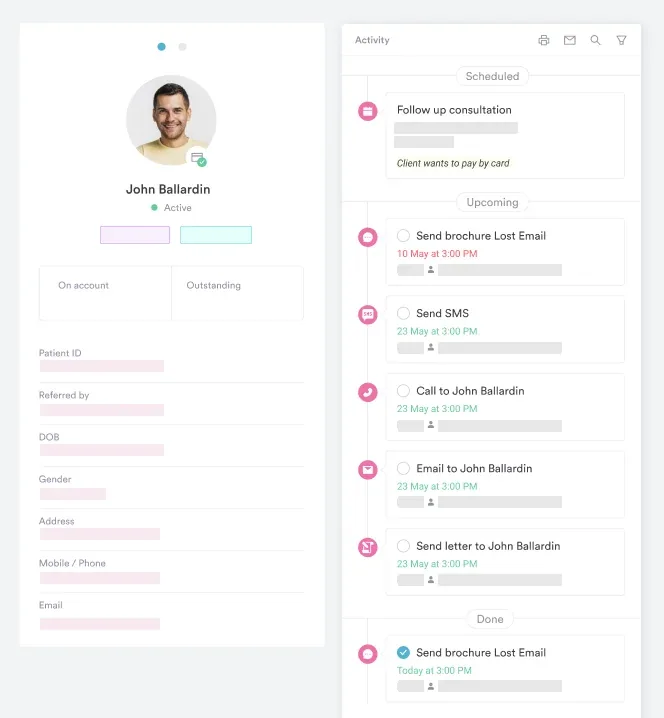
From that record, Pabau’s private healthcare claims management sends CCSD-coded claims to UK insurers through Healthcode and Bupa. Billing staff can spot an incomplete note before the claim leaves, so fewer W2930 claims come back with a query.
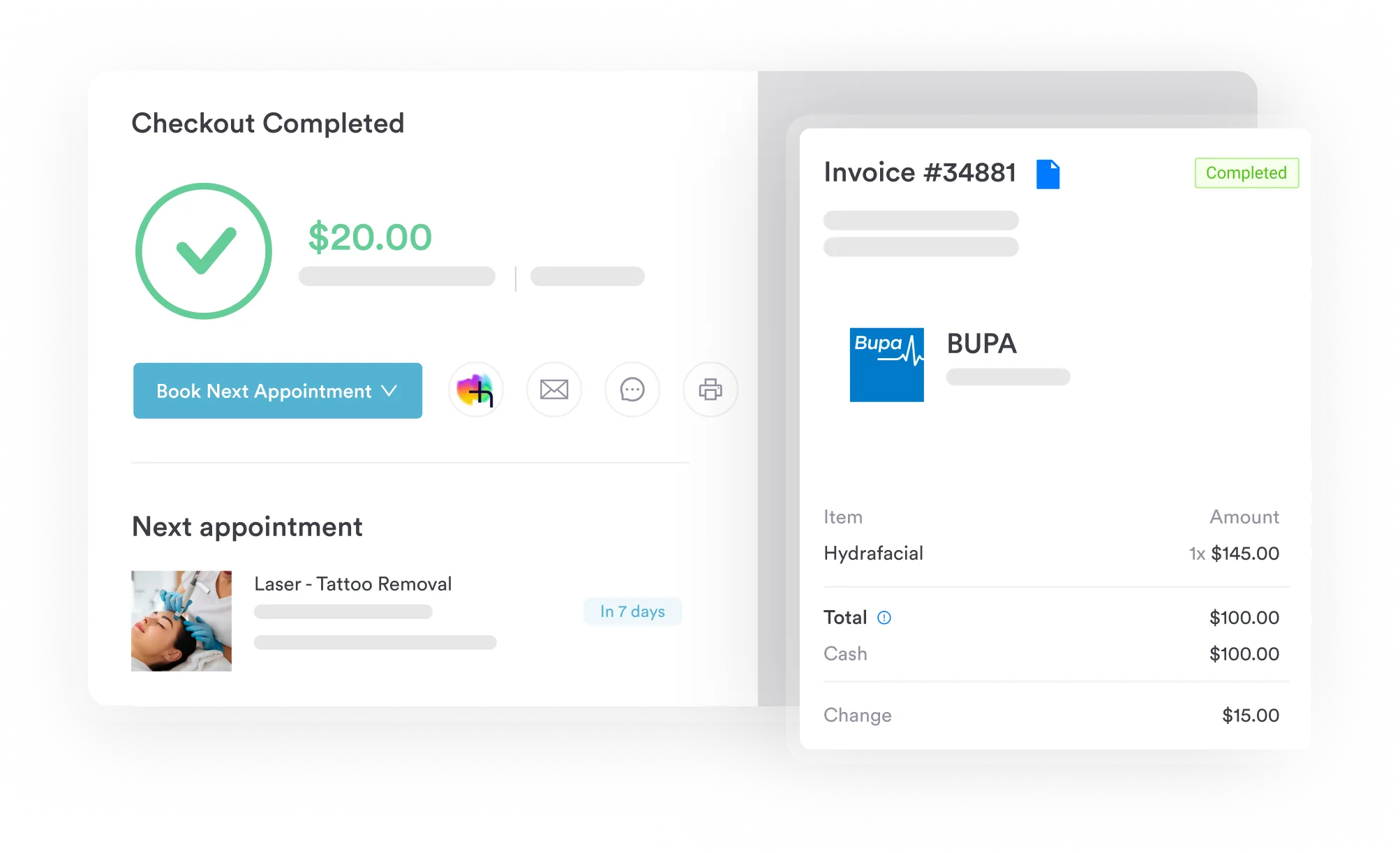

Pabau links each orthopaedic procedure note to its CCSD-coded claim and sends it to UK insurers through Healthcode and Bupa.

W2930 pays a modest fee, so one insurer query can cost more admin time than the claim is worth. The fix sits before submission. Confirm from the insertion note that the device was skeletal traction, then record device, site, laterality and anaesthetic on the day of removal.
Where removal happens inside a definitive fixation operation, expect the insurer to bundle it, and bill it separately only with their agreement. Book a demo to see how Pabau ties each removal note to the CCSD claim it supports.

Removing a fixator, pins or wires alongside a plaster change? CCSD Code W3032 covers removal of a fixator, pins or wire with a plaster change as a sole procedure.
Is the patient still in an Ilizarov frame before removal? CCSD Code W3020 explains how to code adjustments to Ilizarov frames and rings.
Checking what Bupa pays for orthopaedic procedures? The Bupa procedure codes and fee schedule guide lists fee bands and surgeon fees across CCSD codes.
Choosing software to send CCSD claims to UK insurers? Our roundup of the best medical billing software in the UK compares tools for private practices that bill Healthcode and insurers.
CCSD Code W2930 covers the removal of skeletal traction from bone. That means extracting a bone-anchored device, such as a Steinmann pin or Kirschner wire, inserted to apply traction across a fracture or joint. It does not cover skin traction removal, and external fixator removal is coded as W3030.
Skeletal traction removal (W2930) involves extracting a metal pin or wire anchored directly in bone; it requires a formal procedure and operative note. Skin traction is applied externally using adhesive strapping or foam boots with no bone penetration, and its removal does not constitute an equivalent surgical event. The two code pathways are clinically and administratively distinct.
A W2930 claim requires an operative or procedure note that records the device type and size, the anatomical site with laterality, and the anaesthetic used. It also states the indication for removal, any complications (or confirmation of none), and the operating consultant’s name and date. Missing any of these elements is a leading cause of denial by UK private insurers.
The most common reasons are an incomplete operative note and applying W2930 to an external fixator removal instead of a traction pin. Insurers also deny claims over bundling disputes, where they treat removal as part of the fracture episode. Missing pre-authorisation and dates that differ between the procedure note and the claim form complete the list.
Yes, when removal occurs at a clearly separate clinical encounter from the original fracture management episode, W2930 can typically be billed alongside the fracture code. Whether the insurer accepts this depends on its episode bundling policy. Document each encounter with a distinct date of service and a separate procedure note to support the separate billing.
W2930 covers single-pin or single-wire traction devices connected to a traction bow and weights. External fixator removal (W3030) covers multi-pin scaffold frames that require disassembly under controlled conditions, typically in a theatre setting. The two procedures differ in complexity and billing level; applying W2930 to an external fixator removal is a miscoding that payers will query or reject.
Yes. W2930 applies regardless of whether the anaesthetic used is local infiltration, sedation, or general anaesthesia. The choice of anaesthetic does not affect the billable status of the removal itself. Payers may still query a general anaesthetic claim if local anaesthetic would have been clinically standard. Document the anaesthetic type and agent in all cases.




