

CPT Code 30801: Superficial turbinate ablation billing guide
CPT Code 30801: Official descriptor and procedure overview The American Medical ...

Last Updated: Nov 27, 2026
W3020 is the CCSD code for adjustments to Ilizarov frame/rings. It covers the technical changes a surgeon makes to the frame during treatment. Examples are repositioning rings, retensioning wires or half-pins, and altering strut length.
A review with no change to the frame does not qualify. Frame application for a secondary non-union or mal-union (W3040) and frame removal (W3032) take their own codes. CCSD lists W3040 as an unacceptable combination with W3020, and AXA Health lists W3032.
Let Pabau's smart automation suggest the right codes, reduce claim denials, and keep your practice compliant—effortlessly.
Automate repetitive tasks and focus on what matters most—your patients.
Reduce coding errors and ensure compliance with the latest regulations.
Clean claims, fewer denials, and faster reimbursements.
Powerful insights and reporting to help your practice thrive.
HIPAA compliant SOC 2 certified GDPR-compliant Trusted by 4,000+ clinics worldwide

CCSD Code W3020 covers adjustments to an Ilizarov frame or its rings, not the frame application or the final removal.
Frame application for a secondary non-union or mal-union is W3040, and removal of the frame, pins or wires is W3032.
CCSD lists W3040 as an unacceptable combination with W3020, and AXA Health also lists W3032 and W9240.
Pin-site adjustments for a secondary non-union or mal-union have their own code, W3050.
Each W3020 claim needs a note that records the specific adjustment, its clinical reason and the consultant’s findings.
CCSD Code W3020 is the code for adjustments to Ilizarov frame/rings in the Clinical Coding and Schedule Development (CCSD) schedule. That schedule holds the standard procedure codes for the UK private healthcare sector, and private medical insurers (PMIs) read invoices against it. The code applies when a consultant orthopaedic surgeon makes a technical adjustment to an Ilizarov-type circular external fixator.
The work covered includes repositioning rings, adjusting wire or half-pin tension, and changing strut length or orientation. It also covers checking frame alignment against the limb and reviewing the bone regenerate under the frame. A review where the surgeon examines the patient but makes no change to the frame does not qualify.
The schedule entry does not fix the setting for the adjustment. Bupa grades W3020 as MAJOR 3, which it priced at £575 when this guide was checked. Confirm the setting, grading and fee in the CCSD schedule and in each insurer’s own code entry before you invoice.
NHS coding: The NHS codes procedures in OPCS-4, not CCSD. Clinicians who work across both sectors use W3020 on private invoices only.
An Ilizarov frame is a circular external fixator. Metal rings are joined by threaded rods and held to the bone with tensioned wires or half-pins. Soviet surgeon Gavriil Ilizarov developed it. It is now used for limb lengthening, deformity correction, complex fractures and limb reconstruction after infection or bone loss. A standard frame applied after a closed reduction of a short-bone fracture falls under W2580 instead. Applying an external fixator to bone with no fracture reduction is coded W3010.
The frame relies on distraction osteogenesis. A controlled, gradual separation of a bone cut (corticotomy) stimulates new bone to form in the gap between the bone ends.
The Taylor Spatial Frame (TSF) is a related circular fixator that uses hexapod struts and computer-planned correction of multi-plane deformities. Coders should check the current schedule edition before billing a TSF adjustment as W3020.
An adjustment visit goes further than a standard review. The surgeon assesses the regenerate on imaging and checks the pin sites. Strut lengths or ring positions are then changed to hold the prescribed distraction or compression rate. W3020 exists to capture that technical work on the frame.
Scope is where most W3020 claims go wrong. The table below sets out what falls within the code and what takes a separate code.
Pin-site care: CCSD gives pin-site adjustments for a secondary non-union or mal-union their own code, W3050. Before you add W3050 or a dressing code to a W3020 invoice, check the insurer’s code entry for combination rules.
Before billing W3020, confirm that the surgeon made a physical adjustment to the frame at the visit. If the surgeon assessed the patient and found no change was needed, the visit takes a different code. W3020 requires a documented adjustment, not an assessment that the frame is satisfactory.
The W30 codes split an Ilizarov episode into application, adjustment and removal. A single traction pin on a bow and weights is not a frame, and its removal is coded W2930. The table below names each neighbouring code and how it differs from W3020.
The sequence below shows where each code sits across one frame episode, and which ones should not appear with W3020.
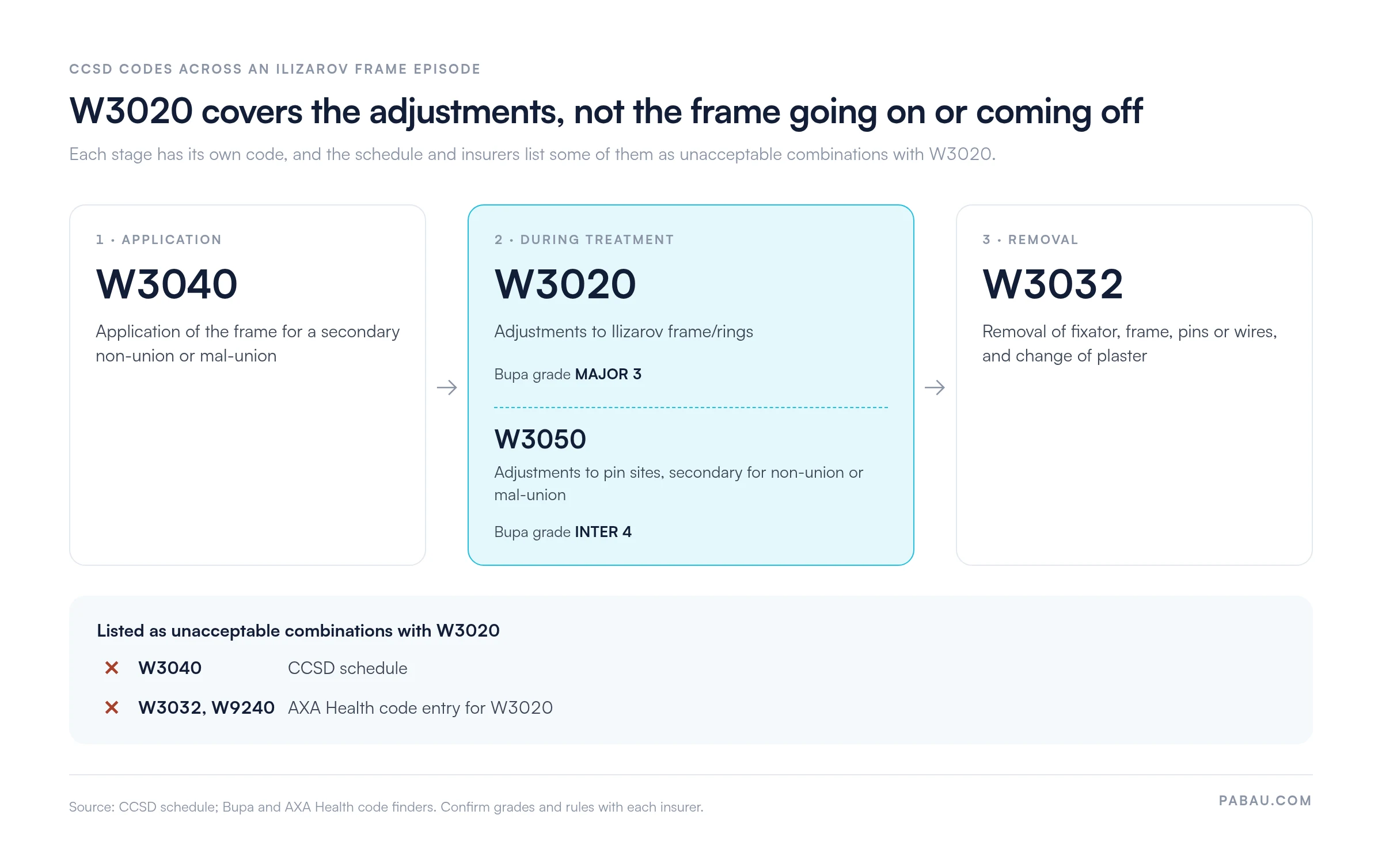
The most common error in this cluster runs both ways. Coders bill a follow-up consultation when W3020 applies, or bill W3020 for a visit with no frame intervention. The deciding question is whether a physical adjustment was made and documented. For the rest of the schedule, the CCSD codes library lists each code by chapter.
Documentation is the main audit point for W3020 claims. Insurers that review claims after payment look for evidence that an adjustment was performed, not only that the frame was assessed. A clinic letter that reads “frame looks satisfactory, continue as planned” will not support a W3020 invoice.
The clinic letter or procedure note should record each of the elements below. A structured adjustment template helps your team capture them at every visit.
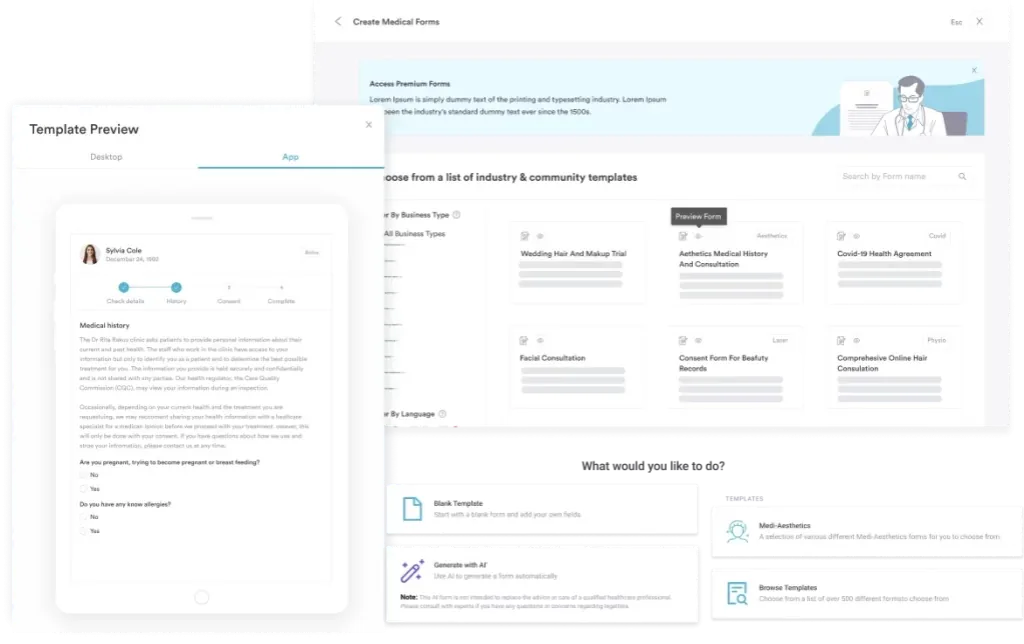
Tip: An adjustment proforma that prompts for each point above keeps notes consistent across surgeons. It also gives you a clean audit trail if an insurer queries a claim.
W3020 is typically billed per adjustment episode, as the insurer’s schedule specifies. It does not replace the frame application code, and the CCSD technical guide explains how the schedule treats combinations and narratives.
Practical billing steps for a W3020 claim:
Pabau, a practice management platform, sends UK insurer claims through Healthcode and BUPA from its claims management software. For Bupa’s own schedule and submission rules, see the Bupa CCSD codes reference.
Pre-authorisation for Ilizarov frame management is typically sought for the episode, not for each adjustment visit. When a consultant requests authorisation for a lengthening or deformity correction programme, the insurer generally covers the anticipated treatment plan.
The rules differ between insurers and change over time. The table below reflects publicly available provider guidance, so verify current requirements on each insurer’s portal before you submit.
Critical risk: Insurers may decline adjustment invoices if the authorisation covered only the operative procedure. Flag the full planned course of treatment when you request pre-authorisation. In Pabau, the authorisation code, dates and sessions sit on the patient’s case, with a warning when one is missing.
Most W3020 denials have administrative causes rather than clinical ones. These are the patterns to check before an invoice goes out.
Agree one billing routine for every Ilizarov episode. On the day of each adjustment visit, the billing team raises the W3020 invoice and confirms the pre-authorisation reference is still active. That routine closes off the late-submission and missing-authorisation denials in one step.
Sometimes, but W3040 and W3032 should not appear with it. CCSD lists W3040 as an unacceptable combination with W3020, and AXA Health’s entry for W3020 also lists W3032 and W9240. Other codes may sit alongside W3020 only when the activities are distinct and separately documented.
An Ilizarov episode spreads one authorisation across many adjustment visits, each with its own note and invoice. Many practices track that in a spreadsheet next to the clinical system, which is how a visit gets billed without a valid reference.
Pabau keeps the clinical note, the authorisation and the claim on one patient record. The authorisation code, dates and sessions are tracked on the case, with a warning when one is missing. Claims go to UK insurers through Healthcode and BUPA.
Digital forms let your surgeons record every adjustment in the same structure. The billing team then raises each W3020 invoice from a complete note, inside the insurer’s time limit.

Pabau keeps the adjustment note, the pre-authorisation and the insurer claim on one patient record. Your team gets a warning when an authorisation is missing, and sends claims through Healthcode and BUPA.

W3020 pays for the technical work between putting a frame on and taking it off. That makes the note the claim: if it does not say what changed on the frame and why, the code has nothing to stand on.
Code the episode as a set before the first visit. Note W3040 or W3032 where they apply, keep them off the same invoice as W3020, and ask for authorisation that covers the whole adjustment programme.
Book a demo to see how Pabau keeps each adjustment note, authorisation and insurer claim together for your orthopaedic patients.

Billing Bupa for a frame episode? Bupa CCSD codes covers the Bupa procedure schedule and how to submit CCSD-coded invoices to Bupa.
Coding the osteotomy behind a lengthening? CCSD Code W1080 explains how to bill an osteotomy of a long bone.
Working on a fracture fixation case? CCSD Code W1940 covers open reduction of a small bone with fixation.
Looking to streamline insurer invoicing? Claims management software from Pabau sends UK insurer claims and tracks pre-authorisation on each case.
CCSD Code W3020 covers adjustments to an Ilizarov frame or its rings. That includes repositioning rings, changing strut length or orientation, adjusting wire or half-pin tension, and reviewing frame alignment. It does not cover frame application, frame removal or a formal surgical revision under anaesthesia.
W3020 is typically billed per adjustment episode, as the insurer’s schedule specifies, against the episode pre-authorisation number. Submit the invoice within the insurer’s time limit, usually three to six months from the date of service. A clinical note must document the specific adjustment performed.
The note must record the visit date, the adjustment made (for example, strut lengthened by 2 mm), and the clinical reason for it. It also records imaging findings, pin-site status and the treating consultant’s signature. A note that says only that the frame was reviewed will not support a W3020 claim.
W3020 is accepted by Bupa, AXA Health, Vitality, WPA and other UK PMIs; verify with each insurer. Pre-authorisation is typically obtained for the whole treatment episode rather than for each adjustment visit. Rules differ between insurers and change, so check each provider portal before you submit.
The usual causes are notes that do not describe a specific adjustment and a consultation code used in place of W3020. Missing or expired pre-authorisation and late submission are common too. Another is billing W3020 with a code listed as an unacceptable combination, such as W3040 or W3032.




