

CPT Code 30801: Superficial turbinate ablation billing guide
CPT Code 30801: Official descriptor and procedure overview The American Medical ...

Last Updated: Nov 27, 2026
W2580 is the CCSD code for closed reduction of fracture of short bone with external fixator. It covers a displaced fracture of a metacarpal, metatarsal or phalanx that is realigned through intact skin and held with a percutaneous external frame.
An open reduction takes a different code, and so does a fracture held only by a cast or K-wires. Most UK private insurers require pre-authorisation before the procedure.
Let Pabau's smart automation suggest the right codes, reduce claim denials, and keep your practice compliant—effortlessly.
Automate repetitive tasks and focus on what matters most—your patients.
Reduce coding errors and ensure compliance with the latest regulations.
Clean claims, fewer denials, and faster reimbursements.
Powerful insights and reporting to help your practice thrive.
HIPAA compliant SOC 2 certified GDPR-compliant Trusted by 4,000+ clinics worldwide

CCSD Code W2580 covers closed reduction of a short-bone fracture held with an external fixator, on bones such as metacarpals, metatarsals and phalanges.
Pre-authorisation from the insurer is required by most UK private payers before the procedure is performed.
The operative note must confirm a closed approach and document the external fixator, or the claim is likely to be queried or rejected.
The external fixator device may be billed separately as an implant line, subject to insurer contract terms and a supplier invoice.
CCSD Code W2580 is the code for closed reduction of a fracture of a short bone with an external fixator. The Clinical Coding and Schedule Development (CCSD) Group maintains the schedule, and insurers print its descriptor word for word. National Friendly’s schedule of fees, for example, lists W2580 as “closed reduction of fracture of short bone with external fixator.”
The code sits within Chapter 16 of the CCSD schedule, “Bones, joints and connective tissue/tendon”, among the small-bone fracture codes in our CCSD code library.
It applies when a consultant surgeon repositions a displaced short-bone fracture by manual manipulation and confirms alignment on fluoroscopy. The bone is then held with an external fixation frame, not an internal implant or a plaster cast alone.
Two elements must both be present for W2580 to apply. The first is a closed approach, with no skin incision to reach the bone directly. The second is an external fixator, a rigid frame attached through percutaneous pins or wires that holds the reduction.
If only one element is present, a different code applies. A fracture opened through the skin to reduce it is an open reduction and is coded as one. Applying a frame without reducing a fracture is W3010, application of external fixation to bone.
The procedure covered by W2580 follows a defined clinical sequence. Understanding each step helps coders verify that the operative note supports the code before submission.
Surgeons choose external fixation over casting in three situations:
It is also used for contaminated wounds, or for open fractures that have been debrided and are being managed in stages. Bone drainage, debridement and sequestrectomy are reported separately, under CCSD code W1800.
W2580 applies to the short bones of the hand and foot: metacarpals, metatarsals and phalanges, plus selected carpal and tarsal bones. The descriptor says “short bone”, and CCSD files the code with its other small-bone fracture codes. The table below lists the bones in scope and where W2580 is typically applied.
Metacarpal and phalangeal fractures of the hand are the typical W2580 cases, especially in hand-surgery units, followed by metatarsal fractures. A fracture of a long bone such as the radius, ulna, tibia or fibula takes a long-bone code instead. That is W2500 with an external fixator, or W2502 with a cast or K-wires.
If it is unclear whether the bone counts as a short bone, name it in the operative note rather than relying on the descriptor. The scaphoid, for example, has its own fixation codes. Open fixation of an established scaphoid non-union with cancellous graft is CCSD code W3200, not W2580. Where the surgeon reconstructs the scaphoid with a wedge bone graft instead, the code is CCSD code W3202.
Document the specific bone name and laterality (left or right) in every CCSD Code W2580 operative note. ‘Short bone’ in the code descriptor is a billing category, not sufficient clinical documentation. Payers audit bone specificity, and a note that says only ‘short bone fracture reduced’ without naming the bone is common grounds for query or rejection.
Several W-series codes cover overlapping clinical scenarios, and picking the wrong one is a frequent source of upcoding and downcoding on fracture claims. The table below contrasts W2580 with the codes most often confused with it.
Read as a decision, the six codes turn on two questions: which bone was treated, and what holds the reduction. The grid below sets them out side by side.
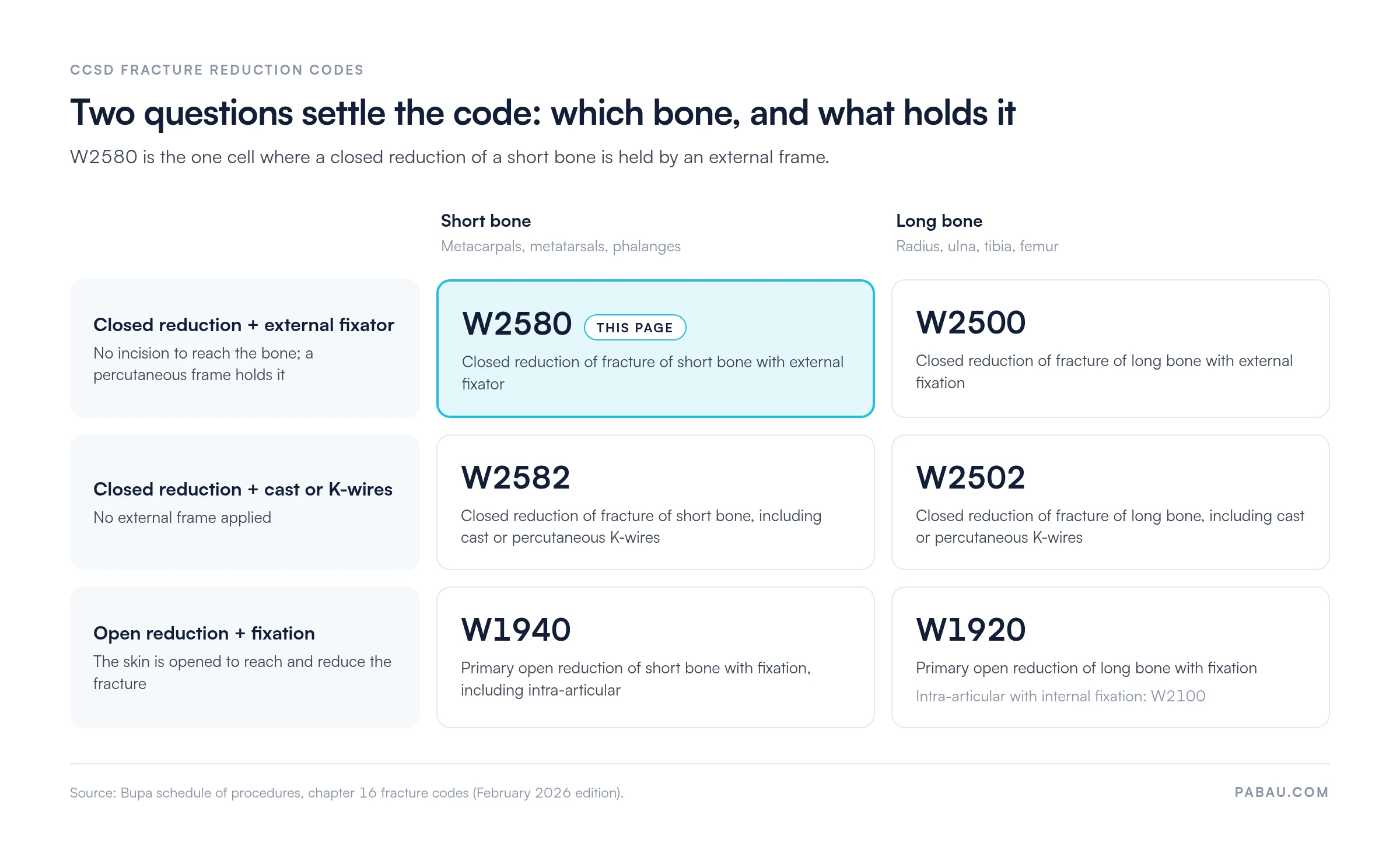
Two miscoding errors come up on short-bone fractures, and they run in opposite directions. Reporting W1940 when the reduction was closed and held by a frame inflates the claim and invites a payer audit.
Reporting W2582 when a frame was applied is the second error, and the reverse happens too: K-wires with no connecting frame belong under W2582. Bupa and National Friendly both band W2580 and W2582 as intermediate procedures, so the slip rarely changes the fee.
It still draws a query, because the note and the code disagree. Check the operative note against the code before submission. A pin placed only to hold skeletal traction on a bow and weights fits neither W2580 nor W2582, and its removal is coded W2930.
A W2580 claim needs specific documentation before the payer will process it, and a missing element is a common reason for first-pass rejection. Practice managers can build the list below into the billing workflow as a checklist, rather than relying on review after the claim is sent.
UK insurers code diagnoses with WHO ICD-10, and its S-codes for injuries are the pairing cluster for W2580. The table below shows the codes most often paired with it. Check each code against the insurer’s current list, as some ask for the optional fifth character that marks a fracture as closed or open.
A long-bone fracture code paired with W2580 draws a rejection, because the diagnosis and the procedure describe different bones. Make sure the diagnosis code reflects the bone named in the operative note.
UK private insurers that use the CCSD schedule each keep their own provider manuals, pre-authorisation thresholds and documentation rules. The guidance below reflects general industry practice.
Check the current provider manual for each insurer, as terms change every year. For Bupa’s own coding rules, see our Bupa CCSD billing guide.
One area of variation is the external fixator device itself. Some insurers pay for the frame within the procedure fee. Others treat it as a pass-through implant, billed separately with a supplier invoice. Confirm the position with each insurer before the procedure, as it changes the invoice, not the CCSD code.
W2580 denials tend to trace back to the same handful of causes. Fixing them at submission costs less work than an appeal. Build a pre-submission check into the billing workflow that flags missing fields before the claim goes out.
When a claim is denied, ask the insurer for the denial reason code in writing. Support the appeal with the operative note, the original pre-authorisation confirmation, and a covering letter from the consultant surgeon explaining the clinical decision. Keep the appeal correspondence on the patient record, so it is to hand if the payer asks for a review.
The external fixator device is a distinct billable item in many UK private insurer contracts, but the rules differ by payer. Getting it right decides whether the frame is paid for at all.
Insurers that allow pass-through billing require a supplier invoice showing the cost of the fixator frame, pins and other components. The claim line is typically the invoice cost with no mark-up, though each insurer sets its own cost-plus or cost-only policy.
Some insurers also set a device-cost threshold above which they ask for clinical justification. Confirm the threshold before the procedure, not at the billing stage.
Insurers that bundle the device into the procedure fee will not pay a separate device line regardless of the invoice value. If your contract with the insurer bundles the fixator, your W2580 fee already includes the hardware. Submitting a separate device line in this scenario is an overbilling error that generates queries and delays payment on the entire invoice.
Fracture management under W2580 often involves follow-up episodes that are billed separately. Removing the frame is its own procedure, which Bupa’s schedule lists as W3030, removal of external fixation from bone.
Internal plates and screws come out under W2830 instead. Document it as a separate operative episode, with a note confirming the frame was removed and the fracture site assessed.
Fracture clinic follow-up appointments are billed as outpatient consultations under the relevant CCSD consultation code, not under W2580. Physiotherapy after fixator removal is usually covered under the policy’s rehabilitation benefits and sits outside the W2580 episode.
CCSD has no global period like the CMS global days attached to CPT codes. Each clinical contact is billable as a separate episode, subject to the insurer’s policy terms. Track every episode at the point of booking, so the removal and follow-ups each reach an invoice.
Add fixator removal as a separate appointment type in your scheduling system, flagged for billing review. It is coded as W3030 in Bupa’s schedule and billed as a new episode with its own operative note. On a manual list, the removal is often booked informally and never raises an invoice.
The denial causes above share a pattern. The operative note, the authorisation number and the supplier invoice each exist, but they sit in three places, and the claim is assembled from memory.
Pabau’s claims management software keeps those pieces on one patient record. The insurer’s authorisation code, dates and sessions are tracked on the case, with a warning when one is missing. Claims go out electronically through Healthcode and Bupa.
The result is a W2580 invoice that carries its own evidence. When AXA Health or Vitality queries the claim, the answer is already on the record.

Pabau tracks pre-authorisation codes on the case, keeps the operative note on the patient record and sends claims through Healthcode and Bupa. Each W2580 invoice goes out with its evidence attached.

W2580 is a narrow code, which makes it easy to defend. Three facts in the operative note decide it: a closed reduction, a short bone and an external frame. Change any one of them and the code changes too.
Payment depends on what surrounds the code. A pre-authorisation number on file, a supplier invoice for the frame and a separate W3030 booking for removal turn the procedure into a paid episode. Book a demo to see how Pabau keeps the note, the authorisation and the claim on one patient record.

Comparing billing tools for a UK private practice? Best medical billing software in the UK compares the platforms practices use to code, invoice and chase private insurer claims.
Coding another fracture reduced without an incision? CCSD code V0930 covers closed reduction of a zygomatic complex fracture.
Billing an external fixator for a US-insured patient? CPT code 20690 covers application of a uniplane, unilateral external fixation system.
Need the US code for pinning a metacarpal fracture? CPT code 26608 covers percutaneous skeletal fixation of a metacarpal fracture, per bone.
CCSD Code W2580 is the code for closed reduction of a fracture of a short bone with an external fixator. It covers manipulation under anaesthesia and stabilisation with a percutaneous frame, on bones such as metacarpals, metatarsals and phalanges. It does not cover a fracture reached through a skin incision, or one held with an internal device such as a plate or screw.
W2580 requires a closed approach, with the bone manipulated through intact skin and no incision to reach the fracture site. Open reduction codes apply when the surgeon makes an incision to see and reposition the bone directly, such as W1940 for a short bone. Using an open reduction code for a closed technique is upcoding, and it can lead to claim rejection and audit.
A valid claim needs a pre-operative imaging report and an operative note confirming the closed approach and the external fixator. The note also names the side and the bone treated. Add the anaesthesia record if it is billed separately, the pre-authorisation reference number, and a matching ICD-10 fracture code. Where the fixator is billed as a separate device line, a supplier invoice is required too.
The leading denial triggers are an operative note that does not state the closed approach and external fixator, and missing pre-authorisation. A mismatched ICD-10 code, such as a long-bone fracture code, causes rejections too, as does undocumented laterality. So does a fixator billed as a separate line without a supplier invoice. Claims submitted after the insurer’s deadline are rejected regardless of documentation quality.
Yes. The anaesthetic episode is billed separately under the relevant CCSD anaesthesia code, with the anaesthetist submitting their own claim. Post-operative fracture clinic follow-up is billed as an outpatient consultation, not under W2580. Fixator removal is billed as a distinct episode, which Bupa’s schedule lists as W3030. Physiotherapy after removal is usually covered under rehabilitation benefits and is submitted separately by the treating physiotherapist.
Yes. Bupa, AXA Health, Aviva, Vitality Health and WPA all reimburse W2580 under the CCSD schedule, subject to the patient’s policy terms and coverage limits. Pre-authorisation must be obtained before the procedure in all cases. Cover for the external fixator as a separate implant cost varies by insurer and policy, so confirm the device billing approach before proceeding.




