

CPT Code 30801: Superficial turbinate ablation billing guide
CPT Code 30801: Official descriptor and procedure overview The American Medical ...

Last Updated: Nov 27, 2026
W3032 is the CCSD code for removal of fixator/frame/pins/wires and change of plaster. It applies only when external fixation hardware is removed and the plaster is changed in the same episode of care.
If either component is missing, W3032 does not fit, so confirm the correct code in the licensed CCSD schedule. CCSD's coding principles list W3530, the percutaneous wire removal code, with W3032 as an unacceptable combination. Each insurer decides whether to apply that rule.
Let Pabau's smart automation suggest the right codes, reduce claim denials, and keep your practice compliant—effortlessly.
Automate repetitive tasks and focus on what matters most—your patients.
Reduce coding errors and ensure compliance with the latest regulations.
Clean claims, fewer denials, and faster reimbursements.
Powerful insights and reporting to help your practice thrive.
HIPAA compliant SOC 2 certified GDPR-compliant Trusted by 4,000+ clinics worldwide

CCSD Code W3032 covers removal of a fixator, frame, pins or wires together with a change of plaster in the same episode.
If the plaster is not changed, or no hardware comes out, W3032 does not fit, so confirm the right code in the licensed CCSD schedule.
CCSD’s coding principles list W3530, the percutaneous wire removal code, with W3032 as an unacceptable combination, and each insurer decides whether to apply it.
Vague operative notes and missing pre-authorisation references are the most avoidable causes of W3032 rejections by UK private insurers.
Pabau, a practice management platform, keeps the procedure note, pre-authorisation reference and W3032 claim on one patient record, then sends the claim through Healthcode.
CCSD Code W3032 is the Clinical Coding and Schedule Development code for removal of fixator/frame/pins/wires and change of plaster. The CCSD Schedule sets the standard procedure codes for UK private healthcare, and private insurers use them to identify each claimed procedure. W3032 applies when a consultant removes external fixation hardware and changes the plaster in one episode of care.
Both halves of the descriptor have to happen. Removing a frame without applying a new plaster does not meet it. Neither does changing a plaster with the wires left in place. Read the operative note against the descriptor before you select W3032.
The descriptor uses four umbrella terms: fixator, frame, pins and wires. Between them they cover the external fixation hardware most UK private orthopaedic practices remove. Fitting that hardware in the first place is a separate claim under code W3010. Adjusting an Ilizarov frame or its rings while it stays on is a separate claim too, coded W3020. Internal plates, nails and screws are a different claim, coded W2830. The table maps each device to its usual clinical scenario. Screws inserted under code W1912 to pin the femoral head are internal hardware, so they follow the W2830 route too. Removing skeletal traction from bone, such as a traction pin, is a separate claim again, coded W2930.
Whatever the device, W3032 still needs a plaster change in the same episode. Where removal is unusually complex, such as buried olive wires that need separate incisions, check the licensed CCSD schedule before billing W3032 alone. The original fixation was coded separately at the time, for example as W1940 when a small bone was openly reduced and fixed. A closed reduction of a short bone held with an external fixator was billed as code W2580 instead.
Picking the wrong code is an avoidable cause of W3032 rejections. The full CCSD schedule sits behind a login, so this guide names only codes whose role can be confirmed from CCSD’s own records. The CCSD code library covers other procedures in the schedule.
Two common episodes fall outside W3032. In the first, wires come out and no new plaster goes on, so the plaster component is missing. W3530 may fit that episode, but confirm it in the licensed schedule first.
In the second, a frame or fixator comes out with no new plaster. W3032 does not apply, and this guide does not name a replacement code. Look the episode up in the current schedule, because CCSD revises codes in regular publication cycles. The grid below sets the four combinations of hardware and plaster side by side.
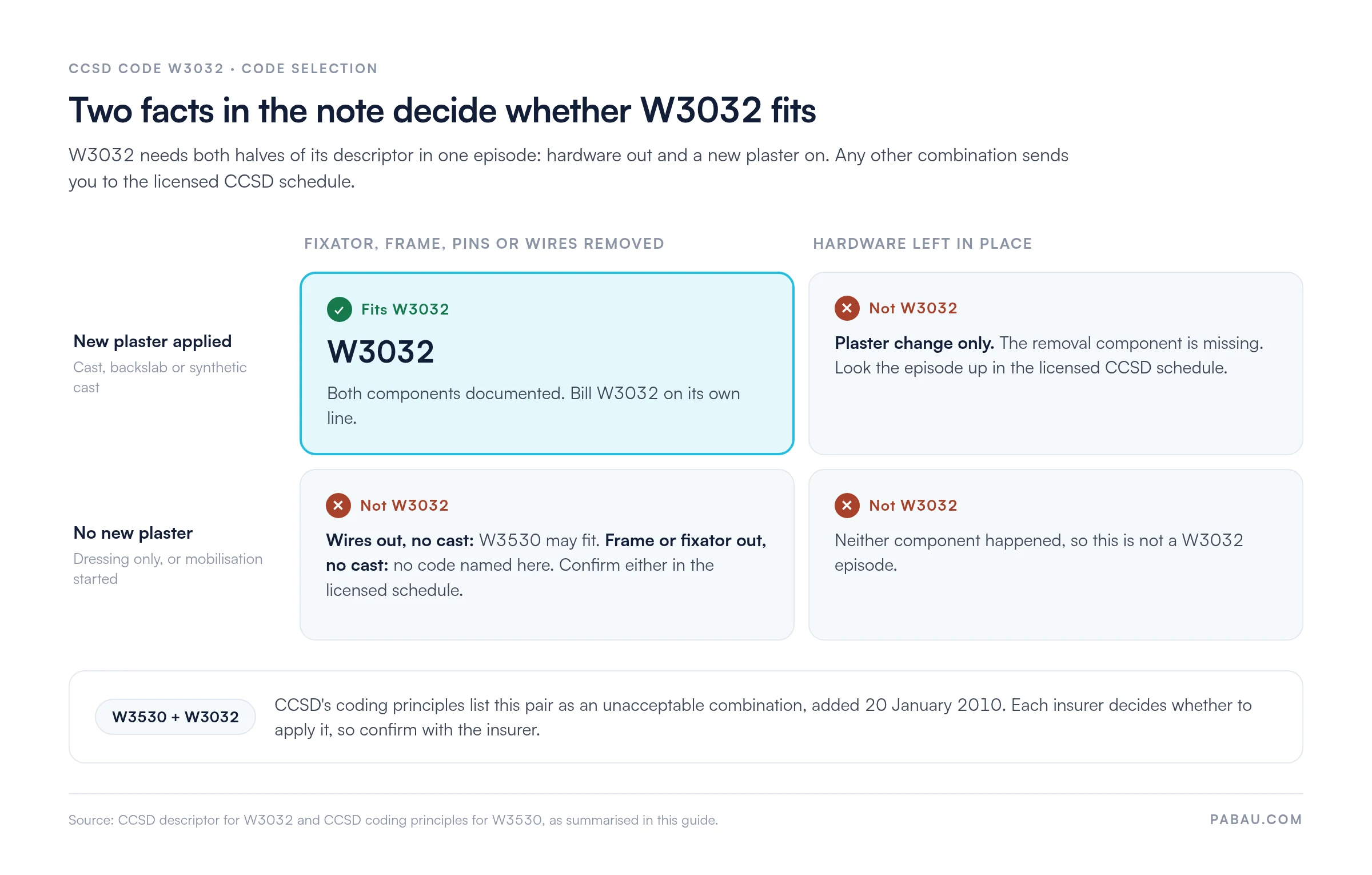
Read the note for two facts before you code: what hardware came out, and whether a new plaster went on. Both present means W3032, and CCSD’s coding principles keep W3530 off the claim. If only one is documented, look the episode up in the licensed CCSD schedule rather than guessing a neighbouring code.
A W3032 claim stands or falls on the operative or procedure note. UK private insurers expect specific clinical detail before they process payment. Generic entries such as K-wire removed, cast applied often trigger requests for more information and slow down payment.
A complete note records the following elements.
Build a structured procedure note template for W3032 episodes with digital clinical forms. Required fields stop a note reaching the billing team without the device, the side or the new cast.
Pre-authorisation rules for W3032 vary by insurer and by the patient’s policy. The table gives general direction only. Check current requirements with each insurer, because policies change.
Enter the pre-authorisation reference in its own field on the Healthcode claim. A missing reference is a frequent reason for a claim to stall, whichever insurer receives it.
A clean W3032 claim follows the same workflow from procedure to payment. Each step below belongs to either the consultant or the billing coordinator.
A separate anaesthesia claim may apply when general anaesthesia or sedation is used, subject to insurer policy. For Ilizarov or Taylor Spatial Frame removal under general or spinal anaesthesia, check the insurer’s rules. Some insurers expect the anaesthetist to submit their own claim.
Local anaesthetic given by the operating consultant, the usual case for K-wire removal, is rarely claimed separately. Confirm the insurer’s current policy before you submit. An anaesthesia line the insurer does not accept can hold up the whole claim.
Each cause below can be caught before the claim leaves the practice. The table pairs each one with its fix.
Unbundling means splitting one procedure into separate codes. On W3032 the classic case is a wire removal line, W3530, added next to W3032 for the same episode. CCSD’s coding principles have listed that pair as an unacceptable combination since 20 January 2010. The principles are guidance, and each insurer decides whether to apply them.
Insurers apply bundling rules when they validate claims, and fee schedules such as the Healix fee schedule publish their own. An insurer that applies the rule is likely to reject a claim carrying both codes, or cut it back to a single line.
Upcoding means choosing a code that implies more work than the note documents. If the note describes a straightforward K-wire removal with a cast change, W3032 is the code. Claiming more complexity without evidence is a compliance risk and can prompt an insurer audit.
These vignettes show how the W3032 rules work in practice. Where W3032 does not apply, the answer is to confirm the code in the licensed schedule, not to guess.
A wound dressing is not a plaster. If post-removal management is a dressing only, with no cast or backslab, the plaster component of W3032 is not met. Record that management moved to soft dressings, then find the correct code in the licensed CCSD schedule.
Orthopaedic aftercare billing involves several hand-offs. The consultant performs the procedure and writes the note. The billing coordinator codes from that note, and the claim travels through Healthcode to the insurer. Each hand-off is a point where detail can be lost.
Pabau keeps those hand-offs on one patient record. Its Healthcode-ready claims management sends the W3032 claim from the record that already holds the procedure note. The pre-authorisation reference is tracked on the case, ready at submission.
Claim status tracking shows which W3032 claims are still unpaid. A rejected claim is corrected and resubmitted before the insurer’s time limit runs out. That matters in a practice with several consultants, where frame removals often follow weeks after the original fracture. It is also a fair test when you compare UK medical billing software.

Pabau’s claims management and Healthcode submission, with digital forms for the procedure note, help orthopaedic teams send complete W3032 claims and avoid preventable rejections.

W3032 rewards one habit: code from the note, not from memory. When hardware comes out and a new plaster goes on, the claim is W3032 on its own. When one half is missing, the answer sits in the licensed CCSD schedule, not in a guessed neighbouring code.
The rest is discipline at the desk. Check whether the insurer applies CCSD’s W3530 rule, and quote the pre-authorisation reference. Send a note that names the device, the side and the new cast. Book a demo to see how Pabau keeps W3032 claims complete from procedure note to Healthcode submission.

Need a broader CCSD billing reference for Bupa submissions? Bupa CCSD codes guide covers the full Bupa procedure code schedule and submission requirements.
Coding the fixation that came before the removal? CCSD code W1940 covers open reduction of a small bone with fixation.
Looking up a different procedure? The CCSD code library collects Pabau’s guides to individual CCSD codes.
Choosing a system for UK insurer billing? Best medical billing software in the UK compares the options for private practices.
CCSD Code W3032 covers removal of an external fixator, frame, pins or wires together with a change of plaster, in one episode of care. Both components must be documented. If only one is performed, W3032 does not apply, so confirm the correct code in the licensed CCSD schedule.
Usually not. W3530 is the CCSD code for percutaneous wire removal, and CCSD’s coding principles list it as an unacceptable combination with W3032, dated 20 January 2010. The principles are guidance, and each insurer decides whether to apply them. Confirm with the insurer, and bill W3032 alone where the rule applies.
Only when a plaster change happens in the same appointment. Kirschner wire removal with a new cast meets both parts of the W3032 descriptor. Wire removal with no new plaster does not. W3530, the percutaneous wire removal code, may fit that episode, but confirm it in the licensed CCSD schedule first.
The operative or procedure note should name each device removed, with size and quantity, and record laterality and the clinical indication. It should also note the anaesthetic used, the wound inspection findings and the new plaster applied. A missing element is a common reason for an insurer query.
A separate anaesthesia claim may apply when general anaesthesia or sedation is used, subject to the insurer’s policy. Some insurers expect the anaesthetist to claim directly. Local anaesthetic given by the operating consultant is rarely claimed separately. Confirm the current policy with each insurer before submitting.
The usual causes are an incomplete operative note, a missing pre-authorisation reference and a claim where no new plaster was applied. W3530 billed beside W3032 and late submission are the other two. Checking each claim against those five points before submission prevents most avoidable rejections.




