

CPT Code 30801: Superficial turbinate ablation billing guide
CPT Code 30801: Official descriptor and procedure overview The American Medical ...

Last Updated: Nov 27, 2026
W1800 is the CCSD code for drainage/debridement of bone(s), including sequestrectomy for osteomyelitis. UK private medical insurers use it to authorise and pay the surgeon's fee for clearing infected bone in one operation. It covers the incision, drainage, debridement of dead bone, sequestrum removal, intraoperative cultures and wound closure.
Implant removal, flap closure and the anaesthetist's fee are coded separately. Insurers expect imaging and microbiology confirming osteomyelitis, an M86 ICD-10 diagnosis and pre-authorisation before surgery.
Let Pabau's smart automation suggest the right codes, reduce claim denials, and keep your practice compliant—effortlessly.
Automate repetitive tasks and focus on what matters most—your patients.
Reduce coding errors and ensure compliance with the latest regulations.
Clean claims, fewer denials, and faster reimbursements.
Powerful insights and reporting to help your practice thrive.
HIPAA compliant SOC 2 certified GDPR-compliant Trusted by 4,000+ clinics worldwide

CCSD Code W1800 covers surgical drainage, debridement and sequestrectomy for osteomyelitis as one billable episode, so the three steps are never coded separately.
Insurers expect imaging plus microbiology confirming osteomyelitis before they authorise W1800. Clinical suspicion alone does not meet that standard.
Missing pre-authorisation and an ICD-10 diagnosis outside the M86 series are the two most common reasons W1800 claims are denied.
Implant removal (W2830), local flap closure (S2500) and the anaesthetist’s fee sit outside W1800 and are coded separately, subject to insurer policy.
Pabau, a practice management platform, sends UK claims through Healthcode and Bupa and tracks each pre-authorisation code on the patient’s case.
CCSD Code W1800 is the Classification of Surgical Operations and Procedures code for drainage and debridement of bone, including sequestrectomy for osteomyelitis.
UK private medical insurers (PMI) use it to authorise and pay for surgery that clears infected bone. The code set is maintained by the insurer-led CCSD Group, whose members are Bupa, Vitality, AXA Health and Aviva.
The official descriptor, quoted verbatim from the schedule, is “Drainage/debridement of bone(s) (including sequestrectomy for osteomyelitis).” W1800 sits in Chapter 16 of the schedule, which covers bones, joints and connective tissue, and Bupa bands it as INTER 5. One code covers the whole operative episode, from incision and drainage through sequestrectomy to wound closure.
Payers treat W1800 as an inclusive code for clearing the bone infection, and that shapes how companion procedures are billed. Soft tissue debridement done to reach the infected bone is included. Implant removal, antibiotic cement insertion and flap closure fall outside that scope. Infected bone at the petrous apex, deep in the temporal bone, has its own drainage code, CCSD W1870.
They may carry separate CCSD codes, depending on insurer policy and operative complexity. An external fixator removed with a change of plaster in the same episode, for example, is billed separately under code W3032. A later Ilizarov frame for a resulting secondary non-union is a separate operation, coded W3040 Ilizarov frame.
Osteomyelitis is a bacterial, or less commonly fungal, infection of bone. It can arise through the bloodstream, by spread from an adjacent soft-tissue infection, or by direct inoculation after trauma or surgery.
Surgery becomes necessary when antibiotics fail to clear the infection, or when a sequestrum has formed. A sequestrum is a fragment of avascular, necrotic bone that has separated from the viable cortex. It harbours bacteria within a biofilm that antibiotics cannot penetrate, so operative removal is essential for cure.
The surgical steps that W1800 encompasses typically follow this sequence:
The extent of debridement and sequestrectomy varies by case. Chronic osteomyelitis with an established involucrum and multiple sequestra requires more extensive bone excision than acute haematogenous osteomyelitis presenting early. Operative notes must reflect this variation to support the W1800 claim.
W1800 is typically indicated when osteomyelitis has been confirmed by imaging and microbiological evidence, and when one or more of the following conditions is present:
The table below clarifies what is bundled within W1800 and what requires a separate CCSD code.
Whether antibiotic cement insertion or implant removal in the same operative episode attracts an additional code depends on individual insurer contracts. Verify with the specific insurer before billing additional codes alongside W1800. Insurers can treat improper unbundling or upcoding as fraud.
W1800 sits within the W-series of CCSD codes, which covers orthopaedic procedures. The table below lists the codes most often met alongside W1800, plus the closest OPCS-4 codes for coders working across NHS and private settings.
No official one-to-one CCSD-to-OPCS-4 crosswalk is published. The OPCS-4 codes below are the closest equivalents, not certified mappings. Confirm current code definitions using the NHS Classifications Browser.
After missing pre-authorisation, thin documentation is the most common reason a W1800 claim fails. An operative note without specifics on the nature and extent of bone debridement gives the insurer grounds to downcode or reject the claim. The operative note and claim submission for CCSD Code W1800 must include the following elements.
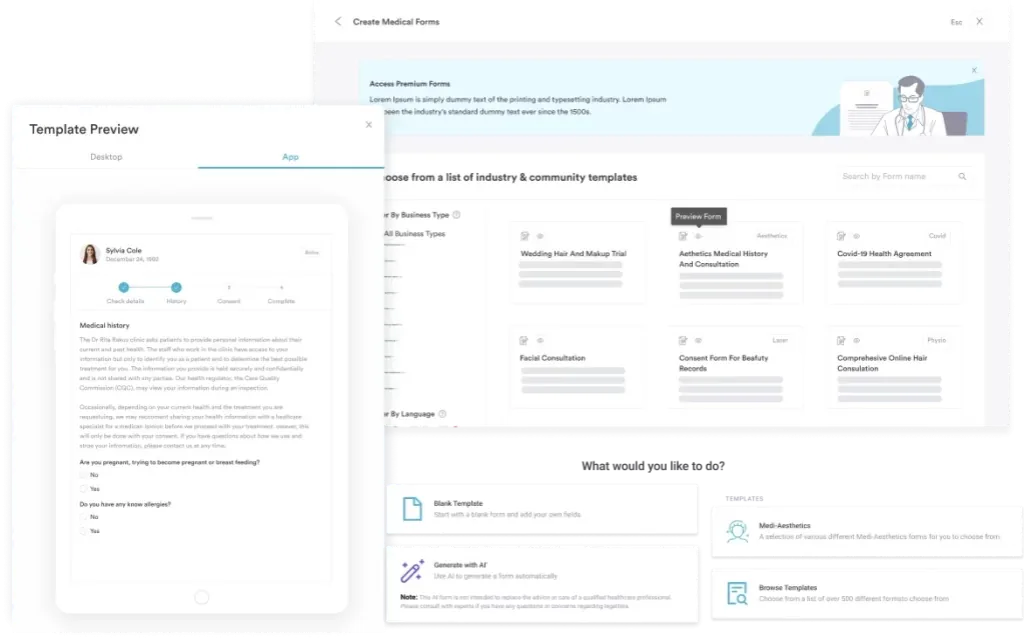
Structured digital forms make it harder to leave one of these elements out. Practice software such as Pabau lets a practice build treatment-specific forms from a blank template or a template library. The form for osteomyelitis surgery can then prompt for each item above.
UK private insurers require a WHO ICD-10 diagnosis code on every claim. For W1800, this must fall within the M86 series. A code outside this range, such as a soft-tissue infection code from L00-L08, will trigger an automatic mismatch denial.
All major UK private medical insurers require pre-authorisation before W1800 can be performed as an elective or planned procedure. Emergency or urgent procedures may be authorised retrospectively, but the insurer needs prompt notification, typically within 24 to 48 hours of surgery. Requirements vary by insurer, so verify current rules with the payer before submitting a pre-auth request.
The Bupa CCSD codes resource outlines Bupa’s authorisation framework. Generally, Bupa, AXA Health, Vitality, and Aviva require the following for a W1800 pre-authorisation request:
Pre-authorisation numbers must appear on all claim documentation submitted after surgery. A claim without an authorisation reference will be rejected, even for a clinically straightforward W1800, and will need a formal appeal.
Most W1800 denials trace back to avoidable submission errors, while disputed medical necessity is rarer. Each of the five checkpoints below closes off one of those errors before the claim leaves the practice.
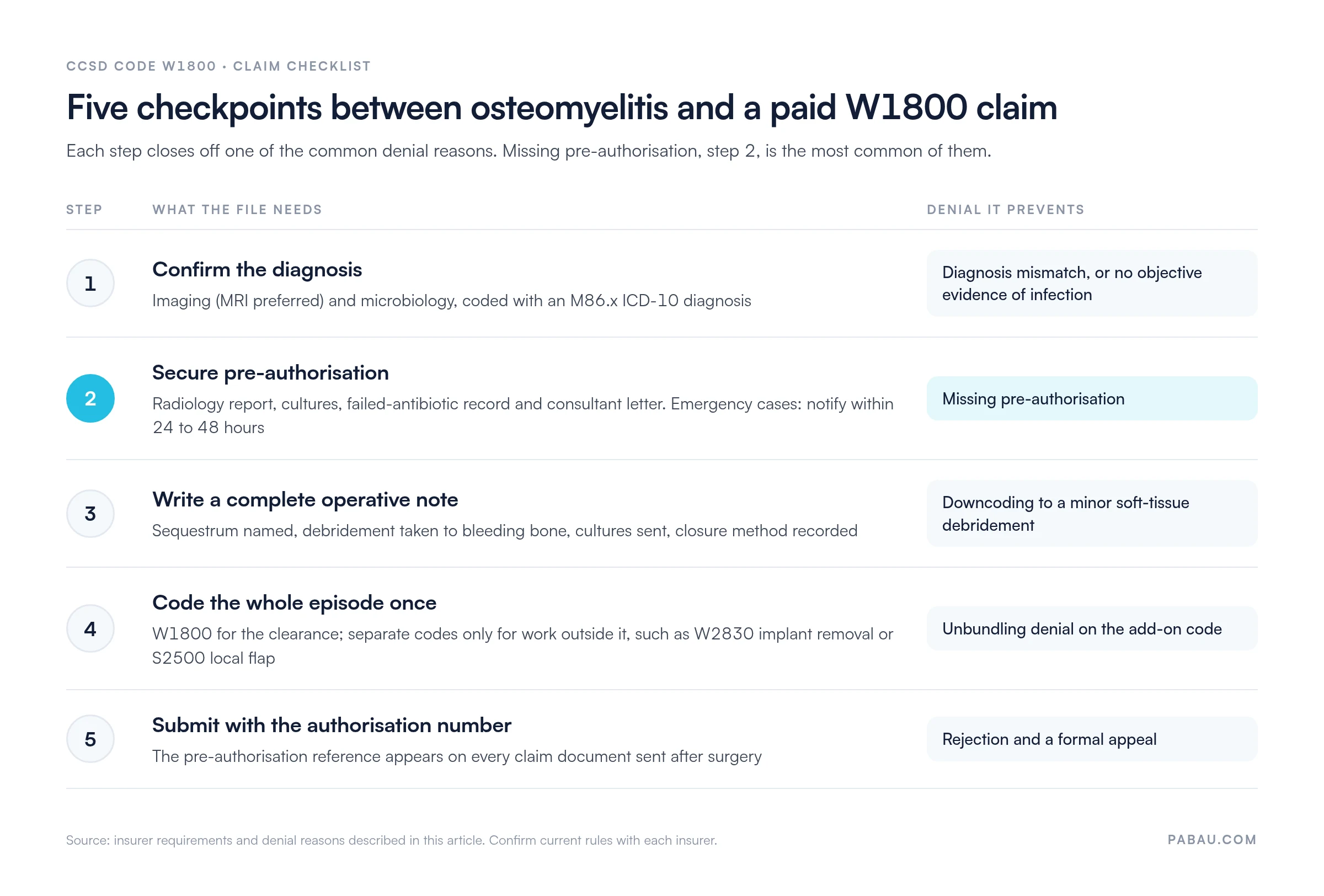
The five most common denial reasons, and the remedy for each, are listed below.
Before submitting a W1800 claim, check three things in the operative note. It names the sequestrum, states that debridement reached bleeding bone, and records that cultures were taken. These three elements resolve the majority of initial denials without a formal appeal.
W1800 covers the surgeon’s operative fee. The anaesthetist bills separately under their own CCSD anaesthetic codes, calculated on time-based or procedure-based rates depending on the insurer’s fee schedule. These are not included in W1800 and do not constitute unbundling when billed concurrently.
Beyond anaesthesia, two additional procedure categories frequently arise in the same operative episode as W1800.
Infected implant removal: An intramedullary nail, plate or other fixation device is sometimes removed in the same procedure because it drives the osteomyelitis. That removal may attract a separate CCSD code, such as W2830. Revising an infected hip replacement is a separate operation with its own codes, set out in our guide to hip revision code W3740.
Whether the insurer pays both W1800 and an implant removal code depends on its policy and the operative complexity documented. Some payers treat implant removal as integral to the bone debridement episode; others accept it as an additional procedure. Submit with a detailed operative note explaining why implant removal was necessary and distinct from the debridement itself.
Antibiotic-loaded cement or bead chains: Insertion of antibiotic-loaded calcium sulphate, polymethylmethacrylate cement, or bead chains as local antibiotic delivery following debridement varies by practice.
Whether this is separately reimbursable or considered bundled with W1800 is not standardised across UK PMI providers. Some insurers reimburse the implant cost as a supply item under a separate drug or implant line. Others consider it included in the surgical fee.
Verify with the specific insurer before billing this separately. Never bill it as a separate surgical procedure code without explicit insurer guidance, as this risks an upcoding allegation.
A W1800 claim usually passes through three people: the surgeon writing the operative note, the secretary chasing pre-authorisation and the biller submitting to the insurer. When each works in a different system, the authorisation number or a culture result can drop out before the claim goes in.
Pabau keeps those steps on one patient record. Its private practice claims management sends claims electronically to UK insurers through Healthcode and Bupa. The pre-authorisation code, its dates and the authorised sessions sit on the patient’s case, and Pabau warns the team when one is missing.
Treatment-specific digital forms handle the documentation side. An osteomyelitis surgery form can prompt for the sequestrum, the extent of debridement and the cultures sent. The note then answers the insurer’s likely questions before the claim is submitted.

Pabau sends UK claims through Healthcode and Bupa and tracks each pre-authorisation code on the case. W1800 claims go out with the reference attached.

W1800 is an easy code to choose and a demanding one to get paid. When a surgeon clears infected bone, the code itself is rarely in doubt. Payment depends on whether the file proves osteomyelitis, the note proves the sequestrectomy, and the insurer agreed to the surgery first.
If your practice treats bone infection regularly, build those three proofs in at the booking stage. Request imaging and cultures when surgery is first discussed, and open the pre-authorisation the same day. The case may start a little later, but each step done early is one appeal the billing team never has to write.
Book a demo to see how Pabau keeps operative notes, pre-authorisation codes and Healthcode claims together for UK private practices.

Closing the wound with a local flap? CCSD code S2500 covers local flap closure of less than 9cm² and when insurers accept it as a separate code.
CCSD Code W1800 covers the drainage and debridement of bone, including sequestrectomy for osteomyelitis, as a single billable procedure code. It includes incision, drainage of purulent material, removal of devitalised bone and sequestra, intraoperative cultures, and wound closure. Implant removal, antibiotic cement insertion and flap closure are outside its scope and may need separate codes, depending on insurer policy.
A sequestrectomy is the surgical removal of a sequestrum, a fragment of avascular, necrotic bone that has separated from the viable cortex because of osteomyelitis. It is billed under W1800, not as a separate code, whenever sequestra are removed during bone drainage and debridement for osteomyelitis. That holds whether the removal is a standalone step or part of wider debridement of the infected bone.
The closest OPCS-4 codes are W18 (Drainage of bone), specifically W18.3 (Sequestrectomy of bone), and W33.6 (Debridement of bone NEC). No official one-to-one CCSD-to-OPCS-4 crosswalk exists, so treat these as the nearest equivalents rather than certified mappings. Use the NHS Classifications Browser to confirm current OPCS-4 definitions when cross-referencing with Hospital Episode Statistics data.
Yes. W1800 applies to surgical drainage and debridement of bone for osteomyelitis whether the infection is acute, subacute or chronic. The paired ICD-10 diagnosis code from the M86 series tells the insurer which type it is. For example, M86.0 is acute haematogenous osteomyelitis and M86.4 is chronic osteomyelitis with a draining sinus. The clinical indication and operative findings decide the right M86.x code.
Before authorising W1800, Bupa and AXA Health typically want imaging confirming osteomyelitis, microbiology results, a record of failed conservative treatment and a consultant letter. Emergency or urgent procedures may be authorised retrospectively if the insurer is notified promptly, usually within 24 to 48 hours of surgery. Requirements change, so verify current criteria with the insurer before submitting the request.
The most common reasons are missing pre-authorisation and an ICD-10 diagnosis code outside the M86 series. Others are an operative note that does not record the sequestrum or the extent of debridement, and soft-tissue debridement unbundled from W1800. A first submission with a detailed note, a matched M86.x code and the pre-authorisation reference prevents most of these denials.




