

CPT Code 30801: Superficial turbinate ablation billing guide
CPT Code 30801: Official descriptor and procedure overview The American Medical ...

Last Updated: Nov 27, 2026
W3010 is the CCSD code for application of external fixation to bone. UK private medical insurers such as Bupa, AXA Health and Aviva use it to pay the surgeon for this work. Pins or wires go through the skin into bone and lock to an external frame.
AXA Health lists it as a Major procedure. Anaesthetic fees, the fixator device and removal (W3030) are billed separately. An Ilizarov frame for secondary non-union or mal-union bills as W3040, and later adjustments use W3020 or W3050.
Let Pabau's smart automation suggest the right codes, reduce claim denials, and keep your practice compliant—effortlessly.
Automate repetitive tasks and focus on what matters most—your patients.
Reduce coding errors and ensure compliance with the latest regulations.
Clean claims, fewer denials, and faster reimbursements.
Powerful insights and reporting to help your practice thrive.
HIPAA compliant SOC 2 certified GDPR-compliant Trusted by 4,000+ clinics worldwide

CCSD code W3010 covers application of external fixation to bone, used only in UK private healthcare billing (not NHS tariff or OPCS-4).
W3010 covers the surgeon’s procedure only. Anaesthetic fees, implant or device costs, and removal of the fixator (W3030) are billed separately.
An Ilizarov frame for secondary non-union or mal-union is W3040, and later frame or pin-site adjustments bill as W3020 or W3050.
Most UK private medical insurers require pre-authorisation before elective external fixation. Emergency trauma cases may be authorised retrospectively, but they must be reported promptly.
Pabau, a practice management platform, supports insurance billing through Healthcode and BUPA. It tracks authorisation codes on the case, with a warning when one is missing.
CCSD code W3010 is the Schedule of Procedures code for the surgical application of an external fixation device to bone. AXA Health’s chapter 16 schedule lists it as “Application of external fixation to bone”, a Major procedure in the external fixation and traction section. The Clinical Coding and Schedule Development (CCSD) group maintains the code for UK private medical insurer (PMI) claims.
W3010 sits in chapter 16 of the schedule, which covers bones, joints and connective tissue. Our Bupa CCSD codes guide explains how that schedule works. It is distinct from internal fixation codes, which describe hardware implanted inside the body.
CCSD code W3010 is specific to private practice billing in the United Kingdom. NHS trusts code with OPCS-4 and HRGs for tariff purposes, so W3010 never appears on an NHS claim. Consultants in independent hospitals, day-case units and private treatment centres use it to bill Bupa, AXA Health, Aviva or another PMI for this procedure.
External fixation is a surgical technique in which pins, screws or wires are inserted into bone through the skin. They connect to an external frame that holds the bone in alignment, with no hardware left permanently inside the body. The surgeon drills percutaneous pins proximal and distal to the fracture or deformity site, positions the frame, and locks the construct under fluoroscopic guidance.
Device types vary by clinical need. Common configurations include:
Clinical indications that justify W3010 include:
Emergency trauma and elective correction both bill as W3010, because clinical urgency does not change the code.
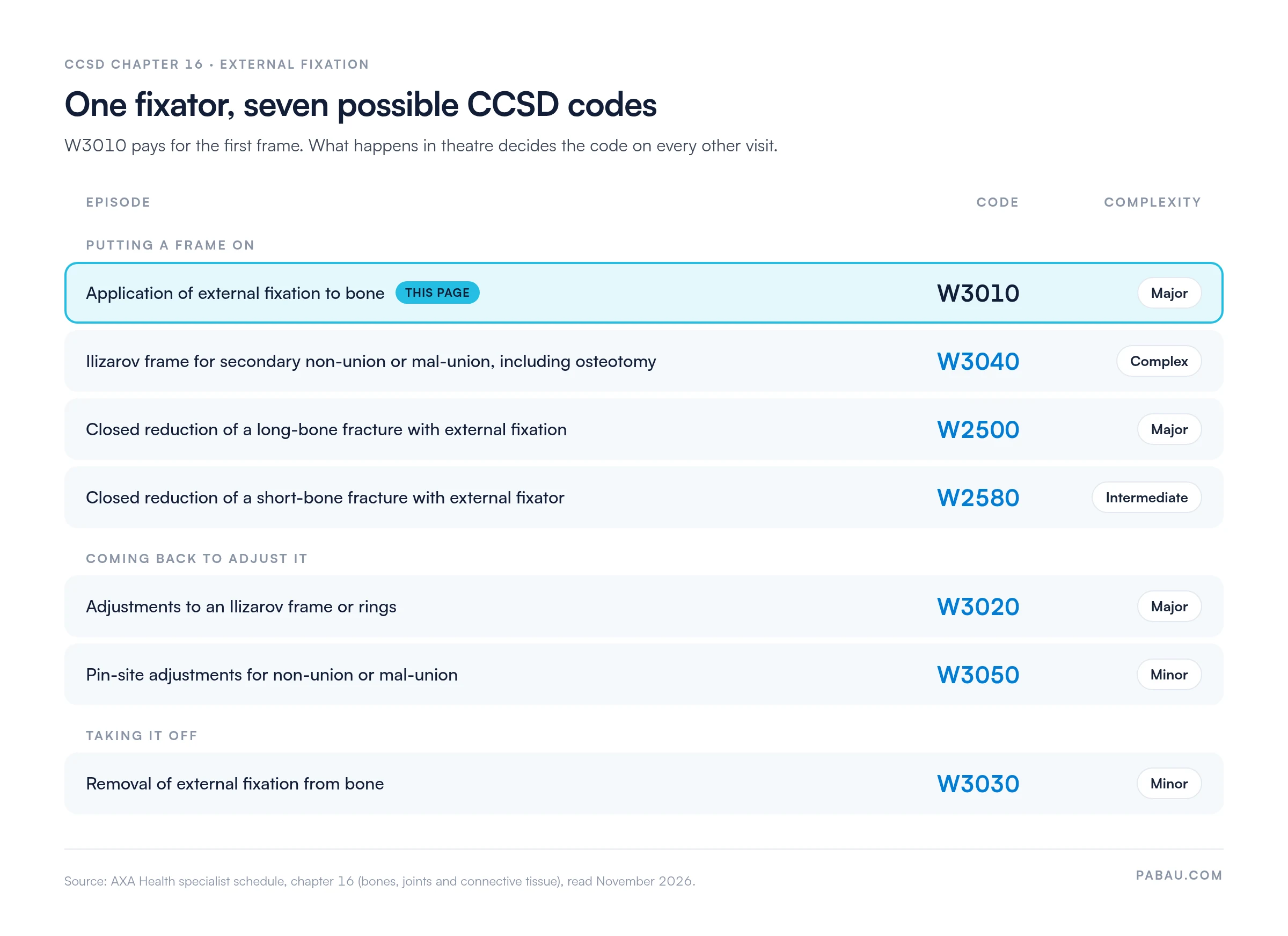
Not every frame is W3010, though. Applying an Ilizarov frame for secondary non-union or mal-union, including osteotomy, bills as W3040, a Complex procedure. Adjustments to an Ilizarov frame or rings bill as W3020 (Major), and pin-site adjustments for non-union or mal-union as W3050 (Minor). Closed reduction of a fracture with an external fixator has its own codes too. W2500 covers a long bone (Major) and W2580 a short bone (Intermediate). Removal is W3030 (Minor). When the plaster is also changed in the same episode, removal is coded W3032. The chart below sets each episode against its code.
Understanding the bundle boundaries of W3010 prevents both under-coding (missed revenue) and over-coding (claim rejection or audit risk). The table below sets out what is and is not included.
Knowing adjacent codes prevents bundling errors and ensures concurrent procedures are captured. The table below lists codes frequently used in the same episode or confused with W3010. Confirm current code numbers against the CCSD Schedule before submitting, as codes are subject to revision. Our CCSD code guides help you check a neighbouring orthopaedic code before it goes on a claim.
Vague operative notes are the single most controllable cause of W3010 claim denial. For a clean claim, the operative note must contain these elements, in line with the Royal College of Surgeons of England’s operative note standards:
Notes that read only “external fixation applied” without specifying device type, laterality, and indication give the insurer grounds to query or reject the claim. Document as if the reviewer has no access to the radiology report or the ward notes, because in many cases they do not.
Run a documentation checklist before closing the operative note: device type, bone, side, pin count, indication, staged or primary, concurrent procedures. A three-minute self-review at this stage prevents a four-week claim cycle.
Most UK private medical insurers require pre-authorisation before elective external fixation. Without a valid authorisation reference number, the claim will typically be rejected.
For Bupa, consultants or the treating hospital submit the proposed procedure code alongside a diagnosis code and clinical justification before the procedure. Bupa’s code search portal confirms whether W3010 requires authorisation under the patient’s specific policy. For AXA Health, procedure authorisation requests are submitted through the AXA Health specialist forms portal. Aviva sets its own fee schedule and authorisation requirements for practitioners. Confirm current requirements with each insurer, as policies change.
Emergency trauma cases may be authorised retrospectively. Most PMIs allow notification within 24 to 48 hours of an emergency admission, but the window and documentation requirements vary. Missing the notification deadline can convert a payable claim into a disputed one.
Once authorised, claims are typically submitted via Healthcode EDI, the standard electronic billing gateway for UK private practice. When completing a W3010 submission through Healthcode:
Healthcode’s EDI validation rejects claims missing mandatory fields before they reach the insurer. A rejected EDI submission is not an insurer denial, but it still delays payment. Practice software with built-in claims management can warn about a missing authorisation before the claim leaves the practice.
Denial patterns for CCSD code W3010 fall into predictable categories. Each has a straightforward resolution step.
CCSD has no modifiers. Laterality and complexity sit in the code narrative and the chapter rules set out in the CCSD Technical Guide. This section reflects those coding principles, not modifier rules, so confirm the insurer’s own rules before submitting.
Bilateral fixation in one session: A surgeon may fix two separate bones in one episode, such as both tibiae after high-energy trauma. That episode may legitimately need two codes. Confirm the insurer’s multiple-code rule before billing. Document both sites clearly in the operative note, with distinct laterality, pin counts and frame types. Some insurers pay the second procedure at a percentage of the first, so check the fee schedule before assuming full payment on both.
Staged fixation across separate admissions: A later adjustment of a temporising fixator bills under its own CCSD code, not W3010. W3020 covers adjustments to an Ilizarov frame or rings, and W3050 covers pin-site adjustments for non-union or mal-union. A fresh W3010 applies only where a new fixator is applied. Each operative episode still needs its own pre-authorisation reference, operative note and claim. Submitting a later visit under the original W3010 authorisation reference is a common cause of denial on staged cases.
Multiple-segment fixation on the same limb: Applying a single frame spanning multiple fracture levels on one bone is generally billable as a single W3010. Applying separate, independent frames to two distinct bones in the same limb within the same session may legitimately need two codes. Confirm the insurer’s multiple-code rule before billing, and document the clinical rationale for each construct separately.
The distinction between external fixation (W3010) and internal fixation is clinical, not administrative. If hardware is placed outside the skin and attached to bone through percutaneous pins, it is external fixation. Hardware implanted beneath the skin and left inside the body, such as a plate, nail or screw construct, is internal fixation. Its code comes from the CCSD internal fixation group, not W3010. Removing that internal hardware later is coded W2830. Primary open reduction of a fractured hand or foot bone with K-wires, plates or screws, for example, bills as W1940. Open repair of a scaphoid non-union with cancellous bone graft is another internal fixation case, coded code W3200. Skeletal traction is a third set-up, with one pin or wire through bone on a bow and weights. Its removal is coded W2930, not under the fixation codes.
Implant and device costs: Whether the frame, pins and ancillary components can go on a separate implant line alongside W3010 varies by insurer. Bupa, AXA Health and Aviva each have their own passthrough device policies. Some require device pre-approval before surgery, with the invoice attached. Others allow passthrough billing up to a cost threshold without prior approval.
As a rule, present the device invoice separately from the W3010 surgeon fee. Confirm the insurer’s current implant policy at the time of authorisation, because assuming the device is covered is a common and avoidable billing error.
CCSD code W3010 billing has five moving parts: pre-authorisation, operative note detail, concurrent codes, Healthcode submission and implant approval. Tracking them by hand across a busy orthopaedic list produces the denial patterns described above.
Pabau supports insurance billing through Healthcode and BUPA, and tracks authorisation codes on the case with a warning when one is missing. Your team spots a missing authorisation before the claim goes out, rather than after the insurer rejects it. Healthcode’s gateway then checks each submission against its field requirements, catching missing mandatory fields, such as the diagnosis code, before they reach the insurer.
Pabau is built for private practices, including UK practices billing insurers. Its billing workflows keep Healthcode claims and authorisation tracking in one system. Practice managers spend less time chasing denials and more time supporting the clinical team.

Pabau supports insurance billing through Healthcode and BUPA, and tracks authorisation codes on the case with a warning when one is missing. See how it fits your orthopaedic claims in a live demo.

W3010 pays for one piece of work: the surgeon applying an external fixator to bone. Whether the claim pays first time depends on what surrounds it, so settle the episode before the frame goes on.
Check whether the case is a first frame, an Ilizarov frame for non-union under W3040, or a later adjustment under W3020 or W3050. Get the authorisation reference for that exact code. Then write an operative note a reviewer could code from without the ward notes. Removal, the device and the anaesthetic each go on their own line.
Book a demo to see how Pabau tracks authorisation codes and sends Healthcode claims for orthopaedic private practices.

Need a full reference for Bupa procedure codes? Bupa CCSD codes guide covers how the Bupa schedule and its submission requirements work for UK private practice.
Coding internal fixation of a small bone instead? CCSD code W1940 explains open reduction of a short bone with plates, screws or K-wires.
Want to reduce claim admin across your whole practice? Claims management software shows how Pabau handles Healthcode and BUPA claims and tracks authorisation codes on the case.
CCSD code W3010 covers the application of external fixation to bone. It pays for the consultant surgeon placing a percutaneous pin-and-frame construct to stabilise a fracture or correct a deformity. The anaesthetic fee, the fixator device and the later removal of the frame are each billed separately.
Yes, for elective procedures most UK private medical insurers including Bupa and AXA Health require pre-authorisation before W3010 is performed. Emergency trauma cases may be authorised retrospectively but must typically be reported to the insurer within 24 to 48 hours of the admission. Always confirm the current requirement with the specific insurer and policy before proceeding.
Yes. Application and removal of an external fixator are separate billable events under CCSD. W3010 covers the application only. Removal should be billed under the applicable CCSD removal code at the episode when the frame is taken off. Never bundle both under W3010 on a single claim.
Not automatically. The fixator frame and pins are typically billed as a separate implant line, but the policy varies by insurer. Some insurers want pre-approval for device costs above a threshold, with the invoice submitted alongside the claim. Others allow passthrough billing up to a set amount without prior approval. Confirm the relevant insurer’s current implant policy at the time of pre-authorisation.




