

CPT Code 30801: Superficial turbinate ablation billing guide
CPT Code 30801: Official descriptor and procedure overview The American Medical ...

Last Updated: Nov 27, 2026
W3040 is the CCSD code for applying an Ilizarov frame to treat secondary non-union or mal-union, including any osteotomy done in the same operation. It applies when an earlier treatment has failed and the fracture has not healed, or has healed out of alignment.
The code sits in CCSD section 16.3.5, Fixation Devices. A primary external fixation with no failed treatment behind it is coded W3010 instead, while later frame adjustments use W3020.
Let Pabau's smart automation suggest the right codes, reduce claim denials, and keep your practice compliant—effortlessly.
Automate repetitive tasks and focus on what matters most—your patients.
Reduce coding errors and ensure compliance with the latest regulations.
Clean claims, fewer denials, and faster reimbursements.
Powerful insights and reporting to help your practice thrive.
HIPAA compliant SOC 2 certified GDPR-compliant Trusted by 4,000+ clinics worldwide

CCSD code W3040 covers applying an Ilizarov frame for secondary non-union or mal-union, after an earlier treatment has failed.
An osteotomy performed in the same operative episode is part of the W3040 descriptor.
A primary external fixation with no failed treatment behind it is coded W3010, not W3040.
Missing imaging evidence of non-union, or an osteotomy left out of the operative note, are common denial triggers.
Major UK insurers typically require prior authorization, so confirm each insurer’s current rules before the operation date.
CCSD code W3040 is the code for application of an Ilizarov frame for secondary non-union or mal-union, including osteotomy. It sits in the CCSD Schedule, which holds the standard procedure codes for UK private healthcare. Use it when a fracture has failed an earlier treatment and the surgeon applies a circular frame to fix it or correct the resulting deformity.
The official descriptor reads: Application of Ilizarov frame for secondary non-union/mal-union including Osteotomy. It sets out three elements, and each one must appear in the clinical record for a claim to hold up at review.
The device is an Ilizarov frame, a circular external fixator built from rings joined by threaded rods. Tensioned olive wires or half-pins hold the bone segments in place. The indication is secondary non-union or mal-union. The included procedure is an osteotomy performed in the same operative episode.
The Bupa CCSD billing guide explains how Bupa’s fee schedule maps to CCSD codes, which helps when checking W3040 against adjacent codes. Other orthopedic procedures in the schedule have their own pages in the CCSD codes reference.
W3040 is the correct code when two conditions are both present. The non-union or mal-union must be secondary, meaning an earlier treatment was attempted and failed. The Ilizarov frame must then be applied to address that failure or to correct the deformity it left behind.
Secondary non-union means the fracture has not healed within the expected timeframe after a prior fixation attempt. Definitions vary, but non-union is commonly diagnosed when a fracture shows no progress toward healing after six to nine months. The threshold also shifts with fracture site and patient factors. Many of these patients reach private practice after initial NHS treatment.
Mal-union means the fracture has healed but in an abnormal position, producing angular, rotational, or translational deformity that impairs function or causes pain. The corrective osteotomy re-breaks or wedges the bone. The Ilizarov frame then holds the segments and gradually corrects the alignment through distraction osteogenesis.
W3040 does not apply to primary fixation, where the frame is the first treatment for an acute fracture. That scenario points to W3010, application of external fixation to bone. Getting this primary-versus-secondary call wrong is the quickest route to a W3040 coding error.
The W3040 descriptor does not mention infection. For an infected non-union, check the full CCSD schedule and the insurer’s guidance before billing.
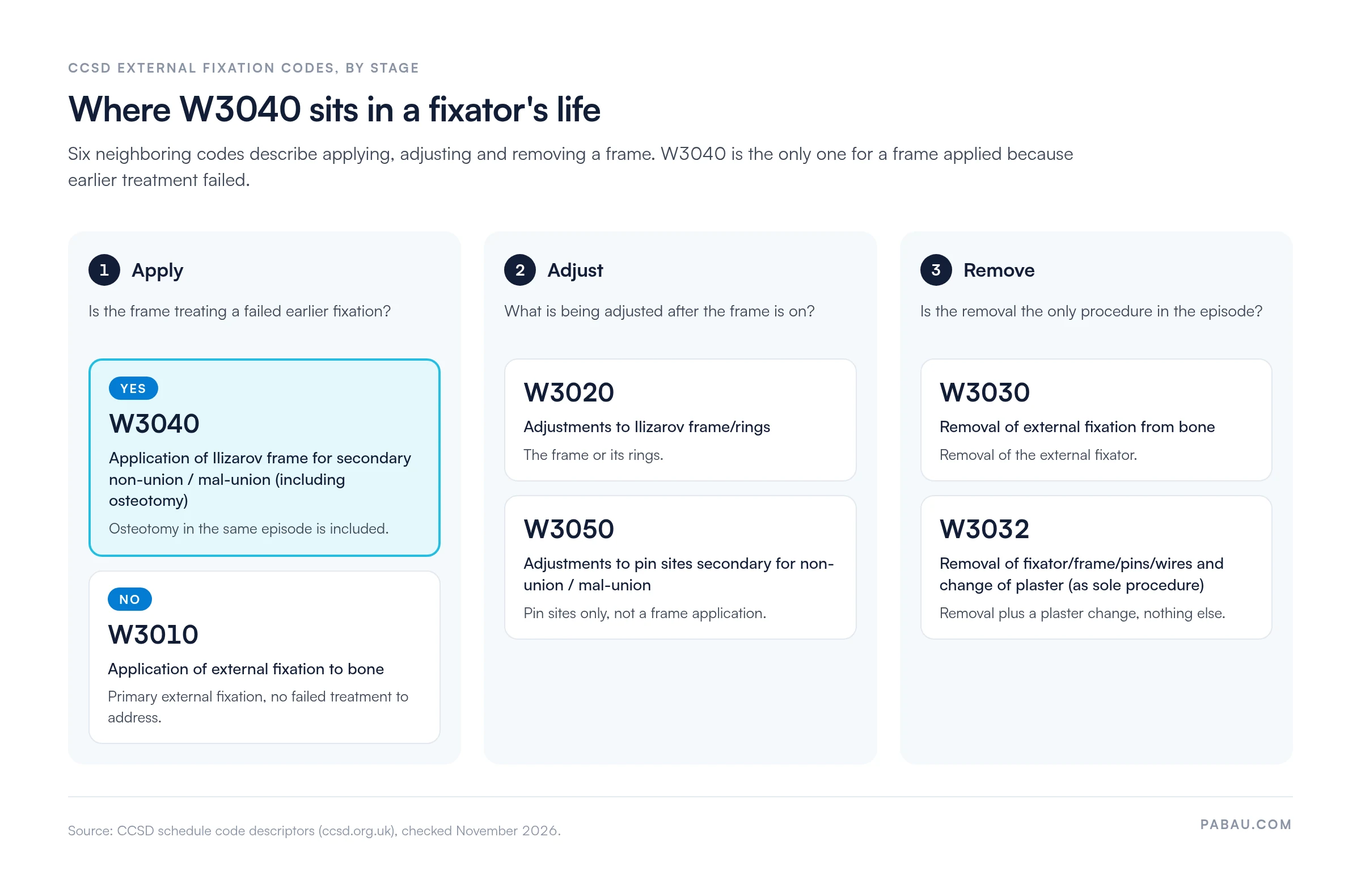
The W-series holds several external fixation codes that look alike. They split on three questions: Is the indication primary or secondary? Is an osteotomy included? Is the frame going on, being adjusted, or coming off?
The W3010/W3040 distinction matters most. If the record shows a previous fixation that failed to achieve union, such as a nail, a plate or an earlier frame, W3040 is correct. If the frame is the first treatment for the fracture, W3010 applies instead. Check both descriptors against the live CCSD schedule before billing, as the schedule is updated periodically.
Once the frame is on, later work carries its own codes. Adjusting the frame or its rings is W3020. Removal with a plaster change, as the only procedure in the episode, is W3032. The diagram below places all six codes across the life of a frame.
Insurers reviewing a W3040 claim look for two things above all. The first is evidence that the non-union is secondary, with the prior treatment documented and shown to have failed. The second is evidence that the osteotomy in the descriptor was performed. Missing either is the most direct route to a denial.
The operative note must address each element in the descriptor. Structured clinical records capture treatment history, imaging findings, and intraoperative steps in one consistent format. That cuts the omissions that otherwise only surface at the claims stage.
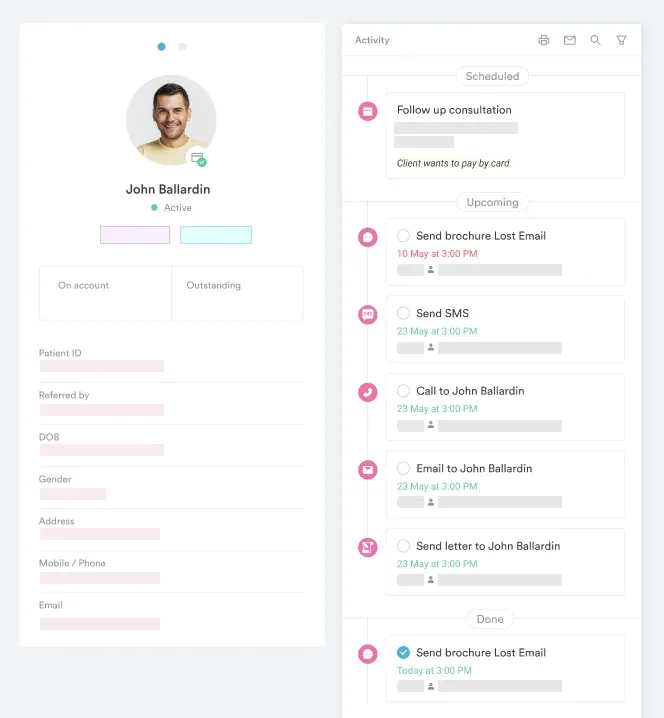
Digital pre-authorization forms that prompt for each of these data points before surgery catch omissions early. The team then finds a missing detail before the claim goes out, not during a denial review.
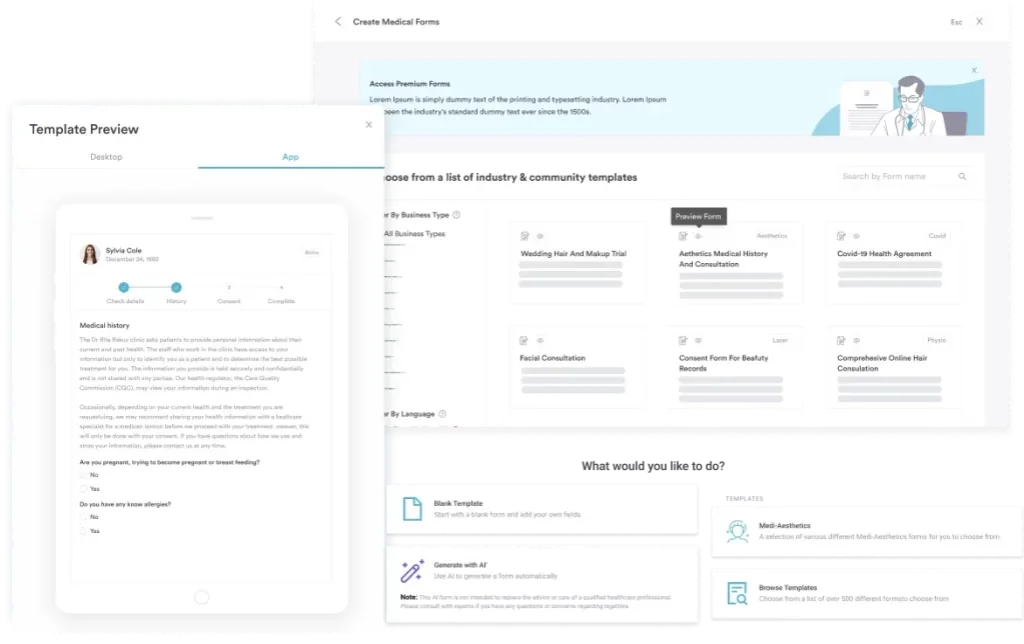
Major UK private medical insurers (PMI) typically require prior authorization before an Ilizarov frame application for non-union or mal-union. Bupa, AXA Health, Aviva, and Vitality each set their own rules, so confirm each insurer’s current requirements. Missing pre-authorization is one of the simplest denial causes to avoid.
Many of these patients had their first fracture treatment on the NHS and come to private practice when it failed. Their NHS operation notes and discharge summaries then become the main evidence for the secondary indication.
Always verify current pre-authorization requirements directly with each insurer before submission. The Bupa procedure code search and the Aviva fee schedule carry current procedural information. Either may set extra requirements for W3040 or its W-series neighbors. Insurer policies change, and the requirements here reflect general practice rather than any insurer’s current position.
W3040 claims are denied for a small set of recurring reasons. Each one has a specific fix that can be built into the pre-operative and documentation workflow, rather than handled later at the dispute stage.
Documentation workflows built around these five denial categories cut down on claims that need correcting later. The osteotomy point deserves the most attention. Because the W3040 descriptor includes osteotomy, an insurer reviewing the claim will expect to find it in the operative note. If none was performed, the record should still describe the clinical scenario clearly, so the correct code can be verified.
Before billing W3040, run a three-point check on the operative note. First, the prior treatment is named and confirmed to have failed. Second, the imaging evidence is referenced with its date and type. Third, the osteotomy step is described with technique and site. Clearing all three before submission avoids the most common denial categories.
W3040 covers the surgical procedure. The Ilizarov frame hardware itself is typically invoiced separately using the relevant CCSD implant or prosthesis codes, though bundling rules differ between insurers.
Frame components (rings, connecting rods, olive wires, half-pins) are generally billed under CCSD implant coding at cost plus the insurer’s agreed mark-up, where recognized. Bone grafting at the same operative episode may attract a separate procedure code, depending on the method (autograft vs allograft) and the insurer’s bundling policy. Payer rules diverge here: Some insurers accept separate bone graft coding, while others treat it as bundled within the index procedure.
The Healix fee schedule includes specific unbundling guidance for orthopedic procedure codes. It helps when checking whether a co-billed code is likely to be accepted or queried.
W3040 is a complex reconstructive procedure. Whether the current CCSD schedule recognizes an assistant surgeon entitlement depends on the schedule version in force at the time of treatment. Do not assume entitlement without confirming it against the live CCSD schedule or with the insurer’s provider relations team.
Anesthetic coding for Ilizarov frame application follows the standard CCSD time-based anesthetic rules. The anesthetist bills the appropriate CCSD anesthetic codes based on induction, basal, and time units, with the index surgical code referenced. Frame assembly and wire placement under general anesthesia can take a long time, so accurate intraoperative time recording is essential.
In many orthopedic practices, the evidence for a W3040 claim lives in different places. The NHS discharge summary sits in an inbox, the imaging report in a radiology portal, and the operative note in a dictation queue. Someone at the billing desk assembles the claim days later, and that is where the osteotomy line or the authorization number goes missing.
Pabau records CCSD code W3040 against the patient’s encounter, with the operative note, imaging references and prior authorization number attached. The authorization code, dates and sessions sit on the case, and Pabau warns the team when one is missing. Its claims management software then submits the claim through Healthcode, the UK electronic billing clearinghouse used by Bupa, AXA Health, Aviva, and others.
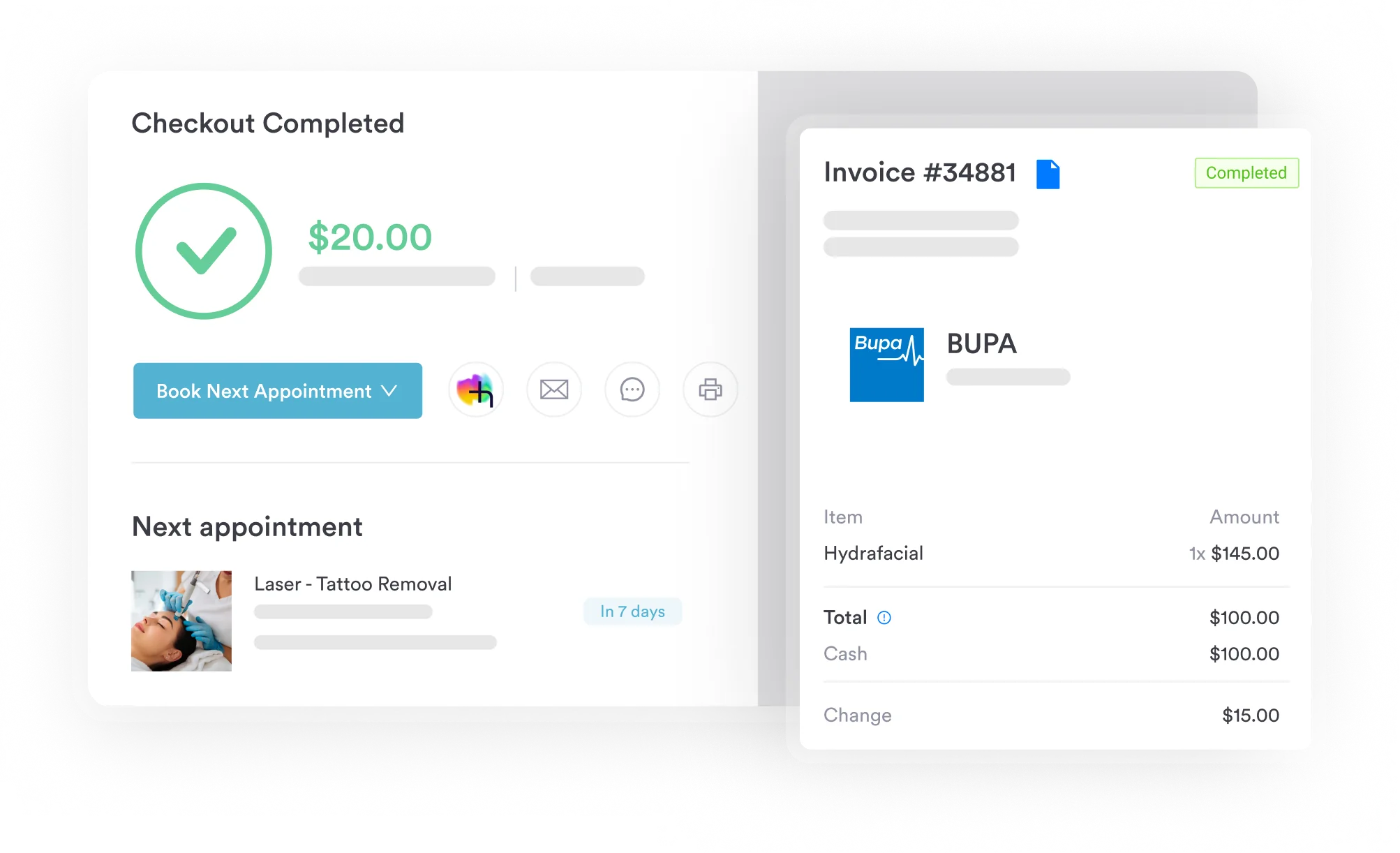
The result is a claim that agrees with the operative note it came from. A technical rejection, such as a missing authorization number or a mismatched date, is a correction rather than a denial. Keep the clearinghouse’s rejection reason codes, so the team can find and resubmit the specific error quickly.

Pabau links the CCSD code, operative note, imaging references and prior authorization to one encounter, then submits the claim through Healthcode. Insurers see the full secondary indication on the first submission.

Code W3040 only when the record proves the indication is secondary. A frame applied as first-line treatment is W3010, and later frame or pin work has codes of its own. Before the claim goes out, check that the operative note names the failed earlier treatment, cites the imaging and describes the osteotomy.
Get those three right and the claim stands on the note alone. Leave one out and the insurer queries a high-value procedure, which delays payment while the team rebuilds the case. Book a demo to see how Pabau ties the operative note, imaging and authorization to each orthopedic claim before it reaches the insurer.

Checking how Bupa maps its fees to CCSD codes? Bupa CCSD billing guide explains how Bupa’s fee schedule lines up with CCSD procedure codes for private orthopedic work.
Billing another secondary non-union case? CCSD code W3202 covers scaphoid non-union treated with open reduction and internal fixation.
Planning a corrective osteotomy of the tibia? CCSD code W1660 walks through tibial osteotomy billing for UK private practice.
Looking for broader private practice billing support? Claims management software from Pabau handles CCSD code entry, insurer submission, and rejection tracking in one workflow.
CCSD code W3040 covers application of an Ilizarov circular external fixator for secondary non-union or mal-union of a fracture. Any corrective osteotomy performed in the same operative episode is included. It applies where an earlier fixation attempt has failed and the frame addresses that failure or the resulting deformity.
W3010 covers application of external fixation to bone, where there is no failed earlier treatment to address. W3040 applies when a previous treatment was attempted and failed, which makes the non-union secondary. The clinical record must show that failure for W3040 to hold up at claim review.
The W3040 descriptor includes osteotomy, so the code is designed for cases where an osteotomy is performed alongside the frame application. Where no osteotomy was performed, check whether W3040 or an adjacent W-series code fits. Either way, the operative note should describe the clinical scenario clearly.
Insurers typically ask for an operative note confirming the frame type, the secondary diagnosis, and the osteotomy if one was performed. They also expect imaging reports confirming the non-union or deformity, records of the failed prior treatment, and the prior authorization reference. Requirements vary, so confirm them with Bupa, AXA Health, Aviva, or Vitality directly.
The most common reasons are coding W3040 for a primary fixation that fits W3010, and missing imaging evidence of non-union. Others are an operative note that omits the osteotomy, and no prior authorization before surgery. Addressing these four points in the pre-operative workflow prevents most W3040 denials.
The W3040 descriptor does not mention infection. Assess infected non-union against the full CCSD schedule and the insurer’s guidance before billing, as the documentation requirements may differ.




