

CCSD code XR940: Foreign body retrieval billing guide
CCSD code XR940 is the UK private healthcare code for retrieval of a foreign bod...

Last Updated: Nov 26, 2026
V0930 is the CCSD code for closed reduction of fracture of zygomatic complex of bones. CCSD is the UK procedure schedule that private medical insurers such as Bupa use. The code applies when a surgeon puts a displaced cheekbone back into place without opening the fracture site.
V0930 sits in sub-chapter 6.1.0 Face and Jaws, under chapter 6.0.0 Face, Mouth, Salivary & Thyroid, with CCSD reference Ff.003. An open reduction of the same fracture takes V0980 instead.
Let Pabau's smart automation suggest the right codes, reduce claim denials, and keep your practice compliant—effortlessly.
Automate repetitive tasks and focus on what matters most—your patients.
Reduce coding errors and ensure compliance with the latest regulations.
Clean claims, fewer denials, and faster reimbursements.
Powerful insights and reporting to help your practice thrive.
HIPAA compliant SOC 2 certified GDPR-compliant Trusted by 4,000+ clinics worldwide

CCSD code V0930 covers closed reduction of a zygomatic complex fracture. Open reduction of the same fracture takes V0980 instead.
V0930 sits in CCSD chapter 6.0.0 Face, Mouth, Salivary & Thyroid, under 6.1.0 Face and Jaws, with CCSD reference Ff.003.
There are no codes V0920, V0931, V0960 or V0900. A fractured jaw takes V0830 or V0820, and a nasal ethmoidal fracture takes V0910.
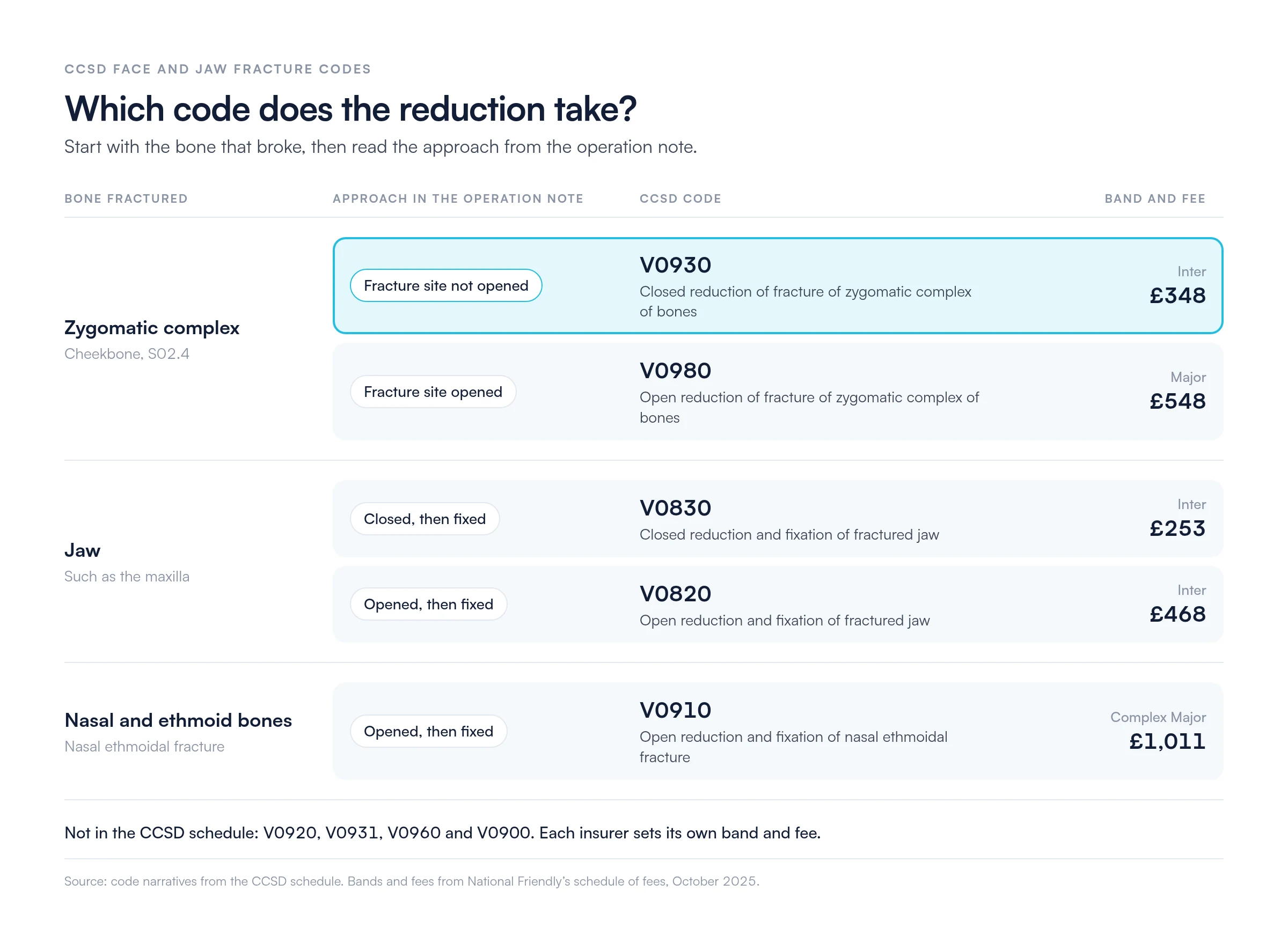
National Friendly’s CCSD-based schedule lists V0930 as Inter at £348 and V0980 as Major at £548, so the approach changes the fee.
The WHO ICD-10 code for a zygoma fracture is S02.4. It has no left or right subcodes, only an optional .0 closed or .1 open.
UK private insurers use CCSD code V0930 when a surgeon puts a fractured zygomatic complex back into place without opening the fracture site. National Friendly’s CCSD-based schedule of fees lists V0930 as “Closed reduction of fracture of zygomatic complex of bones”, in the Inter band at £348.
The zygomatic complex is the cheekbone and its joins with the frontal, maxillary, temporal and sphenoid bones. A displaced fracture can flatten the cheek and disturb the floor and rim of the orbit.
In a closed reduction, the surgeon moves the bone through a small incision or a percutaneous instrument. When the fracture site is opened to reduce it, the code is V0980 instead.
The CCSD schedule holds the standard procedure codes for the UK private healthcare sector. Each insurer sets its own band and fee, so check the paying insurer’s schedule before you invoice. For other procedure codes, browse our CCSD code library.
The AO Foundation’s surgery reference for zygomatic complex fractures describes four ways to reduce the bone without opening the fracture:
A simple fracture that isn’t comminuted can snap into a stable position with closed manipulation alone. The surgeon may then leave out fixation. AO advises intraoperative imaging to confirm the reduction in those cases.
An unfixed reduction has to be protected for at least two to three weeks after surgery, according to the same reference. Record that advice in the discharge notes, because a late displacement can lead to a second operation.
Ask the surgeon to record two facts in the operation note. Was the fracture site opened, and was any fixation left in place? Together they decide between V0930 and V0980.
The table lists the codes most often confused with V0930. Narratives come from the CCSD schedule, and fees from National Friendly’s schedule. CCSD has no codes V0920, V0931, V0960 or V0900.
The approach moves the fee as well as the code. National Friendly pays £348 for V0930 and £548 for V0980, so a closed case billed as open will draw a query. The chart maps each bone and approach to its code and fee.
If the surgeon starts closed but then opens the fracture site to reduce it, the claim takes V0980. The CCSD narratives don’t say where a reduction fixed through small incisions belongs. Ask the insurer before you bill a case like that.
V0930’s narrative used to read “Reduction of fracture of zygomatic complex of bones”. The word “Closed” was added later, so older billing templates may still carry the old wording.
Insurers want to know which injury the reduction treats before they authorize surgery. Use the same diagnosis in the referral, the pre-authorization request and the operation note. The WHO ICD-10 browser holds the codes below.
WHO ICD-10 has no left or right subcodes for S02.4. Its only optional fifth character marks the fracture as closed (.0) or open (.1). A fracture not stated as either is classified as closed.
That fifth character describes the wound, not the operation. An open fracture (S02.41) can still be reduced closed and billed as V0930. Record the side in the operation note and the pre-authorization request instead.
A V0930 claim is only as strong as the operation note behind it. A note that says only “fracture reduced” leaves the coder guessing between V0930 and V0980.
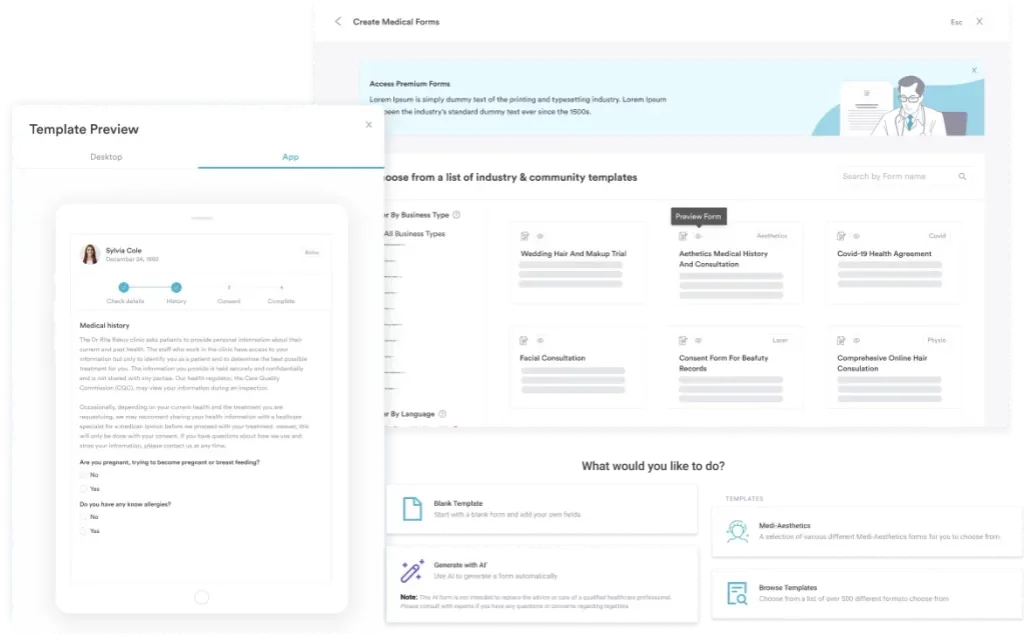
Structured digital forms with an operation note template make these items hard to miss. The surgeon fills them in at the point of care, not from a dictation days later.
The work starts before the operation. UK insurers such as Bupa, AXA Health, Aviva and Vitality generally ask for planned surgery to be approved in advance. Our guide to Bupa CCSD codes covers how Bupa handles CCSD claims.
Facial fractures are often treated soon after the injury. If the operation can’t wait, contact the insurer before surgery where you can, and record what they agree.
The anesthetist usually bills separately for the same operation. Check whether the insurer wants both claims to carry the same authorization code.
Each of these slips gives the insurer a reason to query a V0930 claim, and each one has a fix.
If a claim is still refused, check the insurer’s current provider manual for its appeal process. Only commit to a deadline you have confirmed there.
In many maxillofacial practices, the authorization sits in an email and the operation note in another system. Then the claim is keyed in by hand. Each handoff is a chance to lose the authorization code or bill the wrong reduction code.
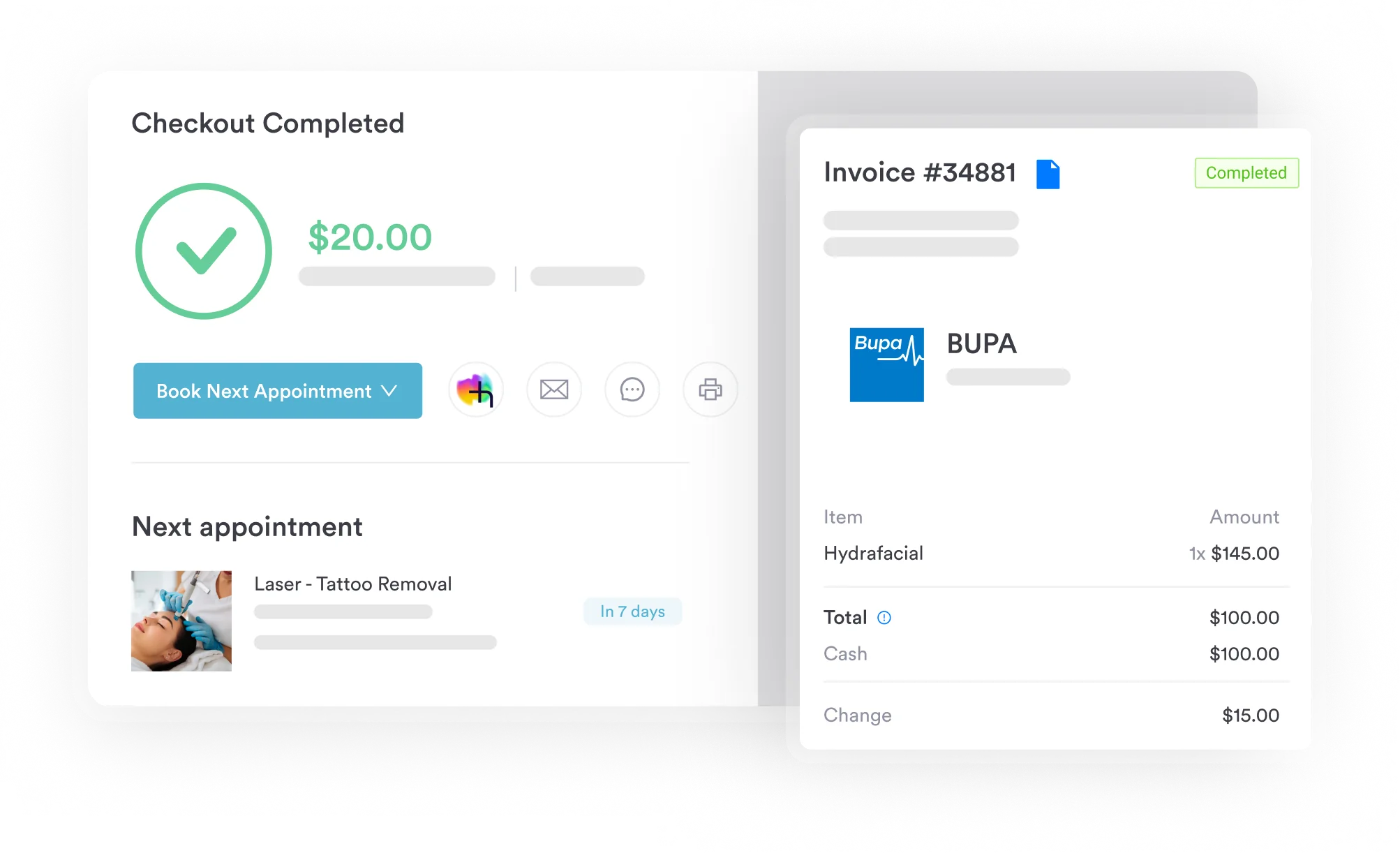
Pabau keeps those steps on the patient record. Its claims management software sends claims electronically through Healthcode and to Bupa. The authorization code sits on the patient’s case, with a warning when it is missing.
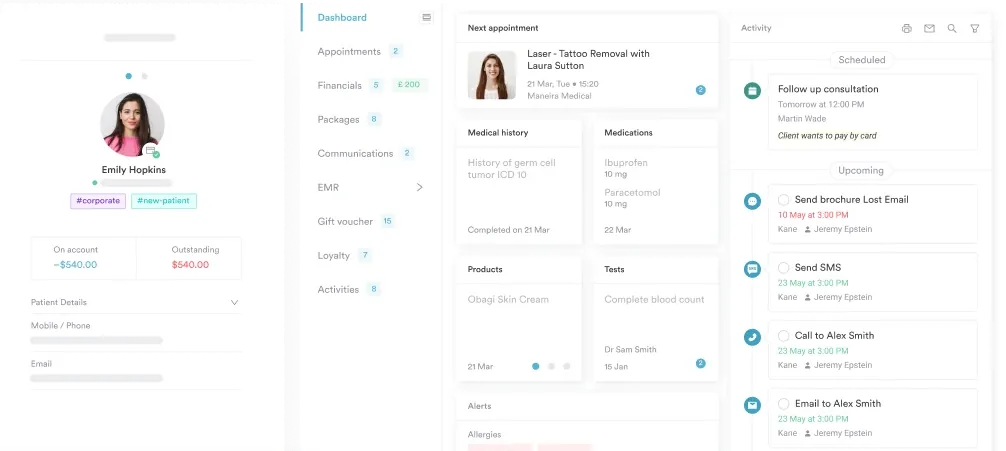
The patient record also holds the imaging report, the operation note and the referral. Your coder can check the approach before the claim is built, rather than calling the surgeon afterward.
The result is fewer claims queried for a missing authorization code or the wrong reduction code.

Pabau keeps the authorization code on the patient’s case and warns you when it is missing. Claims go electronically through Healthcode and to Bupa.

V0930 is the code for a zygomatic complex fracture reduced without opening the fracture site, and the approach decides the claim. An open reduction belongs on V0980, and a jaw fracture on V0830 or V0820. Rebuilding the jaw with a non-vascularised bone graft is a separate claim, coded CCSD code V1910.
Build a note template that records the approach, any fixation and how the reduction was checked. Then confirm each insurer’s current fee before you invoice. Book a demo to see how Pabau tracks authorization codes and sends your Healthcode claims from one patient record.

Looking for another CCSD procedure code? CCSD codes lists the procedure codes Pabau covers, chapter by chapter.
Need a full Bupa CCSD billing reference? Bupa CCSD codes covers Bupa’s procedure list and how its claims work.
Was the fracture site opened? CCSD code V0980 covers open reduction of a zygomatic complex fracture.
Treating a dislocated jaw joint? CCSD code V2120 covers reduction of a dislocated temporomandibular joint.
CCSD code V0930 covers closed reduction of fracture of zygomatic complex of bones. The surgeon puts the displaced cheekbone back into place without opening the fracture site. UK private insurers use it on CCSD-based claims.
V0930 covers a closed reduction, where the fracture site is not opened. V0980 covers open reduction of the same fracture. National Friendly lists V0930 as Inter at £348 and V0980 as Major at £548.
No. None of them is in the CCSD schedule. A fractured jaw takes V0830 or V0820, and an open nasal ethmoidal fracture repair takes V0910.
V0930 sits in chapter 6.0.0 Face, Mouth, Salivary & Thyroid, under sub-chapter 6.1.0 Face and Jaws. Its CCSD reference is Ff.003.
The WHO ICD-10 code is S02.4, fracture of malar and maxillary bones, which includes the zygoma. It has no left or right subcodes. Its only optional fifth character marks the fracture as closed (.0) or open (.1).
Most UK insurers expect planned surgery to be pre-authorized. Send the referral, the diagnosis and the code before the operation, and record the authorization code. If the operation is urgent, contact the insurer before surgery where you can.
It depends on the insurer. National Friendly’s October 2025 schedule lists V0930 in the Inter band at £348. Check the paying insurer’s current schedule before you invoice.



