
Pabau Engage inbox

Pabau Engage is here: every patient conversation in one inbox.

Learn more
Book a demo Book a demo
☰
CCSD Code

CCSD code W1940 – Open reduction of small bone with fixation


Code Definition

W1940 is the CCSD code for primary open reduction of a short bone with fixation, including intra-articular fractures. It covers the first open operation on a fractured phalanx, metacarpal or other short bone of the hand or foot. K-wires, plates and screws all qualify.

A fracture that enters the joint stays on W1940. A secondary operation for delayed union or non-union bills as W2300, and a closed reduction bills as W2582 or W2580.

Group
16 Bones, joints and connective tissue/tendon
Category
Fractures - Small Bones
Subcategory
16.3.2 Small bones
Billable
No
Code also known as
small bone ORIF, intra-articular fracture fixation, phalanx ORIF, metacarpal ORIF, scaphoid open reduction, hand fracture fixation
Save time. Improve accuracy. Get paid faster.
Automate coding with Pabau

Let Pabau's smart automation suggest the right codes, reduce claim denials, and keep your practice compliant—effortlessly.

  • AI-powered code suggestions
  • Real-time compliance checks
  • Faster claims, fewer denials
Why practices choose Pabau
Save hours every week

Automate repetitive tasks and focus on what matters most—your patients.

Improve accuracy

Reduce coding errors and ensure compliance with the latest regulations.

Get paid faster

Clean claims, fewer denials, and faster reimbursements.

Grow with confidence

Powerful insights and reporting to help your practice thrive.

HIPAA compliant SOC 2 certified GDPR-compliant Trusted by 4,000+ clinics worldwide

Key takeaways

Key takeaways

CCSD code W1940 covers a primary open reduction of a short bone, such as a phalanx or metacarpal, with fixation.

Intra-articular fractures are included in W1940 rather than required by it, so an extra-articular open fixation bills under the same code.

A secondary operation for delayed union or non-union moves to W2300, and a closed reduction moves to W2582 or W2580.

The operative note must confirm the open approach, the named bone, the fixation hardware, and that this is the first operation on the fracture.

Most UK private insurers expect pre-authorisation before elective fracture fixation, so the authorisation number belongs on the booking.

CCSD code W1940: definition and clinical scope

CCSD code W1940 is the UK private insurance code for a primary open reduction of a short bone with fixation, including intra-articular fractures. AXA Health’s published CCSD schedule lists it in chapter 16.3, Fractures, under small bones. Its descriptor reads “primary open reduction of short bone with fixation (including intra-articular).” The schedule itself is maintained by the Clinical Coding and Schedule Development (CCSD) Group.

Each part of the descriptor narrows the code. “Primary” means the first operation on this fracture. “Open reduction” means the surgeon exposed the fracture through an incision. “Short bone” sets the anatomical boundary at the small bones of the hand and foot.

“Including intra-articular” works the other way. It brings fractures that enter a joint into W1940, so joint involvement never pushes the claim onto another code. Short bones have no separate extra-articular code in the schedule.

W1940 belongs to UK private healthcare billing. NHS activity is coded in OPCS-4, so W1940 appears on insurer invoices rather than NHS records.

Descriptor elementWhat it means for billingWhat it excludes
PrimaryFirst surgical fixation of this fractureSecondary operations for delayed union or non-union (W2300)
Open reductionSurgical incision to expose and reduce the fractureClosed reduction, including percutaneous K-wires (W2582) or an external fixator (W2580)
Short bonePhalanges, metacarpals and carpal bones, plus their foot equivalentsRadius, ulna, femur, tibia, fibula and other long bones (W1920, W2100)
With fixation (including intra-articular)Hardware holds the reduction, whether or not the fracture enters a jointNo exclusion on joint grounds. Extra-articular fractures bill here too

Which bones and procedures does W1940 cover?

W1940 covers open reduction and fixation of the short bones of the hand and foot. The fracture may stay in the shaft or run into a joint, and the code is the same either way. A first metatarsophalangeal joint fused for arthritis, rather than fixed after a fracture, is a different claim under CCSD fusion code W0330. Removing a carpal bone is a different operation. Total excision of the trapezium with ligament reconstruction is billed as code W0284. A planned cut through a small hand bone to realign it, rather than a fracture repair, is billed as CCSD code W1641.

  • Phalanges (finger and toe bones): Proximal, middle and distal phalanges. A condylar fracture entering the PIP or DIP joint bills as W1940, and so does an open shaft fixation.
  • Metacarpals and metatarsals: Head, neck, shaft and base fractures. The intra-articular Bennett and Rolando fractures at the base of the thumb metacarpal sit here too.
  • Carpal bones: Open fixation of carpal fractures such as the hamate or trapezium. Check the scaphoid separately, because Bupa’s schedule lists early open fixation of a scaphoid fracture, within six weeks, as W3203.

The fixation method does not change the code. K-wires, mini-plates, lag screws and headless compression screws all fall within W1940 once the fracture has been opened. The operative note must still state which hardware was used.

How primary open reduction of a small bone is performed

Knowing the procedure helps the coder read the operative note. A primary open reduction of a small bone follows a consistent sequence, though the details vary by bone and fracture pattern.

  1. Anaesthesia: General anaesthesia or a regional block, such as a wrist or digital nerve block, is established. The anaesthetic type is documented because the anaesthetist bills separately.
  2. Incision and exposure: The surgeon makes a dorsal or volar incision over the fracture site. Soft tissue is retracted to expose the fractured bone and any involved joint surface.
  3. Fracture reduction: The displaced fragments are reduced under direct vision. This open step separates W1940 from the closed reduction codes W2582 and W2580.
  4. Fluoroscopic confirmation: Intra-operative image intensifier (C-arm) imaging confirms the reduction before fixation. Missing fluoroscopy documentation may prompt insurer queries about technique.
  5. Fixation: K-wires are most common for phalangeal fractures, and mini-plates or lag screws for metacarpal fractures. Headless compression screws suit carpal fractures. The hardware type, size and configuration must appear in the operative note.
  6. Wound closure: Layered closure is performed, then dressings and a splint are applied. Post-operative instructions are documented.

Fixation methods and typical anatomical pairings

Fixation methodTypical anatomyQualifies under W1940?
K-wire (Kirschner wire), openPhalangeal fractures, small metacarpal fragmentsYes, when the fracture was opened
Mini-plate and lag screwMetacarpal head, proximal phalanx baseYes, when the fracture was opened
Headless compression screwCarpal bonesYes, when opened. Early scaphoid fixation is W3203 in the Bupa schedule
Closed K-wire (percutaneous)Any small boneNo. Closed reduction with percutaneous K-wires is W2582

CCSD code W1940 documentation requirements

The operative note is the billing foundation for CCSD code W1940. Insurers audit claims against it, and missing elements are the main cause of denial. The Royal College of Surgeons of England expects operative notes detailed enough for another surgeon to follow the procedure.

For W1940, six elements are non-negotiable.

  • Confirmation of open approach: The note must state that an incision was made and the fracture was exposed under direct vision. A note that describes only the reduction result is insufficient.
  • Specific bone identified: Name the bone precisely (“proximal phalanx of the ring finger”, “first metacarpal base”). Generic references to “a finger bone” do not meet insurer standards.
  • Fracture pattern described: Record whether the fracture line enters the joint surface. W1940 covers both patterns, but the description supports the case for open fixation.
  • Fixation hardware described: Record the hardware type, size and number of implants. “Two 1.0mm K-wires placed across the PIP joint” is adequate, while “K-wires applied” is not.
  • Fluoroscopic confirmation: Document that intra-operative imaging verified the reduction and hardware position. It is the standard of care for small bone fixation, and its absence may prompt insurer queries.
  • Primary procedure status: The note must show this is the first operation on the fracture. A re-operation for delayed union or non-union is W2300.

An ICD-10 diagnosis code for the specific fracture must be paired with W1940 on the claim. Use the most specific fracture code available, identifying the bone, laterality and displacement status. A structured operative note template prompts surgeons to capture these elements before the note is finalised.

Pro Tip

Audit the last ten W1940 claims you submitted. For each, check that the operative note states the open approach, the specific bone, the hardware details, fluoroscopy confirmation and primary status. Any missing element maps directly to a denial risk.

Pre-authorisation requirements from UK private insurers

Elective orthopaedic surgery in UK private healthcare generally requires pre-authorisation from the insurer before the procedure. For W1940, the urgency of the fracture affects how the requirement is applied, but the obligation exists across the major insurers.

InsurerPre-auth typically required?Reference
BupaYes, for elective surgical admissionsBupa code search portal
AXA HealthYes, pre-treatment authorisation requiredAXA Health provider guidelines
AvivaYes, refer to fee schedule and invoicing requirementsAviva fee schedule
Vitality HealthYes, for surgical proceduresVitality provider guidelines
WPAYes, pre-treatment approval requiredWPA provider terms
HealixYes, refer to Healix CCSD fee scheduleHealix fee schedule

A pre-authorisation request for a W1940 procedure should include these details.

  • The fracture diagnosis, naming the specific bone, with its ICD-10 code
  • Imaging, such as an X-ray or CT scan, showing the displacement that needs open fixation
  • The clinical urgency and the planned procedure date
  • The setting, either day case or inpatient
  • The consultant’s GMC number

Where surgery cannot safely wait for approval, notify the insurer as soon as practically possible after the operation. Building the request into the booking step, rather than leaving it until after surgery, keeps the claim payable.

How W1940 differs from adjacent CCSD codes

Choosing the wrong neighbouring code is a costly billing error.

W1920 covers primary open reduction of a long bone, while W2100 covers an intra-articular long-bone fracture. Short bones have no such split, so W1940 covers both patterns. A planned corrective cut through a long bone, rather than a fracture repair, is a separate procedure under W1080.
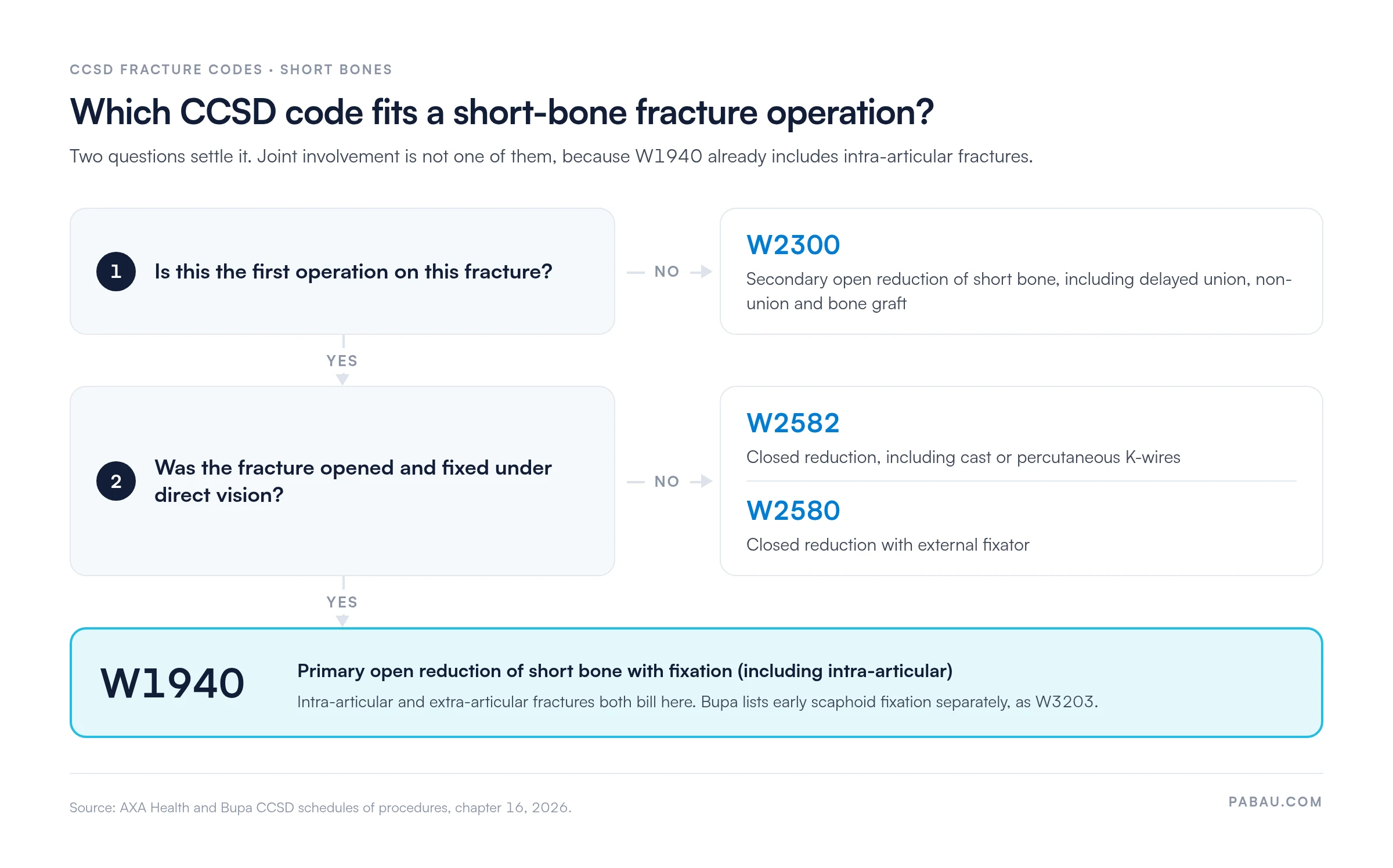
Decision flow for CCSD short-bone fracture codes
Primary status and an open approach decide the code, while joint involvement never moves a short-bone fixation off W1940. Codes from the AXA Health and Bupa CCSD schedules.
CodeDescriptor (summary)Use whenKey distinction from W1940
W1940Primary open reduction of short bone with fixation (including intra-articular)First open fixation of a short bone, joint involved or notReference code
W2300Secondary open reduction of fracture of short bone, including delayed union, non-union and bone graftRe-operation on a fracture that has failed to uniteNot the first operation
W2582Closed reduction of fracture of short bone (including cast or percutaneous K-wires)No incision, with any K-wires passed through the skinClosed approach
W2580Closed reduction of fracture of short bone with external fixatorClosed reduction held with an external frameClosed approach, external fixation
W3203Early open reduction and internal fixation of scaphoid fracture, within six weeks (Bupa schedule)Scaphoid fixed within six weeks of injuryScaphoid-specific code
W1920Primary open reduction of long bone with fixationFirst open fixation of a long boneLong bone, not short bone
W2100Primary open reduction of intra-articular fracture of long bone with internal fixationLong-bone fracture entering a jointLong bone, with its own intra-articular code

The CCSD technical guide sets the business rules for the schedule. Where code selection is in doubt, rely on the guide and your insurer’s schedule. The CCSD code library lists the rest of chapter 16.

The Bupa CCSD procedure codes reference covers how Bupa applies the schedule.

Common claim denial reasons and how to avoid them

W1940 claims fail for a small and consistent set of reasons. Each one has a corrective action that prevents the rejection from recurring.

Denial reasonRoot causeCorrective action
No pre-authorisation obtainedSurgery performed without prior insurer approvalRequest authorisation at booking, and never schedule elective fixation without the reference number
Open approach not documentedOperative note does not state that an incision was madeUse a structured operative note template with an “approach” field that requires an entry
Bone or fracture pattern not describedNote says “finger fracture” without naming the bone, side or patternName the bone, digit, side and fracture pattern in the operative note
Closed reduction coded as openW1940 submitted when the fracture was reduced closed and pinned through the skinCode from the operative note, not the booking entry. Closed pinning is W2582
Mismatched ICD-10 diagnosis codeW1940 paired with an unrelated or non-fracture diagnosis codeUse the most specific fracture ICD-10 code for the named bone and check the pairing
Primary and secondary confusedW1940 billed for a non-union re-operation, or W2300 billed for a first operationConfirm from the clinical record whether earlier fixation exists before choosing the code

Coding risks and upcoding considerations

Coding errors with W1940 run in both directions. Billing W1940 for a closed reduction overstates the procedure, because the closed codes carry lower fees in the published schedules. Billing it for a non-union operation understates the work, because W2300 carries the higher fee.

Three patterns warrant particular attention in UK private practice billing.

  • Treating joint involvement as a requirement: Some coders look for a different code when the fracture stays out of the joint. The schedule holds no extra-articular short-bone code, so the open fixation still bills as W1940.
  • Coding W1940 for a closed procedure: A planned open reduction is sometimes converted to closed manipulation and percutaneous pinning. If the approach changed, the code must reflect the procedure performed, which is W2582.
  • Coding primary when revision was performed: Where earlier fixation has failed and the surgeon refixes the fracture, W1940 does not apply. W2300 covers that secondary operation, and insurers may treat the wrong code as a contractual breach.

The Competition and Markets Authority’s Private Healthcare Market Investigation Order shapes how consultants and insurers handle fees. The Private Healthcare Information Network (PHIN) publishes performance data. Where coding consistently favours higher-value codes without clinical support, insurers may audit. A working knowledge of the Bupa fee schedule shows where neighbouring codes differ in value.

How Pabau keeps W1940 claims moving from booking to payment

Most W1940 rejections start before surgery, with a missing authorisation or a thin operative note. Pabau, a practice management platform, keeps the booking, the authorisation and the clinical record on one patient file.

  1. Attach the CCSD code to the episode: Add W1940 to the patient’s episode once surgery is confirmed. The code then sits with the clinical record, the authorisation reference and the invoice.
  2. Record the pre-authorisation approval: Log the insurer’s authorisation number and approval date against the episode before the operation date.
  3. Store the operative note: Attach the finalised operative note to the patient record. It is then ready when an insurer queries the claim, with no paper files to search.
  4. Submit the claim: Pabau’s private insurer claims management sends claims to UK insurers through Healthcode. The claim carries W1940, the matched ICD-10 diagnosis, the authorisation number and the consultant’s details.
  5. Track claim status: Follow each claim from the billing dashboard. When a claim is queried or rejected, the linked authorisation and operative note are on hand for resubmission.

Pro Tip

Make a pre-authorisation checklist a standard step when booking any W1940 procedure in Pabau. Flag the booking as incomplete until the authorisation reference is recorded. That one change removes the most common reason W1940 claims are rejected.

Manage CCSD billing from pre-auth to claim settlement

Pabau lets private orthopaedic practices attach CCSD codes, record insurer authorisations and send claims through Healthcode from one system. Every W1940 claim leaves with its authorisation and operative note attached.

Pabau billing dashboard for private orthopaedic practice

Conclusion

Code W1940 from the operative note, not the booking. A first operation with an incision and fixation of a short bone is W1940. Whether the fracture reached the joint makes no difference.

The expensive mistakes sit at the edges. A closed pinning billed as W1940 overstates the procedure, and a non-union operation billed as W1940 leaves the W2300 fee unclaimed. Check scaphoid fixations against your insurer’s schedule before you submit.

Book a demo to see how Pabau keeps authorisations, operative notes and Healthcode claims together for private hand and orthopaedic surgery practices.

Continue your research

Continue your research

Need the full picture on CCSD billing for Bupa patients? Bupa CCSD procedure codes covers the Bupa code schedule, fee structure and submission requirements in detail.

Fixing a long bone that broke into the joint? CCSD code W2100 explains the intra-articular long-bone code that W1940 has no short-bone equivalent of.

Comparing what neighbouring codes are worth? Bupa procedure codes fee schedule sets out how fee bands work across the schedule.

Frequently asked questions

What does CCSD code W1940 cover?

CCSD code W1940 covers a primary open reduction of a short bone with fixation, including intra-articular fractures. It applies to the first open operation on a fractured phalanx, metacarpal or carpal bone, fixed with K-wires, plates or screws. The fracture may or may not enter a joint.

How does W1940 differ from W2300 and W2582?

W1940 is the first open operation on a short-bone fracture. W2300 is a secondary open reduction of a short bone, used for delayed union or non-union and including bone graft. W2582 is a closed reduction of a short bone, including cast or percutaneous K-wires. Billing W1940 for either is a common audit finding.

Can W1940 be used for K-wire fixation of a phalanx fracture?

Yes, when the fracture was opened through an incision before the K-wires were placed. W1940 does not depend on the fixation method, so K-wires, mini-plates, lag screws and headless compression screws all qualify. Closed pinning through the skin is W2582 instead.

Do UK private insurers require pre-authorisation for W1940 procedures?

Yes, the major UK private insurers, including Bupa, AXA Health, Aviva, Vitality and WPA, typically require pre-authorisation before elective orthopaedic surgery. Proceeding without an authorisation reference number is the leading cause of W1940 claim rejection. Emergency cases should be notified to the insurer as soon as possible after surgery.

Does the fracture have to be intra-articular to use W1940?

No. The W1940 descriptor includes intra-articular fractures, so the code covers short-bone fractures that enter a joint and those that do not. Long bones are different, because W2100 is a separate code for an intra-articular long-bone fracture.


Avatar photo
Despina Petrushevska
Content Writer

Despina Petrushevska is a content writer covering aesthetics, dermatology, and clinic operations, known for making detailed clinical concepts clear and engaging. Outside of work, she enjoys photography, weekend getaways, and finding inspiration in everyday experiences.
×

