

HCPCS Code L0472: Hyperextension TLSO billing guide
HCPCS code L0472: Official descriptor and device definition HCPCS code L0472 des...

Last Updated: Nov 5, 2026
26608 is the CPT code for percutaneous skeletal fixation of metacarpal fracture, each bone.
It covers K-wires or pins placed through the skin to hold a broken metacarpal without opening the fracture site. It is billed once per bone treated. Closed treatment without fixation is CPT 26605, and any incision that exposes the fracture moves the case to CPT 26615.
Let Pabau's smart automation suggest the right codes, reduce claim denials, and keep your practice compliant—effortlessly.
Automate repetitive tasks and focus on what matters most—your patients.
Reduce coding errors and ensure compliance with the latest regulations.
Clean claims, fewer denials, and faster reimbursements.
Powerful insights and reporting to help your practice thrive.
HIPAA compliant SOC 2 certified GDPR-compliant Trusted by 4,000+ clinics worldwide

CPT code 26608 covers percutaneous skeletal fixation of a metacarpal fracture, billed once per bone treated.
The approach must stay percutaneous throughout, and an intraoperative conversion to open treatment moves the case to CPT 26615.
A 90-day global surgery period applies, bundling routine post-op follow-up unless modifier -24, -78 or -79 is appended.
The paired ICD-10-CM code, from S62.2 or S62.3, must name the metacarpal, fracture type and laterality to avoid medical necessity denials.
Pabau’s claims management software runs claim validation that catches missing or invalid details before submission.
CPT code 26608 is defined by the American Medical Association as: Percutaneous skeletal fixation of metacarpal fracture, each bone. The “each bone” wording matters. When two metacarpals are fixed percutaneously in the same session, 26608 is reported twice, with modifier -51 on the second line.
The procedure involves inserting K-wires, intramedullary pins, or similar fixation devices through the skin without formally opening the fracture site. Fluoroscopic guidance confirms wire placement and fracture reduction, but imaging guidance itself is not separately billable under this code. The surgeon may or may not perform a closed reduction first. Either way, 26608 applies.
26608 applies when all four of these conditions are met. If any condition is absent, the code is wrong.
The most common qualifying scenario is a displaced metacarpal neck or shaft fracture, including a boxer’s fracture of the fifth metacarpal. The deformity is too severe for a cast alone, but the surgeon can reduce and fix it without opening the site.
Several procedure types fall outside 26608, and mislabeling them as percutaneous fixation is among the most audited hand-coding errors.
Unbundling risk is highest when a surgeon documents both percutaneous fixation and a separate open wound exploration at the same site. National Correct Coding Initiative (NCCI) edits generally bundle those services. Document the percutaneous approach clearly, and code only 26608 unless the open component is at a distinct anatomical site.
The 26600-26615 family covers the full spectrum of metacarpal fracture treatment. The decision pivot is approach (closed vs percutaneous vs open) and fixation type (none, external, internal). See the crosswalk in the AAPC Codify CPT lookup for full descriptor text.
The 26607 vs 26608 distinction trips up coders regularly. Code 26607 is closed treatment with an external fixator frame, so the device sits outside the body. Code 26608 uses percutaneous internal fixation, with K-wires inside the bone and only the wire tail protruding.
If the operative note says “external fixator” or “external frame,” use 26607. If it says “K-wires,” “intramedullary pin,” or “buried pin,” use 26608. Once the surgeon opens the fracture site to place hardware, the case moves to 26615. The decision tree below asks those questions in the order a coder reads the note.
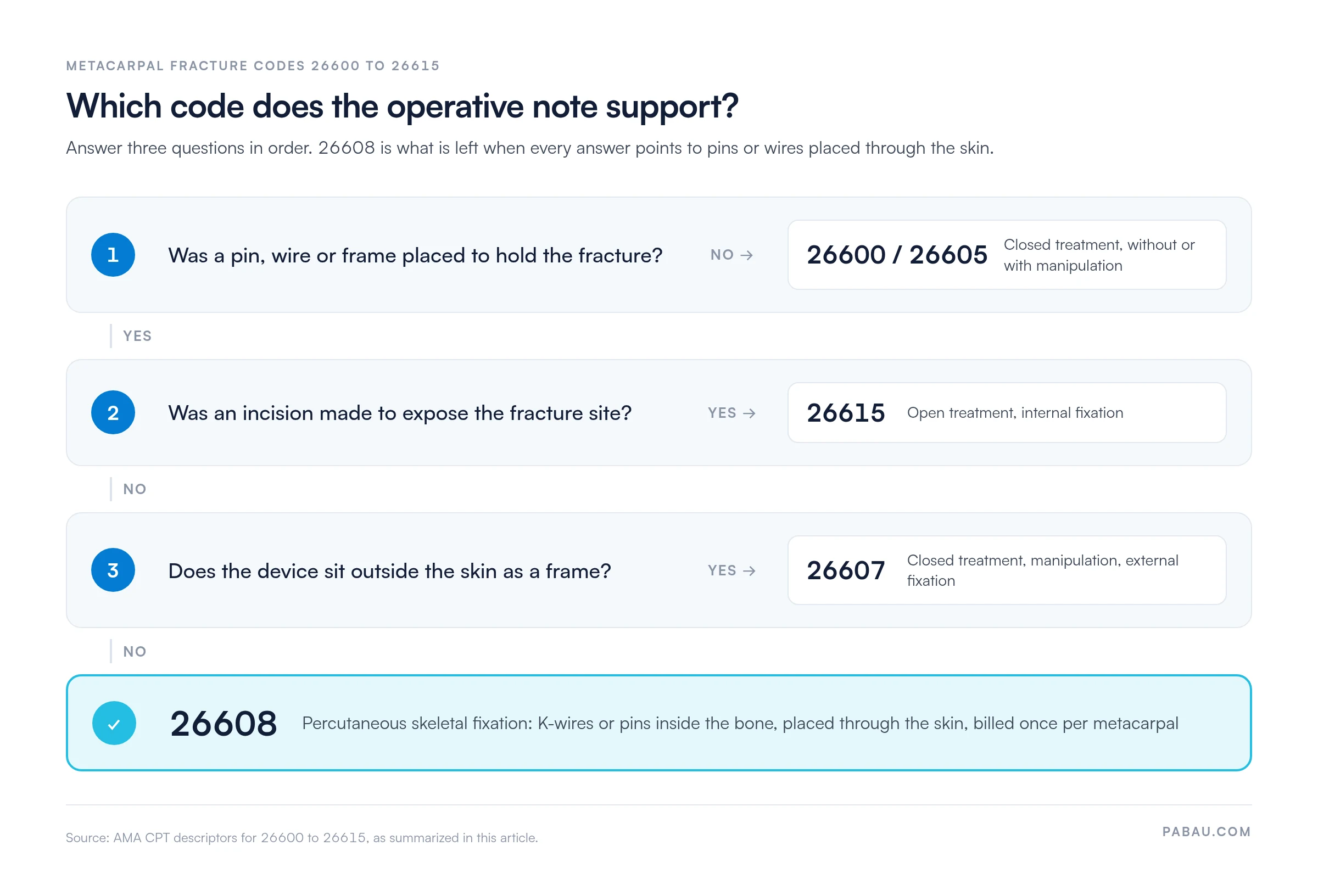
The operative note must establish percutaneous approach beyond any ambiguity. Payers audit this code for documentation that supports the “percutaneous” qualifier. Ensure the note addresses medical billing compliance requirements by including all of the following elements.
A clean surgical note focused on these points also makes submitting a clean claim faster. Coders can pull the key data straight from it instead of interpreting vague procedural language.
Every 26608 claim pairs with one of the ICD-10-CM codes in category S62, Fracture at wrist and hand level. The diagnosis must specify the metacarpal bone, fracture type, laterality, and encounter type. An initial encounter for a closed fracture takes the seventh character “A.” The pairings below reflect the most frequently billed scenarios.
Laterality errors are the most common ICD-10 mismatch behind a denial. The operative site on the claim must match the ICD-10 code’s laterality character. Verify right vs left against the operative report before submitting. For subsequent encounters (follow-up visits within the global period), append the seventh-character “D” rather than “A.”
When billing two metacarpals from the same session, each requires its own ICD-10 code with the correct bone and laterality. A single unspecified code (S62.309A) paired with two line items for 26608 is an audit trigger. Specificity at the diagnosis level matches the ‘each bone’ language of the CPT descriptor.
Applying the wrong modifier, or omitting a required one, is a frequent cause of 26608 denials. The table below covers the modifiers most relevant to hand fracture fixation.
Digit modifiers -F1 through -F9 are designed for finger-level procedures, so their use on metacarpal fixation varies by payer. Some Medicare Administrative Contractors (MACs) accept them when a finger procedure is billed in the same session. Others do not recognize them for metacarpal codes at all. Check the relevant Local Coverage Determination (LCD) before applying one.
The CMS 2026 relative value file gives 26608 a bilateral surgery indicator of 0, so the 150 percent bilateral payment adjustment does not apply. Bill each hand on its own line with -RT or -LT.
Prior authorization requirements for CPT 26608 vary significantly by payer type and plan. Orthopedic fracture fixation is generally classified as a surgical procedure, which means most commercial payers require pre-authorization, while Medicare generally does not for this code.
A prior authorization (PA) request should show why closed treatment (CPT 26605) was not enough. Document the degree of fracture displacement, rotational deformity, or instability that makes percutaneous fixation necessary.
Payers applying medical necessity criteria for surgical fixation typically look for angulation greater than 30 to 40 degrees or rotational malalignment. Verify the specific threshold in the applicable LCD or plan policy. Claims management software that tracks authorization status per procedure stops claims going out without a required PA number.
Medicare pays CPT 26608 under the Resource-Based Relative Value Scale (RBRVS). The three relative value unit (RVU) components below come from the CMS 2026 Medicare Physician Fee Schedule (MPFS) relative value file, October 2026 release. Use the CMS MPFS look-up tool to check the rate for your locality. Geographic practice cost indices (GPCI) adjust the final payment by region.
The facility and non-facility columns match because CMS flags the non-facility practice expense for 26608 as NA. That flag marks a service CMS does not expect in an office setting, so the file carries one total of 13.90 RVUs. At the 2026 conversion factor of $33.4009, that is about $464.27 nationally before GPCI.
Commercial payer rates vary considerably and are set by contract rather than the MPFS conversion factor. For a quick cross-check of the CMS figures, the FastRVU 2026 RVU look-up tool carries the same file.
A clearinghouse check before transmission catches mismatched procedure-diagnosis pairs before they turn into rate errors. The Claim.MD clearinghouse routes claims to thousands of US payers and flags missing or invalid details first.
CPT 26608 carries a 90-day global surgery period (CMS global indicator “090”). Understanding the medical billing fundamentals behind the global package prevents two errors. Underbilling misses a service you could bill separately, and overbilling charges for bundled visits without a modifier.
The global package includes the day before surgery, the procedure day itself, and 90 days of post-operative follow-up directly related to the fracture fixation. Routine follow-up visits, wire removal, and cast checks are all bundled and cannot be billed separately.
Three scenarios permit separate billing during the global period:
Wire removal is the most commonly overbilled service in the 26608 global period. If the wires are removed in the office or OR within 90 days of the original fixation, that service is bundled. No separate CPT code for removal is billable unless the payer has a specific exception policy.
Most CPT 26608 denials cluster around the six root causes below. Fixing each requires a different workflow adjustment, not just a corrected claim. Applying these prevention steps as part of a structured denial management workflow reduces rework and accelerates payment.
The approach documentation failure is the hardest to correct on appeal. If the note never says “percutaneous,” the payer has no record of how the wires went in. It can then deny the claim for documentation that does not support the code billed.
Without a system, catching these errors means a coder reading the operative note, the authorization letter and the claim form side by side. That check is easy to skip when a hand surgery list runs long.
Pabau, the practice management and billing platform we build, moves those checks into the billing workflow. Prior authorizations are stored as cases, so the authorization code follows the appointment onto the claim. A claim with no code attached is flagged before it leaves.
Claim validation then catches missing or invalid details before submission, and eligibility checks run through Claim.MD before the visit. Fewer 26608 claims come back asking for a fix you could have made on the day of surgery.

Pabau’s claim validation catches missing or invalid details before submission, and Claim.MD eligibility checks run before the visit. See how it works for orthopedic and hand surgery practices.

Treat the operative note as the first draft of the claim. A note that names the approach as percutaneous, numbers each metacarpal and lists the hardware holds 26608 up on audit. No modifier added later can repair a note that leaves those out.
The trade-off sits in the 90-day global period. Wire removal and follow-up fold into one payment, so the money is made or lost on the original claim.
Book a demo to see how Pabau’s claim validation and authorization tracking help hand surgery practices send 26608 claims out complete the first time.

Need to understand how claim denials are tracked and resolved? Denial management in healthcare explains the end-to-end workflow for identifying, appealing, and preventing claim rejections.
Want a primer on what makes a claim clean before submission? What is a clean claim? covers the key elements payers check before processing payment.
Looking for detail on the clearinghouse that validates your CPT submissions? Claim.MD clearinghouse outlines how electronic claim validation works across thousands of US payers.
Did the surgeon open the fracture site? CPT code 26615 covers open treatment of a metacarpal fracture, including internal fixation.
Treating a metacarpal fracture without fixation? CPT code 26600 covers closed treatment of a metacarpal fracture without manipulation.
CPT code 26608 covers percutaneous skeletal fixation of a metacarpal fracture, billed per bone treated. The code applies when a surgeon inserts K-wires, pins, or similar internal fixation devices through the skin without a formal incision to expose the fracture. It applies with or without a prior closed reduction.
CPT 26607 is closed treatment with manipulation and external fixation, while CPT 26608 is percutaneous internal fixation. The distinction is where the device sits. External fixation (26607) means the frame or pins remain outside the skin. Percutaneous fixation (26608) means the wire or pin is inside the bone, with only the cut end protruding.
CPT 26615 is open treatment of a metacarpal fracture, requiring an incision to expose the fracture site directly. CPT 26608 is percutaneous, meaning no formal incision is made. If the surgeon converts from a percutaneous approach to open intraoperatively, the correct code is 26615, not 26608.
Modifier -RT or -LT for laterality is required by most payers and should be appended to every CPT 26608 claim line. When two metacarpals are fixed in the same session, add modifier -51 to the second line item. Modifier -59 applies when 26608 is billed alongside a separate procedure at a distinct anatomical site.
CPT 26608 carries a 90-day global surgery period. Routine post-operative follow-up, cast changes, and wire removal within those 90 days are bundled into the procedure payment. Separate billing is permitted only with modifier -24 (unrelated E&M), -79 (unrelated procedure), or -78 (return to OR for complication).
Prior authorization requirements depend on the payer. Traditional Medicare generally does not require prior auth for CPT 26608, but Medicare Advantage plans, most commercial PPOs, and Workers’ Compensation payers typically do. Medicaid requirements vary by state. Always verify with the specific plan before scheduling the procedure.
ICD-10-CM codes from the S62.2xx-S62.3xx range (first and other metacarpal fractures) are the appropriate pairing for CPT 26608. The code must specify the metacarpal bone number, fracture type (displaced vs undisplaced, neck vs shaft vs base), and laterality. Its seventh character marks the encounter type, with “A” for an initial encounter.
When a planned percutaneous fixation requires conversion to an open approach during the case, CPT 26615 (open treatment of metacarpal fracture) replaces 26608. The operative note must document the conversion reason and confirm the fracture site was formally opened. Billing 26608 for a procedure that became open is a coding error that payers may audit.



