

CPT Code 30801: Superficial turbinate ablation billing guide
CPT Code 30801: Official descriptor and procedure overview The American Medical ...

Last Updated: Nov 27, 2026
W3202 is the CCSD code for open reduction and internal fixation wedge reconstruction bone graft scaphoid non-union. It covers surgery on an established scaphoid non-union. The surgeon fixes the bone and inserts a shaped wedge of graft to restore its length and correct the hump-back deformity.
W3202 sits in chapter 16 of the CCSD schedule, in the hand fixation and arthrodesis section. UK private medical insurers use it to pay the surgeon's fee. A cancellous graft without the wedge correction is coded W3200 instead, and early fixation of an acute fracture is W3203.
Let Pabau's smart automation suggest the right codes, reduce claim denials, and keep your practice compliant—effortlessly.
Automate repetitive tasks and focus on what matters most—your patients.
Reduce coding errors and ensure compliance with the latest regulations.
Clean claims, fewer denials, and faster reimbursements.
Powerful insights and reporting to help your practice thrive.
HIPAA compliant SOC 2 certified GDPR-compliant Trusted by 4,000+ clinics worldwide

CCSD code W3202 covers open reduction and internal fixation with a wedge reconstruction bone graft for scaphoid non-union. Simple fixation without a corrective graft takes a different code.
The operative note must describe the wedge reconstruction explicitly, or payers will reclassify the claim to a simpler fixation code.
Iliac crest graft harvest may attract a supplementary CCSD code, depending on insurer policy. Vascularized grafts take a separate W-code, so check the current schedule edition.
Pabau, a practice management platform, sends UK insurance claims through Healthcode and Bupa. It tracks the pre-authorization code on each case and warns staff when one is missing.
CCSD code W3202 describes open reduction and internal fixation with wedge reconstruction bone graft for scaphoid non-union. The code is listed in the official CCSD schedule, and its descriptor names three operative elements. All three must be present for the code to apply:
W3202 is a W-prefix code. The CCSD schedule places it in the Bones, joints and connective tissue chapter (chapter 16), in the hand fixation / arthrodesis section. Its neighbor W3200 covers fixation of a non-union with a cancellous bone graft, without the wedge reconstruction. W3203 covers early fixation of an acute scaphoid fracture, within six weeks of the fracture.
A vascularized graft, where the blood supply to the graft is preserved, takes a different code again. W3202 is used only in UK private medical insurance billing. It has no equivalent in NHS tariff, CPT, or HCPCS coding.
Each surgical step maps to an element of the W3202 descriptor, so the operative note has to describe all of them.
A W3202 claim survives audit only when the operative note covers each of these steps. A note that describes fixation without the wedge shaping and graft insertion will not support the code.
W3202 applies when the clinical picture shows an established non-union, rather than a recently failed fixation or an acute fracture. Hand surgeons generally treat the following as indications for wedge grafting.
W3202 does not fit acute scaphoid fractures, or simple delayed unions managed with percutaneous screw fixation alone. It also does not fit SNAC stage III–IV, where salvage procedures such as proximal row carpectomy or four-corner fusion are indicated instead.
Graft billing is where W3202 claims most often go wrong. The answer depends on the graft source and the insurer’s schedule policy.
Iliac crest graft harvest rules are not universal. Some insurers bundle iliac crest bone graft (ICBG) harvest into the primary procedure fee. Others pay it as a separate CCSD code when it is performed through a separate incision. Check the insurer’s current schedule, and get written pre-authorization before billing the additional code.
Always document the graft donor site, harvest technique, and graft dimensions in the operative note, even when you believe the harvest is bundled. If the insurer later queries the harvest, that record is the only evidence you have.
W3202 covers non-vascularized wedge bone graft techniques. A vascularized bone graft (VBG) raises and preserves a vascular pedicle alongside the bone. The most common is a pedicled graft based on the 1,2 intercompartmental supraretinacular artery (1,2 ICSRA), known as the Zaidemberg graft. It is a technically distinct and more complex procedure.
Billing W3202 for a vascularized graft case undercodes the operation, because the vascularized code is the more complex and typically higher-fee code. The operative note must state whether the graft was vascularized, because payers cannot tell from the CCSD code alone.
Knowing the codes on either side of W3202 tells coders when a supplementary or alternative code fits better. The graft recorded in the operative note is what routes the claim.
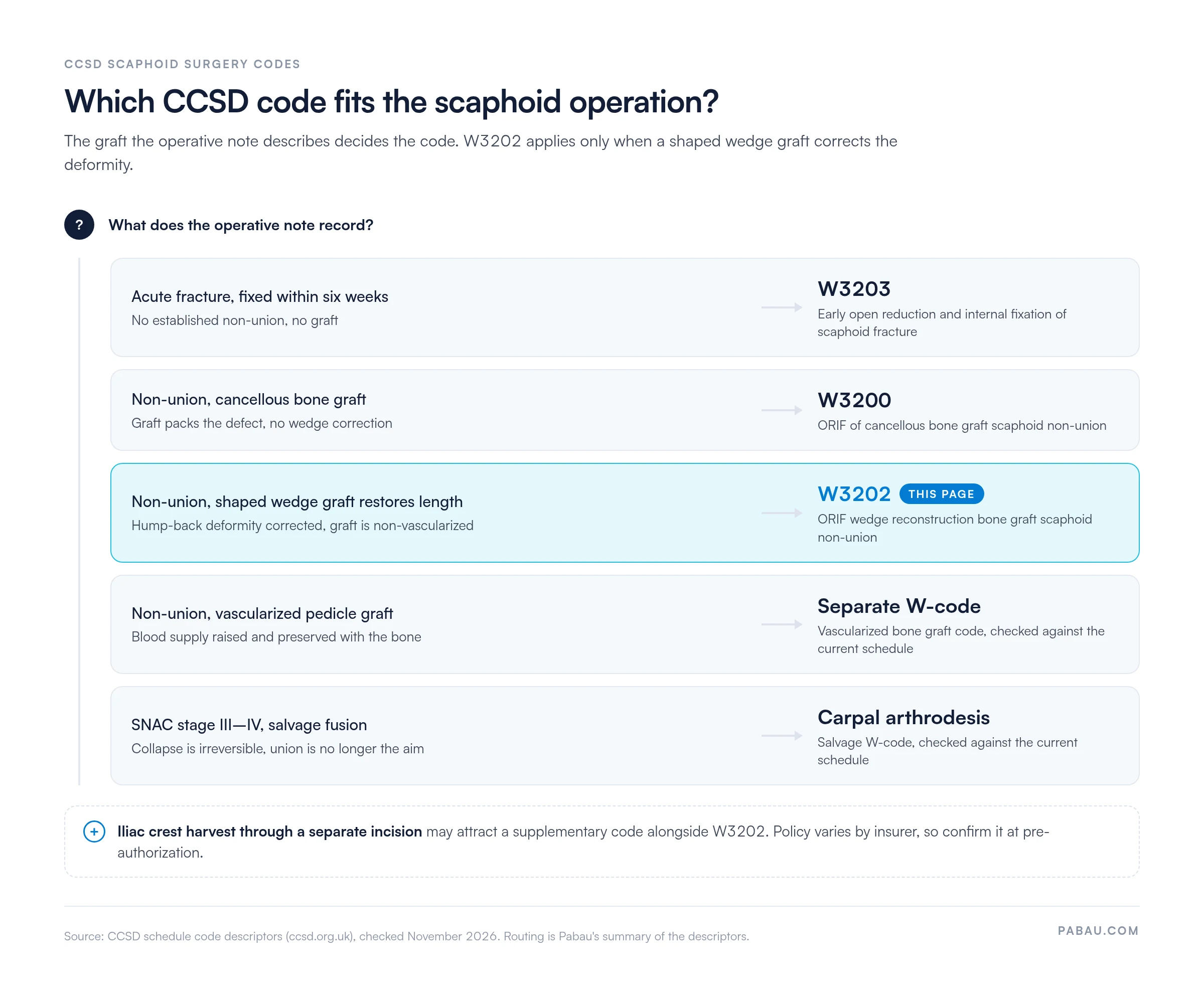
CCSD code numbers for adjacent procedures change between schedule editions. Always check the code number against the current CCSD schedule rather than printed references or software libraries that may lag behind. The CCSD codes hub collects billing guides for other procedures in the schedule.
A valid W3202 claim needs documentation that supports every component of the code descriptor. Payers such as Bupa, AXA Health and Aviva audit surgical claims against the operative note. A note that mentions fixation but not wedge reconstruction leads to reclassification or rejection.
The operative note must address each of the following points. A structured operative note template can prompt the surgeon to cover each one before the note is finalized.
Major UK private medical insurers treat W3202 as an elective surgical procedure that needs pre-authorization before the operation. A claim without a valid pre-auth reference number is one of the fastest routes to denial.
Most insurers ask for the same evidence bundle:
Each insurer runs its own route for pre-auth requests. Examples include the Bupa code search and pre-auth portal, AXA Health’s specialist procedure portal, and the Aviva fee schedule and provider portal.
Allow at least five to ten working days for pre-auth decisions on complex orthopedic cases. For iliac crest harvest or implant passthrough costs, get written confirmation that those elements are approved. Verbal confirmation is not enough for billing. The Bupa CCSD billing guide covers the pre-auth workflow specific to Bupa.
Most scaphoid ORIF denials are preventable. The root causes cluster around four recurring failures.
The headless compression screw used in W3202 is a significant implant cost. Typical choices are a Herbert, Acutrak 2 or Synthes headless compression screw. Whether it is paid as a passthrough or bundled into the procedure fee depends on the insurer.
Bupa and AXA Health generally require pre-authorization of implant passthrough costs above a threshold set in their current fee schedules. The original supplier invoice goes in alongside the claim. Aviva and Healix apply their own passthrough eligibility criteria, and the Healix fee schedule includes guidance on implant passthrough for orthopedic procedures.
Some insurers cap the reimbursable implant value or make the hospital absorb costs above the cap. Never invoice an implant passthrough without written approval. Billing it after the fact is a leading cause of partial payment on W3202 claims.
K-wire fixation, used instead of a compression screw in some revision or staged cases, is typically treated as a consumable. It is bundled into the procedure fee rather than paid as a passthrough implant.
Request the insurer’s implant passthrough limit in writing at the pre-auth stage. If the screw cost exceeds the cap, discuss the shortfall with the patient before the procedure, not after the claim is partially settled.
The anesthetist bills under a separate CCSD code and invoices independently of the surgeon. CCSD anesthetic codes for orthopedic procedures are time-based. The fee is calculated from the procedure’s duration, converted to base units plus time units, then multiplied by the insurer’s conversion factor.
W3202 cases typically run for 90 to 150 minutes of anesthetic time, depending on graft source and fixation complexity. The anesthetist should record start and stop times and confirm the CCSD anesthetic code with the insurer at pre-auth. Some insurers cap anesthetic fees for specific surgical categories, so check that before agreeing to treat at network rates.
A W3202 claim passes between the surgeon, the billing administrator and the insurer at four points. Those are pre-authorization, the operative note, the implant invoice and the claim itself. When each sits in a separate inbox or spreadsheet, a missing auth code often surfaces only after the insurer rejects the claim.
In Pabau, the pre-authorization code, its dates and the approved sessions sit on the patient’s case. Staff get a warning when the code is missing. The operative note, consent forms and imaging letters live on the same patient record. Claims go to UK insurers through Healthcode and Bupa, using Pabau’s claims management software.
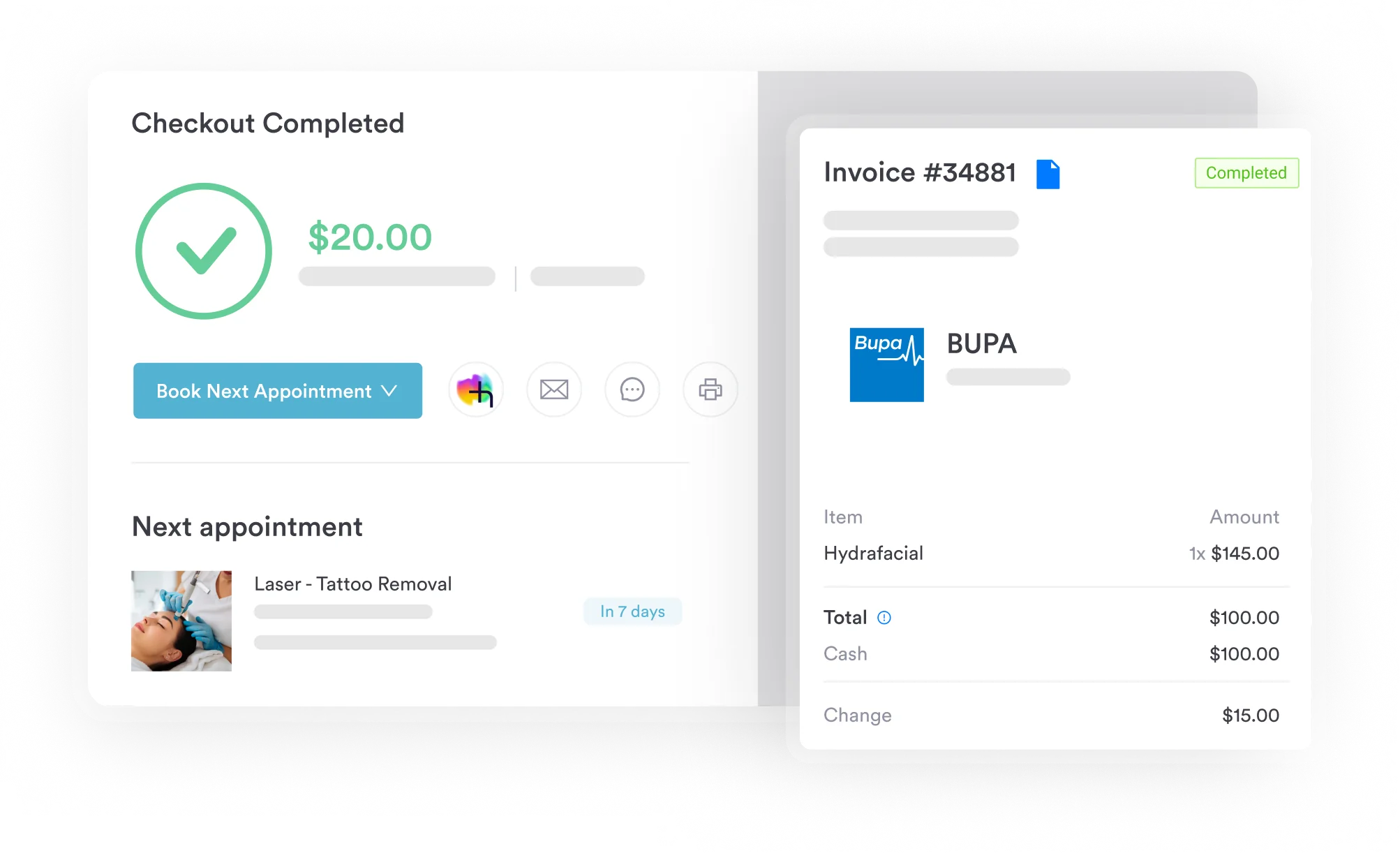
Your billing team checks one record before submission instead of chasing three people for paperwork. Fewer claims reach the insurer without the auth code or the evidence it asks for.

Pabau tracks the pre-authorization code on each case and warns your team when one is missing. Claims then go to UK insurers through Healthcode from the same patient record.

Treat the wedge as the line between W3202 and W3200. If the operative note records the shaped graft and the angle it corrected, the code stands. If it records only a graft and a screw, expect the insurer to pay the simpler code.
The cheapest fix happens before surgery. Settle the graft source, any iliac crest harvest and the implant passthrough at pre-authorization, in writing. Each item agreed up front is one fewer query after the claim goes in.
Book a demo to see how Pabau keeps pre-authorization codes, operative notes and Healthcode claims together for UK orthopedic practices.

Billing a Bupa-funded case? Bupa CCSD codes guide covers code lookup, fee schedule navigation, and submission requirements for Bupa-funded cases.
Was the non-union grafted without a wedge? CCSD code W3200 covers open reduction and internal fixation with a cancellous bone graft.
Managing a non-union with an external frame? CCSD code W3040 covers an Ilizarov frame for secondary non-union and mal-union.
CCSD code W3202 covers open reduction and internal fixation with wedge reconstruction bone graft for scaphoid non-union. It applies when a surgeon exposes a failed scaphoid union and inserts a shaped structural autograft to correct angular deformity. A headless compression screw or K-wire then secures the construct. All three elements must be performed and documented for the code to apply.
Distal radius graft harvest is typically bundled within W3202. Iliac crest bone graft (ICBG) harvest may be separately billable under a supplementary CCSD code. This varies by insurer and schedule edition, so confirm with the payer before billing it. Never assume a universal bundling rule.
A vascularized bone graft is not covered by W3202, which is specific to non-vascularized wedge graft techniques. A pedicled vascularized graft, such as the 1,2 ICSRA graft, takes a separate CCSD code. Check the exact code against the current schedule edition, because code numbers change between releases.
Major UK private medical insurers, including Bupa, AXA Health, Aviva, Vitality Health and Healix, require pre-authorization for W3202 as an elective orthopedic procedure. Submit imaging evidence, the consultant letter and the proposed CCSD code before scheduling. Operating without a pre-auth reference number on file is the fastest route to claim denial.
W3202 claims are usually denied for one of four reasons. The operative note leaves out the wedge graft shaping, or the pre-authorization reference is missing. Imaging evidence may not be attached, or implant passthrough costs were never approved. Structured documentation and pre-auth workflows prevent each one.
W3202 may apply to revision cases where the surgeon again performs open reduction, internal fixation and wedge bone graft reconstruction for a persistent non-union. The clinical justification and operative note requirements are the same as for primary cases. If the revision is a different procedure, such as proximal row carpectomy, a different CCSD code applies. Check the scenario against the current schedule.




