CCSD Code G3100: Laparoscopic biliary gastric bypass billing guide
CCSD Code G3100: Definition and Surgical Scope CCSD Code G3100 is the Classifica...

Last Updated: Nov 25, 2026
T8580 is the CCSD code for block dissection of pelvic lymph nodes (as sole procedure). It is used when the pelvic nodes are cleared on their own, usually to stage a pelvic cancer, with no resection at the same episode.
It sits in the lymphatic system section of chapter 9 of the CCSD schedule. UK private medical insurers such as Bupa, AXA Health, Aviva and Vitality use it on claims submitted through Healthcode. Bupa bands it MAJOR 4.
Let Pabau's smart automation suggest the right codes, reduce claim denials, and keep your practice compliant—effortlessly.
Automate repetitive tasks and focus on what matters most—your patients.
Reduce coding errors and ensure compliance with the latest regulations.
Clean claims, fewer denials, and faster reimbursements.
Powerful insights and reporting to help your practice thrive.
HIPAA compliant SOC 2 certified GDPR-compliant Trusted by 4,000+ clinics worldwide

CCSD Code T8580 covers block dissection of the pelvic lymph nodes, billed only when no other operation takes place at the same episode.
When the dissection is part of a radical hysterectomy, prostatectomy, cystectomy or exenteration, the resection code covers it and T8580 stays off the claim.
Laparoscopic, robotic, para-aortic, inguinal and sentinel node procedures each have their own CCSD code, so the operative note must name the nodes and the approach.
Most UK private medical insurers expect pre-authorisation before T8580, and a missing authorisation number is a common reason for a rejected claim.
Pabau, a practice management platform, records CCSD codes, tracks the authorisation on the case and sends claims through Healthcode and Bupa.
CCSD Code T8580 covers block dissection of pelvic lymph nodes performed as the sole operative procedure at an episode of care. The National Friendly schedule of fees lists it as “Block dissection of pelvic lymph nodes (as sole procedure)” in the Major complexity band. Bupa bands it MAJOR 4.
The CCSD (Clinical Coding and Schedule Development) Group maintains the schedule, and T8580 sits in the lymphatic system section of chapter 9. The descriptor separates it from operations where pelvic lymphadenectomy is part of a larger cancer resection. Our CCSD codes for surgeons library covers the rest of that chapter.
The nodes cleared under this code are usually the obturator, internal iliac and external iliac groups, depending on the clinical context. Para-aortic and inguinal nodes have separate CCSD codes. So the operative note should name each nodal group removed, which is what justifies T8580 over a neighbouring code.
CCSD codes are used in UK private healthcare billing. NHS settings use OPCS-4 procedure codes instead. Private medical insurers (PMIs) such as Bupa, AXA Health, Aviva, Vitality and WPA code and price claims against the CCSD schedule.
Bupa’s code search shows how Bupa treats each code. For Bupa’s own coding rules, see Pabau’s Bupa CCSD code guidance.
Block dissection of pelvic lymph nodes as a sole procedure comes up most often in cancer staging and restaging. The patient has a known or suspected pelvic malignancy and needs a dedicated lymph node assessment. No primary resection takes place at that surgical episode.
Common clinical indications include:
In each of these scenarios, the operative intent is pelvic lymph node assessment alone. The absence of a primary resection is what makes T8580 the correct code, so the operative note has to say so plainly.
The phrase “as sole procedure” in the T8580 descriptor is a billing constraint written into the code itself. T8580 can only be submitted when the pelvic node dissection is the only significant procedure at that operative episode.
The qualifier exists because pelvic lymph node dissection is a standard step in several major cancer resections. A radical hysterectomy usually includes pelvic lymphadenectomy. Radical prostatectomy and radical cystectomy routinely include pelvic node dissection too. In those operations the dissection is bundled into the resection code, so T8580 does not appear on the claim.
The qualifier does two jobs. It defines when T8580 applies, which is only when no resection code covers the same operative territory. It also prevents unbundling, where the steps of a larger operation are claimed as separate codes. Insurers reject unbundled claims, and repeated unbundling can become a compliance matter with the insurer.
PMI medical reviewers read the operative documentation on a sole-procedure lymph node dissection closely. An incomplete record is a common reason for a query, a downgrade or a rejection. These are the elements a T8580 claim needs.
A structured operative note template captures these elements at the point of care. That way an incomplete record is caught in theatre, not at the claims stage.
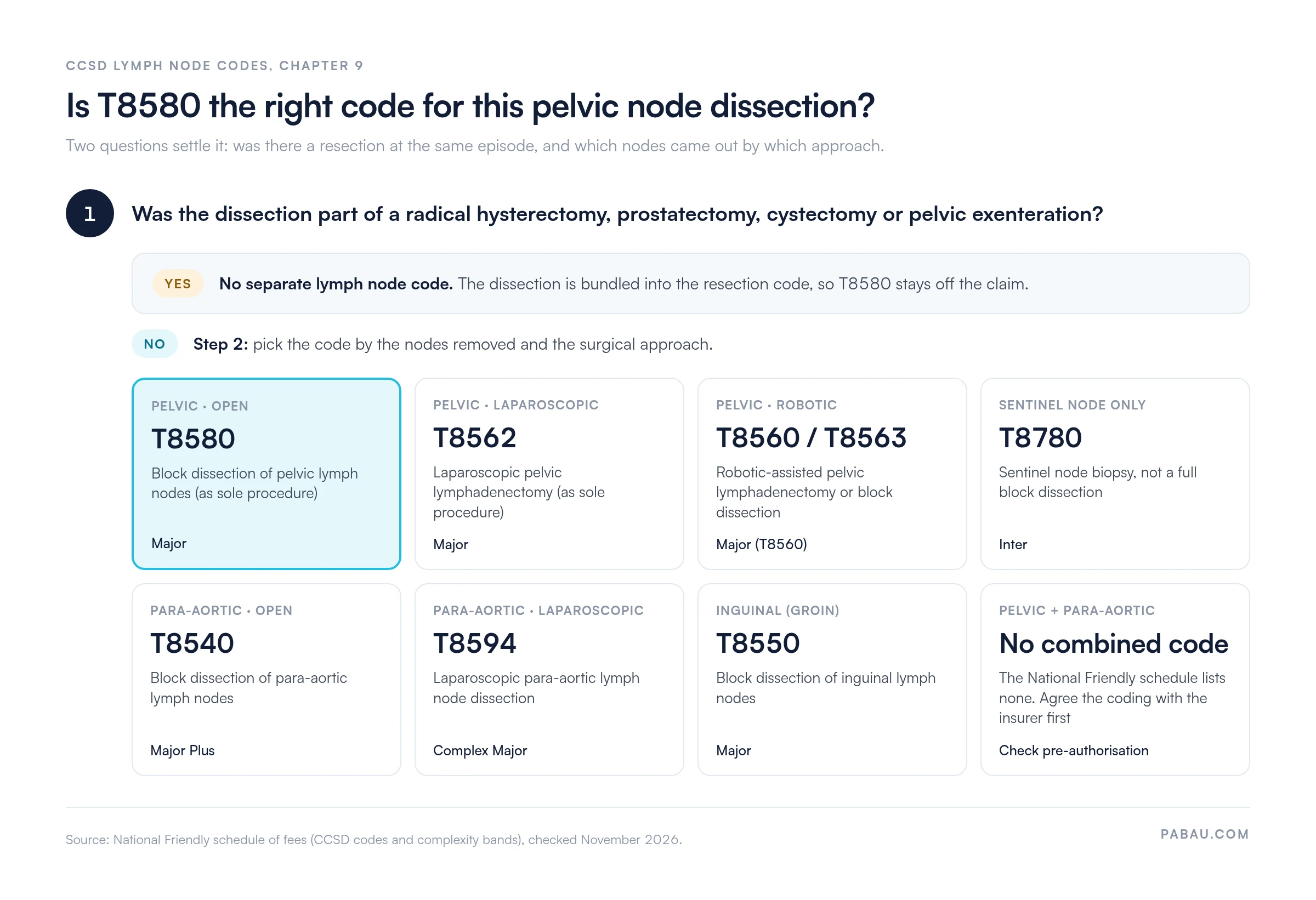
Several neighbouring CCSD codes cover lymph node procedures in the pelvis and abdomen. Choosing the wrong one is a frequent reason for queries from PMI medical reviewers. The descriptors and complexity bands below come from the National Friendly schedule of fees.
Two questions settle the code: whether a resection happened at the same episode, and which nodes came out by which approach. Keyhole para-aortic work, for example, is billed as T8594 rather than T8580. The chart below walks through both questions.
Confirm every code against the current CCSD schedule, which the CCSD Group’s official site makes searchable once you register. Insurer code lookups, such as Bupa’s, may also show which code combinations each insurer accepts.
CCSD bundling rules stop a step that forms part of a larger operation from being claimed as its own code. For T8580, that means the code is not billed when the pelvic node dissection is part of any of these procedures.
When a combination is unclear, check the current CCSD technical guide and confirm with the PMI before submission. Bundling rules can change between schedule updates.
Check the current CCSD bundling rules before you submit T8580 alongside any other pelvic procedure code. Bundling policies change periodically, and a pairing an insurer accepted last year may now trigger a query from its medical reviewer.
Most major UK private medical insurers require pre-authorisation before T8580 is performed and claimed. Because the procedure is part of a cancer pathway, they usually ask for clinical justification before they approve it. A T8580 claim without a valid pre-authorisation reference is likely to be rejected.
A pre-authorisation request usually needs the following clinical information:
Pre-authorisation requirements vary by insurer, so check them with each PMI you bill. The Vitality Health fee finder and the WPA medical fees portal publish what each insurer pays per CCSD code. Healthcode is the electronic platform most UK PMIs use to receive CCSD-coded claims.
Practices that treat both NHS and private cancer patients should build pre-authorisation into scheduling. Confirming the authorisation when the procedure is booked prevents most rejections before they happen.
T8580 claims are rejected for a predictable set of reasons. Knowing them in advance lets practice teams prevent most through documentation and pre-submission checks.
The T8580 descriptor does not say whether the dissection is unilateral or bilateral, and coders often ask which applies. In standard cancer practice, a pelvic block dissection is almost always bilateral, because staging needs both sides of the pelvis. CCSD has no bilateral modifier for T8580. Even so, insurers do not all treat bilateral and unilateral dissections the same way.
How to handle laterality under T8580:
The CCSD publishes no definitive guidance on this point. Settle the bilateral question with each PMI during the pre-authorisation conversation.
Every T8580 claim carries an ICD-10 diagnosis code that supports an isolated pelvic lymph node dissection. The diagnosis links the procedure to the underlying malignancy and shows staging as the operative intent. A generic or mismatched code is a common reason for a rejection.
Use the most specific ICD-10 sub-code available. UK private healthcare codes diagnoses with WHO ICD-10, and the NHS Classifications Browser holds the UK fifth edition that PMIs read alongside CCSD codes.
Healthcode is the UK’s private healthcare billing network, and most PMIs receive CCSD-coded claims through it. A clean T8580 submission lines up the code, the pre-authorisation and the diagnosis before it is sent.
Today many surgical practices keep the operative note in one place, the authorisation in an email and the claim in a billing portal. Each hand-off is a chance for the sole-procedure statement or the authorisation number to go missing.
Pabau’s insurance claims management keeps the steps in one record. The authorisation code and its dates sit on the patient’s case, with a warning when one is missing. The CCSD code and diagnosis go onto the claim, and the claim is sent through Healthcode or Bupa.
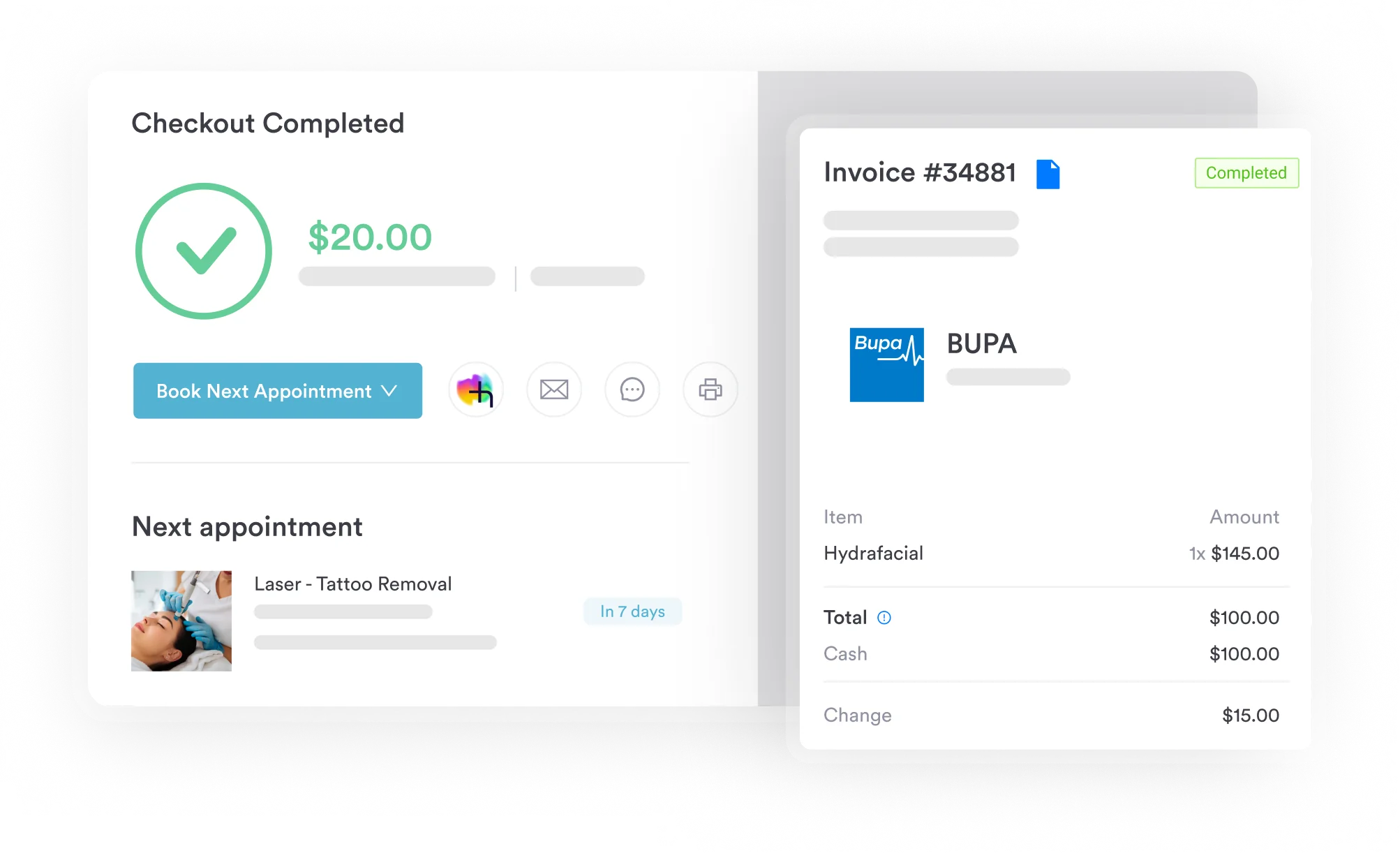
The result is fewer claims bounced back for a missing reference or a mismatched code. Your billing team spends less time chasing insurers across several systems.

Pabau tracks the pre-authorisation on each case and sends CCSD-coded claims through Healthcode and Bupa. See how private surgical practices cut rejected claims.

T8580 is a narrow code, and the claim rests on one line in the operative note. That line says the pelvic nodes were cleared and nothing else was done. Write that sentence, name the nodal groups and the side, and most queries never arrive.
Some cases are less tidy, such as a keyhole approach or para-aortic nodes taken at the same sitting. Settle the code for those with the insurer at pre-authorisation. A question asked before theatre costs a phone call. The same question after a rejection costs weeks.
Book a demo to see how Pabau keeps the authorisation, the CCSD code and the claim together for your surgical patients.

CCSD Code T8580 covers block dissection of pelvic lymph nodes performed as a sole procedure. The pelvic lymphadenectomy is the main operative intent of that episode, and no cancer resection takes place at the same time.
T8580 applies when the pelvic node dissection is done on its own. Typical reasons are cancer staging before or after treatment, restaging, or a pathway where radiotherapy replaces surgery. When the dissection accompanies a radical hysterectomy, prostatectomy or cystectomy, the resection code covers it and T8580 is not added.
Most major UK private medical insurers, including Bupa, AXA Health, Aviva, Vitality and WPA, expect pre-authorisation for T8580. Requirements vary by insurer and can change between policy years. Confirm them directly with the PMI before the procedure date.
Yes. The T8580 descriptor does not distinguish unilateral from bilateral dissection, and standard cancer practice is bilateral. Most PMIs read T8580 as covering a bilateral dissection at a single episode. Do not submit it twice on one claim unless the insurer tells you to, and record the laterality in the operative note.
The most common reasons are a missing or expired pre-authorisation and a bundling violation. A bundling violation means T8580 was added to a resection that already includes the dissection. Others are an operative note that does not confirm the sole procedure, and a non-specific ICD-10 code that does not justify an isolated dissection.
T8580 covers a formal block dissection, where the whole nodal territory is removed. Sentinel node biopsy (T8780) removes only the first one or few nodes that drain the tumour. Billing T8780 for a full dissection undervalues the work, and billing T8580 for a sentinel biopsy overstates it.