CCSD code L6530: Revision femoral bypass graft
CCSD code L6530: Definition and clinical scope CCSD code L6530 carries the offic...

Last Updated: Nov 13, 2026
P2310 is the CCSD code for anterior +/- posterior colporrhaphy (including primary repair of enterocele) (including cystoscopy). UK private insurers use it for vaginal prolapse surgery that always repairs the front wall, with or without the back wall.
A first-time enterocele repair and any same-episode cystoscopy are part of the code, so neither is billed separately. A posterior repair alone is P2230, and colporrhaphy with vaginal hysterectomy is P2380.
Let Pabau's smart automation suggest the right codes, reduce claim denials, and keep your practice compliant—effortlessly.
Automate repetitive tasks and focus on what matters most—your patients.
Reduce coding errors and ensure compliance with the latest regulations.
Clean claims, fewer denials, and faster reimbursements.
Powerful insights and reporting to help your practice thrive.
HIPAA compliant SOC 2 certified GDPR-compliant Trusted by 4,000+ clinics worldwide

CCSD code P2310 is anterior +/- posterior colporrhaphy (including primary repair of enterocele) (including cystoscopy), in CCSD section 14.4 Vagina/Perineum.
Primary enterocele repair and same-episode cystoscopy are inside P2310, so neither goes on the claim as a second line.
CCSD lists M4510, M4514, P1300, P2210, P2230, P2340, Q0830 and Q0890 as unacceptable combinations with P2310.
Colporrhaphy done with a vaginal hysterectomy has its own codes, P2380 and P2390, rather than P2310 plus a hysterectomy code.
CCSD codes carry no modifiers, so get pre-authorisation for the exact code and make the operative note match it.
CCSD code P2310 is the UK private-practice code for anterior +/- posterior colporrhaphy (including primary repair of enterocele) (including cystoscopy). The surgeon repairs the front vaginal wall, and the back wall too where needed. In addition, a first-time enterocele repair and any cystoscopy in the same case are part of the code.
The code sits in Chapter 14 of the CCSD schedule, Female reproductive organs, in section 14.4 Vagina/Perineum. The Clinical Coding and Schedule Development Group maintains the schedule. UK private insurers such as Bupa, AXA Health, Aviva and Vitality use it, and you can find neighbouring CCSD codes in our code library.
Read the “+/-” in the descriptor carefully. P2310 fits an anterior repair on its own, or an anterior repair with a posterior repair in the same surgery. However, a posterior repair with no anterior repair is a different code, P2230.
First, anterior colporrhaphy corrects a cystocele, where the bladder bulges into the front vaginal wall. Posterior colporrhaphy, in contrast, corrects a rectocele in the back wall. Finally, an enterocele is small bowel herniating into the upper vagina. A fistula between the bladder and the vagina is a different repair, coded P2510. One between the urethra and the vagina is coded P2520. Rebuilding the vagina itself, rather than repairing a wall, is billed as P2100.
P2310 includes:
P2310 does not cover:
The word “primary” matters. CCSD names primary enterocele repair inside P2310 and says nothing about a recurrent one. So if the enterocele has come back after earlier surgery, ask the insurer how it wants the case coded before you submit.
The usual P2310 error is choosing a code one row away in section 14.4. The descriptors and bands below come from AXA Health’s published CCSD-based specialist schedule, which we checked in November 2026. However, P2390 is not on AXA’s schedule, so its descriptor comes from National Friendly’s schedule of fees.
Ask three questions about the operative note, in the order below, and the choice settles itself.
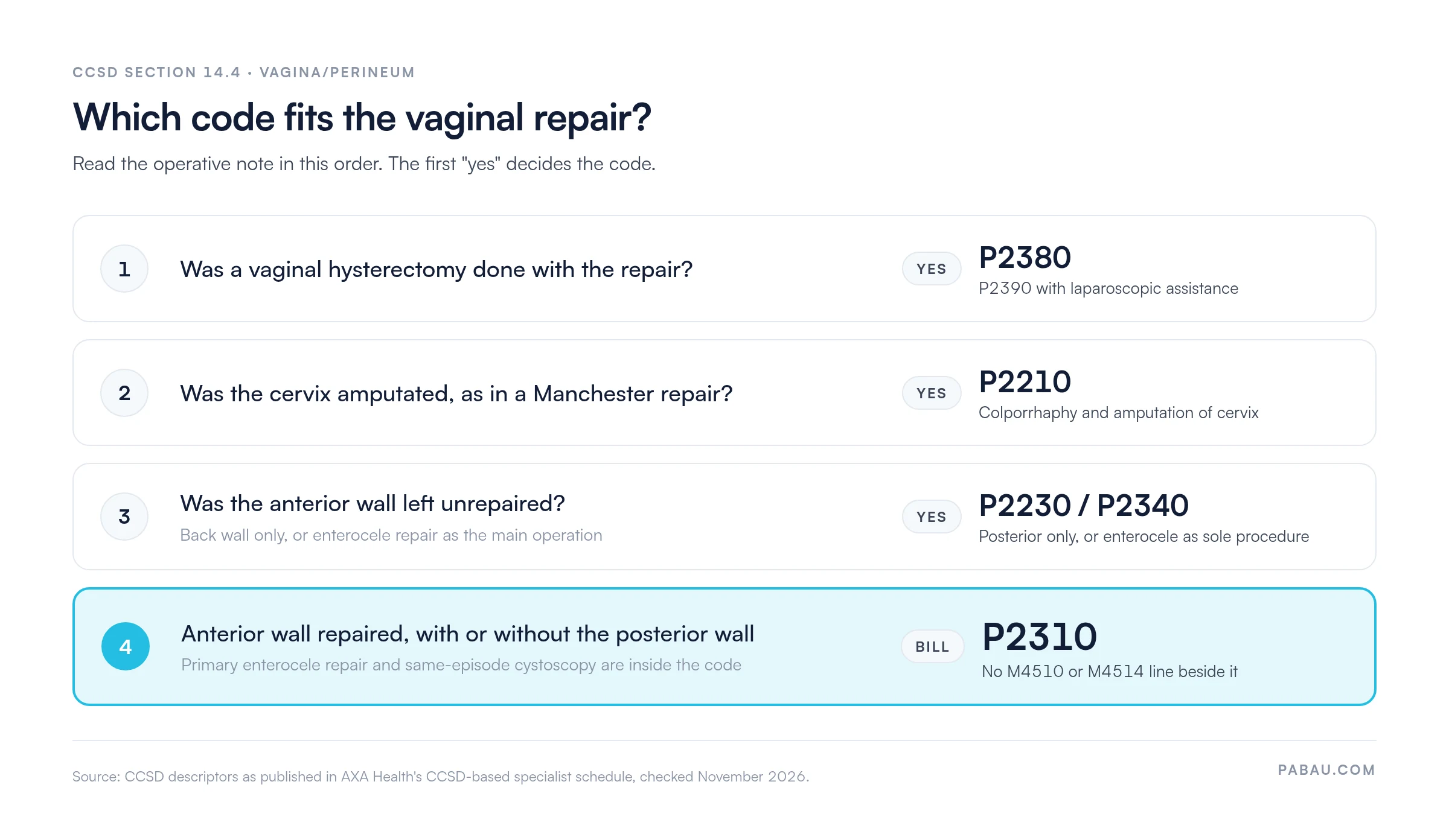
Our M4510 billing guide covers flexible cystoscopy when it is the only procedure. However, once the scope is part of a colporrhaphy, it belongs to P2310.
First, CCSD lists unacceptable combinations for P2310. If you bill one of these beside it in the same case, the insurer will reject the line or cut it back to a single code.
In fact, AXA Health’s own list for P2310 goes further. It also blocks P2380, Q0800 (vaginal hysterectomy without laparoscopic assistance), and the bladder outlet support codes M5100 and M5300. Each insurer decides which combinations it adopts, so check the payer’s list before you add a second code.
CCSD codes have no modifiers. There is no multiple-procedure or bilateral modifier to add, so the code you choose has to describe the whole operation on its own.
UK insurers use WHO ICD-10, not the US ICD-10-CM, so the N81 female genital prolapse category holds the codes that often support a P2310 claim.
So, code each compartment the note records. For example, a combined cystocele and rectocele repair carries N81.1 and N81.6, with N81.5 added if the surgeon closed an enterocele. Then quote the same codes on the approval request and the invoice.
Insurers read the operative note against the descriptor. For example, a note that says only “pelvic floor repair” doesn’t show that the front wall was repaired, so the claim gets queried. Where the note describes a repair of the perineal body alone, the code is P1300 instead.
For P2310, the operative note should record:
Colporrhaphy is planned surgery, so the patient’s insurer must authorise it before the hospital stay. UK insurers expect members to call before any planned surgery. Our guide to Bupa CCSD codes covers how Bupa handles recognition and fees.
Next, here is what the approval request should carry:
If the plan changes in theatre, call the insurer afterwards and have the insurer amend the approval. Otherwise, a claim that uses a different code from the authorised one often stalls payment.
Because a colporrhaphy produces several invoices from one hospital stay, each party then bills its own part against the same procedure code.
Specialist invoices often go online through Healthcode or the insurer’s own portal. However, fees depend on the insurer and your recognition status. For example, AXA Health’s contracted schedule lists P2310 at £570 for the procedure and £285 for anaesthesia, as we checked in November 2026.
For a self-pay patient, though, your own fee schedule applies, and P2310 is just the reference on the invoice. For an insured patient, however, check the insurer’s shortfall rules before billing the patient for any difference.
Take a sample case. A patient has a symptomatic cystocele and rectocele, with a small enterocele seen at the exam. The consultant plans an anterior and posterior repair and obtains pre-authorisation for P2310.
First, in theatre, the surgeon repairs both walls and closes the enterocele sac. Next, a cystoscopy after the anterior repair confirms the bladder is intact. Finally, the operative note records all three steps.
As a result, the surgeon bills P2310 alone, with N81.1, N81.6 and N81.5 as the diagnoses. The cystoscopy stays off the claim because M4514 is an unacceptable combination. In contrast, had the surgeon also removed the uterus vaginally, the code would have been P2380.
When a P2310 claim fails, the reason is often one of these.
You can often appeal these with the operative note. To do so, write a short cover letter that ties the evidence to the descriptor.
When a colporrhaphy claim stalls, the cause is often paperwork. For example, the approval sits in an email, the operative note sits in the hospital system, and the invoice gets typed up days later.
Pabau, the practice management platform we build, instead keeps those pieces on one patient record. Its clinical records hold the operative note and exam findings, and digital forms collect consent before the hospital stay. Your invoice to the insurer comes from that record, and Pabau’s claims management software then sends it through Healthcode.
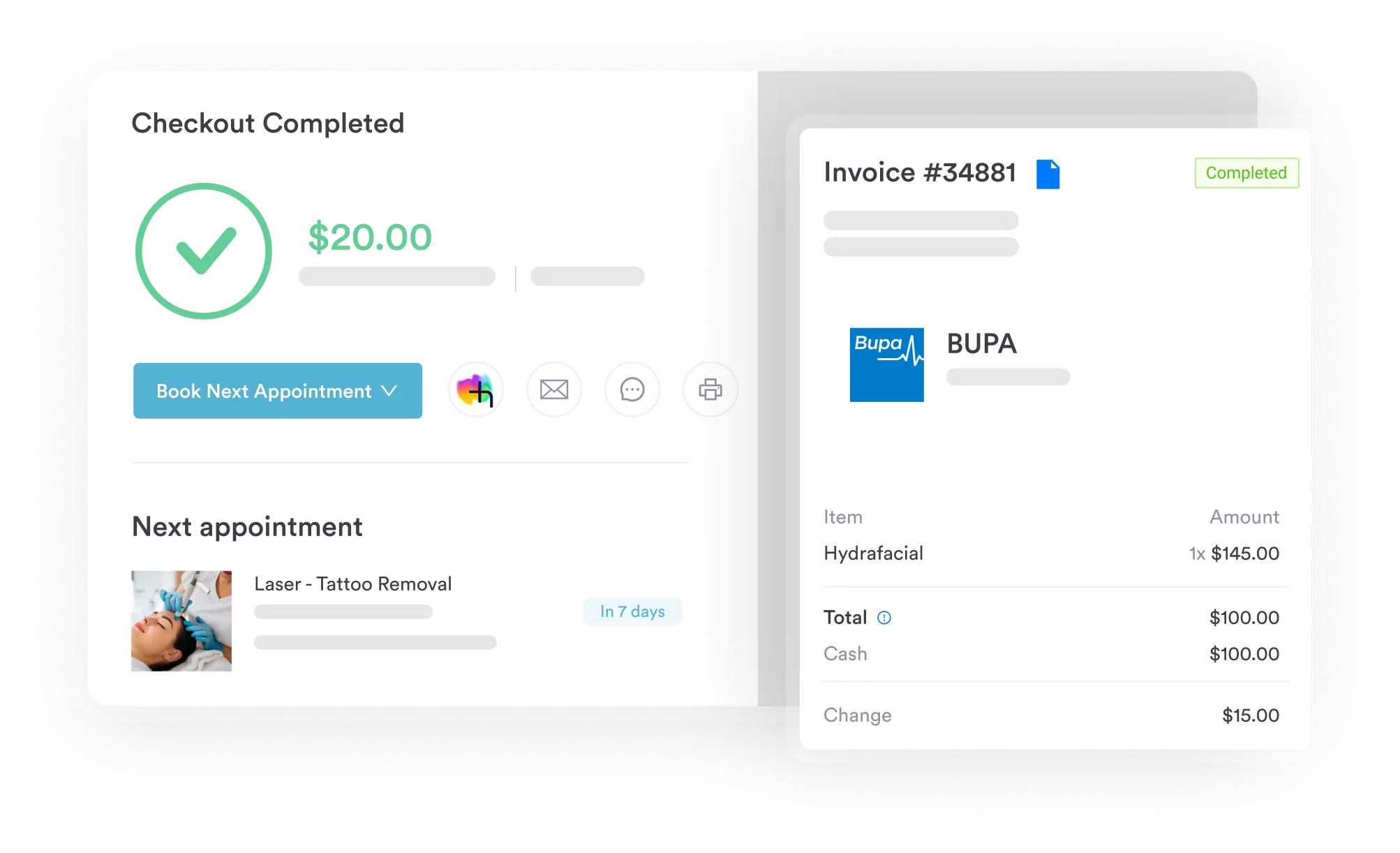
As a result, you get fewer queries about missing numbers and quicker payment for your surgical work.

Pabau keeps authorisation numbers, consent and operative notes on one record, then sends the insurer invoice through Healthcode.

P2310 is a vaginal repair code with a precise descriptor. So bill it when the front wall was repaired, with or without the back wall, and no cervix or uterus came out. Keep the cystoscopy and the enterocele repair off the claim as separate lines.
Also, get the approval for the same code you will invoice, and make the operative note name each wall repaired. Do both, and the insurer has no paperwork reason left to query the claim.
Book a demo to see how Pabau keeps each surgery claim and its proof on one patient record.

Need the full Bupa coding picture? Bupa CCSD codes explains how the CCSD schedule works with Bupa claims, recognition and fees.
Was the enterocele the main surgery? CCSD code P2340 covers enterocele repair as a sole procedure.
Was it a diagnostic cystoscopy only? CCSD code M4510 covers flexible cystoscopy and when a biopsy stays inside the code.
Is bladder outlet surgery planned in the same case? CCSD code M5100 covers combined abdominal and vaginal bladder outlet surgery.
UK private insurers, and the specialists and hospitals that bill them. CCSD stands for Clinical Coding and Schedule Development, and its schedule is the shared procedure code set for UK private healthcare.
No. CCSD lists posterior colporrhaphy, P2230, as an unacceptable combination with P2310. Bill P2230 on its own only when no anterior repair was done.
No. The P2310 descriptor includes cystoscopy, and CCSD lists M4510 and M4514 as unacceptable combinations with it.
P2380 covers anterior (+/- posterior) colporrhaphy with vaginal hysterectomy. P2390 covers the same operation with laparoscopic assistance. Neither is billed alongside P2310.
No. CCSD codes carry no modifiers, so the code itself has to describe the whole operation. Where two procedures are an acceptable combination, each is billed under its own code.
UK insurers use WHO ICD-10. Cystocele is N81.1, rectocele is N81.6 and vaginal enterocele is N81.5. Uterovaginal prolapse falls under N81.2, N81.3 or N81.4, depending on the degree recorded.